The UGREEN DXP4800 Pro and QNAP TS-464 are the two most closely matched 4-bay NAS units for Australian buyers in 2026. But they are not equals. The Pro runs an Intel Core i3-1315U (6-core, up to 4.5GHz) against the TS-464's Intel Celeron N5105 (4-core, 2.9GHz), includes 10GbE networking as standard, and costs $1,149. The price difference varies by retailer and should be checked against live listings. The remaining reason to choose the TS-464 is software maturity: QTS is substantially longer-established than UGOS Pro.
For a broader overview of this topic, see our complete QNAP ecosystem guide.
In short: The DXP4800 Pro wins on hardware: significantly faster CPU, 10GbE standard, and DDR5 RAM that expands to 96GB. The TS-464 wins on software maturity, while both systems provide relay-based remote access that can work behind CGNAT. For Docker, Plex 4K transcoding, or small office workflows, the Pro justifies a retailer-dependent premium based on live prices. For buyers who need QTS's app ecosystem or reliable relay-based remote access, the TS-464 remains the safer choice.
Specifications Side by Side
UGREEN DXP4800 Pro vs QNAP TS-464. Full Specs (AU)
 UGREEN NASync DXP4800 Pro
|
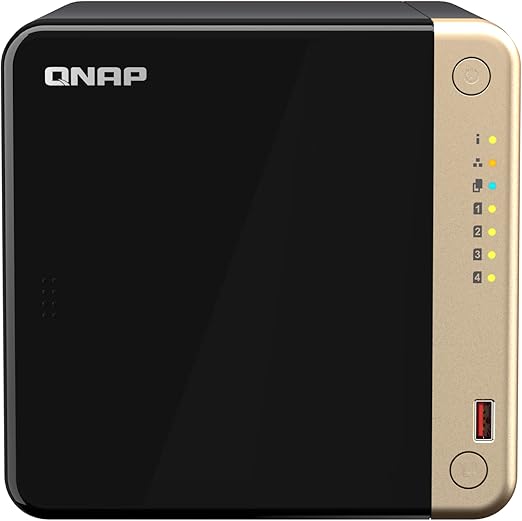 QNAP TS-464-8G
|
|
|---|---|---|
| AU Price | $1,149 (Scorptec / UGREEN AU) | Check current Scorptec / PLE pricing |
| CPU | Intel Core i3-1315U (6-core, up to 4.5GHz) | Intel Celeron N5105 (4-core, 2.0-2.9GHz) |
| RAM | 8GB DDR5 (expandable to 96GB) | 8GB DDR4 (2 slots, max 16GB) |
| Drive bays | 4x SATA (HDD hot-swap only) | 4x SATA (hot-swap; M.2 SSDs excluded) |
| M.2 slots | 2x M.2 NVMe PCIe Gen 4 | 2x M.2 NVMe PCIe Gen 3 |
| Network | 1x 10GbE + 1x 2.5GbE | 2x 2.5GbE |
| PCIe expansion | None | 1x PCIe Gen 3 x2 |
| USB special | DXP4800 Pro - | 1x USB-C 3.2 Gen 2 |
| HDMI output | Yes (4K) | Yes (HDMI 2.1, up to 4096×2160 at 60Hz) |
| Operating system | UGOS Pro | QTS 5.x |
| Docker | Yes (Docker app, x86) | Yes (Container Station, x86) |
| Warranty (AU) | 2 years (UGREEN AU) | 3 years standard warranty |
CPU and RAM
The CPU difference is the most important spec change. The current Australian TS-464-8G uses the Intel Celeron N5095, a quad-core Jasper Lake processor running up to 2.9GHz. The DXP4800 Pro uses the Intel Core i3-1315U, a 6-core Raptor Lake chip (2023) running up to 4.5GHz with two Performance cores and four Efficiency cores. In multi-threaded workloads. Simultaneous Docker containers, video transcoding, Plex with multiple streams. The i3-1315U is in a different performance class. This is not a marginal upgrade.
Both units ship with 8GB RAM. The Pro uses DDR5-4800 expandable to 96GB across two SO-DIMM slots. The TS-464 uses DDR4 expandable to 16GB. Whether 8GB is sufficient depends on the enabled services, concurrent users, containers and virtual machines. For users running memory-intensive containers or VMs, the Pro's 96GB ceiling gives long-term headroom that the TS-464's documented 16GB ceiling cannot match.
Network: 10GbE Standard vs PCIe Expansion
The DXP4800 Pro ships with one 10GbE port and one 2.5GbE port. The TS-464 ships with two 2.5GbE ports and a PCIe Gen 3 x2 slot. To match the Pro's networking, a TS-464 buyer needs to purchase a 10GbE NIC separately. Current Australian listings checked for QNAP's QXG-10G1T started at about $175, with several listings around $289-$351; verify live pricing and compatibility before purchase. At that point, the TS-464's total cost depends on the selected retailer and compatible NIC; check both prices live before comparing totals.
The practical implication: if your switch supports 10GbE (or you plan to upgrade), the Pro delivers that connection without extra hardware or configuration. The 2.5GbE port handles standard home networks as a fallback. The TS-464's PCIe slot remains useful if you want a different NIC, a wireless adapter, or a future expansion option that the Pro cannot accommodate.
UGOS vs QTS. The Software Reality
This is where the TS-464 has a clear advantage for most buyers. QTS is a mature, feature-complete NAS OS with a long-established ecosystem of apps, active community forums, and predictable update cadence. UGOS Pro is functional and improving, but it is a younger platform. For Docker-specific workflows, the gap is smaller. Both support Compose-based container management and both use Docker-based container runtimes. For NAS-native apps (Surveillance Station, Moments, SynologyDrive equivalents), QTS has no equivalent gap.
The CGNAT consideration matters for Australian remote access users. QNAP's myQNAPcloud relay works without port forwarding, which is important on NBN connections behind CGNAT. UGOS Pro includes UGREENlink remote access, which does not require a public IP address or manual router port forwarding. QNAP similarly provides myQNAPcloud Link, so CGNAT alone does not establish a remote-access advantage for the TS-464.
Price Analysis: Compare Current Retailer Prices
Retailer pricing fluctuates; compare live prices for both NAS units before calculating the premium or adding the cost of a compatible 10GbE NIC. Once you factor in a 10GbE NIC for the TS-464, the gap closes or inverts. What the Pro delivers for that premium:
- Intel Core i3-1315U vs Celeron N5105. Generational CPU advantage for transcoding and Docker
- 10GbE built in. No NIC purchase required; the cost of a compatible TS-464 NIC should be checked live
- DDR5 RAM. Faster memory bandwidth, and expandable to 96GB vs 16GB
For a buyer who would add 10GbE to the TS-464 anyway, the Pro is effectively the same price or cheaper with a substantially faster processor. For a buyer who will never use 10GbE and runs only light workloads, the TS-464's lower upfront cost and QTS software ecosystem make it the more practical choice.
Who Should Buy the UGREEN DXP4800 Pro?
- Home lab and self-hosting users running multiple demanding Docker containers simultaneously
- Plex Pass or Jellyfin users who want integrated-graphics transcoding headroom for compatible 4K workflows without a discrete GPU
- Buyers planning to use 10GbE networking. Pro includes it, no NIC card needed
- Users who need RAM beyond 16GB over the NAS's lifespan. Pro expands to 96GB, TS-464 caps at 16GB
- Small office environments with multi-user concurrent access where CPU throughput matters
Who Should Buy the QNAP TS-464?
- Buyers who prioritise software maturity and a well-established app ecosystem. QTS is substantially longer-established
- Users who specifically prefer QNAP's myQNAPcloud Link remote-access workflow
- Buyers whose workloads are light (file serving, backups, 1-2 containers) and will never need more than 16GB RAM
- Users who want PCIe expansion flexibility for accessories other than a 10GbE NIC
Pros
- DXP4800 Pro: Intel i3-1315U (6-core, 4.5GHz). Significantly faster than the N5105 for Docker and transcoding
- DXP4800 Pro: 10GbE included as standard. No additional NIC purchase needed
- DXP4800 Pro: DDR5 RAM expandable to 96GB vs TS-464 max 16GB
- DXP4800 Pro: 2-year warranty via UGREEN AU store
- TS-464: QTS. Mature, feature-rich OS with a long-established ecosystem
- TS-464: myQNAPcloud relay works on Australian CGNAT without port forwarding
- TS-464: Upfront cost varies by retailer; check live pricing
Cons
- DXP4800 Pro: UGOS Pro is a newer platform with a smaller app ecosystem than QTS
- DXP4800 Pro: UGREENlink supports remote access without a public IP address or manual port forwarding
- DXP4800 Pro: No PCIe expansion slot for accessories
- TS-464: Celeron N5105. Slower than i3-1315U for multi-container and transcoding workloads
- TS-464: 2.5GbE only. 10GbE requires a separately priced compatible PCIe NIC card
- TS-464: DDR4 RAM, capped at 16GB total
Verdict
The DXP4800 Pro is the better hardware choice at this price point. A faster processor, built-in 10GbE, and expandable DDR5 RAM; the price difference varies by retailer and should be checked live. Or the same price once you factor in the NIC card the TS-464 needs to match the Pro's networking. For Docker-focused buyers, Plex server operators, and small office users where CPU headroom matters, the Pro is the stronger long-term platform.
The TS-464 remains the right choice for buyers where QTS software maturity is the deciding factor. If you rely on QNAP's relay-based remote access for CGNAT connections, use specific QTS-native apps with no UGOS equivalent, or simply want the proven platform, the TS-464 earns its place. At the current price gap it is not a value compromise. It is a software preference.
Australian Buyers: Pricing and Where to Buy
- UGREEN DXP4800 Pro: $1,149 at Scorptec and the UGREEN AU store (ai-au.ugreen.com). The best option for price match, warranty support, and free shipping.
- QNAP TS-464: $999 at Scorptec, $1,129 at PLE, and $1,432 at Mwave. Add the live price of a compatible 10GbE NIC to match the Pro's networking.
- The DXP4800 Pro carries a 2-year warranty; the TS-464 carries a 3-year standard warranty, extendable to 5 years. UGREEN AU handles warranty directly; QNAP warranty handling should be confirmed with the Australian retailer or QNAP support.
See our full UGREEN vs QNAP ecosystem comparison for all models and price points in Australia.
Related reading: our NAS buyer's guide and our Synology vs QNAP comparison.
Our RAID Calculator shows usable capacity for both models' 4-bay configurations, and our NAS Power Cost Calculator compares annual running cost at your AU state electricity rate.
Use our free NAS Sizing Wizard to get a personalised NAS recommendation.
Once you have chosen your NAS, get a second opinion on the full build. Drives, RAID type, network setup, and backup strategy. Before committing. $149 AUD, delivered within 3 business days.
See also: our complete QNAP ecosystem guide.
See also: our complete QNAP ecosystem guide.
See also: our complete UGREEN NAS Australia guide.
See also: our complete QNAP NAS Australia guide.
Related reading: our UGREEN brand guide.
Looking for UGREEN accessories?
UGREEN also makes chargers, power banks, USB-C docks, wireless chargers, Ethernet adapters and storage accessories. We have sorted the Australian range into the products actually worth considering.
Browse UGREEN accessories →Why is the DXP4800 Pro worth more than the QNAP TS-464?
The relative price varies by retailer and should be checked live. The DXP4800 Pro has an Intel Core i3-1315U and 10GbE networking as standard; QNAP specifies an Intel Celeron N5095 for the TS-464-8G. A TS-464 buyer who wants 10GbE needs to purchase a compatible PCIe NIC card separately, so the resulting price comparison depends on live NAS and NIC prices. The Pro also uses DDR5 RAM expandable to 96GB, versus DDR4 with a 16GB ceiling on the TS-464.
Does the UGREEN DXP4800 Pro include 10GbE networking?
Yes. The DXP4800 Pro ships with one 10GbE port and one 2.5GbE port as standard. No additional NIC card is required. This is a meaningful advantage over the QNAP TS-464, which ships with two 2.5GbE ports and requires a separately priced compatible PCIe 10GbE NIC card to reach the same single-port networking speed the DXP4800 Pro has built in.
Which has better Docker support: UGREEN DXP4800 Pro or QNAP TS-464?
Both run x86 Docker containers without ARM compatibility issues. QNAP introduced Container Station in 2015, while UGOS Pro's Container app supports Compose-based deployments through its Project interface. UGOS Pro's Container app supports Compose-based deployments through its Project interface. The DXP4800 Pro's i3-1315U processor runs containers faster under heavy load than the TS-464's N5105. Both support Docker containers, but comparative performance depends on the workload and configuration.
How much RAM can the DXP4800 Pro and TS-464 support?
The DXP4800 Pro supports up to 96GB DDR5 across two SO-DIMM slots and ships with 8GB. The QNAP TS-464 supports up to 16GB DDR4 across two SO-DIMM slots and ships with 8GB. If your workload involves running many Docker containers simultaneously or you plan to add VMs, the Pro's 96GB ceiling gives substantial long-term headroom that the TS-464 cannot match.
Where can I buy the UGREEN DXP4800 Pro in Australia?
The UGREEN DXP4800 Pro is available from the UGREEN AU store (ai-au.ugreen.com) at $1,149, and from Scorptec at the same price. UGREEN AU offers 30-day returns, 2-year warranty, and free shipping on orders over a threshold. All prices are for the diskless (no drives) model.