Synology and QNAP are the two most widely available NAS brands in Australia, and both are genuinely good choices. But for different buyers. Synology wins on software polish, ease of use, and retail availability. QNAP wins on technical depth, connectivity options, and price-to-hardware ratio at the mid-range and above. Neither brand is universally better. The right choice depends on what you actually need the NAS to do.
In short: Choose Synology if you want a straightforward NAS that is easy to set up, easy to maintain, and backed by reliable AU retailer availability. Choose QNAP if you need deeper technical capabilities. Virtualisation, high-speed networking, ZFS via QuTS Hero, or specialised connectivity like Thunderbolt. Both are sold through Australian authorised retailers with full Australian Consumer Law protections.
Brand Overview: Where Each Brand Sits in 2026
Synology is the dominant NAS brand in the Australian consumer and prosumer market. Their strategy is deliberate and focused: a smaller product catalogue, simpler software, and a buyer experience that does not require technical expertise to navigate. This approach has made Synology the default recommendation in most online discussions and the go-to choice for IT providers deploying NAS in straightforward SMB environments.
QNAP takes the opposite approach. Their product catalogue is significantly larger. More bays, more connectivity options, more specialised models. They target buyers who know exactly what they want and are prepared to navigate a steeper learning curve to get it. IT professionals frequently reach for QNAP when a client has a specific requirement: Thunderbolt 4 for video editing, 10GbE built-in for network performance, or ZFS via QuTS Hero for enterprise-grade data integrity. For general SMB use, those same IT providers often default back to Synology.
Both brands are distributed in Australia by BlueChip IT, which holds the deepest NAS stock in the country. Air freight from Taiwan fills gaps in 2-3 weeks when local stock runs out. Synology is also distributed by Multimedia Technology (MMT). QNAP is also carried by Dicker Data. Australian NAS pricing currently runs 10-20% above US levels due to lower stock allocations, higher freight costs, and smaller market volumes. For background on what a NAS is and whether one suits your situation, see what is a NAS.
Head-to-Head Comparison: Synology vs QNAP
Synology vs QNAP: Key Differences at a Glance
| Synology | QNAP | |
|---|---|---|
| Software OS | DSM 7.x | QTS / QuTS Hero |
| Ease of use | Excellent. Beginner friendly | Moderate to complex. Steeper curve |
| Product range size | Focused, smaller catalogue | Extensive, larger catalogue |
| File system (default) | Btrfs / ext4 | ext4 (QTS) / ZFS (QuTS Hero) |
| ZFS support | No | Yes. QuTS Hero models |
| Virtualisation depth | Basic (Virtual Machine Manager) | Advanced (Virtualization Station, QEMU) |
| Built-in 2.5GbE+ | DS225+ and newer Plus models | Most mid-range models |
| 10GbE built-in | Expansion card or XS+ series only | Multiple desktop models |
| Thunderbolt 4 | No consumer models | TVS-H874T series |
| NAS plus switch ecosystem | NAS only. No switches | QSW switch range available |
| Drive compatibility (2026) | DSM 7.3 restores WD/Seagate for desktop Plus; M.2 NVMe still restricted | No brand restrictions on any model |
| AU warranty process | Retailer to BlueChip/MMT to Synology TW, 2-3 weeks | Retailer to BlueChip/Dicker to QNAP TW, 2-3 weeks |
| AU retail availability | Excellent. Most models in stock | Good. Some high-end models on order |
| 3-year warranty (consumer) | Yes | Yes |
| AU pricing trend | Stable. Global pricing team | Rising. Up approximately 100% since 2020-21 |
| Entry 2-bay price (AU) | DS223J from $319 (Mwave) | TS-233 from $399 (Scorptec) |
| Mid 2-bay price (AU) | DS225+ from $539 (Umart) | TS-264 from $759 (Computer Alliance) |
| Mid 4-bay price (AU) | DS425+ from $799 (Umart) | TS-464 from $989 (Scorptec) |
| Performance 4-bay price (AU) | DS925+ from $995 (Scorptec) | TS-473A from $1,269 (Umart) |
Prices last verified: 28 March 2026. Always check retailer before purchasing.
Software: DSM vs QTS and QuTS Hero
DSM (DiskStation Manager) is Synology's operating system and is designed with ease of use as the first priority. The interface is clean, the learning curve is gentle, and features like Hyper Backup, Active Backup for Business, and Synology Drive are accessible to users who are not deeply technical. Docker is available on Plus series and above models, and Virtual Machine Manager provides basic virtualisation capabilities. The word overwhelming is rarely applied to DSM.
QNAP runs two operating systems. QTS is the standard OS, Linux-based with ext4, suitable for home users through to SMB deployments. QuTS Hero is QNAP's ZFS-based enterprise OS, offering data integrity advantages including end-to-end checksums, self-healing of silent data corruption, copy-on-write snapshots, inline deduplication and compression, and RAID-TP triple parity. QuTS Hero needs 8GB RAM to install and 16GB or more to take full advantage of deduplication. Both QTS and QuTS Hero include Qtier auto-tiering, which moves hot data to SSD and cold data to HDD automatically on models with M.2 slots, and App Center with a wide range of applications.
For most home users and small offices, DSM is the more enjoyable day-to-day experience. For IT professionals and technical users running virtualisation, compliance workloads, or high-density video storage, QuTS Hero's ZFS capabilities are a genuine advantage over anything Synology offers. Switching between QTS and QuTS Hero requires a full reinitialisation. All data must be backed up first. Plan the OS choice before purchasing, not after.
QuTS Hero RAM requirement: Do not install QuTS Hero on a NAS with 4GB RAM and expect meaningful deduplication performance. Minimum 16GB RAM is required for deduplication workloads, and 32GB or more for heavy virtualised environments. The TS-473A-8G ships with 8GB and supports up to 64GB. Even 8GB is tight for production deduplication. Upgrade RAM before enabling deduplication, and factor the RAM cost into the total purchase price.
The Synology Drive Compatibility Controversy
In April 2025, Synology announced that Plus series models released from 2025 onward. Including the DS925+, DS1825+, and DS425+. Would require either Synology-branded drives or third-party drives specifically certified by Synology. Non-approved drives were blocked from creating new storage pools and lost access to health monitoring. The community response was severe. Long-time Synology advocates began evaluating QNAP, TrueNAS, and other alternatives. The policy contradicted years of Synology being the brand you could recommend to anyone precisely because of its flexibility.
Synology reversed course with DSM 7.3 in October 2025, restoring the ability to use third-party 3.5-inch HDDs and 2.5-inch SATA SSDs from Western Digital and Seagate on desktop Plus series models. Storage pool creation and drive health monitoring were restored for non-Synology drives. However, important restrictions remain in place: M.2 NVMe SSDs still require drives from Synology's official Hardware Compatibility List for new cache or storage pool creation. Enterprise and rackmount models (RS, FS, SA, XS series) still enforce stricter compatibility. Surveillance DVA models maintain drive restrictions. Reputational damage in the enthusiast community is real and ongoing. Some buyers will not return to Synology regardless of the reversal.
Still relevant in 2026: If you plan to use M.2 NVMe SSDs in a Synology Plus series NAS for SSD cache or all-flash storage pools, check Synology's Hardware Compatibility List before purchasing any NVMe drive. The DSM 7.3 reversal does not cover NVMe. Rackmount and XS+ models also retain drive restrictions. QNAP has no brand restrictions on any model, including NVMe.
Model Range: Entry, Mid-Range, and Performance
Understanding where each brand's current AU retail models sit makes the choice clearer. The models below are all confirmed in stock at Australian retailers as of March 2026, with prices drawn from Mwave, Scorptec, Umart, Computer Alliance, and PLE scraper data. For a full model-by-model breakdown see best NAS Australia.
Entry-Level 2-Bay: DS223J vs TS-233
Entry 2-Bay: Synology DS223J vs QNAP TS-233
| Synology DS223J | QNAP TS-233 | |
|---|---|---|
| AU Price (lowest confirmed) | $319 (Mwave, Scorptec) | $399 (Scorptec) |
| CPU | Realtek RTD1619B 1.7GHz 4-core | ARM Cortex-A55 2.0GHz 4-core |
| RAM | 1GB DDR4 (not upgradeable) | 2GB DDR4 (not upgradeable) |
| Bays | 2 x 3.5" / 2.5" | 2 x 3.5" / 2.5" |
| Network | 1x GbE | 1x GbE |
| M.2 slots | No | No |
| HDMI | No | No |
| Max RAID | RAID 1 | RAID 1 |
| Software OS | DSM 7.x | QTS 5.x |
| Warranty (AU) | 3 years | 3 years |
The DS223J suits the buyer who wants a simple, reliable home backup NAS at the lowest entry cost. DSM is easier to navigate than QTS, the DS223J is $80 cheaper, and Synology has better name recognition for resale value. The TS-233 delivers 2GB RAM versus 1GB. A meaningful difference if you plan to run more than basic file sharing. Both max out at RAID 1 with two drives. Neither has M.2 or 10GbE. Buyers who expect to grow into those capabilities should budget up to the DS225+ or TS-264 instead.
Mid-Range 2-Bay: DS225+ vs TS-264

| Model | Synology DS225+ |
|---|---|
| CPU | Intel Celeron J4125 2.0GHz 4-core (burst 2.7GHz) |
| RAM | 2GB DDR4 (upgradeable to 6GB) |
| Bays | 2 x 3.5" / 2.5" |
| Network | 1x 2.5GbE + 1x GbE |
| M.2 slots | No |
| HDMI | No |
| AU Price (Umart) | $539 |
| AU Price (Scorptec) | $599 |
| AU Price (PLE) | $599 |
Pros
- Intel Celeron CPU. Snappy DSM performance and hardware-accelerated media transcoding
- 2.5GbE built-in. Meaningful real-world speed boost over GbE for local file transfers
- DSM 7. Polished, beginner-friendly OS with excellent app ecosystem
- Wide AU retailer availability at consistent pricing across Umart, Scorptec, Mwave, PLE
- Upgradeable RAM to 6GB for running Docker workloads
Cons
- No M.2 NVMe slots. Cannot create SSD cache or all-flash storage pool
- Only 2GB RAM out of the box. Heavy Docker workloads will need a RAM upgrade
- M.2 NVMe restrictions still apply after DSM 7.3. Even if you add an expansion card
- Single 2.5GbE port. Link aggregation not possible without an expansion card

| Model | QNAP TS-264-8G |
|---|---|
| CPU | Intel Celeron N5095 2.0GHz 4-core (burst 2.9GHz) |
| RAM | 8GB DDR4 (upgradeable to 16GB) |
| Bays | 2 x 3.5" / 2.5" |
| Network | 2x 2.5GbE |
| M.2 slots | 2x M.2 2280 PCIe Gen 3 NVMe |
| HDMI | Yes. HDMI 2.0 |
| AU Price (Computer Alliance) | $759 |
| AU Price (PLE) | $819 |
| AU Price (Scorptec) | $949 |
Pros
- 8GB RAM out of the box. Significantly more headroom for Docker containers and light VMs
- Dual 2.5GbE ports. Link aggregation possible for up to 5GbE effective throughput
- 2x M.2 NVMe slots. SSD cache or Qtier auto-tiering without consuming drive bays
- HDMI output for local desktop access or media playback
- No drive brand restrictions. Use any WD, Seagate, or Toshiba NVMe without approval
Cons
- Significantly more expensive than DS225+. $220 to $350 premium depending on retailer
- QTS interface is more complex. Steeper initial learning curve for new NAS users
- Larger and heavier physical footprint than DS225+
- Less beginner-friendly software if DSM experience is the priority
The DS225+ from $539 suits buyers who want a capable, easy-to-manage 2-bay NAS for home backup, Synology Drive sync, and Surveillance Station with one or two cameras. The TS-264 from $759 suits buyers who specifically need M.2 NVMe cache, dual 2.5GbE link aggregation, and significantly more RAM in the same 2-bay footprint. There is no Synology equivalent to the TS-264's combination of hardware features at this price point. If you need M.2 and dual 2.5GbE, the TS-264 is the only mainstream option available in Australia at this bay count.
Mid-Range 4-Bay: DS425+ vs TS-464

| Model | Synology DS425+ |
|---|---|
| CPU | Intel Celeron J4125 2.0GHz 4-core |
| RAM | 2GB DDR4 (upgradeable to 6GB) |
| Bays | 4 x 3.5" / 2.5" |
| Network | 1x 2.5GbE + 1x GbE |
| M.2 slots | No |
| AU Price (Umart) | $799 |
| AU Price (Scorptec) | $819 |
| AU Price (PLE) | $999 |
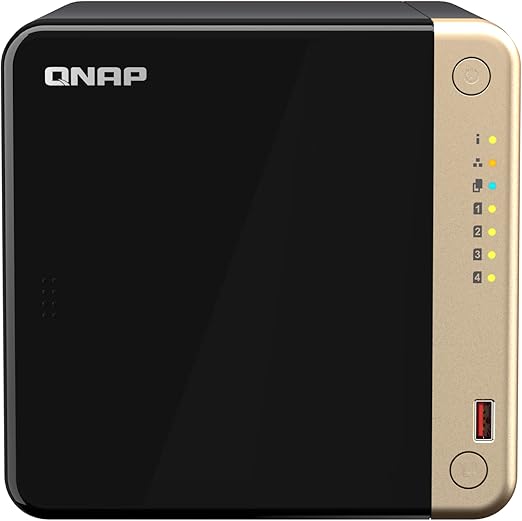
| Model | QNAP TS-464-8G |
|---|---|
| CPU | Intel Celeron N5095 2.0GHz 4-core (burst 2.9GHz) |
| RAM | 8GB DDR4 (upgradeable to 16GB) |
| Bays | 4 x 3.5" / 2.5" |
| Network | 2x 2.5GbE |
| M.2 slots | 2x M.2 2280 PCIe Gen 3 NVMe |
| AU Price (Scorptec) | $989 |
| AU Price (PLE) | $1,099 |
| AU Price (Mwave) | $1,442 |
The same hardware-advantage story plays out at the 4-bay level. The DS425+ from $799 delivers a solid DSM experience for RAID 5 home and SMB storage, Active Backup for Business, and straightforward file sharing. The TS-464 from $989 at Scorptec adds 8GB RAM, dual 2.5GbE, and two M.2 NVMe slots. Meaningfully more capable hardware at approximately $190 premium at that retailer, though pricing varies significantly across AU retailers. For buyers running heavier workloads. Multiple simultaneous backup jobs, Docker containers, or several surveillance camera streams. The TS-464's RAM headroom and M.2 cache make a practical difference. The DS425+ suits buyers who want RAID 5 protection and DSM's ease of use without needing M.2 or dual 2.5GbE.
Performance 4-Bay: DS925+ vs TS-473A
Performance 4-Bay: Synology DS925+ vs QNAP TS-473A
| Synology DS925+ | QNAP TS-473A-8G | |
|---|---|---|
| AU Price (lowest confirmed) | $995 (Scorptec, Umart) | $1,489 (PLE Computers) |
| CPU | AMD Ryzen V1500B 2.2GHz 4-core / 8-thread | AMD Ryzen V1500B 2.2GHz 4-core / 8-thread |
| RAM | 4GB DDR4 (upgradeable to 32GB) | 8GB DDR4 (upgradeable to 64GB) |
| Bays (HDD) | 4 x 3.5" / 2.5" | 4 x 3.5" / 2.5" |
| M.2 slots | 2x M.2 2280 NVMe (Synology approved list only) | No M.2 onboard. PCIe expansion only |
| Network | 1x 2.5GbE + 1x GbE | 1x 2.5GbE + 1x GbE |
| PCIe expansion | 1x PCIe 3.0 x8 | 1x PCIe 3.0 x4 |
| 10GbE upgrade | Via PCIe expansion card | Via PCIe expansion card |
| ZFS (QuTS Hero) | No | Yes. QuTS Hero available |
| Max RAM | 32GB | 64GB |
| Warranty (AU) | 3 years | 3 years |
Both the DS925+ and TS-473A use the same AMD Ryzen V1500B processor. A capable quad-core with eight threads that handles concurrent workloads well. The DS925+ ships with 4GB RAM but upgrades to 32GB; the TS-473A ships with 8GB and scales to 64GB. The DS925+ has two M.2 NVMe slots built in. Only Synology-approved drives work here. While the TS-473A has no onboard M.2 but accepts expansion cards via PCIe. The critical difference is that the TS-473A can run QuTS Hero for ZFS file system benefits, including data integrity checksums, self-healing, and deduplication. The DS925+ cannot offer ZFS. At a $274 price gap, the TS-473A offers more RAM headroom and ZFS capability; the DS925+ offers integrated M.2 and DSM's ease of use.
5-Bay and Above: Value Leaders in Each Range
At 5-bay and above, Synology offers models that are difficult to match on value in Australia. The DS1525+ from $1,234 at Umart and MSY is an AMD Ryzen V1500B 5-bay NAS with 8GB RAM, dual M.2 NVMe slots, and a PCIe expansion slot. The natural choice for prosumers who want to grow a storage pool over time without replacing the NAS. The DS1825+ from $1,699 at CPL and Umart is the 8-bay equivalent with the same CPU and 8GB RAM. Both are widely stocked at major AU retailers, which is a genuine practical advantage.
QNAP's nearest 8-bay equivalent is the TS-873A-8G from $2,135 at CPL and Scorptec. Running the same Ryzen V1500B CPU with QuTS Hero ZFS capability as the key differentiator. The pricing gap narrows at the 8-bay level, and buyers with genuine ZFS requirements will find the TS-873A worth the premium. For most home and SMB buyers without ZFS requirements, the DS1825+ delivers more value per dollar. See best NAS Australia for a full breakdown of both brands across all bay counts and budgets.
QNAP's QSW Network Switches: An Ecosystem Advantage Synology Cannot Match
One area where QNAP has no Synology equivalent is their QSW network switch range. Most NAS buyers who want to take advantage of 2.5GbE or 10GbE connectivity hit a wall when they look at traditional network switches. A 24-port managed switch with 10GbE ports costs thousands of dollars and is overkill for a home or small office that needs three or four high-speed connections. Synology does not manufacture network switches.
QNAP's QSW switches solve this with purpose-built options at accessible prices. The QSW-1108-8T-R2 provides 8-port 2.5GbE unmanaged for a home upgrade from gigabit. The QSW-2104-2T-R2 bridges 2.5G and 10G devices affordably in a small office. The QSW-3205-5T delivers full 10GbE across 5 ports for setups where the NAS, workstation, and backup target all need fast connections. A QNAP NAS plus a QNAP switch is the only single-vendor NAS and high-speed networking solution from a major brand in Australia. If a client needs high-speed storage and networking from one vendor for support simplicity, QNAP is the only option in this category.
QNAP Security History: Context Without Sensationalism
QNAP has experienced several high-profile ransomware incidents affecting NAS devices exposed directly to the internet. This comes up in every Synology vs QNAP comparison and deserves an honest assessment. The incidents were real, but the most important context is that any NAS device with its management interface exposed publicly. Regardless of brand. Is a potential target. QNAP's response included improving snapshot technology as a practical defence mechanism, and their helpdesk unlocked affected customers' data free of charge in many cases. Their security advisories and response time have improved materially since the major incidents.
Remote access and security on both brands: Do not expose your NAS management interface directly to the internet. Use a VPN. Synology's QuickConnect uses a relay, while Tailscale or WireGuard provide proper encrypted tunnels with no inbound port exposure. On Australian NBN connections, upload speeds average 56Mbps on NBN 100 plans, and many residential connections are behind CGNAT which blocks inbound connections entirely. If CGNAT applies to your connection, a VPN via a VPS exit node or Tailscale is the practical solution for remote access. See the NAS remote access and VPN guide for Australian-specific setup details.
QNAP Pricing and Supply Chain Reality in 2026
QNAP pricing has increased nearly 100% since 2020-2021. Buyers replacing an older QNAP NAS will frequently find the current equivalent model costs close to double what they originally paid. This reflects a global cost increase driven by chip and RAM shortages, combined with QNAP's leadership-driven removal of reseller incentives and promotional pricing following a complete turnover of the ANZ regional team in late 2024. Where previous QNAP management ran aggressive pricing and reseller incentive programs, the current approach is flat volume-based pricing with no vendor-led promotions.
Stock availability is also a genuine concern for QNAP in 2026. Production is 3-6 months behind on some models due to global RAM and chip constraints. If you are looking at a specific high-end QNAP model, check current stock before planning a deployment. A purchase order placed in February may not arrive until August depending on demand. BlueChip IT has been QNAP's anchor through this period of vendor turmoil, maintaining reliable supply for the models they do hold in stock. Synology's smaller product catalogue means AU distributors and retailers can hold the full range at all times, which is a practical advantage for buyers who need stock quickly or want to avoid backorder risk.
AU Warranty, ACL, and Buying Guidance
Australian Consumer Law applies when purchasing from Australian authorised retailers for both brands. Consumer models carry 3-year warranties; enterprise and rackmount models typically carry 5 years. Neither brand has service centres in Australia. Warranty claims go through the retailer to the distributor to the vendor in Taiwan and back, typically taking 2-3 weeks minimum. A dead NAS is a minor failure under ACL, not a major one. The retailer chooses the remedy (repair, replacement, or refund), not the buyer. Advanced replacements are not officially supported by most NAS vendors in Australia. Ask your retailer about their process before you need it. For more detail on ACL rights for NAS purchases, see where to buy a NAS in Australia.
Most Australian retailers operate on 3-5% NAS margin, which is why pricing is remarkably uniform across Mwave, Scorptec, Umart, CPL, and PLE for the same model. The meaningful differences between retailers are stock depth, pre-sales knowledge, and what happens when something goes wrong. For a first-time NAS buyer, buying from a specialist like Scorptec or PLE where staff genuinely understand the product is worth any small premium over Amazon AU. Amazon has started holding NAS stock directly in 2026, often at prices 10-20% below local retailers. But if a unit fails, Amazon will typically push to issue a credit rather than a direct replacement, particularly for higher-end or less common models. When the NAS holds your data, that distinction matters.
For business buyers: always request a formal quote from your preferred retailer rather than paying listed price. Resellers can request pricing support from BlueChip and Dicker Data. Discounts that never appear on the website but are routinely available for quoted business deals. The answers you get about stock availability, lead times, and warranty process will also tell you more about the value of buying from that retailer than the price on screen. For NAS storage planning and drive selection, see best NAS hard drive Australia. For running cost planning, see NAS power consumption Australia.
Who Should Buy Synology in 2026
Synology suits the buyer who wants reliable backup and file sharing that works without ongoing configuration effort. The DS225+ from $539 at Umart is the right choice for a 2-bay home NAS with 2.5GbE and Intel Celeron performance. The DS425+ from $799 suits four-drive RAID 5 for a home or small office. The DS925+ from $995 suits buyers who want AMD Ryzen performance, integrated M.2 NVMe, and the option of 10GbE via PCIe expansion. With the caveat that NVMe drives must be from Synology's approved list. The DS1525+ from $1,234 is the best-value 5-bay NAS available in Australia for most buyers who want to grow a large storage pool.
Synology also suits IT providers who need a low-risk recommendation for an SMB client who is not technically engaged, any deployment where simplicity and ease of management outweigh the need for deep technical features, and buyers who value stable pricing and consistent AU retailer availability. Do not pay the Synology premium purely for hardware. The value of Synology is in DSM and the software ecosystem. If you will not use the software features, consider whether Synology is the right choice over a more hardware-capable QNAP at a similar price. See Synology NAS Australia for a full breakdown of the current Synology lineup.
Who Should Buy QNAP in 2026
QNAP suits the buyer who has a specific technical requirement that Synology's focused product catalogue cannot meet. The TS-264-8G from $759 at Computer Alliance is the right choice for a buyer who specifically needs dual 2.5GbE, M.2 NVMe slots, 8GB RAM, and HDMI output in a 2-bay package. There is no comparable Synology equivalent. The TS-464-8G from $989 at Scorptec delivers the same hardware advantage at the 4-bay level. The TS-473A-8G from $1,269 suits buyers who want AMD Ryzen performance and the option of QuTS Hero's ZFS file system. The TS-664-8G from $1,249 at Computer Alliance is a capable 6-bay Celeron NAS for buyers who need more bays at a lower price point than comparable Synology 6-bay models.
QNAP also suits buyers who need Thunderbolt 4 connectivity for video editing workflows, high-speed networking via the QSW switch ecosystem, virtualisation depth beyond what DSM's Virtual Machine Manager provides, ZFS data integrity and deduplication via QuTS Hero, or an enterprise-grade NAS at a significantly lower price than Dell, HPE, or Lenovo equivalents. IT professionals often bring QNAP into the conversation when a client has one of these specific requirements and default to Synology for general SMB deployments. For data protection planning on either brand, see 3-2-1 backup strategy and NAS RAID explained. For buyers still deciding between local NAS and cloud storage, see NAS vs cloud storage Australia.
Use our free NAS Sizing Wizard to get a personalised NAS recommendation.
Related reading: our Plex vs Jellyfin comparison, our TerraMaster F4-424 Pro review, and our Synology SHR explained.
See also: our complete Synology ecosystem guide.
Is Synology or QNAP easier to set up for a first-time NAS user in Australia?
Synology is consistently easier for first-time users. DSM guides you through initial setup, drive configuration, and the most common tasks. Backup, file sharing, and media serving. Without requiring deep technical knowledge. QNAP's QTS is more capable but also more complex to navigate. For a buyer who has never used a NAS before, Synology is the lower-risk starting point. QNAP suits buyers who are already comfortable navigating technical interfaces and want more control and flexibility from day one.
Did Synology fix the drive compatibility issue in 2025? Can I use any hard drive now?
Partially. DSM 7.3 in October 2025 restored support for third-party 3.5-inch HDDs and 2.5-inch SATA SSDs from Western Digital and Seagate on desktop Plus series models. Storage pool creation and health monitoring now work with non-Synology drives on these models. However, M.2 NVMe SSDs still require drives from Synology's official Hardware Compatibility List for SSD cache and all-flash storage pools on Plus series models. Enterprise and rackmount models (RS, FS, SA, XS series) and surveillance DVA models still enforce stricter drive compatibility. Always check the Synology Hardware Compatibility List before purchasing NVMe drives for a Synology NAS. QNAP has no brand restrictions on any model, including NVMe.
What is QuTS Hero and do I need it over standard QTS on a QNAP NAS?
QuTS Hero is QNAP's ZFS-based operating system for enterprise and advanced users. It offers data integrity advantages over standard QTS's ext4 file system: end-to-end checksums, self-healing of silent data corruption, copy-on-write snapshots, inline deduplication and compression, WORM (Write Once Read Many) for compliance, and RAID-TP triple parity. Most home users and small offices do not need QuTS Hero. Standard QTS handles backup, file sharing, Docker, and virtualisation well. QuTS Hero suits commercial deployments with virtualisation workloads, compliance requirements, or large data pools where silent data corruption is a genuine concern. Minimum 8GB RAM to install; 16GB or more for deduplication workloads. Switching between QTS and QuTS Hero requires a full data wipe and reinitialisation. Plan this before purchasing, not after.
Is QNAP less secure than Synology after the ransomware incidents?
Not inherently. Any NAS with its management interface exposed directly to the internet is a security risk regardless of brand. QNAP's ransomware incidents targeted devices with open management ports. The same vulnerability would affect Synology if configured the same way. The right approach on either brand is to use a VPN for remote access rather than exposing the management interface. Synology's QuickConnect uses a relay server; a proper VPN via Tailscale, WireGuard, or built-in OpenVPN provides a stronger security posture. Keep firmware updated on both brands. QNAP's snapshot technology. Improved partly in response to the ransomware incidents. Provides a practical defence layer when combined with a proper VPN setup.
What is the warranty process for Synology and QNAP in Australia?
Neither brand has service centres or phone support in Australia. Warranty claims go through the retailer to the distributor to the vendor in Taiwan and back. The process typically takes 2-3 weeks minimum. Consumer models carry 3-year warranties; enterprise and rackmount models typically carry 5 years. Under Australian Consumer Law, the retailer is responsible for warranty resolution. Advanced replacements are not officially supported by either brand in Australia, though some specialist resellers will allow an informal advance purchase arrangement. Ask your retailer about their warranty process before purchasing, particularly for production deployments where a 2-3 week outage would be disruptive.
Which brand is better for remote access on an Australian NBN connection?
Both brands support remote access, but the approach matters more than the brand. Australian NBN connections average 56Mbps upload on NBN 100 plans, which limits remote access throughput regardless of NAS brand. Many residential connections are also behind CGNAT, which blocks inbound connections entirely. A VPN via a VPS exit node or Tailscale is the practical solution for CGNAT users. Synology's QuickConnect provides easy remote access without a VPN but routes traffic through Synology's relay servers. A direct VPN connection using Tailscale, WireGuard, or OpenVPN is faster and more secure on either brand. For a full walkthrough of Australian-specific remote access options, see the NAS remote access guide.
Should I buy from Amazon AU or a specialist retailer when purchasing a NAS?
Amazon AU has started holding NAS stock directly in 2026, often at prices 10-20% below specialist retailers. For a technically confident buyer who does not need pre-sales advice and has a robust backup strategy that tolerates extended NAS downtime, Amazon is a legitimate option. The risk is in the warranty process: if a unit fails, Amazon will push to issue a credit rather than a direct replacement, especially for higher-end or less common models. A specialist like Scorptec or PLE can access distributor stock to find a direct replacement. For a first-time NAS buyer, or any deployment where the NAS holds critical data without a secondary copy, buying from a specialist is worth the premium. See where to buy a NAS in Australia for a full retailer comparison.
How do Synology and QNAP compare on price in Australia?
Entry-level Synology models are generally cheaper: DS223J from $319 versus TS-233 from $399. At mid-range, QNAP's hardware advantages (more RAM, M.2 slots, dual 2.5GbE) justify a meaningful premium. TS-264 from $759 versus DS225+ from $539. At the performance 4-bay level the gap narrows: DS925+ from $995 versus TS-473A from $1,269. QNAP pricing has risen nearly 100% since 2020-2021. Synology pricing is more stable due to their global pricing team. Australian NAS pricing overall runs 10-20% above US levels due to lower stock allocations, higher freight costs, and smaller market volumes. Shopping across Mwave, Scorptec, Umart, PLE, and CPL typically finds 5-10% variation for the same model given the uniform 3-5% margin across most AU NAS sellers.
What RAID level should I use on a 4-bay Synology or QNAP NAS?
For a 4-bay NAS, RAID 5 is the most common choice. It tolerates one drive failure while delivering usable capacity of three drives worth of storage. RAID 6 tolerates two simultaneous failures but costs more usable space. Synology Hybrid RAID (SHR) is a Synology-specific option that allows mixing drive sizes efficiently. Useful if you plan to expand your pool over time with larger drives rather than replacing all drives at once. QNAP's Qtier auto-tiering moves hot data to SSD and cold data to HDD automatically on models with M.2 NVMe slots, improving real-world performance beyond what RAID level alone delivers. On QuTS Hero, RAID-TP (triple parity) tolerates three simultaneous drive failures. Relevant for large pools in commercial environments. Remember that RAID is not a backup. See 3-2-1 backup strategy for a full explanation of why.
Can I switch from Synology to QNAP or vice versa without losing my data?
Not directly. Synology uses Btrfs or ext4 storage pools managed by DSM; QNAP uses ext4 (QTS) or ZFS (QuTS Hero). The file systems and RAID metadata are not cross-compatible. If you are switching brands, you need to back up all data to an external location first, reinitialise the new NAS, and restore your data. The drives themselves can be moved to a new NAS of the same brand to preserve an existing pool. For example, moving drives from a DS425+ to a DS925+ within Synology's ecosystem is supported. Always follow a 3-2-1 backup strategy so that migrating hardware does not put your only copy of data at risk. See 3-2-1 backup strategy for the full backup framework.
Ready to choose the right NAS for your situation? See the full breakdown of the best Synology and QNAP models available in Australia right now, with current AU pricing and use-case recommendations for every budget.
Best NAS Australia 2026 →