The QNAP TS-464 is QNAP's most popular 4-bay NAS in Australia, and for good reason. It packs an Intel Celeron N5095 quad-core, 8 GB of expandable RAM, dual 2.5GbE networking, two M.2 NVMe slots, and HDMI 2.0 output into a desktop enclosure priced from $999 at Scorptec. That feature set at that price point makes it the strongest mid-range 4-bay available from any NAS vendor in 2026. It directly competes with the Synology DS925+ ($995-$1,029) and the Asustor AS5404T (~$980), but the TS-464 offers HDMI media playback and M.2 NVMe caching that neither competitor matches at this price. If you want a NAS that handles Plex transcoding, Docker containers, surveillance, and file sharing without hitting a performance wall, the TS-464 is the model to evaluate first.
In short: The QNAP TS-464 suits technical home users and small businesses who need a versatile 4-bay NAS with strong CPU performance, dual 2.5GbE networking, NVMe SSD caching, and HDMI media output. At $999-$1,099 in Australia, it sits right alongside the Synology DS925+ but offers broader connectivity. If you don't need HDMI or the deeper QNAP feature set, the DS925+ with its ECC RAM may be a safer choice. If budget is the priority, the Asustor AS5404T at $799 delivers similar Intel hardware for $200 less. But with fewer software features.
QNAP TS-464 Full Specifications
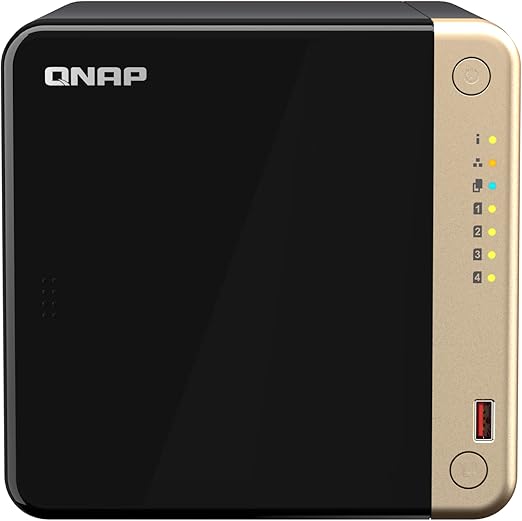
| CPU | Intel Celeron N5095. 4-core / 4-thread, 2.0 GHz base (burst 2.9 GHz) |
|---|---|
| Architecture | 64-bit x86, Jasper Lake (10 nm) |
| Hardware Encryption | AES-NI hardware acceleration |
| RAM (installed) | 8 GB DDR4 SO-DIMM (non-ECC) |
| RAM (max) | 16 GB (2 x 8 GB DDR4 SO-DIMM) |
| Drive Bays | 4 x 3.5"/2.5" SATA III (hot-swappable) |
| M.2 NVMe Slots | 2 x M.2 2280 PCIe Gen 3 (for SSD caching or storage pool) |
| Max Raw Capacity | 4 x 24 TB = 96 TB (SATA bays only) |
| LAN Ports | 2 x 2.5 GbE RJ45 (supports Link Aggregation and failover) |
| USB Ports | 2 x USB 3.2 Gen 2 (Type-A), 1 x USB 2.0 |
| HDMI Output | 1 x HDMI 2.0 (4K @ 60Hz) |
| PCIe Expansion | 1 x PCIe Gen 3 x2 slot (low-profile, for 10GbE or other cards) |
| Operating System | QTS 5.x (ext4) or QuTS Hero (ZFS) |
| Dimensions (mm) | 168 x 170 x 226 mm |
| Weight | 2.18 kg (diskless) |
| Power Consumption | 15.84 W (idle), 32.23 W (typical operation) |
| Noise Level | 18.6 dB(A) |
| Warranty | 3 years (extendable to 5 years) |
| AU Price (Scorptec) | $999 |
| AU Price (PLE Computers) | $1,099 |
Where to Buy the TS-464 in Australia
The TS-464-8G is currently in stock at both Scorptec ($999) and PLE Computers ($1,099). Scorptec is the better buy at $100 less for the identical unit. Both retailers source from BlueChip, QNAP's primary Australian distributor, so you are getting officially distributed stock with full Australian Consumer Law protections.
A $100 price gap between two authorised retailers is unusual for NAS products. Most Australian retailers operate on 3-5% margin, which normally keeps pricing uniform. Check both sites at the time of purchase, as pricing can shift. If you are a business, education, or government buyer, request a formal quote from either retailer. Resellers can request pricing support from distributors and vendors, and quoted prices are often sharper than the website listing.
Stock note (February 2026): QNAP has been hit by global chip and RAM shortages, with production running 3-6 months behind on some models. The TS-464 is showing as in stock at Scorptec and PLE right now, but if it sells out, expect a wait. If you are planning a purchase, don't assume stock will be available indefinitely.
Performance: What the N5095 Actually Delivers
The Intel Celeron N5095 is a Jasper Lake quad-core processor that burst-clocks to 2.9 GHz. It is not the most powerful CPU you will find in a NAS at this price. The DS925+'s AMD Ryzen V1600B has eight threads to the N5095's four. But it handles everything a 4-bay NAS is expected to do without strain. File transfers over 2.5GbE saturate the connection. Plex transcoding of 1080p content is smooth, and 4K direct play via HDMI is native. Docker containers for Home Assistant, Pi-hole, or lightweight web services run comfortably alongside file serving.
Where the N5095 shows its limits is heavy simultaneous workloads. If you are running Plex with multiple 4K transcode streams, a busy surveillance station with 15+ cameras, and Docker containers all at once, you will feel the constraint. For that level of demand, QNAP's own TS-473A with its AMD Ryzen V1500B ($1,369-$1,489) is the next step up, or consider the Synology DS925+ if the Ryzen V1600B's extra threads matter to your workload.
RAM: 8 GB Standard, Expandable to 16 GB
The TS-464 ships with 8 GB of DDR4, which is generous for this class. Most competing 4-bay NAS units ship with 4 GB. The 8 GB default means you can run QTS with Docker containers, Plex, and file services without immediately needing an upgrade. If you plan to install QuTS Hero (ZFS), the 8 GB minimum is met out of the box, though 16 GB is recommended for deduplication workloads. RAM is expandable to 16 GB via two SO-DIMM slots. A straightforward user upgrade.
One caveat: the TS-464 uses non-ECC RAM. The DS925+ ships with ECC (Error-Correcting Code) memory, which detects and corrects single-bit memory errors. A meaningful advantage for always-on storage devices and ZFS workloads. For most home and small business users, non-ECC will never cause a noticeable problem. But if data integrity is your top priority and you plan to run QuTS Hero with ZFS, the DS925+'s ECC RAM is a legitimate reason to choose Synology.
Networking: Dual 2.5GbE and a PCIe Expansion Slot
Dual 2.5 GbE ports are standard on the TS-464, delivering up to 5 Gbps aggregate throughput with link aggregation. For an Australian home or small office on an NBN connection (where typical upload speeds are around 20-50 Mbps depending on your plan), the NAS's internal network speed far exceeds your internet bandwidth. The real benefit of 2.5GbE is local network performance. Transferring large files between workstations and the NAS, or streaming 4K video to multiple devices simultaneously.
To take advantage of 2.5GbE, your network switch needs to support it. QNAP's own QSW-1105-5T ($159 at Scorptec) is a 5-port 2.5GbE unmanaged switch that pairs perfectly with the TS-464. It is a cost-effective upgrade from gigabit without buying a full enterprise switch. If you want to go further, the TS-464 includes a PCIe Gen 3 x2 expansion slot that accepts a 10GbE network card, a 5GbE card, or a QNAP QM2 M.2 SSD expansion card. That PCIe slot is a feature the Asustor AS5404T lacks entirely.
NBN and CGNAT note: If you plan to access your NAS remotely, be aware that some NBN connections use CGNAT (Carrier-Grade NAT), which blocks incoming connections. You may need to use QNAP's myQNAPcloud relay service, set up a VPN through a DDNS service, or contact your ISP to request a static IP. Check your connection type before assuming remote access will work out of the box.
M.2 NVMe Slots: SSD Caching That Makes a Real Difference
The TS-464 includes two M.2 2280 NVMe slots on the underside of the unit. These can be used for SSD caching (accelerating reads and writes for frequently accessed data) or as a dedicated SSD storage pool for high-speed applications. SSD caching is where most users will see the benefit. It dramatically improves random read performance for workloads like photo thumbnail generation, database queries, and virtual machine disk I/O.
QNAP's Qtier auto-tiering technology can automatically move hot data to the NVMe SSDs and cold data back to the HDDs, which is a genuinely useful feature for mixed workloads. The M.2 slots connect via PCIe Gen 3, so you get meaningful speed improvements without sacrificing any of the four SATA bays. This is a key advantage over the Synology DS925+, where the M.2 slots are also PCIe Gen 3 x1. But Synology restricts them to read-only caching by default (write caching requires Synology-branded SSDs or an unsupported workaround). QNAP allows full read-write caching and SSD storage pools without vendor lock-in on the SSD brand.
HDMI 2.0: Direct Media Playback
This is where the TS-464 genuinely differentiates itself. The HDMI 2.0 output supports 4K at 60 Hz, turning the NAS into a media player that connects directly to your TV or monitor. Install QNAP's HD Station or Plex Media Server, plug in an HDMI cable, and you have a dedicated media centre that does not require a separate streaming device.
Neither the Synology DS925+ nor the Asustor AS5404T offer HDMI output. If direct-to-TV media playback matters to you. Particularly if you want to avoid relying on a Chromecast, Apple TV, or Shield to stream from your NAS. The TS-464 is effectively the only option at this price point from a major NAS vendor. QNAP's HD Station supports Kodi, Plex, and YouTube, and the N5095's integrated Intel UHD Graphics handle 4K HEVC decoding natively.
Software: QTS vs QuTS Hero
The TS-464 runs either QTS (ext4-based, standard) or QuTS Hero (ZFS-based, enterprise-grade). Most buyers should start with QTS. It is lighter on resources, has broader app compatibility, and handles home and SMB workloads efficiently. QTS includes Qtier auto-tiering, full Docker support via Container Station, and QNAP's extensive App Center with hundreds of installable packages.
QuTS Hero is the option for users who need ZFS's data integrity features: end-to-end checksums, self-healing of silent data corruption, inline deduplication, and WORM (Write Once, Read Many) for compliance. For a broader look at the QNAP range in Australia, see the full brand hub. With 8 GB of RAM, QuTS Hero runs adequately. With 16 GB (a cheap SO-DIMM upgrade), it runs well. Don't install QuTS Hero on a 4 GB NAS and expect miracles. ZFS is RAM-hungry by design. Switching between QTS and QuTS Hero requires a full reinitialisation, so decide before you load your data.
For a deeper look at what you can run on this hardware, see the Docker and virtualisation guide.
QNAP Security: Addressing the Elephant in the Room
QNAP has had high-profile ransomware incidents targeting NAS devices exposed to the internet. This is a legitimate concern, and it would be dishonest to ignore it. However, context matters: every NAS brand is a target when devices are exposed directly to the internet without proper security. The correct response is not to avoid QNAP. It is to follow security best practices regardless of which brand you choose.
On the TS-464, take these steps immediately after setup: disable UPnP on your router, access the NAS remotely via VPN only (not by opening ports), enable two-factor authentication, use strong unique credentials, keep QTS firmware updated, and enable QNAP's built-in snapshot protection so you can roll back if something does go wrong. QNAP's snapshot technology has actually become one of the better ransomware defences available on consumer NAS devices. For a detailed walkthrough, see the NAS security and ransomware protection guide.
How the TS-464 Compares: QNAP vs Synology vs Asustor
The TS-464 sits in the most competitive segment of the Australian 4-bay NAS market. Here is how it stacks up against its two closest competitors.
QNAP TS-464 vs Synology DS925+ vs Asustor AS5404T
| QNAP TS-464 | Synology DS925+ | Asustor AS5404T | |
|---|---|---|---|
| AU Price | $989 (Scorptec) | $995-$1,029 | $879 (Mwave) |
| CPU | Intel Celeron N5095 (4C/4T, 2.9 GHz burst) | AMD Ryzen V1600B (4C/8T, 3.1 GHz burst) | Intel Celeron N5105 (4C/4T, 2.9 GHz burst) |
| RAM (default / max) | 8 GB / 16 GB (non-ECC) | 4 GB / 32 GB (ECC) | 4 GB / 16 GB (non-ECC) |
| LAN Ports | 2 x 2.5GbE | 2 x 2.5GbE | 2 x 2.5GbE |
| M.2 NVMe Slots | 2 x PCIe Gen 3 | 2 x PCIe Gen 3 x1 | 2 x PCIe Gen 3 |
| NVMe Usage | Cache + storage pool + Qtier | Cache only (read-write with restrictions) | Cache + storage pool |
| HDMI Output | Yes. HDMI 2.0 (4K@60Hz) | No | Yes. HDMI 2.0b (4K@60Hz) |
| PCIe Expansion Slot | 1 x PCIe Gen 3 x2 | No (expansion via DX525) | No |
| ECC RAM | No | Yes | No |
| Operating System | QTS / QuTS Hero | DSM 7 | ADM 4 |
| Docker Support | Container Station (full) | Container Manager (full) | Portainer (full) |
| Warranty | 3 years (ext. to 5) | 3 years (ext. to 5) | 3 years |
Prices last verified: 10 March 2026. Always check retailer before purchasing.
When to Choose the TS-464 Over the DS925+
Choose the TS-464 if you want HDMI output for direct media playback, a PCIe expansion slot for a future 10GbE upgrade, full NVMe read-write caching without vendor restrictions, or access to QNAP's broader software ecosystem including HD Station, QuTS Hero with ZFS, and Qtier auto-tiering. The TS-464 also ships with 8 GB RAM versus the DS925+'s 4 GB, which means fewer immediate upgrade costs.
When to Choose the DS925+ Over the TS-464
Choose the DS925+ if you value ECC RAM for data integrity, Synology's simpler and more polished DSM interface, the DX525 expansion unit for growing to 9 bays, or if you are deploying in a business environment where IT providers are more likely to support Synology. The Ryzen V1600B's 8 threads also give the DS925+ an edge in heavily multi-threaded workloads like concurrent Active Backup jobs.
When to Choose the Asustor AS5404T
Choose the Asustor AS5404T if budget is the deciding factor. At $799, it delivers a very similar Intel Celeron platform with HDMI output for $200 less than the TS-464. The trade-off is a less mature software ecosystem, no PCIe expansion slot, and a smaller community. For a dedicated media server or basic file sharing where you don't need QNAP's depth of features, the AS5404T is a strong value proposition.
RAID and Storage Configuration
With four bays, the TS-464 supports RAID 0, 1, 5, 6, 10, and JBOD. For most users, RAID 5 is the practical choice. It provides single-drive fault tolerance while using three of the four drives for usable capacity. With four 8 TB NAS drives (such as the Seagate IronWolf or WD Red Plus), RAID 5 gives you approximately 24 TB of usable space.
If you cannot tolerate the risk of a second drive failing during a rebuild, RAID 6 provides dual-drive redundancy at the cost of more capacity overhead. The same four 8 TB drives yield approximately 16 TB usable. For maximum redundancy in a 4-bay setup, RAID 10 mirrors pairs of drives, giving you 16 TB usable from four 8 TB drives with excellent read performance.
RAID is not a backup. It protects against drive failure, not against accidental deletion, ransomware, fire, theft, or NAS hardware failure. Always maintain at least one off-site copy of important data. A NAS should be one part of a 3-2-1 backup strategy, not your only copy.
Ideal Use Cases for the TS-464
Home Media Server and Plex
The TS-464 is one of the best NAS options for Plex in Australia. The N5095's Intel UHD Graphics support hardware transcoding for 1080p streams (up to 2-3 simultaneous transcodes), and the HDMI output means you can run Plex directly on your TV without a separate client device. For 4K content, direct play is smooth via both HDMI and network streaming. Pair it with NVMe SSD caching and your Plex library metadata loads near-instantly.
Small Business File Server
For a small business with 5-15 users sharing documents, running basic backups, and needing a central file repository, the TS-464 handles the workload comfortably. Dual 2.5GbE with link aggregation provides adequate bandwidth, and QTS includes Active Directory integration, user quotas, and shared folder permissions out of the box. The PCIe slot means you can add 10GbE later if the business grows without replacing the NAS.
Docker and Home Lab
QNAP's Container Station provides a full Docker environment with a GUI for managing containers. The 8 GB RAM default is enough to run several lightweight containers simultaneously. Home Assistant, Pi-hole, Nginx Proxy Manager, and a monitoring stack (Grafana, Prometheus) all fit within the TS-464's capabilities. For heavier virtualisation workloads using QNAP's Virtualisation Station, upgrade to 16 GB RAM.
Surveillance Station
The TS-464 includes 8 free camera licences for QVR Pro (QNAP's surveillance app), compared to 2 licences included with Synology's Surveillance Station. If you are deploying IP cameras at a home or small office, the TS-464 saves you the cost of additional camera licences. The N5095 comfortably handles 8-12 camera streams at 1080p.
Who Should Not Buy the TS-464
Non-technical users who want simplicity. QNAP's QTS is powerful but not as polished or intuitive as Synology's DSM. If you have never set up a NAS before and want the smoothest possible experience, the Synology DS425+ ($819-$899) or DS925+ will be less frustrating. QNAP's bigger product range and deeper feature set come with a steeper learning curve.
Buyers who need more than 4 bays now. The TS-464 has no official expansion unit. If you know you will need 6+ bays within the next 12 months, look at the QNAP TS-664 ($1,549-$1,649) or the Synology DS925+ with a DX525 expansion. Don't buy a 4-bay NAS and immediately regret not buying a 6-bay.
Pure budget buyers. If you need basic 4-bay file sharing and backup without the TS-464's advanced features, the QNAP TS-433 at$989-$1442 delivers 4 bays with a 2.5GbE port at a significantly lower price. You lose the Intel CPU, HDMI, M.2 slots, and PCIe expansion, but if you don't need those features, don't pay for them.
Warranty, Support, and Buying Advice
The TS-464 comes with a 3-year warranty, extendable to 5 years through QNAP's extended warranty programme. In Australia, your warranty claim goes to the retailer, not QNAP directly. QNAP has no service centres here. The standard process runs through the full chain: retailer to distributor (BlueChip or Dicker Data) to QNAP in Taiwan, then back again. Expect 2-3 weeks minimum for a warranty resolution.
Advanced replacements are generally not available through standard warranty. Some resellers will let you buy a replacement at full price and refund you when the faulty unit comes back. But ask about this before you need it, not after. Before purchasing, ask your retailer: "If this unit fails, what is your warranty process? Can I get an advanced replacement?" The answer tells you more about the value of buying from that retailer than the price on the sticker.
Australian Consumer Law: ACL protections apply when purchasing from Australian retailers. A dead NAS is a minor failure under ACL, not a major one. Even if it interrupts your business. The retailer can offer repair or replacement; they are not obligated to give you an immediate refund. ACL also does not protect your data. Only the hardware purchase. This is why maintaining backups is non-negotiable. For official information on your consumer rights, visit accc.gov.au.
QNAP support in Australia is online-only via tickets and remote sessions. Neither QNAP nor Synology have a phone number in Australia. Some users have had success calling QNAP's US office for technical assistance, though this involves international charges. For pre-sales guidance, buy from a specialist retailer like Scorptec or PLE rather than Amazon AU. Amazon's pricing may occasionally be competitive, but their support model means you are on your own if a unit fails with your data inside it.
The Verdict
The QNAP TS-464 is the most feature-complete 4-bay NAS available in Australia under $1,100. No other unit at this price combines an Intel x86 quad-core, 8 GB RAM, dual 2.5GbE, M.2 NVMe slots, HDMI 2.0, and a PCIe expansion slot. It suits technical home users who want a do-everything NAS, small businesses that need room to grow into 10GbE networking, and media enthusiasts who want direct HDMI playback without a separate streaming device.
It is not the right choice if you prioritise simplicity (buy the DS925+), need ECC RAM for mission-critical data integrity (buy the DS925+), or are on a tight budget (buy the Asustor AS5404T at~$980). But for the buyer who wants the broadest feature set in a 4-bay desktop NAS without stepping up to the $1,300+ price bracket, the TS-464 at $999 from Scorptec is the strongest value in the Australian market right now.
Pros
- Dual 2.5GbE, M.2 NVMe, HDMI 2.0, and PCIe expansion in one unit. Unmatched connectivity at this price
- 8 GB RAM standard (double what most competitors ship with)
- HDMI 2.0 output for direct 4K media playback. No separate streaming device needed
- Choice of QTS (ext4) or QuTS Hero (ZFS) operating systems
- PCIe Gen 3 x2 slot for future 10GbE or additional M.2 expansion
- 8 free surveillance camera licences (QVR Pro)
- Full read-write NVMe caching and storage pools without SSD brand restrictions
- Qtier auto-tiering moves hot data to SSD automatically
Cons
- Non-ECC RAM. The DS925+'s ECC memory is better for ZFS and always-on reliability
- QTS learning curve is steeper than Synology DSM for first-time NAS users
- No official expansion unit. You are limited to 4 SATA bays plus M.2 slots
- QNAP's security history requires diligent setup (disable UPnP, use VPN, keep firmware updated)
- N5095 has 4 threads vs the DS925+'s 8 threads. Less headroom for heavy multi-threaded workloads
- PLE pricing at $1,099 is $100 above Scorptec for the same unit
Related reading: our NAS buyer's guide.
Use our free NAS Sizing Wizard to get a personalised NAS recommendation.
See also: our complete QNAP ecosystem guide.
Is the QNAP TS-464 good for Plex in Australia?
Yes. The Intel Celeron N5095 supports hardware-accelerated transcoding for 1080p streams and handles 4K direct play natively. The HDMI 2.0 output means you can run Plex directly to your TV without a Chromecast or Apple TV. With NVMe SSD caching, library metadata loads near-instantly. For most Australian households streaming to 2-3 devices, the TS-464 handles Plex without breaking a sweat. See the full best NAS for Plex Australia guide for more detail.
QNAP TS-464 vs Synology DS925+. Which should I buy?
It depends on your priorities. The TS-464 ($999 at Scorptec) offers HDMI output, a PCIe expansion slot, 8 GB RAM standard, and full NVMe read-write caching. More hardware features for a similar price. The DS925+ ($995 at Scorptec) counters with ECC RAM, a more polished DSM interface, expansion to 9 bays via the DX525, and stronger multi-threaded CPU performance from its Ryzen V1600B. Choose the TS-464 for features and connectivity; choose the DS925+ for simplicity, ECC data integrity, and expandability. See the full Synology vs QNAP comparison.
Can the QNAP TS-464 run Docker containers?
Yes. QNAP's Container Station provides a full Docker environment with a graphical interface for managing containers. The TS-464's 8 GB RAM is enough to run several lightweight containers simultaneously. Home Assistant, Pi-hole, Nginx Proxy Manager, and monitoring stacks all fit comfortably. For heavier workloads, upgrade to 16 GB RAM. See the Docker and virtualisation on NAS guide for setup instructions.
Should I use QTS or QuTS Hero on the TS-464?
For most users, QTS is the right choice. It uses the ext4 file system, runs efficiently on 8 GB RAM, and has the widest app compatibility. QuTS Hero uses ZFS for enterprise-grade data integrity features (checksums, self-healing, deduplication, WORM compliance) but needs 16 GB RAM to perform well with deduplication enabled. Install QuTS Hero only if you specifically need ZFS features. Switching between the two requires a full reinitialisation. All data must be backed up first.
Where is the cheapest place to buy the QNAP TS-464 in Australia?
As of February 2026, Scorptec has the TS-464-8G at $999 (in stock), while PLE lists it at $1,099 (in stock). Both are authorised Australian retailers sourcing from official distributors (BlueChip), so you get full Australian Consumer Law protections either way. The $100 difference makes Scorptec the better buy. Check both at the time of purchase as pricing fluctuates. For business purchases, always request a formal quote. Resellers can often sharpen pricing below the listed price.
What hard drives should I use in the QNAP TS-464?
Use NAS-rated drives designed for 24/7 operation: Seagate IronWolf or WD Red Plus are the standard choices for home and small business use. IronWolf Pro or WD Red Pro are worth the premium for business-critical deployments due to longer warranties and better vibration handling. Avoid desktop drives (WD Blue, Seagate Barracuda). They are not designed for the constant vibration and always-on duty cycle of a NAS. See the full best NAS hard drive Australia guide for current pricing and recommendations.
Is QNAP safe to use after the ransomware incidents?
Yes, provided you follow security best practices. QNAP's past ransomware incidents primarily affected devices exposed directly to the internet without proper security. On the TS-464, disable UPnP, access remotely via VPN only, enable two-factor authentication, use strong unique passwords, and keep QTS updated. QNAP's snapshot technology provides an effective rollback mechanism if ransomware does strike. Any NAS from any brand is a potential target when exposed to the internet. Proper security hygiene matters more than the brand name.
Looking for more options? See the full Best 4-Bay NAS Australia guide or explore the complete QNAP range in the QNAP NAS Australia hub.
Explore All QNAP NAS →