The Synology DS925+ is the best 4-bay NAS for Australian small businesses and power users who need reliable, expandable storage with genuine performance headroom. Priced from $995 at Scorptec to $1,029 at Mwave (February 2026), it slots between the consumer-focused DS425+ ($819-$899) and the 5-bay DS1525+ ($1,285-$1,399). If you run Plex, Active Backup for Business, Docker containers, or Synology Drive for a team of 10-20 users, the DS925+ has the CPU and ECC memory to handle it. If you only need basic file sharing and backup for a household, the DS425+ at~$980 will do the job and save you $176. Don't overspend on hardware you won't use.
In short: The DS925+ suits small businesses running Active Backup, Synology Drive, or Docker workloads, and home power users who need Plex transcoding, dual 2.5GbE networking, and room to expand via the DX525. At $995-$1,029 in Australia, it is not cheap. But the AMD Ryzen V1600B CPU with ECC RAM justifies the price for anyone pushing a NAS beyond basic file storage. If your needs are simpler, save money with the DS425+ at $819.
DS925+ Full Specifications
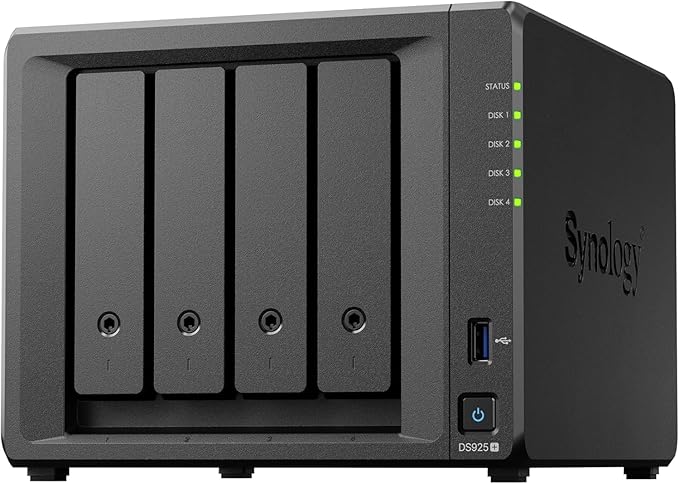
| CPU | AMD Ryzen V1600B. 4-core / 8-thread, 2.6 GHz (burst 3.1 GHz) |
|---|---|
| Architecture | 64-bit x86, Zen 1 |
| RAM (installed) | 4 GB DDR4 ECC SODIMM |
| RAM (max) | 32 GB (2 x 16 GB DDR4 ECC SODIMM) |
| Drive Bays | 4 x 3.5"/2.5" SATA (hot-swappable) |
| M.2 NVMe Slots | 2 x M.2 2280 NVMe (PCIe Gen 3 x1) |
| Max Raw Capacity | 4 x 24 TB = 96 TB (internal), 9 bays with DX525 |
| LAN Ports | 2 x 2.5 GbE RJ45 (supports Link Aggregation) |
| USB Ports | 2 x USB 3.2 Gen 1 (Type-A) |
| PCIe Expansion | 1 x PCIe Gen 3 x2 (for 10GbE or M.2 adapter) |
| eSATA | 1 x eSATA (for DX525 expansion unit) |
| File System | Btrfs, ext4 |
| RAID Support | SHR, SHR-2, RAID 0/1/5/6/10, JBOD |
| Hardware Encryption | AES-NI hardware encryption engine |
| Power Consumption | 32.49 W (access) / 10.79 W (HDD hibernation) |
| Noise Level | 21.2 dB(A) |
| Dimensions | 166 x 199 x 223 mm |
| Weight | 2.24 kg (diskless) |
| Warranty | 3 years (extendable to 5 years) |
| Operating System | DSM 7.2+ (DiskStation Manager) |
| AU Price (Scorptec) | $995 |
| AU Price (Mwave) | $1,029 |
Australian Pricing and Where to Buy
Scorptec currently has the DS925+ at $995 (in stock), while Mwave lists it at $1,029. PLE Computers does not stock the DS925+ at the time of writing. That $34 spread is typical. NAS margins in Australia run at 3-5%, leaving little room for price variation. The meaningful difference between retailers is stock availability, pre-sales knowledge, and after-sales support, not the price tag.
Business and government buyers should always request a formal quote rather than paying the listed retail price. Resellers can request pricing support from their distributors (BlueChip and MMT both distribute Synology in Australia), and vendors sometimes provide additional discounts to close deals. Quoted pricing is often at or near sale pricing.
Price context: Australian NAS pricing runs 10-20% above US levels. The DS925+ retails for around US$570 in the United States. At A$995-$1,029, the AU price reflects lower stock allocations, higher freight costs, and smaller market volumes. This is not a rip-off. It is the reality of buying locally with full Australian Consumer Law protection.
Performance: AMD Ryzen V1600B
The AMD Ryzen V1600B is a meaningful step up from the Intel Celeron J4125 used in the DS923+ and DS425+. Four Zen 1 cores with simultaneous multithreading (8 threads) handle concurrent workloads far more comfortably. Running Active Backup for Business on a schedule while serving files to a dozen users and transcoding a Plex stream is well within the V1600B's capability. The Celeron J4125 can do this too, but it shows strain under combined loads, particularly when Docker containers are in the mix.
For Plex users, the V1600B's hardware transcoding handles a single 4K or multiple 1080p streams. Direct play is always preferable, but for remote streaming over NBN where upload speeds top out at 20-40 Mbps on most plans, the DS925+ can transcode down to a manageable bitrate. On a typical NBN 100 plan with around 20 Mbps upload, a single 1080p transcode is comfortable. Note that CGNAT on some Australian ISPs (particularly Aussie Broadband and TPG fixed wireless) blocks direct remote access. You'll need a static IP, VPN tunnel, or Plex Relay as a workaround.
ECC RAM: Why It Matters
ECC (Error-Correcting Code) memory detects and corrects single-bit errors in real time. On a NAS running 24/7 with RAID parity calculations, Btrfs checksumming, and database operations, an undetected memory error can silently corrupt data before it's written to disk. Standard non-ECC RAM lets these errors pass unnoticed. ECC eliminates this risk. Particularly important for a device that manages your data around the clock.
The DS925+ ships with 4 GB DDR4 ECC, expandable to 32 GB across two slots. Synology's 8 GB ECC SODIMM is~$980 at Mwave. Expensive, but third-party DDR4 ECC SODIMMs can be sourced for less. For business deployments, use Synology-branded modules to maintain full support coverage. If you plan to run Docker, VMs, or Surveillance Station, upgrade to at least 8-16 GB. The default 4 GB becomes a bottleneck quickly once you layer on services.
Networking and 10GbE Expansion
Two 2.5 GbE RJ45 ports support Link Aggregation (802.3ad LACP or ALB) for improved multi-client throughput or failover redundancy. A single file transfer still caps at 2.5 Gbps, but for environments with multiple simultaneous users, the combined bandwidth prevents congestion.
The PCIe Gen 3 x2 expansion slot accepts Synology's E10G18-T1 10GbE adapter ($239 at Mwave, $289 at Scorptec). The x2 lane is a minor limitation compared to x4, but with 4 spinning drives you're unlikely to saturate it. The 10GbE option suits video editing workflows or any environment with regular large file transfers. Just budget for a 10GbE switch or direct connection on the other end.
M.2 NVMe Cache and Storage
Two M.2 2280 NVMe slots on the underside of the DS925+ can be configured as SSD read/write cache to accelerate random I/O. Beneficial for database workloads, VMs, and Synology Drive with many concurrent users. Alternatively, they can form a dedicated SSD storage pool separate from the main SATA array, useful for running Docker containers on fast NVMe while keeping bulk data on larger SATA drives.
NVMe compatibility: While Synology reversed third-party restrictions for 3.5" HDDs and 2.5" SSDs with DSM 7.3 (October 2025), M.2 NVMe SSDs still require drives from Synology's Hardware Compatibility List. Creating a new NVMe storage pool with an unlisted drive is blocked. Synology's SNV3410 (400 GB) is $499 at Scorptec.
DX525 Expansion
The DS925+ supports the DX525 expansion unit ($879 at Mwave), adding five 3.5"/2.5" bays via eSATA for a total of 9 bays. For a small business that starts with 4 drives and grows over 2-3 years, this avoids the cost and downtime of a full NAS migration. At $879, the DX525 is nearly as much as the NAS itself. Users who know they'll need more than 4 bays from day one should consider the 5-bay DS1525+ ($1,285 at Mwave, $1,399 at Scorptec) as a more cost-effective starting point.
Drive Compatibility and DSM 7.3
In April 2025, Synology locked all new Plus series models (including the DS925+) to Synology-branded or specifically certified drives. The community backlash was severe. Synology reversed course with DSM 7.3 in October 2025, restoring support for third-party 3.5" HDDs and 2.5" SATA SSDs from Western Digital, Seagate, and Toshiba. You can use Seagate IronWolf, WD Red Plus, or any mainstream NAS-class drive without restriction on the DS925+.
Two caveats remain: M.2 NVMe SSDs still require HCL-listed drives for new storage pools, and enterprise/rackmount models maintain stricter compatibility. The reputational damage is real. Synology lost trust with enthusiasts, and some of that won't come back quickly. But for the typical SMB or home buyer, the products remain strong and the reversal shows Synology will listen when they overstep. See our Synology NAS Australia guide for full brand context.
Software: DSM and Key Applications
DSM (DiskStation Manager) is the primary reason Synology dominates the Australian consumer NAS market. The web-based interface is clean, intuitive, and rarely overwhelming. For buyers who want a NAS that "just works," DSM delivers.
Active Backup for Business is the standout for SMB deployments. Agentless backup for Windows PCs, servers, VMware, Hyper-V, and Microsoft 365, all managed from a single console. It replaces paid backup subscriptions (Veeam, Acronis) with a licence-free solution included with every Synology NAS. The DS925+'s Ryzen V1600B handles scheduled backups for 20+ endpoints without impacting other services. Synology Drive turns the NAS into a private cloud with desktop and mobile sync. Ideal for businesses handling sensitive data (legal, medical, accounting). Docker runs well for self-hosted applications, while Virtual Machine Manager handles light VM workloads (upgrade RAM to at least 16 GB if VMs are part of your plan).
Who Should Buy the DS925+
The DS925+ is the right NAS if you are:
- A small business (5-50 employees) needing centralised backup, file sharing, and room to grow with the DX525
- A home power user running Plex alongside Docker containers, who needs the CPU headroom and ECC reliability Celeron-based models lack
- A prosumer or creative working with large files who benefits from dual 2.5GbE and the option to add 10GbE
- Upgrading from a DS918+ or DS920+. The DS925+ is the direct successor with better CPU, native 2.5GbE, and built-in M.2 NVMe
Who Should NOT Buy the DS925+
Don't buy the DS925+ if:
- You only need basic backup and file sharing. The DS425+ at~$980 (Scorptec) has 4 bays, runs DSM, and handles home workloads. The $176+ premium for the DS925+ is wasted if you're not pushing the NAS with concurrent services.
- You want deep technical flexibility. The QNAP TS-464 at $999 offers more depth for technical users who want VMs, HDMI output, or a less locked-down OS.
- You need more than 4 bays now. The DS1525+ ($1,285-$1,399) gives you 5 bays natively without needing the $879 DX525.
DS925+ vs DS425+ vs QNAP TS-464
DS925+ vs DS425+ vs QNAP TS-464. Australian Pricing
| DS925+ | DS425+ | QNAP TS-464 | |
|---|---|---|---|
| AU Price (lowest) | $995 (Scorptec) | $819 (Scorptec) | $989 (Scorptec) |
| CPU | AMD Ryzen V1600B | Intel Celeron J4125 | Intel Celeron N5095 |
| CPU Cores/Threads | 4C/8T | 4C/4T | 4C/4T |
| RAM | 4 GB ECC (max 32 GB) | 2 GB (max 8 GB) | 8 GB (max 16 GB) |
| M.2 NVMe Slots | 2 | 0 | 2 |
| LAN | 2 x 2.5GbE | 1 x 2.5GbE + 1 x 1GbE | 2 x 2.5GbE |
| PCIe Slot | Yes (Gen 3 x2) | No | Yes (Gen 3 x2) |
| Expansion Unit | DX525 (5 bays) | No | No |
| ECC RAM | Yes | No | No |
| HDMI | No | No | Yes (HDMI 2.0) |
| Best For | SMB, power users | Home, light prosumer | Technical users, multimedia |
Prices last verified: 10 March 2026. Always check retailer before purchasing.
The DS425+ is the budget-conscious choice at $819. It runs the same DSM software and handles home workloads, but lacks PCIe expansion, M.2 NVMe, and the CPU headroom for stacked services. The QNAP TS-464 at $999 matches the DS925+ on networking, ships with 8 GB RAM (vs 4 GB), adds HDMI 2.0, and offers more hardware per dollar. The Celeron N5095 trades blows with the Ryzen V1600B but lacks ECC. The TS-464 wins on features per dollar; the DS925+ wins on software polish, ease of use, and the DX525 expansion path. As covered in our best NAS Australia guide, the choice usually comes down to user capability and intent.
Pros
- AMD Ryzen V1600B (8 threads) handles concurrent workloads far better than Celeron J4125
- ECC RAM protects data integrity during 24/7 operation. Rare at this price point
- Dual 2.5GbE with Link Aggregation, plus PCIe slot for 10GbE upgrade
- DX525 expansion adds 5 more bays. Unmatched expandability in a 4-bay desktop NAS
- Two M.2 NVMe slots for SSD caching or dedicated storage pool
- Active Backup for Business included. Replaces paid backup software for SMBs
- DSM remains the most user-friendly NAS OS on the market
- Strong AU distributor support via BlueChip and MMT
Cons
- AU pricing ($995-$1,029) is a significant step up from the DS425+ ($819-$899)
- 4 GB base RAM is tight for Docker/VM workloads. Budget $533 for Synology's 8 GB ECC module
- M.2 NVMe drives still require HCL-listed drives. Third-party NVMe restrictions remain
- No HDMI output. QNAP TS-464 offers this at a similar price
- PCIe slot is Gen 3 x2, not x4
- DX525 expansion unit costs $879. Nearly as much as the NAS itself
- The 2025 drive compatibility controversy damaged Synology's trust with enthusiasts
Warranty, ACL, and After-Sales in Australia
The DS925+ ships with a 3-year warranty, extendable to 5 years. In Australia, your warranty claim goes to the retailer. Synology has no service centre or office here. The process runs: retailer to distributor (BlueChip or MMT) to Synology in Taiwan, then back. Expect 2-3 weeks minimum. Advanced replacements are generally not available through the standard process, though some resellers will let you purchase a replacement and refund you when the faulty unit returns. Ask about this before you buy.
Australian Consumer Law (general guidance): Your retailer is your primary warranty path under ACL. A NAS hardware failure is typically a minor failure. The retailer chooses the remedy (repair, replacement, or refund). ACL protects the hardware purchase, not your data. Always maintain offsite backups. For official information, visit accc.gov.au.
A NAS is not a backup. Plan for a 2-3 week replacement window as the realistic Australian timeline, and build your data protection strategy around the assumption that hardware will eventually fail. A 3-2-1 backup strategy (3 copies, 2 media types, 1 offsite) is the standard. Synology's Hyper Backup makes this straightforward with cloud destinations including Backblaze B2, AWS S3, and Synology C2.
Verdict
The Synology DS925+ is the 4-bay NAS to buy in Australia for small businesses and serious home power users. The AMD Ryzen V1600B with ECC RAM, dual 2.5GbE, M.2 NVMe caching, PCIe expansion, and DX525 expandability make it the most capable compact desktop NAS in Synology's current lineup. At $995-$1,029, it is not an impulse purchase. But for anyone running Active Backup, Synology Drive, Docker, or Plex alongside other services, the DS925+ delivers the performance and reliability to justify the price.
If your needs are simpler, the DS425+ at $819 runs the same software and saves money. If you want more hardware flexibility and are comfortable with a steeper learning curve, the QNAP TS-464 at $999 is a strong alternative. But if you want the most polished NAS experience with genuine SMB capability in a 4-bay form factor, the DS925+ is the one to get. Browse the full Synology lineup ranked for other options.
Related reading: our AU retailer guide.
Use our free NAS Sizing Wizard to get a personalised NAS recommendation.
See also: our complete Synology ecosystem guide.
Is the Synology DS925+ worth it in Australia at $995-$1,029?
Yes, if your workload justifies it. The DS925+ is overkill for basic home backup. The DS425+ at $819 handles that. For small businesses running Active Backup, Synology Drive, and Docker, or home power users running Plex alongside multiple services, the Ryzen V1600B CPU and ECC RAM justify the premium.
Can I use Seagate IronWolf or WD Red drives in the DS925+?
Yes. Since DSM 7.3 (October 2025), Synology restored full support for third-party 3.5" SATA HDDs and 2.5" SATA SSDs on Plus series models including the DS925+. Seagate IronWolf, WD Red Plus, and other NAS-class drives work without restriction. M.2 NVMe SSDs still require drives from Synology's Hardware Compatibility List.
How much RAM should I put in the DS925+?
The default 4 GB is sufficient for basic file serving and backup. If you run Docker, VMs, Surveillance Station, or Active Backup for many endpoints, upgrade to 8-16 GB. Synology's 8 GB ECC SODIMM is $533 at Mwave. Maximum supported is 32 GB (2 x 16 GB). For most SMB deployments, 16 GB total is the sweet spot.
Is the DS925+ good for Plex in Australia?
Yes. The Ryzen V1600B supports hardware transcoding for a single 4K or multiple 1080p streams. For remote streaming, NBN upload speeds are the limiting factor. Most NBN 100 plans offer around 20 Mbps upload, supporting one comfortable 1080p transcode. CGNAT on some ISPs blocks direct remote access. You'll need a static IP, VPN, or Plex Relay. See our best NAS for Plex Australia guide for setup advice.
DS925+ or DS425+. Which should I buy?
Buy the DS425+ ($819) for basic backup, file sharing, and light media serving. Buy the DS925+ ($995) if you'll run concurrent services (Active Backup + Synology Drive + Docker + Plex), need ECC RAM, want dual 2.5GbE, or need DX525 expansion. The DS925+ is significantly more capable. But that capability is wasted money if your needs are simple.
What is the warranty process for the DS925+ in Australia?
The DS925+ has a 3-year warranty (extendable to 5). Claims go to the retailer, who escalates through their distributor (BlueChip or MMT) to Synology in Taiwan. Expect 2-3 weeks. The outcome is usually replacement, not repair. Advanced replacements are not standard. Ask your retailer before you buy. Australian Consumer Law protections apply when purchasing from an Australian retailer (general guidance. Visit accc.gov.au for official information).
Can I add 10GbE to the DS925+?
Yes. The PCIe Gen 3 x2 slot accepts Synology's E10G18-T1 10GbE adapter ($239 at Mwave, $289 at Scorptec). For a 4-bay NAS with spinning drives, the x2 lane width is sufficient. You'll need a 10GbE switch or direct connection on the other end.
Where is the cheapest place to buy the DS925+ in Australia?
Scorptec has it at $995 and Mwave at $1,029 (February 2026). The $34 difference is typical for NAS. Margins are 3-5% so pricing is uniform. Rather than chasing the cheapest price, consider which retailer offers better after-sales support. For a device that stores your data, the warranty experience matters more than $34. Business buyers should request a formal quote for sharper pricing.
Still deciding between Synology models? Our complete guide ranks every current Synology NAS available in Australia with live AU pricing.
Read the Full Synology Rankings →