The UGREEN DXP4800 Plus and QNAP TS-464 share the same Intel Celeron N5105 CPU, but the comparison splits on RAM, software maturity, and value: the TS-464 ships with 8GB and runs a feature-complete NAS OS; the DXP4800 Plus ships with 16GB and runs a software ecosystem that is still maturing. This guide breaks down the hardware differences that actually matter. PCIe bandwidth, USB4 connectivity, and RAM configuration. And explains when the DXP4800 Plus's $260 premium is justified. Pricing and retailer availability for both models are in the AU section below.
For a broader overview of this topic, see our complete QNAP ecosystem guide.
In short: The TS-464 wins on value and software maturity at $999-$1,099. The DXP4800 Plus justifies its $1,259.99 price only if you specifically need 16GB base RAM, the USB4 port, or Thunderbolt 4 direct-attach storage. For most Australian 4-bay buyers, the TS-464 is the stronger all-round purchase.
Specifications Side by Side
UGREEN DXP4800 Plus vs QNAP TS-464. Full Specs (AU)
 UGREEN DXP4800 Plus
|
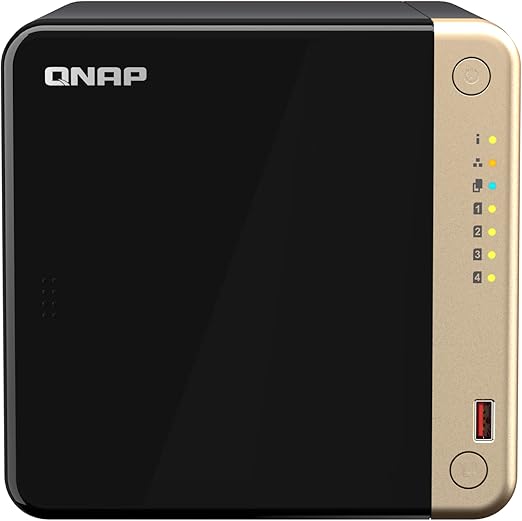 QNAP TS-464-8G
|
|
|---|---|---|
| None | $1,259.99 (UGREEN AU) | $999-$1,099 (Scorptec / PLE) |
| None | Intel Celeron N5105 (4-core, 2.0-2.9GHz) | Intel Celeron N5105 (4-core, 2.0-2.9GHz) |
| None | 16GB DDR4 (2 slots, max 32GB) | 8GB DDR4 (2 slots, max 16GB) |
| None | 4x SATA (hot-swap) | 4x SATA (hot-swap) |
| None | 2x M.2 NVMe PCIe Gen 3 | 2x M.2 NVMe PCIe Gen 3 |
| None | 2x 2.5GbE | 2x 2.5GbE |
| None | 1x PCIe 3.0 x4 | 1x PCIe 3.0 x2 |
| None | 1x USB4 (Thunderbolt 4 compatible) | 1x USB-C 3.2 Gen 2 |
| None | Yes (HDMI 2.0) | No |
| None | UGOS | QTS 5.x |
| None | Yes (Dockge, x86) | Yes (Container Station, x86) |
| None | 2 years (UGREEN AU) | 2 years (Dicker Data) |
Same CPU, Different RAM
Both units use the Intel Celeron N5105. So CPU performance is identical. The meaningful hardware differences are RAM, PCIe bandwidth, the USB4 port, and HDMI output.
The DXP4800 Plus ships with 16GB DDR4 (two 8GB sticks, max 32GB). The TS-464 ships with 8GB (one 8GB stick, max 16GB). For a home lab user running 8-12 Docker containers simultaneously, the DXP4800 Plus’s 16GB base is a genuine advantage. For a NAS serving files and running 2-3 containers, 8GB is more than sufficient. The TS-464 can be user-upgraded to 16GB with a compatible SO-DIMM, closing the gap at additional cost.
PCIe Bandwidth and USB4
The DXP4800 Plus has a PCIe 3.0 x4 slot versus the TS-464’s x2. In practice, a 10GbE NIC saturates a PCIe x2 slot at ~16Gbps, and 10GbE is ~10Gbps. So the x4 slot provides no real benefit over x2 for 10GbE. The x4 bandwidth matters if you’re installing a 25GbE card, which is uncommon in Australian home and SMB deployments at this price point.
The USB4 (Thunderbolt 4 compatible) port is the DXP4800 Plus’s most distinctive hardware feature. USB4 at 40Gbps allows you to connect a Thunderbolt 4 external drive for up to ~3,000 MB/s transfer speeds. Far exceeding what any NAS drive array can deliver, but useful if you’re attaching a fast NVMe enclosure for direct local access. It also allows connection to a Thunderbolt 4 hub. The TS-464 has a USB-C 3.2 Gen 2 port at 10Gbps. The gap is significant for Thunderbolt workflows, irrelevant for everything else.
UGOS vs QTS. The Software Reality
This is where the comparison shifts firmly in QNAP’s favour for most buyers. QTS is a mature, feature-complete NAS OS with a large ecosystem of apps, reliable updates, and years of community support. UGOS is functional but younger. For Docker workflows, UGOS’s Dockge interface works well for Compose-based deployments. For everything else. Virtualisation, backup apps, media management, protocol support depth. QTS’s Container Station and broader app ecosystem is more developed.
The CGNAT consideration is relevant for remote access users. QNAP's myQNAPcloud relay works on CGNAT connections without port forwarding; UGOS remote access requires more manual configuration. If your internet connection uses CGNAT, QTS has a clear advantage here.
Price Analysis. Is the DXP4800 Plus Worth $260 More?
At $1,259.99 (DXP4800 Plus) vs $999 (TS-464 at Scorptec), you’re paying $261 more for:
- +8GB base RAM (16GB vs 8GB). Worth ~$60-$80 if purchased as a user upgrade for the TS-464
- USB4 / Thunderbolt 4 port. Valuable only for Thunderbolt workflows
- PCIe x4 vs x2. Negligible difference for 10GbE use cases
- HDMI 2.0 output. Useful for media server direct TV connection
- UGOS instead of QTS. Subjectively inferior for most workflows
Factoring in the RAM upgrade cost, the DXP4800 Plus’s effective premium is closer to $180-$200 for the USB4 port, HDMI, and PCIe x4 slot. If you need Thunderbolt 4 connectivity or want HDMI output for direct TV/monitor use, those features are available nowhere else in this category and the premium is justified. If you don’t need either, the TS-464 on QTS is the better purchase.
Who Should Buy the UGREEN DXP4800 Plus?
- Home lab users who need 16GB+ RAM from day one without a user upgrade
- Anyone who wants Thunderbolt 4 / USB4 connectivity for direct-attach NVMe enclosures
- Media enthusiasts who want HDMI output for direct TV connection via UGOS’s media player
- Buyers comfortable with a newer software ecosystem and happy to use Docker for advanced features
Who Should Buy the QNAP TS-464?
- Most 4-bay NAS buyers wanting mature software. Better value at the TS-464's price point
- Anyone who values QTS feature depth, Docker management, and app ecosystem maturity
- Users who need reliable relay-based remote access without port forwarding
- Buyers where the $260 premium for base 16GB RAM is not justified by their workload
Pros
- DXP4800 Plus: 16GB base RAM (double the TS-464). No upgrade needed for heavy Docker use
- DXP4800 Plus: USB4 / Thunderbolt 4 port. Unique in this category
- DXP4800 Plus: HDMI 2.0 output for direct media playback
- DXP4800 Plus: PCIe x4 slot (vs TS-464’s x2)
- TS-464: $260 cheaper at Scorptec pricing
- TS-464: QTS. Mature, feature-rich, better community support
- TS-464: myQNAPcloud relay works on Australian CGNAT without extra setup
Cons
- DXP4800 Plus: $1,259.99. $260 more than TS-464 at Scorptec for similar core performance
- DXP4800 Plus: UGOS is newer and less mature than QTS
- DXP4800 Plus: No CGNAT relay. Tailscale workaround required
- TS-464: 8GB base RAM. User upgrade needed for heavy Docker workloads
- TS-464: No USB4 / Thunderbolt 4
- TS-464: No HDMI output
Verdict
For most buyers, the QNAP TS-464 is the better 4-bay NAS. At current retail prices it undercuts the DXP4800 Plus by $260, ships with a mature, full-featured operating system, and delivers the same core CPU performance. The DXP4800 Plus earns its premium in specific use cases: you specifically need 16GB base RAM, a USB4 port for direct-attach NVMe storage, or PCIe 3.0 x4 for a 10GbE NIC without bandwidth compromise.
The DXP4800 Plus earns its premium if you specifically need 16GB base RAM, Thunderbolt 4 connectivity, or HDMI output. Those features are real and not available on the TS-464. But paying $261 more for a less mature software platform to get USB4 only makes sense if USB4 is genuinely in your use case. For a broader view of UGREEN’s 4-bay options, see our UGREEN NAS Australia guide. For all 4-bay options, see our best 4-bay NAS Australia roundup.
🇦🇺 Australian Buyers: Pricing and Where to Buy
Current AU Pricing (March 2026)
- QNAP TS-464: ~$999 at Scorptec, $1,029-$1,079 at Mwave and PLE
- UGREEN DXP4800 Plus: ~$1,259 via Amazon AU. Not stocked at Scorptec/PLE
Where to Buy
The QNAP TS-464 is available from all major Australian NAS retailers (Scorptec, PLE, Mwave, DeviceDeal) with full ACL warranty support. The UGREEN DXP4800 Plus is sold via Amazon AU. Amazon's return policy provides practical consumer protection even without a local distributor. For warranty claims on UGREEN, contact UGREEN Australia support directly.
See our full UGREEN vs QNAP ecosystem comparison for all models and price points in Australia.
QNAP vs UGREEN AustraliaRelated reading: our NAS buyer's guide and our Synology vs QNAP comparison.
Our RAID Calculator shows usable capacity for both models' 4-bay configurations, and our NAS Power Cost Calculator compares annual running cost at your AU state electricity rate.
Use our free NAS Sizing Wizard to get a personalised NAS recommendation.
Why does the UGREEN DXP4800 Plus cost more than the QNAP TS-464 with the same CPU?
The DXP4800 Plus ships with 16GB DDR4 (vs 8GB in the TS-464), includes a USB4 / Thunderbolt 4 port, and has an HDMI 2.0 output. The PCIe slot is also x4 vs x2. These hardware additions account for most of the $160-$260 price premium. The QNAP TS-464 can be user-upgraded to 16GB RAM for ~$60-$80, which narrows the effective premium to the USB4, HDMI, and PCIe x4 features.
Does the UGREEN DXP4800 Plus support Thunderbolt 4?
Yes. The DXP4800 Plus includes a USB4 port that is Thunderbolt 4 compatible. This allows connection of Thunderbolt 4 external NVMe enclosures at up to 40Gbps throughput, and connection to Thunderbolt 4 hubs. The QNAP TS-464 has a USB-C 3.2 Gen 2 port at 10Gbps. Functional for USB-C peripherals but not Thunderbolt compatible.
Which has better Docker support. UGREEN DXP4800 Plus or QNAP TS-464?
Both run x86 Docker containers without ARM compatibility issues. QNAP’s Container Station (TS-464) is more mature and has a larger community of QTS Docker users. UGREEN’s Dockge interface (DXP4800 Plus) is intuitive for Docker Compose users but newer. For standard home lab Docker workloads (Nextcloud, Home Assistant, Portainer, Pi-hole), both work well. For virtualisation or more complex orchestration, QTS’s deeper stack gives the TS-464 an advantage.
Can the QNAP TS-464 be upgraded to 16GB RAM?
Yes. The TS-464 has two SO-DIMM slots. It ships with one 8GB stick. Adding a second compatible 8GB DDR4 SO-DIMM brings the total to 16GB, matching the DXP4800 Plus’s base spec. A compatible 8GB DDR4 2666MHz SO-DIMM costs approximately $60-$80 AU, which narrows the effective price gap between the two units considerably.
Where can I buy the UGREEN DXP4800 Plus in Australia?
The UGREEN DXP4800 Plus is available from UGREEN’s Australian store (ugreen.com.au) at $1,259.99. UGREEN also stocks it through Scorptec. Warranty and support are handled by UGREEN AU directly. The QNAP TS-464 is available at Scorptec ($999), PLE Computers ($1,099), and Mwave, with warranty via Dicker Data.