Synology and UGREEN sit at opposite ends of the maturity/value spectrum in 2026: Synology offers the most polished NAS operating system available (DSM), backed by a decade of app development and enterprise security features; UGREEN offers significantly stronger hardware specs per dollar with a software ecosystem that is still developing. This comparison covers software depth, hardware value, security track record, backup capabilities, and the direct verdict at each use case and price tier. Australian purchasing guidance, pricing, and warranty details are in the AU section below.
For a broader overview of this topic, see our complete Synology ecosystem guide.
In short: Synology suits buyers who want a proven, easy-to-use software platform with strong Australian retail availability and local warranty support through established distributors. UGREEN suits technically confident buyers willing to trade software maturity for better hardware specs per dollar, but who understand that UGREEN has no official Australian distributor yet and warranty support goes through international channels. If you just want it to work without fuss, buy Synology. If you want more hardware for your money and are comfortable managing a newer platform, UGREEN is worth a serious look.
The Core Difference: Software Ecosystem vs Hardware Value
Synology and UGREEN represent two fundamentally different strategies in the NAS market. Synology has spent over two decades refining DiskStation Manager (DSM), building an ecosystem of first-party applications that covers backup, file sync, surveillance, media management, Docker containers, and more. Their hardware is competent but rarely class-leading for the price. You pay a premium for the software experience.
UGREEN entered the NAS market in 2024 with the NASync range and took a different approach: pack in more powerful hardware at aggressive pricing and build the software over time. Their UGOS operating system is functional and improving rapidly, but it is years behind DSM in polish, app breadth, and community ecosystem. The hardware itself is often significantly better specified than a Synology at the same price point.
This is the trade-off that drives every decision in this comparison. If you are reading a best NAS Australia guide and these two brands keep appearing, the deciding factor is almost always whether you value the software or the hardware more.
AU Pricing: Head-to-Head Comparison
Pricing tells a clear story. Synology models are readily available from multiple Australian retailers with consistent pricing. UGREEN NAS units are harder to source locally, with most Australian buyers purchasing through Amazon AU or direct from UGREEN's online store. UGREEN doesn't yet have an official Australian distributor, which means local stock is limited and pricing can fluctuate.
2-Bay Models
2-Bay NAS: Synology vs UGREEN
 Synology DS225+
|
 UGREEN NASync DXP2800
|
|
|---|---|---|
| AU Price | $599 (PLE Computers) | ~$450-550 (Amazon AU, price varies) |
| CPU | Intel Celeron (4-core, 2.0GHz) | Intel N100 (4-core, 3.4GHz boost) |
| RAM | 2GB DDR4 (expandable) | 8GB DDR5 |
| Network | 1x 2.5GbE + 1x 1GbE | 1x 2.5GbE |
| M.2 Slots | 2x NVMe (cache/storage) | 2x NVMe |
| USB | 2x USB 3.2 Gen 1 | 2x USB 3.2 Gen 2 |
| Operating System | DSM 7.x | UGOS |
| Warranty | 3 years (extendable to 5) | 2 years |
Prices last verified: 16 March 2026. Always check retailer before purchasing.
The DS225+ is Synology's current 2-bay flagship with a dual-port network configuration and DSM's full software suite. The DXP2800 counters with significantly more RAM and a faster CPU at a similar or lower price. For a deeper look at the Synology side, see our Synology DS225+ review.
4-Bay Models
4-Bay NAS: Synology vs UGREEN
 Synology DS425+
|
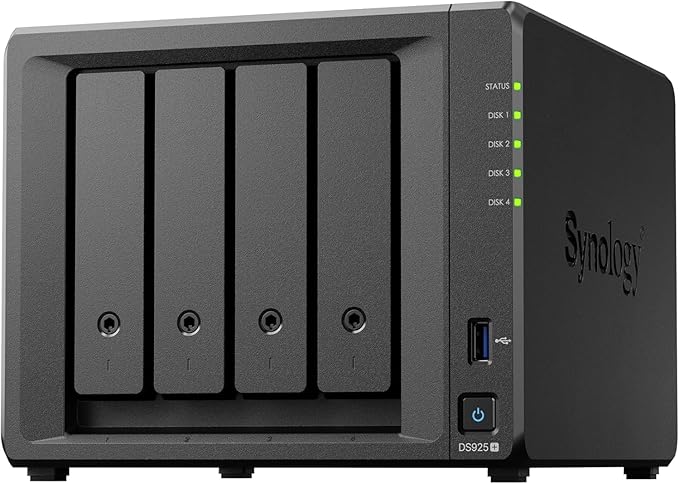 Synology DS925+
|
 UGREEN NASync DXP4800 Plus
|
|
|---|---|---|---|
| AU Price | $819-899 (Scorptec/Mwave) | $995-1029 (Scorptec/Mwave) | ~$650-750 (Amazon AU, price varies) |
| CPU | Intel Celeron (4-core, 2.0GHz) | AMD Ryzen (4-core) | Intel N100 (4-core, 3.4GHz boost) |
| RAM | 2GB DDR4 | 4GB DDR4 (expandable) | 8GB DDR5 |
| Network | 1x 2.5GbE + 1x 1GbE | 2x 2.5GbE | 2x 2.5GbE |
| M.2 Slots | 2x NVMe | 2x NVMe | 2x NVMe |
| Operating System | DSM 7.x | DSM 7.x | UGOS |
| Warranty | 3 years | 3 years (extendable to 5) | 2 years |
At the 4-bay level, the price gap widens. The UGREEN DXP4800 Plus delivers comparable or better hardware specifications than the DS925+ at a substantially lower price. However, the DS925+ benefits from DSM's mature ecosystem, dual 2.5GbE networking, and full Australian retail availability with local warranty support. The DS425+ sits as a more affordable Synology entry point but with only 2GB RAM.
If you are comparing the Synology options against each other, our DS925+ vs DS725+ comparison breaks down the Synology-specific decision.
Software: DSM vs UGOS
This is where Synology holds its strongest advantage and it is not close. DSM is arguably the best NAS operating system available. It is intuitive, well-documented, and backed by a massive community of users and third-party guides. Synology's first-party applications, including Synology Drive, Hyper Backup, Active Backup for Business, Surveillance Station, and Photos, are polished and functional enough that many users never need to install third-party alternatives.
UGOS is functional but young. It covers the basics well: file management, user access control, backup scheduling, and media serving. Docker support is available, which opens up a world of third-party applications. But the first-party app library is thin compared to DSM, documentation is limited, and the community is still small. If you hit a problem with DSM, there are thousands of forum threads, Reddit posts, and YouTube tutorials to guide you. With UGOS, you may be on your own.
For buyers whose primary use case is straightforward backup and file storage, UGOS is perfectly adequate. For anyone who wants more, such as running Docker containers, setting up surveillance, or building a comprehensive backup strategy with 3-2-1 backup, DSM is the more capable and reliable platform today.
Pros
- DSM is the most intuitive NAS operating system available
- Extensive first-party app suite (Drive, Hyper Backup, Photos, Surveillance Station)
- Massive community and documentation for troubleshooting
- Docker and virtualisation support on Plus models
- Regular, well-tested security updates
Cons
- UGOS is improving rapidly but still years behind DSM in maturity
- UGOS documentation and community resources are limited
- UGOS first-party app library is thin
- DSM's M.2 NVMe drive restrictions still apply on newer models
- DSM's drive compatibility controversy (now largely reversed) damaged brand trust
Hardware: Where UGREEN Fights Back
UGREEN's hardware advantage is undeniable. At every price point, UGREEN NAS devices offer more RAM, faster CPUs, and often faster USB connectivity than their Synology equivalents. The DS225+ ships with 2GB of DDR4 RAM. The UGREEN DXP2800 ships with 8GB of DDR5. That is not a marginal difference, it is a generational one.
This hardware gap matters for specific workloads. Docker containers consume RAM. Surveillance with multiple camera streams needs processing power. Running Plex with transcoding demands a capable CPU. If your use case is hardware-intensive, UGREEN gives you significantly more headroom per dollar spent.
However, hardware only matters if the software can use it effectively. Synology's DSM extracts excellent performance from modest hardware through careful optimisation. A Synology DS225+ with 2GB RAM handles file serving, backup, and basic Docker workloads smoothly because DSM is built to run efficiently on constrained hardware. UGREEN's extra hardware specifications are advantageous but partially offset by a less optimised software stack.
Buying in Australia: Availability and Support
This is where the comparison shifts decisively in Synology's favour for most Australian buyers. Synology is distributed by BlueChip and Multimedia Technology (MMT), both of which hold deep stock across the entire Synology range. Consumer models are almost always available at major Australian retailers including Scorptec, PLE, Mwave, and others. Pricing is stable and consistent across retailers because Australian NAS resellers operate on thin 3-5% margins, leaving little room for price variation.
UGREEN does not have an official Australian distributor as of February 2026. This is expected to change during 2026, but until it does, Australian buyers are purchasing UGREEN NAS devices through Amazon AU or international channels. This has practical implications that go beyond price.
UGREEN warranty in Australia: Without an official AU distributor, UGREEN warranty claims currently go through international channels. This means longer turnaround times and no local escalation path. For a device that stores your data, this is a meaningful consideration. Australian Consumer Law protections apply when purchasing from Australian retailers, but the practical support experience will be different from buying a Synology through an established local retailer. If UGREEN secures an Australian distribution partner in 2026, this situation will improve significantly.
For details on where to buy NAS in Australia and understanding the retailer landscape, we have a dedicated guide.
Remote Access and NBN Considerations
Both Synology and UGREEN offer remote access solutions, but Synology's is more mature and better tested on Australian networks. Synology's QuickConnect service provides relay-based remote access that works even behind CGNAT (Carrier-Grade NAT), which affects a growing number of Australian NBN connections. If your ISP uses CGNAT, direct remote access via port forwarding or DDNS is blocked. QuickConnect works around this limitation, though performance is limited by the relay servers.
UGREEN offers remote access through their cloud relay service as well, but it is newer and less field-tested. For Australian users on typical NBN 100 plans with upload speeds around 20-40Mbps (real-world), remote access performance is ultimately bottlenecked by upload bandwidth regardless of which NAS brand you choose. If remote access is a core requirement, Synology's more established relay infrastructure gives greater confidence.
The Drive Compatibility Factor
Synology's 2025 drive compatibility controversy is worth addressing directly. In April 2025, Synology restricted new Plus series models to Synology-branded or certified drives, blocking third-party HDDs from creating new storage pools. The backlash was severe and Synology reversed course with DSM 7.3 in October 2025, restoring support for third-party 3.5-inch HDDs and 2.5-inch SATA SSDs from brands like Seagate and Western Digital on desktop Plus series models.
Important restrictions remain: M.2 NVMe SSDs still require drives from Synology's official Hardware Compatibility List for new cache or storage pool creation. Enterprise and rackmount models still enforce stricter compatibility. This means if you are planning to use SSD cache on a Synology, check the compatibility list carefully before purchasing drives.
UGREEN has no such restrictions. Any standard SATA or NVMe drive works. For buyers who want complete freedom to choose their own drives, including picking up the best NAS hard drives at the best price without checking a compatibility list, UGREEN avoids this headache entirely.
Who Should Buy Synology
The Synology DS225+ at $549-599 or the DS425+ at $819-899 from Australian retailers suits buyers who prioritise a polished, proven experience. If you want a NAS that works reliably out of the box with minimal configuration, excellent mobile apps, a comprehensive backup suite, and the confidence that comes from buying a well-established product through local retailers with local warranty support, Synology is the right choice.
Synology particularly suits first-time NAS buyers. The learning curve is gentle, the documentation is extensive, and when you hit a problem, the answer is almost always available through a quick search. If you are buying from a specialist like Scorptec or PLE, you can also get genuine pre-sales guidance, which is not something Amazon offers regardless of brand.
For a complete overview of the Synology lineup, see our Synology NAS Australia guide or the broader best Synology NAS recommendations.
Who Should Buy UGREEN
The UGREEN NASync range suits technically confident buyers who understand that they are buying into a newer platform and are comfortable with that trade-off. If you are already running Docker containers, are familiar with NAS administration from a previous device, or primarily need a high-performance storage appliance rather than a full software ecosystem, UGREEN delivers exceptional hardware value.
UGREEN also suits buyers who are cost-conscious but still want capable hardware. The DXP4800 Plus with 8GB DDR5 RAM and an Intel N100 processor competes with Synology models costing $300-400 more in Australia. If your use case is primarily Plex media serving, file storage, and basic backup, UGOS handles these tasks competently and the hardware advantage translates to smoother performance under load.
Don't buy UGREEN if you are a first-time NAS buyer with no technical background. The documentation is limited, the community is small, and Australian support is an open question until a local distributor is established. For more on UGREEN's lineup, see our UGREEN NAS Australia guide.
Synology vs UGREEN: Key Specs at a Glance
Synology DS225+
| Bays | 2x 3.5"/2.5" SATA |
|---|---|
| CPU | Intel Celeron (4-core, 2.0GHz) |
| RAM | 2GB DDR4 (expandable) |
| Network | 1x 2.5GbE + 1x 1GbE |
| M.2 Slots | 2x NVMe |
| USB | 2x USB 3.2 Gen 1 |
| OS | DSM 7.x |
| AU Price (Scorptec) | $549 |
| AU Price (Mwave) | $585 |
| AU Price (PLE) | $599 |
Synology DS925+
| Bays | 4x 3.5"/2.5" SATA |
|---|---|
| CPU | AMD Ryzen (Quad-core) |
| RAM | 4GB DDR4 (expandable) |
| Network | 2x 2.5GbE |
| M.2 Slots | 2x NVMe |
| USB | 2x USB 3.2 Gen 1 |
| OS | DSM 7.x |
| AU Price (Scorptec) | $995 |
| AU Price (Mwave) | $1,029 |
Synology DS425+
| Bays | 4x 3.5"/2.5" SATA |
|---|---|
| CPU | Intel Celeron (4-core, 2.0GHz) |
| RAM | 2GB DDR4 |
| Network | 1x 2.5GbE + 1x 1GbE |
| M.2 Slots | 2x NVMe |
| USB | 2x USB 3.2 Gen 1 |
| OS | DSM 7.x |
| AU Price (Scorptec) | $819 |
| AU Price (Mwave) | $899 |
| AU Price (PLE) | $999 |
UGREEN NASync DXP2800
| Bays | 2x 3.5"/2.5" SATA |
|---|---|
| CPU | Intel N100 (4-core, 3.4GHz boost) |
| RAM | 8GB DDR5 |
| Network | 1x 2.5GbE |
| M.2 Slots | 2x NVMe |
| USB | 2x USB 3.2 Gen 2 |
| OS | UGOS |
| AU Price (est.) | ~$450-550 (Amazon AU) |
UGREEN NASync DXP4800 Plus

| Bays | 4x 3.5"/2.5" SATA |
|---|---|
| CPU | Intel N100 (4-core, 3.4GHz boost) |
| RAM | 8GB DDR5 |
| Network | 2x 2.5GbE |
| M.2 Slots | 2x NVMe |
| USB | 2x USB 3.2 Gen 2 + 1x USB-C |
| OS | UGOS |
| AU Price (est.) | ~$650-750 (Amazon AU) |
Total Cost of Ownership
The sticker price of a NAS is only part of the equation. Both Synology and UGREEN require drives, and NAS-grade hard drive prices have risen significantly from early 2025 levels. A pair of quality 4TB NAS drives will add $400-600 to either setup, and four drives for a 4-bay unit will add $800-1,200. At these drive costs, the price difference between the NAS enclosures themselves becomes a smaller percentage of the total investment.
Power consumption is another ongoing cost. Both brands are reasonably efficient for home NAS devices, but the Intel N100 in UGREEN's models is known for excellent power efficiency. Over years of 24/7 operation, a few watts difference adds up. See our NAS power consumption guide for detailed analysis.
Don't forget the UPS. A NAS running 24/7 should be protected by an uninterruptible power supply. A basic UPS suitable for a NAS costs $150-300 in Australia. Budget for this regardless of which brand you choose. Our UPS for NAS guide covers the options.
The Verdict
Synology remains the default recommendation for most NAS buyers in 2026. DSM is the best consumer NAS operating system available. Mature, secure, and backed by a deep app ecosystem. If you are buying a NAS for the first time, for a household, or for a small business, Synology is the lower-risk choice.
UGREEN is a legitimate competitor that offers better hardware per dollar. For technically confident buyers who prioritise raw specifications and are comfortable with a newer software platform, UGREEN represents genuine value. The lack of an official Australian distributor is the single biggest drawback for Australian buyers. When UGREEN secures local distribution, which is widely expected in 2026, the competitive equation shifts significantly in their favour.
If you are comparing across all NAS brands, not just Synology and UGREEN, our Synology vs QNAP comparison and Synology vs Asustor comparison cover the other major matchups. For a broader view, start with our best NAS Australia guide.
Business and government buyers: Always request a formal quote rather than buying at listed retail price. Resellers can request pricing support from distributors and vendors, and these discounts are routinely available for quoted deals. For NAS purchases specifically, quote pricing is often at or near sale pricing. Also note: Australian Consumer Law protections apply when purchasing from Australian retailers, giving you stronger after-sales coverage than buying internationally.
🇦🇺 Australian Buyers: Pricing, Availability, and Warranty
Synology in Australia
Synology is distributed through BlueChip IT and well-stocked at all major Australian retailers. Pricing reference (March 2026): DS225+ ~$549, DS425+ ~$819, DS925+ ~$995 at Scorptec/Mwave/PLE. ACL and 3-year manufacturer warranty apply through any Australian retailer.
UGREEN in Australia
UGREEN has no official Australian distributor as of March 2026. Purchase via Amazon AU. The DXP2800 (2-bay) and DXP4800 Plus (4-bay) are listed. Amazon's return policy provides practical consumer protection. For remote access: CGNAT connections require Tailscale rather than direct port forwarding. Use the NBN Remote Access Checker to verify your connection type.
Use our free NAS Sizing Wizard to get a personalised NAS recommendation.
Is UGREEN NAS available in Australia?
UGREEN NAS devices are available to Australian buyers primarily through Amazon AU and UGREEN's own online store. However, UGREEN does not yet have an official Australian distributor as of February 2026, which limits local stock availability and means warranty claims go through international channels. This is expected to change during 2026. Traditional Australian NAS retailers like Scorptec, PLE, and Mwave do not currently stock UGREEN NAS models.
Is Synology better than UGREEN for a first NAS?
Yes, for first-time NAS buyers, Synology is the better choice. DSM has a gentle learning curve, extensive documentation, and a massive community of users who have asked and answered most questions you will encounter. You can buy from a specialist Australian retailer like Scorptec or PLE who can provide pre-sales guidance, and warranty support goes through established local channels. UGREEN is a strong option for buyers who already have NAS experience and want better hardware value, but the limited documentation and smaller community make it harder for beginners.
Does UGREEN NAS support Docker?
Yes, UGREEN's UGOS supports Docker containers, which opens up a wide range of third-party applications. Docker support is available on all NASync models with Intel processors (DXP2800, DXP4800, DXP4800 Plus, DXP6800 Pro, and DXP8800 Plus). This is comparable to Synology's Docker support on Plus series models. The Docker implementation itself works well, though UGOS has fewer integrated management tools compared to DSM's Container Manager application.
Can I use any hard drive in a UGREEN NAS?
Yes, UGREEN NAS devices accept any standard 3.5-inch SATA hard drive or 2.5-inch SATA/NVMe SSD without compatibility restrictions. This contrasts with Synology, which reversed third-party HDD restrictions with DSM 7.3 but still maintains M.2 NVMe compatibility requirements on newer Plus series models. For hard drive recommendations that work across all NAS brands, see our best NAS hard drive Australia guide.
What happens if my UGREEN NAS needs warranty repair in Australia?
Without an official Australian distributor, UGREEN warranty claims currently go through international support channels. If you purchased through Amazon AU, Amazon's return and refund policy is generally fast, but they may not offer a like-for-like replacement if the model is out of stock. They will typically push to issue a credit or refund. If you purchased directly from UGREEN's online store, warranty claims go through UGREEN's international support team. Expect longer turnaround times compared to Synology's established retailer-to-distributor-to-vendor chain. A NAS is not a backup, so plan for a potential 3-4 week replacement window and ensure you have an offsite backup strategy in place regardless of which brand you choose.
Will remote access work with UGREEN NAS on NBN with CGNAT?
UGREEN's UGOS includes a cloud relay service for remote access that should work behind CGNAT, similar to Synology's QuickConnect. However, Synology's QuickConnect is more established and better tested on Australian NBN connections. If your ISP uses CGNAT (which blocks direct port forwarding and DDNS-based access), both brands rely on relay servers, and performance is limited by your NBN upload speed, typically 20-40Mbps on an NBN 100 plan. For the most reliable remote access on Australian networks, Synology currently has the edge due to years of refinement.
Should I wait for UGREEN to get an Australian distributor before buying?
If Australian warranty support is important to you, waiting is reasonable. An official distribution agreement would mean local stock at established retailers, warranty claims through the standard Australian chain (retailer to distributor to vendor), and Australian Consumer Law protections enforced through a local channel. If you are comfortable with Amazon AU's return policy and are technically self-sufficient, buying now saves you money on hardware that is already well-reviewed globally. The NAS itself works the same regardless of where you buy it; it is the after-sales support that changes with local distribution.
Choosing a NAS for your home or office? Start with our complete guide to the best NAS options available in Australia, covering every major brand and use case.
Read the Best NAS Australia Guide