The Synology DS425+ and QNAP TS-464 are the two most popular 4-bay NAS units in Australia, and they target slightly different buyers. The DS425+ prioritises DSM’s polished ecosystem and Synology’s first-party apps. The TS-464 prioritises hardware flexibility. Dual 2.5GbE, M.2 NVMe cache, a PCIe expansion slot, and stronger Docker support out of the box. Price-wise they’re close: DS425+ from $819 (Scorptec) to $999 (PLE), TS-464 from $999 (Scorptec) to $1,099 (PLE). The comparison is tight enough to warrant a proper look.
For a broader overview of this topic, see our complete QNAP ecosystem guide.
In short: Buy the DS425+ for DSM, Synology’s app ecosystem, and simpler management. Buy the TS-464 for dual 2.5GbE, PCIe 10GbE upgrade, M.2 NVMe cache, and stronger Docker. Both are excellent. The right choice depends on your priority, not the price tag.
Specifications Side by Side
Synology DS425+ vs QNAP TS-464. Full Specs (AU)
 Synology DS425+
|
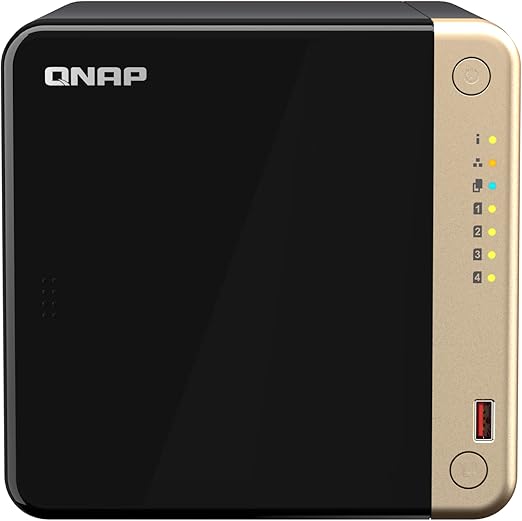 QNAP TS-464-8G
|
|
|---|---|---|
| None | $819-$999 (Scorptec / Mwave / PLE) | $999-$1,099 (Scorptec / PLE) |
| None | Intel Celeron J4125 (4-core, 2.0-2.7GHz) | Intel Celeron N5105 (4-core, 2.0-2.9GHz) |
| None | 2GB DDR4 (1 slot, max 6GB) | 8GB DDR4 (2 slots, max 16GB) |
| None | 4x SATA (hot-swap) | 4x SATA (hot-swap) |
| None | None | 2x M.2 NVMe PCIe Gen 3 |
| None | 1x 2.5GbE + 1x 1GbE | 2x 2.5GbE |
| None | None | 1x PCIe 3.0 x2 (10GbE card) |
| None | 2x USB 3.2 + 1x USB 2.0 | 3x USB 3.2 Gen 1 + 1x USB-C 3.2 Gen 2 |
| None | DSM 7.x | QTS 5.x |
| None | Hardware (Intel Quick Sync) | Hardware (Intel Quick Sync) |
| None | x86 (Container Manager) | x86 (Container Station) |
| None | ~20W | ~22W |
| None | 2 years (Dicker Data) | 2 years (Dicker Data) |
The CPU Difference
Both units use Intel Celeron processors, but not the same one. The DS425+ uses the J4125 (Gemini Lake Refresh, 10nm, up to 2.7GHz burst). The TS-464 uses the N5105 (Jasper Lake, 10nm SuperFin, up to 2.9GHz burst). In practice the N5105 is measurably faster in multi-threaded workloads. Roughly 15-25% better in benchmarks relevant to NAS tasks (file indexing, thumbnail generation, simultaneous user handling). For a home NAS serving 1-3 users, this difference is rarely felt. For a small office with 5-10 simultaneous connections or heavy Docker use, the TS-464’s N5105 has a genuine advantage.
The RAM Gap
This is the DS425+’s most significant hardware disadvantage. It ships with 2GB DDR4 and has a single SO-DIMM slot with a 6GB ceiling (2GB soldered + 4GB user-installed). The TS-464 ships with 8GB and has two slots for a 16GB maximum. For a NAS running purely as a file server, 2GB is workable with DSM’s light footprint. Add Plex, a few Docker containers, and active photo indexing, and 2-6GB becomes a real constraint. The TS-464’s 8GB base and 16GB ceiling give substantially more headroom for mixed workloads.
Networking. Where the TS-464 Pulls Ahead
The DS425+ has one 2.5GbE port and one 1GbE port. You can bond them for ~3.5Gbps aggregate throughput to a multi-link aggregation switch, or use the 2.5GbE for primary traffic and 1GbE for a backup path. The TS-464 has two 2.5GbE ports, allowing true 5Gbps link aggregation or a dedicated workstation connection at 2.5GbE while keeping network switch connectivity on the other port.
The bigger advantage is the TS-464’s PCIe 3.0 x2 slot. Add a QNAP QXG-10G1T card (~$150-$200 AU) and the TS-464 becomes a 10GbE NAS for under $1,200 total hardware cost. The DS425+ has no PCIe slot and no upgrade path beyond its onboard ports. For anyone with an existing 10GbE switch or planning to build toward one, the TS-464 is the only option between these two. See our 10GbE NAS networking guide Australia for what 10GbE actually delivers in practice.
M.2 NVMe Cache. TS-464 Only
The DS425+ has no M.2 slots. The TS-464 has two M.2 PCIe Gen 3 x1 slots for NVMe SSD cache. This is a meaningful differentiator for workloads with high random I/O. Databases, virtual machines, heavily-accessed file shares. For backup-only or sequential media streaming workloads, SSD cache provides minimal benefit. See our SSD cache Australia guide for a full breakdown of when caching helps.
Where the DS425+ Wins. DSM and Software
Despite the hardware gap, the DS425+ has a strong case built on software. DSM 7 is the best NAS operating system available by most measures. Cleaner interface, more reliable updates, better first-party apps, and a more predictable support lifecycle. Specifically:
- Synology Photos. Best-in-class NAS photo management, with face detection, AI object recognition, and family sharing that genuinely rivals Google Photos for private storage
- Synology Drive. A polished personal Dropbox replacement with desktop sync clients for Windows and macOS
- Hyper Backup. The most comprehensive backup solution in the NAS market, with deduplication, versioning, and cloud target support in a single app
- Active Backup for Business. Enterprise-grade agent-based backup for PCs and virtual machines, free on DSM
QNAP has equivalents for all of these (QuMagie, Qsync, Hybrid Backup Sync, Backup Station), but Synology’s implementations are more polished and better integrated. For a family or small business that primarily uses the NAS for file storage, backup, and photo management, the DS425+ with DSM delivers a better day-to-day experience.
Plex and Media Server
Both units support Plex hardware transcoding via Intel Quick Sync (both use Intel Celeron with integrated graphics). The TS-464’s N5105 is slightly faster than the DS425+’s J4125, but both can handle 1-2 simultaneous 1080p hardware transcode streams with Plex Pass. For a household Plex server with 1-2 remote clients that need transcoding, either unit is adequate. The TS-464’s 8GB base RAM is a more comfortable starting point for running Plex alongside other services. See our best NAS for Plex Australia guide for context on transcoding requirements.
Australian Pricing and Availability
The DS425+ shows more price variation than the TS-464 across AU retailers:~$989 at Scorptec, $899 at Mwave, $999 at PLE. The TS-464 is $999 at Scorptec and $1,099 at PLE. Checking Scorptec first for both units is worthwhile. It consistently offers the best pricing for Synology and QNAP in Australia. Both carry 2-year warranties via Dicker Data.
Who Should Buy the DS425+?
- Households and small offices prioritising photos, file sync, and backup
- Mac users wanting Time Machine, Synology Photos, and Drive integration
- Users who want the most polished, lowest-maintenance NAS experience
- Budget-conscious buyers where $180-$280 matters at the Scorptec price point
- Anyone already in the Synology ecosystem who wants consistency
Who Should Buy the TS-464?
- Home lab users running multiple Docker containers
- Anyone planning to add 10GbE via the PCIe slot
- Users who want or need NVMe SSD cache
- Power users who will use all 16GB of RAM headroom
- Households with 5+ simultaneous users where the N5105’s extra performance matters
Verdict
This is genuinely close at the Scorptec pricing: DS425+ at $819, TS-464 at $999. The $180 premium for the TS-464 buys you dual 2.5GbE, M.2 NVMe cache, a PCIe 10GbE upgrade slot, and 8GB base RAM versus 2GB. That’s a significant hardware step up for $180.
The DS425+ wins on software and simplicity. If you’re a Synology user who wants DSM’s ecosystem, Synology Photos, and Hyper Backup, the DS425+ delivers a better user experience than QTS for those workflows. The TS-464 wins on hardware flexibility. For the home lab, the power user, and anyone with a 10GbE switch already in the rack, the TS-464’s expandability justifies the premium. For a full overview of how all Synology 4-bay models stack up, see our best Synology NAS Australia guide.
See all 4-bay NAS options available in Australia with current AU pricing and use-case recommendations.
Best 4-Bay NAS AustraliaRelated reading: our NAS buyer's guide, our Synology brand guide, and our Synology vs QNAP comparison.
Our RAID Calculator shows usable capacity for both models' 4-bay configurations, and our NAS Power Cost Calculator compares annual running cost at your AU state electricity rate.
Use our free NAS Sizing Wizard to get a personalised NAS recommendation.
Is the Synology DS425+ or QNAP TS-464 better for Plex in Australia?
Both support Intel Quick Sync hardware transcoding for Plex. The TS-464’s N5105 is marginally faster than the DS425+’s J4125 and ships with 8GB RAM (vs 2GB), making it more comfortable for running Plex alongside other services. For a household Plex server with 1-2 simultaneous streams, either unit is adequate. For more demanding Plex setups, the TS-464’s 8GB base RAM and higher performance ceiling give it the edge.
Does the Synology DS425+ have a PCIe slot for 10GbE?
No. The DS425+ has no PCIe expansion slot. Its onboard networking is fixed at one 2.5GbE and one 1GbE port. The QNAP TS-464 has a PCIe 3.0 x2 slot that accepts a 10GbE network card (such as the QNAP QXG-10G1T, ~$150-$200 AU). If 10GbE is a requirement now or in the near future, the TS-464 is the only option between these two.
How much does the Synology DS425+ cost in Australia?
The Synology DS425+ (diskless) is $819 at Scorptec, $899 at Mwave, and $999 at PLE Computers. Scorptec is the best value for this model in Australia. It requires separate SATA hard drives. Four 4TB Seagate IronWolf drives add approximately $520, bringing the fully-equipped cost to around $1,340-$1,520.
How much does the QNAP TS-464 cost in Australia?
The QNAP TS-464-8G (8GB RAM, diskless) is $999 at Scorptec and $1,099 at PLE Computers. Adding four 4TB Seagate IronWolf drives (~$520) brings the fully-equipped total to approximately $1,519-$1,619. Check Scorptec first as it consistently offers the lowest QNAP pricing in Australia.
Which 4-bay NAS has better software. Synology DS425+ or QNAP TS-464?
Synology DS425+ with DSM 7 has better software for most users. Synology Photos, Hyper Backup, Synology Drive, and Active Backup for Business are all best-in-class first-party apps. QNAP’s QTS equivalents are functional but less polished and less cohesive. For power users who prefer QTS’s greater configurability, virtualisation depth, and Container Station, QTS is the better fit. For households and small businesses wanting low-maintenance, high-polish software, DSM wins.