QNAP and UGREEN are at opposite ends of the NAS risk spectrum: QNAP is a 25-year-old NAS specialist with mature QTS software, deep app ecosystem, and an established (if troubled) security track record; UGREEN entered NAS in 2024 with stronger hardware specs per dollar and software that is still developing. This comparison covers the software gap, the hardware value case for UGREEN, the security track record reality for both, and a direct verdict at each use case. Australian purchasing guidance, pricing, and warranty notes are in the AU section below.
For a broader overview of this topic, see our complete QNAP ecosystem guide.
In short: QNAP suits buyers who want proven NAS software (QTS or QuTS Hero with ZFS), deep Australian retail availability, and a clear warranty path through local distributors. UGREEN suits budget-conscious, technically confident buyers who prioritise hardware specs over software maturity and are comfortable managing warranty claims through international channels. If this is your first NAS or it is business-critical, go QNAP.
Why This Comparison Matters in 2026
UGREEN entered the NAS market in 2024 with the NASync range, immediately attracting attention for offering Intel N-series processors, generous RAM, and multi-bay configurations at prices that undercut established brands. For Australian buyers accustomed to paying a premium for NAS hardware, the value proposition is hard to ignore.
But a NAS is not a phone charger or a USB hub. It is a 24/7 appliance that holds your data, runs its own operating system, and needs ongoing software support and security patches. The hardware is only half the equation. Software maturity, ecosystem depth, and after-sales support are where NAS brands earn or lose trust over years of ownership. That is why comparing QNAP and UGREEN requires looking well beyond the spec sheet.
QNAP has been manufacturing NAS devices since 2004 and has deep roots in the Australian market through distributors like BlueChip and Dicker Data. UGREEN, by contrast, does not yet have an official Australian distributor. That single fact shapes the entire ownership experience for AU buyers.
The Product Lineups at a Glance
QNAP's Range
QNAP's catalogue is the largest of any consumer NAS vendor. Desktop models range from the entry-level 1-bay TS-133 through to the 6-bay TS-673A with AMD Ryzen, and the enterprise range extends into rackmount models with Xeon processors, 100GbE connectivity, and ZFS-based QuTS Hero. QNAP also manufactures its own network switches (QSW series), making it the only NAS vendor that can deliver a single-brand storage and networking solution. For a full breakdown of the QNAP range, see our best QNAP NAS guide.
UGREEN's NASync Range
UGREEN's NAS lineup is smaller and newer. The current range includes the DXP2800 (2-bay), DXP4800 and DXP4800 Plus (4-bay), DXP6800 Pro (6-bay), DXP8800 Plus (8-bay), and the compact DH2300 and DH4300 Plus. UGREEN also offers the DXP480T Plus as an all-flash model. For a deeper look at the UGREEN range, see our UGREEN NAS Australia guide.
Hardware Comparison: Where UGREEN Shines
On paper, UGREEN's hardware is impressive for the price. The DXP4800 Plus ships with an Intel N100 processor, 8GB DDR5 RAM, dual 2.5GbE ports, and four 3.5-inch bays plus two M.2 NVMe slots. QNAP's closest comparable model, the TS-464, offers a Celeron N5095, 8GB DDR4, dual 2.5GbE, four bays, and two M.2 slots. The UGREEN unit typically costs less while delivering DDR5 memory and a newer-generation processor.
4-Bay NAS Comparison: QNAP vs UGREEN
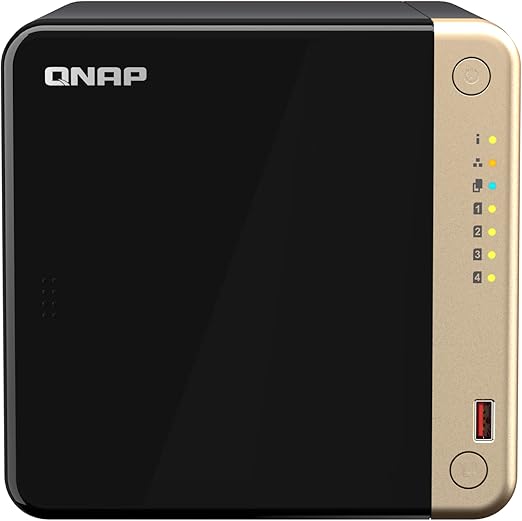 QNAP TS-464-8G
|
 QNAP TS-433-4G
|
 UGREEN DXP4800 Plus
|
|
|---|---|---|---|
| CPU | Intel Celeron N5095 (4-core) | ARM Cortex-A55 (4-core) | Intel N100 (4-core) |
| RAM | 8GB DDR4 (expandable) | 4GB DDR4 (not expandable) | 8GB DDR5 (not expandable) |
| Drive Bays | 4x 3.5" + 2x M.2 NVMe | 4x 3.5" | 4x 3.5" + 2x M.2 NVMe |
| Network | 2x 2.5GbE | 1x 2.5GbE | 2x 2.5GbE |
| HDMI Output | Yes (HDMI 2.0) | No | Yes (HDMI 2.0) |
| USB Ports | 2x USB 3.2, 1x USB 2.0 | 2x USB 3.2 | 2x USB 3.2, 1x USB 2.0 |
| AU Price (approx.) | $989 (Scorptec) | $639 (Scorptec) | ~$550-$650 (Amazon AU) |
| Operating System | QTS 5.x / QuTS Hero | QTS 5.x | UGOS |
| AU Warranty Path | Retailer > BlueChip > QNAP Taiwan | Retailer > BlueChip > QNAP Taiwan | Amazon AU / UGREEN direct |
Prices last verified: 10 March 2026. Always check retailer before purchasing.
UGREEN consistently delivers more raw hardware per dollar. The DXP4800 Plus undercuts the TS-464 by roughly$989-$1442 while offering a newer-generation CPU and DDR5 memory. If hardware specifications were the only factor, UGREEN would be the clear winner at the entry and mid-range price points.
However, QNAP's hardware advantage appears at the higher end. Models like the TS-473A with AMD Ryzen and 8GB RAM ($1,369-$1,489 at Scorptec/PLE), the 6-bay TS-664 ($1,549-$1,649), and the enterprise-grade TS-h973AX with 10GbE and 32GB RAM ($1,699 at PLE) have no direct UGREEN equivalents. QNAP's range extends into rackmount, Thunderbolt 4, and 25GbE/100GbE territory that UGREEN simply does not cover.
Software: QTS vs UGOS
This is where the comparison shifts dramatically in QNAP's favour. Software is what transforms NAS hardware into a functional, secure, and extensible storage platform, and QNAP has been refining its software for over 20 years.
QTS and QuTS Hero
QNAP offers two operating systems. QTS uses the ext4 file system and suits home users, prosumers, and general SMB use. It includes Qtier auto-tiering, SSD caching, a comprehensive App Center with hundreds of applications, Docker and virtualisation support, and mature backup tools including Hybrid Backup Sync for cloud and local targets.
QuTS Hero uses the ZFS file system, offering enterprise-grade data integrity with end-to-end checksums, self-healing of silent data corruption, inline deduplication and compression, RAID-TP (triple parity), WORM for compliance, and SnapSync for near-real-time disaster recovery. QuTS Hero needs at least 8GB RAM to install and performs best with 16GB or more. It is a genuine enterprise storage OS running on NAS-priced hardware.
QTS uses ext4 and works well for most users. QuTS Hero uses ZFS for enterprise-grade data integrity, deduplication, and self-healing, but it needs 16GB+ RAM to take full advantage of those features. Do not install QuTS Hero on a 4GB NAS and expect good results.
UGOS (UGREEN OS)
UGREEN's UGOS is a custom Linux-based operating system that launched alongside the NASync hardware. It covers the basics: file sharing (SMB, NFS, AFP), RAID configuration, user management, and a web-based interface. UGREEN has been adding features through regular updates, including Docker support and improved mobile apps.
However, UGOS is still in its early stages compared to QTS. The app ecosystem is minimal. Backup tools are basic. There is no equivalent to QNAP's Hybrid Backup Sync, no surveillance station alternative, no virtualisation platform, and no ZFS option. Third-party app support is growing but limited. For users who want a NAS that does more than store files, this is a significant gap.
Pros
- Clean, modern interface that is easy to navigate for beginners
- Docker support enables running third-party applications
- Regular update cadence suggests active development commitment
- Mobile app is functional for basic file access and management
Cons
- Limited native app ecosystem compared to QTS App Center
- No ZFS option, no advanced data integrity features
- No built-in surveillance station or virtualisation platform
- Backup tools are basic compared to Hybrid Backup Sync
- Software maturity is measured in months, not decades
Australian Availability and Pricing
This is the most important practical difference for Australian buyers. QNAP is stocked by every major AU NAS retailer. UGREEN NAS devices are primarily available through Amazon AU and UGREEN's own website, with no presence at specialist retailers like Scorptec, PLE, or Mwave.
QNAP AU Pricing (February 2026)
| TS-233 (2-bay, ARM, 2GB) | $399 (PLE, Scorptec) |
|---|---|
| TS-216G (2-bay, ARM, 4GB, 2x 2.5GbE) | $469-$499 (Scorptec/PLE) |
| TS-264-8G (2-bay, Celeron, 8GB, 2x 2.5GbE) | $819-$949 (PLE/Scorptec) |
| TS-433-4G (4-bay, ARM, 4GB, 2.5GbE) | $649-$699 (Scorptec/PLE) |
| TS-464-8G (4-bay, Celeron, 8GB, 2x 2.5GbE) | $999-$1,099 (Scorptec/PLE) |
| TS-473A-8G (4-bay, Ryzen, 8GB, 2.5GbE) | $1,369-$1,489 (Scorptec/PLE) |
| TS-664-8G (6-bay, Celeron, 8GB, 2x 2.5GbE) | $1,549-$1,649 (Scorptec/PLE) |
| TS-673A-8G (6-bay, Ryzen, 8GB, 2x 2.5GbE) | $1,699 (PLE) |
QNAP pricing has increased nearly 100% since 2020-2021. If you are replacing an older QNAP NAS, expect the current equivalent to cost roughly double what you originally paid. Global chip and RAM shortages in 2025-2026 have compounded the issue, with some models sitting 3-6 months behind on production schedules.
UGREEN AU Pricing (February 2026)
UGREEN NAS pricing in Australia is difficult to pin down because there is no official AU distributor and no consistent local retail presence. Prices on Amazon AU fluctuate and UGREEN's direct store ships internationally. As of February 2026, approximate Amazon AU pricing for UGREEN NASync models (when available) ranges from around $400-$500 for the DXP2800 (2-bay) to $900-$1,200 for the DXP6800 Pro (6-bay). The DXP4800 Plus (4-bay) typically lists around $550-$650 on Amazon AU.
These prices undercut QNAP by a significant margin for equivalent bay counts and similar hardware. But the price gap narrows when you factor in what you are not getting: local distribution, local warranty chains, and decades of software development.
Warranty and Support in Australia
This section matters more than specs or price for anyone buying a NAS to store important data. In Australia, your warranty claim goes to the retailer, not the manufacturer. Neither QNAP nor UGREEN has a service centre in Australia. The difference is what happens behind the scenes after you lodge that claim.
QNAP Warranty Chain
When you buy a QNAP NAS from a specialist retailer like Scorptec or PLE, the warranty chain runs: retailer to distributor (BlueChip or Dicker Data) to QNAP in Taiwan, then back again. BlueChip holds the deepest NAS stock in Australia and has been QNAP's anchor through a period of significant vendor leadership changes. This established chain means replacements can typically be sourced within 2-3 weeks, and in many cases faster if the distributor holds stock.
QNAP NAS devices carry a standard 2-year warranty, extendable to 5 years on most models. Technical support is online-only via QNAP's ticket system. Some users have reported success calling QNAP's US office, though this is not an official support channel for Australian buyers.
UGREEN Warranty Chain
UGREEN does not yet have an official Australian distributor, which means warranty claims currently go through international channels. If you buy from Amazon AU, Amazon's own return and refund process applies. Amazon is excellent for refunds but poor for replacements: if Amazon does not have stock, they default to issuing a credit rather than sourcing a like-for-like replacement. You may end up with a refund but no NAS, needing to source a replacement yourself and migrate your drives without assistance.
If you buy from UGREEN's own store, warranty claims go through UGREEN's international support team. Turnaround times are less predictable, and there is no local distributor to escalate through. For a device that holds your data and runs 24/7, this is a meaningful risk to weigh against any price saving.
Australian Consumer Law note: ACL protections apply when purchasing from Australian retailers, including Amazon AU. However, ACL protects the hardware purchase, not your data. If your NAS fails during a warranty dispute, the data is at risk. Always maintain offsite backups regardless of which brand you choose. For official information on your consumer rights, visit accc.gov.au.
Feature Depth: Where QNAP Pulls Ahead
Beyond the core file storage function, QNAP offers a level of ecosystem depth that UGREEN cannot match at this stage of its NAS journey.
App Ecosystem
QNAP's App Center includes hundreds of first-party and third-party applications. Surveillance Station supports IP camera recording with included camera licences. Virtualisation Station runs full virtual machines. Container Station provides Docker and LXC container management. QuMagie offers AI-powered photo management. Hybrid Backup Sync handles cloud, local, and remote backup destinations. These are not third-party add-ons; they are integrated, supported features of the QTS platform.
UGOS has Docker support, which opens the door to running many of the same services through containers. But containerised solutions require more technical knowledge to set up, maintain, and troubleshoot than native applications. For users comfortable with Docker, this is workable. For everyone else, QNAP's native apps are significantly easier to deploy and manage.
Networking and Connectivity
QNAP's product range includes models with 10GbE, 25GbE, Thunderbolt 4, and SFP+ connectivity built in. The TS-h973AX ships with 10GbE out of the box for $1,699 at PLE. For users who need high-speed transfers for video editing or large dataset work, QNAP has options that UGREEN does not.
Additionally, QNAP's QSW network switches let you build a complete high-speed storage and networking solution from a single vendor. A 5-port 10GbE QSW switch for a few hundred dollars lets you connect your NAS, workstation, and backup target at 10 Gigabit speeds without buying a $2,000 enterprise switch. No other NAS vendor offers this. For more on NAS networking, see our NAS networking guide.
Remote Access and NBN Considerations
Both QNAP and UGREEN offer remote access solutions. QNAP provides myQNAPcloud for relay-based access and supports VPN server configuration (OpenVPN, WireGuard) directly on the NAS. UGREEN offers its own cloud relay service for remote access through UGOS.
For Australian users on NBN, remote access performance is limited by upload speeds. A typical NBN 100 plan delivers roughly 20-40 Mbps upload (with some plans now offering up to 40 Mbps on certain RSPs). CGNAT on some NBN connections blocks direct remote access entirely, making relay services or a VPN through a third-party service essential. QNAP's broader VPN and networking options give more flexibility to work around these limitations. For a detailed guide, see our NAS remote access and VPN guide.
Security Track Record
QNAP has had several high-profile security incidents, including ransomware attacks targeting NAS devices exposed to the internet. These incidents were concerning but should not be a reason to avoid the brand entirely. Any NAS exposed to the internet is a potential target regardless of brand. QNAP responded with improved security features, snapshot-based recovery tools, and was eventually able to unlock affected customers' data free of charge in many cases.
UGREEN's NAS platform is newer and has not yet faced the same level of scrutiny from the security research community. This is not necessarily a positive: it may simply mean that vulnerabilities have not been found yet, or that the platform is not yet widely deployed enough to attract targeted attacks. A newer platform with a smaller security research community can be a risk in itself. For best practices on securing any NAS, see our NAS security and ransomware protection guide.
Who Should Buy QNAP
QNAP is the better choice for buyers who fit any of the following profiles:
Business and production environments. The established warranty chain through BlueChip and Dicker Data, combined with QTS/QuTS Hero's enterprise features, make QNAP the lower-risk choice for any deployment where downtime costs money. QuTS Hero's ZFS, WORM compliance, and SnapSync provide genuine enterprise storage capabilities at NAS prices.
Users with specific connectivity needs. Thunderbolt 4 for video editing, 10GbE or 25GbE for high-speed network storage, SFP+ for fibre connections. IT providers often default to Synology for general SMB deployments and bring QNAP into the conversation when a client has a specific requirement. That pattern tells you exactly where QNAP fits.
First-time NAS buyers who want local support. Buying from a specialist retailer like Scorptec or PLE means you can get genuine pre-sales guidance and have a clear post-sales warranty path. With UGREEN, you are largely on your own. For beginners, see our best NAS for beginners guide.
Users who need a mature app ecosystem. Surveillance, virtualisation, comprehensive backup tools, photo management, media serving. If your NAS needs to do more than store files, QNAP's software depth is a significant advantage.
Who Should Buy UGREEN
UGREEN is worth considering for buyers who fit this profile:
Technically confident users on a budget. If you are comfortable with Docker, can troubleshoot Linux-based systems, and primarily need network-attached storage with good hardware specs at a low price, UGREEN delivers strong value. The DXP4800 Plus gives you Intel N100, 8GB DDR5, and four bays for significantly less than a QNAP TS-464.
Secondary or non-critical NAS deployments. As a 3-2-1 backup target, a media server, or a home file store where the data also exists elsewhere, the support trade-offs matter less. If the NAS goes down and you can wait a few weeks for resolution, the price saving makes sense.
Buyers who want modern hardware at the lowest entry point. The UGREEN DXP2800 (2-bay) and DH2300 offer NAS functionality at price points below most QNAP models. For simple home use cases like backing up phones, sharing files on the local network, and running a Plex server via Docker, UGREEN hardware is more than capable.
Don't buy UGREEN if: This is your only copy of important data, you need guaranteed local warranty support, or this is a business-critical deployment. The hardware is good, but the support infrastructure in Australia is not yet established. Wait until UGREEN has an official AU distributor before relying on it for anything you cannot afford to lose.
Head-to-Head Comparison Summary
QNAP vs UGREEN NAS: Full Comparison
| QNAP | UGREEN | |
|---|---|---|
| Years in NAS Market | 20+ years (since 2004) | ~2 years (since 2024) |
| AU Distribution | BlueChip, Dicker Data | No official AU distributor |
| AU Retail Availability | Scorptec, PLE, Mwave, DeviceDeal, others | Amazon AU, UGREEN direct |
| Operating System | QTS (ext4) / QuTS Hero (ZFS) | UGOS (Linux-based) |
| App Ecosystem | Extensive (hundreds of apps) | Basic (Docker-dependent) |
| Docker Support | Yes (Container Station) | Yes |
| Virtualisation | Yes (Virtualisation Station) | No |
| Surveillance Station | Yes (with free camera licences) | No |
| ZFS / Advanced Data Integrity | Yes (QuTS Hero) | No |
| 10GbE / Thunderbolt Models | Yes (multiple models) | No |
| Network Switch Range | Yes (QSW series) | No |
| Warranty (Standard) | 2 years (extendable to 5) | 2 years |
| AU Warranty Chain | Established (retailer > distributor > vendor) | International channels only |
| Hardware Value (price per spec) | Moderate to premium | Strong (undercuts QNAP by 30-40%) |
| Best For | Business, technical users, full-featured NAS | Budget-conscious, technically confident home users |
🇦🇺 Australian Buyers: Where to Buy and What to Watch For
Most Australian retailers operate on 3-5% NAS margin, which is why QNAP pricing is remarkably uniform across the major stores. The real difference between retailers is what happens when something goes wrong. If you are buying a QNAP NAS, buy from a specialist retailer like Scorptec or PLE where you can get genuine pre-sales guidance and have a clear warranty escalation path. For business purchases, always request a formal quote: resellers can request pricing support from distributors and vendors, and discounts that never appear on the website are routinely available for quoted deals.
If you are buying UGREEN, Amazon AU is the most practical channel for Australian buyers. Amazon's return policy is excellent, but if your NAS fails and you need a direct replacement, they may not have stock. They will push to give you a credit and leave you to find an alternative yourself. Go in with eyes open about this trade-off.
Regardless of brand, a NAS is not a backup. Plan for hardware failure, plan for a 2-3 week replacement window, and build your data protection strategy around the assumption that your NAS will eventually fail. A 3-2-1 backup strategy is essential, not optional.
For more brand comparisons, see our Synology vs QNAP, Synology vs UGREEN, and QNAP vs Asustor comparisons. For a broad overview of the best NAS options available in Australia, see our best NAS Australia guide.
Use our free NAS Sizing Wizard to get a personalised NAS recommendation.
Is UGREEN NAS reliable enough to use as a primary NAS in Australia?
The hardware is well-built and uses quality components. The concern is not reliability of the hardware itself but the software maturity and support infrastructure. UGOS is still young, and without an official Australian distributor, warranty claims go through international channels. For a secondary NAS or a non-critical home deployment, UGREEN is a reasonable choice. For a primary or business-critical NAS, QNAP or Synology offer lower risk due to their established AU distribution and mature software platforms.
Can I run Plex, Docker, and other apps on a UGREEN NAS?
Yes. UGOS supports Docker, which means you can run Plex, Home Assistant, Nextcloud, and many other containerised applications. However, you will need to set up and manage these through Docker rather than through native apps. QNAP's QTS includes native apps for many of these functions (Plex is available in the App Center, and Container Station provides a GUI for Docker), which is easier for less technical users. For Plex specifically, see our best NAS for Plex guide.
Is QNAP's past ransomware history a reason to avoid the brand?
No. Any NAS exposed directly to the internet is a potential target, regardless of brand. QNAP's incidents prompted improved security features, and the brand now offers robust snapshot-based recovery tools. The right response is proper security practices: use a VPN for remote access, disable UPnP, keep firmware updated, use strong credentials, and never expose NAS management ports directly to the internet. See our NAS security guide for detailed recommendations.
Where can I buy QNAP and UGREEN NAS in Australia?
QNAP is stocked by all major Australian IT retailers including Scorptec, PLE, Mwave, DeviceDeal, Centre Com, and specialist stores like QNAP Shop and NAS Marketplace. UGREEN NAS devices are primarily available through Amazon AU and UGREEN's own online store. UGREEN does not yet have an official Australian distributor, so you will not find their NAS products at traditional IT retailers. For a full guide on where to buy, see our where to buy NAS in Australia guide.
Will UGREEN NAS get better over time with software updates?
Likely yes. UGREEN has shown a strong update cadence for UGOS and appears committed to developing the platform. The question is how long it will take for UGOS to reach the maturity of QTS, which has had over 20 years of development. If you buy UGREEN today, you are betting on the platform's future rather than its current state. That is a reasonable bet for a budget home NAS but not a wise bet for a business deployment where you need proven features today.
Should I wait for UGREEN to get an Australian distributor before buying?
If warranty support and local availability matter to you, yes. An official Australian distributor would mean UGREEN NAS devices appear at specialist retailers, warranty claims flow through established channels, and pricing becomes more predictable. UGREEN is expected to establish AU distribution in 2026, but until that happens, buying UGREEN NAS in Australia means accepting the trade-offs of purchasing through Amazon AU or internationally.
What about QNAP vs UGREEN for home surveillance and security cameras?
QNAP is the clear choice here. QTS includes Surveillance Station with free camera licences (typically 2 included, more available for purchase). This provides a complete NVR solution with motion detection, recording schedules, and mobile viewing. UGREEN has no equivalent native surveillance feature. You could run a containerised surveillance solution on UGREEN via Docker, but it requires significantly more setup and maintenance. For surveillance use cases, see our best NAS for surveillance guide.
Explore the full QNAP range available in Australia, with real AU pricing and model-by-model recommendations.
Read Best QNAP NAS Guide