Most NAS devices produce 20-35 dB(A) of noise in normal operation. Roughly the volume of a whisper to a quiet library. But the hard drives inside them are often louder than the NAS itself. Where you place your NAS matters more than most buyers realise. A poorly placed NAS can overheat in an Australian summer, vibrate through a desk, or hum loudly enough to disrupt a home office. The good news is that with a few practical decisions about location, ventilation, and cable routing, you can run a NAS that you barely notice is there. This guide covers real-world noise levels for popular Synology, QNAP, and Asustor models, explains the difference between fan noise and drive noise, walks through the best and worst placement options in typical Australian homes, and addresses the unique challenge of keeping electronics cool when outside temperatures hit 40°C+.
In short: A 2-bay NAS with modern drives produces roughly 20-28 dB(A). Barely audible from across a room. A 4-bay unit with spinning HDDs is louder at 28-35 dB(A), mainly due to drive seek noise. For most people, the best placement is a well-ventilated cupboard or shelf in a home office, connected via Ethernet. Avoid garages and non-insulated spaces in Australian summers. Ambient temperatures above 35°C push drives into dangerous territory. If you need a silent NAS, consider a 2-bay unit with SSDs or place a standard NAS in another room with a long Ethernet run.
Understanding NAS Noise: What Actually Makes the Sound
NAS noise comes from two distinct sources, and understanding the difference is key to managing it. The first source is the cooling fan(s) inside the NAS enclosure. The second. And usually louder. Source is the hard drives themselves.
Fan Noise
Every NAS has at least one cooling fan, typically 80mm or 92mm on desktop models. These fans run at variable speeds controlled by the NAS operating system based on internal temperature. At idle or light load, fan noise is minimal. Often below 20 dB(A), which is quieter than a bedroom at night. Under sustained load (large file transfers, Plex transcoding, RAID rebuilds), fan speed increases and noise rises to 25-32 dB(A). Synology and QNAP both offer fan speed controls in their software. You can set fans to "quiet mode" at the cost of slightly higher internal temperatures, or "full speed" for maximum cooling during intensive tasks like Plex transcoding which generates significant heat.
Hard Drive Noise
This is the noise source most people underestimate. A NAS-grade 3.5" hard drive like the Seagate IronWolf or WD Red Plus produces two types of noise: a constant low hum from the spinning platters (typically 20-25 dB(A) idle), and intermittent clicking or chattering from the read/write head seeking across the platters (28-34 dB(A) during active use). Multiply that by 2 or 4 drives in a NAS, and drive noise becomes the dominant sound. Enterprise drives like the Seagate Exos or WD Ultrastar are noticeably louder again. They are built for performance in server rooms, not silence in living rooms. For a detailed look at drive characteristics, see our best NAS hard drives guide.
Tip: If you want a near-silent NAS, 2.5" SSDs eliminate all mechanical noise. The only sound will be the cooling fan at low speed. The trade-off is cost per terabyte. SSDs are significantly more expensive than HDDs for bulk storage. A middle ground is using SSDs for cache (NVMe in M.2 slots) while keeping HDDs for main storage, which reduces how often the drives need to seek.
NAS Noise Levels by Model
Manufacturers publish noise levels in their specifications, but these are measured under controlled conditions (typically idle, in an anechoic chamber). Real-world noise with drives installed is always higher. The table below shows manufacturer-stated levels alongside typical real-world expectations with NAS-grade HDDs installed.
NAS Noise Levels. Popular Models (Desktop)
 Synology DS225+
|
 Synology DS423
|
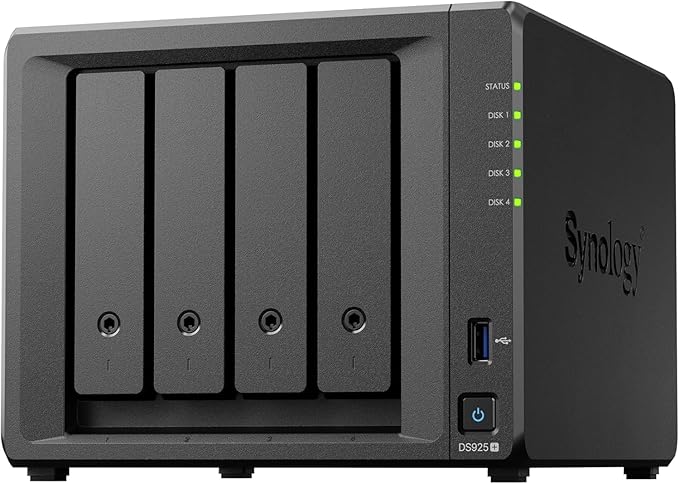 Synology DS925+
|
 QNAP TS-233
|
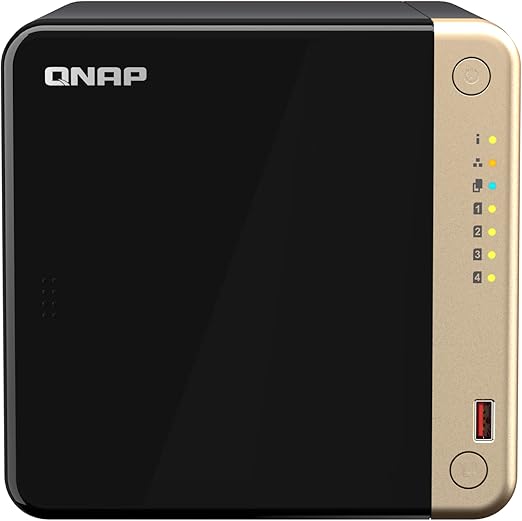 QNAP TS-464
|
 Asustor AS5402T
|
|
|---|---|---|---|---|---|---|
| Bays | 2 | 4 | 4 + 1 NVMe | 2 | 4 + 2 NVMe | 2 + 2 NVMe |
| Stated Noise (Idle) | 20.6 dB(A) | 22.9 dB(A) | 22.8 dB(A) | 16.5 dB(A) | 19.7 dB(A) | 18.8 dB(A) |
| Real-World (HDDs, Idle) | ~24-26 dB(A) | ~27-30 dB(A) | ~27-30 dB(A) | ~22-25 dB(A) | ~27-30 dB(A) | ~23-26 dB(A) |
| Real-World (HDDs, Active) | ~28-32 dB(A) | ~32-36 dB(A) | ~32-36 dB(A) | ~27-30 dB(A) | ~32-36 dB(A) | ~28-32 dB(A) |
| Fan Size | 1×92mm | 2×92mm | 2×92mm | 1×80mm | 1×92mm | 1×80mm |
| Fan Speed Control | Yes (DSM) | Yes (DSM) | Yes (DSM) | Yes (QTS) | Yes (QTS) | Yes (ADM) |
A few patterns emerge from these numbers. Two-bay units are consistently quieter than four-bay models. Fewer drives means less aggregate noise and often smaller or fewer fans. Synology models tend to have slightly higher stated noise than QNAP equivalents on paper, but real-world differences are negligible once drives are installed. The drives dominate. If you are choosing between models purely for noise, the bay count matters more than the brand. Our best 2-bay NAS guide covers the quietest options for noise-sensitive environments.
Noise in Context: What dB(A) Actually Means
Decibel numbers are meaningless without context, so here is a practical reference:
- 10 dB(A): Breathing, virtually silent
- 20 dB(A): Rustling leaves, empty quiet room
- 25 dB(A): Whisper at 1 metre
- 30 dB(A): Quiet library, very soft background hum
- 35 dB(A): Quiet home office with no other noise sources
- 40 dB(A): Refrigerator hum, quiet residential street
- 50 dB(A): Moderate rainfall, normal conversation
Most NAS devices sit in the 20-35 dB(A) range, which means they are audible in a silent room but easily masked by everyday background noise. Air conditioning, a television, traffic, or even an open window. In a bedroom at night with nothing else running, a 4-bay NAS with active drives is noticeable. In a home office during the day, it blends into the background.
Where to Put Your NAS: Placement Options Ranked
The ideal NAS location balances four factors: noise isolation (can you hear it?), temperature (will it overheat?), network connectivity (can you run Ethernet?), and accessibility (can you reach it for drive swaps and maintenance?). Here is how common Australian home placements stack up.
Home Office or Study. Most Common
The most popular NAS placement and often the best compromise. Your router is usually nearby, making Ethernet easy. Temperature is controlled by household air conditioning or a ceiling fan. You can reach the NAS for maintenance without getting off your chair. The downside is noise. If you work in silence, a 4-bay NAS with active drives is audible. A 2-bay unit or SSD-equipped NAS is much less intrusive. Place the NAS on a shelf rather than directly on your desk to reduce transmitted vibration.
Hallway Cupboard or Linen Closet. Best for Noise
Tucking the NAS into a cupboard in the hallway is the sweet spot for many Australian homes. The closed door eliminates most audible noise. However, ventilation is critical. A sealed cupboard will trap heat. Leave the door slightly ajar, install a small USB-powered vent fan, or choose a cupboard with louvred doors. Internal cupboard temperatures can climb 5-10°C above room temperature in summer without airflow. You will need to run an Ethernet cable from your router to the cupboard. See the networking section below, or our NAS networking guide for detailed cable routing advice.
Under the Stairs. Good Option If Available
Two-storey Australian homes sometimes have usable space under the staircase. This location offers decent noise isolation and more airflow than a cupboard. Temperature is typically stable since it is an interior space. The challenge is running Ethernet and power to what is often an awkward, unrenovated area. If you already have a network cabinet or patch panel under the stairs, this is an excellent NAS location.
Garage. Risky in Australia
This is where the Australian climate becomes a real factor. A typical attached garage in Sydney, Melbourne, or Brisbane can hit 45-55°C in summer. Well beyond the operating limits of any NAS and its drives. Most NAS devices are rated for 0-40°C ambient operating temperature. Hard drives have a similar range, with optimal performance between 25-45°C. A garage that regularly exceeds 40°C will shorten drive lifespan, cause thermal throttling, and potentially trigger the NAS to shut down for self-protection.
Warning: Do not place your NAS in an Australian garage unless the space is insulated and climate-controlled. Ambient temperatures above 40°C are common in uninsulated garages during summer across most of the country. Hard drive manufacturers void warranties for drives operated outside their rated temperature range. A failed drive caused by heat damage is not covered.
Laundry. Decent If Ventilated
The laundry is a common placement in Australian homes because it is separated from living areas and often has a hard floor (reducing vibration transfer). Two concerns: humidity from washing and drying, and dust from lint. Place the NAS on a shelf well above the washing machine. Never on top of it, as vibration from a spin cycle can damage hard drives. Ensure the room has some ventilation, either through a window or exhaust fan. If you run a dryer without external venting, humidity levels will spike during drying cycles, which is not ideal for electronics. A laundry with a vented dryer and a window is a perfectly serviceable NAS location.
Bedroom. Not Recommended
A NAS with spinning hard drives in a bedroom is a bad idea if you are a light sleeper. At 2am with no other noise, a 4-bay NAS running a backup or RAID scrub is clearly audible. The intermittent clicking of drive heads seeking is particularly disruptive because it is irregular. Even a 2-bay NAS produces enough low-frequency hum from spinning platters to bother some people. If the bedroom is your only option, schedule intensive tasks (backups, scrubs, antivirus scans) for daytime hours through your NAS operating system, and set the drives to hibernate after a period of inactivity.
Placement Quick Reference
NAS Placement Options for Australian Homes
| Home Office | Hallway Cupboard | Under Stairs | Garage | Laundry | Bedroom | |
|---|---|---|---|---|---|---|
| Noise Isolation | Low | High | High | High | Medium | Very Low |
| Temperature Risk | Low | Medium | Low | Very High | Medium | Low |
| Ethernet Access | Easy | Run required | Run required | Long run | Run required | Easy |
| Accessibility | Excellent | Good | Fair | Fair | Good | Excellent |
| AU Summer Suitability | Good | Good* | Good | Poor | Fair | Good |
| Overall Rating | Recommended | Recommended | Good | Avoid | Acceptable | Avoid |
* Cupboard placement requires deliberate ventilation to avoid heat build-up, particularly during Australian summers when household ambient temperatures are already elevated.
Temperature and Ventilation: The Australian Summer Factor
Australia presents a unique challenge for NAS placement that guides written for North American or European audiences simply do not address. When outside temperatures hit 40°C+. A regular occurrence in Sydney, Melbourne, Adelaide, Perth, and most of regional Australia. Indoor temperatures in non-air-conditioned spaces can easily reach 35-40°C. Add a NAS generating its own heat inside an enclosed space, and you quickly exceed safe operating limits.
Safe Operating Temperatures
These are the temperature ranges you need to stay within:
- NAS enclosure: Most desktop NAS devices are rated for 0-40°C ambient. This means the air temperature around the NAS, not inside it. Internal temperatures will be 5-15°C higher than ambient.
- Hard drives: NAS-grade HDDs like the Seagate IronWolf and WD Red Plus are rated for 0-60°C operating temperature, but optimal drive temperature is 25-45°C. Drives consistently running above 45°C have measurably shorter lifespans. Google's famous datacenter study found that drive failure rates increase significantly above 45°C.
- SSDs: NAND flash is less temperature-sensitive than HDDs during operation, but sustained high temperatures accelerate wear on the flash cells. Keep NVMe SSD temperatures below 70°C under load.
Australian summer reality: If your home regularly hits 35°C indoors without air conditioning during a heatwave, and your NAS is in a cupboard adding another 5-10°C, your drives could be running at 45-50°C. That is beyond the optimal range and into territory that accelerates wear. Either air-condition the space, improve ventilation, or move the NAS to a cooler location during extreme heat events. Monitoring drive temperatures through your NAS software (DSM, QTS, or ADM all show drive temps) is essential during summer.
Ventilation Tips for Enclosed Spaces
If you are placing your NAS in a cupboard, cabinet, or any enclosed space, follow these ventilation principles:
- Airflow path: The NAS needs cool air in and a way for hot air to escape. Front intake, rear exhaust is the standard NAS airflow design. Position the NAS so its rear exhaust is not pressed against a wall. Leave at least 10-15cm of clearance behind the unit.
- Door ventilation: A fully sealed cupboard with a closed door traps heat. Louvred doors are ideal. If your cupboard has a solid door, leave it slightly ajar or install a passive vent panel.
- Active ventilation: A small 120mm USB fan (powered by the NAS USB port or a separate USB charger) placed to exhaust hot air from the top of the cupboard makes a significant difference. These fans cost $15-30 and are near-silent at low speed.
- Avoid stacking: Do not place your NAS on top of your router, modem, or other electronics. Each device generates heat, and stacking compounds the problem.
- Shelf placement: Heat rises. If your cupboard has multiple shelves, place the NAS on a lower shelf where cooler air settles, with the top of the cupboard acting as a heat exhaust path.
Power Consumption and Heat
A NAS that draws more power generates more heat. A 2-bay unit drawing 15-20W produces far less heat than a 4-bay unit drawing 30-40W under load. If heat management is a concern in your placement location, a smaller NAS is a practical advantage beyond just the electricity cost savings. Every watt of power consumed becomes a watt of heat that needs to be dissipated. In a well-ventilated room this is trivial. In a sealed cupboard in a 38°C house, it matters.
Connecting a Remote NAS: Ethernet vs WiFi
If you move your NAS out of the room where your router lives, you need to get network connectivity to it. You have two practical options: run an Ethernet cable or rely on WiFi. The answer is straightforward. always use Ethernet if possible.
Why Ethernet Is the Right Choice
A NAS is a storage server. It handles continuous data transfers. File serving, backups, media streaming, cloud sync. These are sustained, bandwidth-heavy workloads that benefit from the consistency and low latency of a wired connection. Gigabit Ethernet delivers a reliable ~110 MB/s, while WiFi 6 in real-world home conditions typically delivers 30-70 MB/s with variable latency and occasional dropouts. For remote access via VPN, a stable wired connection to the NAS ensures consistent performance even when clients connect over variable internet links. Keep in mind that NBN upload speeds are typically limited to 20-50 Mbps depending on your plan, so remote access performance is bottlenecked by your internet connection rather than your LAN. But a wired NAS still provides the most reliable foundation. Note that some NBN connections use CGNAT, which can complicate remote access setups.
Ethernet also does not compete with your other WiFi devices. Every WiFi device on your network shares the same radio spectrum. Adding a NAS to WiFi means your file transfers compete with phones, tablets, laptops, smart home devices, and streaming boxes for airtime. A wired NAS stays off the WiFi entirely.
Running Ethernet in an Australian Home
Many Australian homes. Particularly single-storey builds which dominate the housing stock. Were not built with structured Ethernet cabling. Running a cable from your router to a cupboard or laundry typically involves one of these approaches:
- Along skirting boards: The simplest method. Run a flat Cat6 Ethernet cable along skirting boards and under carpet edges. Flat cables are 1-2mm thick and nearly invisible when tucked against the wall. No tools required.
- Through the roof space: If you have ceiling access (most single-storey Australian homes have a roof cavity accessible via a manhole), running Ethernet through the ceiling is the cleanest long-term solution. Drop cables down through wall cavities to Ethernet wall plates. This is a common electrician job in Australia. Expect $100-200 per run including the wall plate.
- Through internal walls: For adjacent rooms, a single hole through an internal wall with a cable passed through is quick and effective. Seal around the cable with gap filler for a neat finish.
- Powerline adapters: If running a cable is genuinely impossible, powerline Ethernet adapters send network signals through your home electrical wiring. Performance varies hugely depending on the age and quality of your wiring. Expect 50-300 Mbps in practice. Acceptable for basic NAS access but not recommended for heavy file transfers or media streaming.
For a comprehensive guide to NAS network setup including 2.5GbE upgrades, switch selection, and cable types, see our NAS networking guide.
Tip: Buy Cat6 cable, not Cat5e. The price difference is negligible, and Cat6 supports 10 Gigabit Ethernet at shorter distances (up to 55m), future-proofing your installation for when you upgrade to a 2.5GbE or 10GbE NAS. For runs under 30m inside a home, Cat6 is more than sufficient for any current or near-future NAS networking standard.
When WiFi Is Your Only Option
Most consumer NAS devices do not have built-in WiFi. They are designed for wired connections. If Ethernet is genuinely impossible, you can connect a NAS to WiFi using a WiFi bridge (a WiFi access point or mesh node configured in bridge/client mode, connected to the NAS via Ethernet). This gives the NAS a WiFi backhaul to your router. Performance will be limited by your WiFi conditions, but for light use. Occasional file access, overnight backups, basic media streaming. It works. Do not expect reliable 4K Plex streaming or fast large file transfers over a WiFi bridge.
Vibration: The Overlooked Noise Factor
A NAS with spinning hard drives vibrates. It is a subtle, low-frequency vibration caused by the drives' motors and spinning platters, and it can be surprisingly annoying when transmitted through a desk or shelf. The vibration itself is also a risk factor for the drives. Hard drive manufacturers specify vibration tolerance limits, and drives in a multi-bay NAS can actually interfere with each other through transmitted vibration (a phenomenon called "acoustic vibration" in datacenter contexts).
Practical Vibration Dampening
These simple measures reduce transmitted vibration significantly:
- Rubber or silicone feet: Most NAS devices come with rubber feet. If they have been removed or compressed flat over time, replace them. Aftermarket silicone anti-vibration pads ($5-15 from electronics retailers or Amazon AU) make a noticeable difference on hard surfaces.
- Mouse pad or foam mat: Placing the NAS on a thick mouse pad, rubber mat, or a square of acoustic foam absorbs vibration before it reaches the shelf or desk. This is the cheapest and most effective dampening method.
- Avoid hollow furniture: A NAS sitting directly on a hollow IKEA desk acts like a speaker box. The hollow cavity amplifies vibration into audible hum. Place the NAS on something solid, or add a dampening layer underneath.
- Do not wall-mount without dampening: Wall-mounting a NAS (using a shelf bracket) can transmit vibration directly into the wall structure, which then resonates through the room. Use a rubber-mounted shelf or place dampening material between the NAS and the mount surface.
- Drive selection matters: NAS-rated drives like the Seagate IronWolf include rotational vibration (RV) sensors that detect and compensate for vibration in multi-bay enclosures. Desktop drives without RV sensors perform worse and can experience higher error rates when mounted alongside other spinning drives. This is one of the reasons NAS-grade drives are worth the premium over standard desktop drives.
Quietest NAS Options for Noise-Sensitive Environments
If keeping noise to an absolute minimum is your priority. Whether for a bedroom, recording studio, or open-plan living area. Here are the practical approaches ranked from quietest to acceptable:
1. 2-bay NAS with 2.5" SSDs: Near-silent. No spinning platters, no drive seek noise. The only sound is the cooling fan at low speed. The Synology DS225+ or Asustor AS5402T with 2.5" SATA SSDs produces under 20 dB(A). Effectively inaudible in any room with normal background noise. Cost per terabyte is high, but for users with modest storage needs (1-4TB total), this is the gold standard for silence.
2. 2-bay NAS with quiet HDDs: Minimal noise. The WD Red Plus and Seagate IronWolf are the quietest NAS-grade 3.5" drives available. In a 2-bay NAS, idle noise is typically 24-26 dB(A). Noticeable in a dead-silent room, but easily masked by any background sound.
3. NAS in another room: The most practical solution for most people. Put a standard 4-bay NAS in a cupboard or laundry, run an Ethernet cable, and enjoy zero noise in your workspace. The NAS can be as loud as it wants. You will not hear it.
4. 4-bay NAS with fan set to quiet mode: Audible but unobtrusive. Setting fans to quiet/low in your NAS software reduces fan noise at the cost of slightly higher drive temperatures. Combined with NAS-grade drives and vibration dampening, a 4-bay unit can sit on a shelf in a home office without being a distraction for most people.
Power Protection and UPS Placement
Wherever you place your NAS, connect it to an uninterruptible power supply (UPS). A UPS adds its own considerations to placement. Most desktop UPS units produce a faint hum from their transformer, and some models have fans that spin up during battery charging or under load. Place the UPS alongside the NAS so they share the same location and power source. A UPS also adds heat to the environment, so factor this into your ventilation planning for enclosed spaces. For detailed UPS recommendations and sizing, see our UPS for NAS guide.
UPS and temperature: Lead-acid batteries in UPS units degrade faster at high temperatures. A UPS in a hot cupboard during an Australian summer will have a shorter battery lifespan than one in an air-conditioned room. If your NAS is in a warm location, check UPS battery health annually and budget for replacement batteries every 2-3 years instead of the typical 3-5 years.
NAS Placement Checklist
Before settling on a location for your NAS, run through this checklist:
- Power outlet nearby? You need at least two outlets. One for the NAS, one for the UPS (which the NAS plugs into).
- Ethernet connectivity? Can you run a cable from your router, or is there an existing Ethernet wall plate? If not, how will you get a wired connection to this location?
- Ventilation adequate? Is there airflow around the NAS, or is it sealed in a box? Can hot air escape?
- Temperature safe? Will this location stay below 35°C during summer, including inside any enclosure? Monitor with a cheap digital thermometer for a few days during warm weather to confirm.
- Stable surface? Is the NAS on a solid, level surface that will not amplify vibration?
- Accessible for maintenance? Can you reach the NAS to swap a failed drive without dismantling furniture? Drive failures require physical access.
- Safe from water? Not under a leaking air conditioning unit, not on the floor in a laundry, not near a window that gets left open in rain.
- Away from direct sunlight? A NAS in direct sun through a window adds significant heat load on top of its own heat generation.
Australian Consumer Law Note
ACL note: Australian Consumer Law protections apply when purchasing a NAS from Australian retailers. If your NAS develops a fault. Including fan or thermal issues. Within a reasonable period, your place of purchase is responsible for the remedy. However, damage caused by operating the NAS outside its rated conditions (such as in an environment consistently above 40°C) may not be covered. Always operate your NAS within manufacturer-specified temperature ranges and keep your receipt. For official guidance, visit accc.gov.au.
Related reading: our NAS buyer's guide.
Our NAS Power Cost Calculator estimates annual running cost at your AU state electricity rate. Useful context when deciding whether your NAS warrants a dedicated, acoustically isolated space.
How loud is a NAS compared to a desktop computer?
A NAS is significantly quieter than a desktop computer. A typical desktop PC with a CPU cooler, GPU fan, and case fans produces 30-45 dB(A). A 2-bay NAS produces 20-28 dB(A), and a 4-bay NAS produces 28-35 dB(A). The main noise difference is that a NAS has fewer fans and lower-power components, but its hard drives produce a distinctive clicking sound during active read/write operations that a desktop with an SSD does not.
Can I put my NAS in the garage in Australia?
In most parts of Australia, an uninsulated garage is not a safe location for a NAS. Summer temperatures in garages regularly exceed 45°C across Sydney, Melbourne, Brisbane, Perth, and Adelaide. NAS devices are rated for a maximum ambient temperature of 40°C, and hard drives suffer accelerated wear above 45°C. If your garage is insulated and air-conditioned, it can work. Otherwise, choose an indoor location with climate control. Monitor temperatures with a digital thermometer before committing to a garage placement.
Will a NAS overheat in a cupboard?
It can, especially in summer. A NAS in a sealed cupboard with no airflow will raise the internal temperature 5-10°C above room temperature. If your home is already at 30°C during a heatwave, that puts the cupboard at 35-40°C. Right at the limit. Ensure the cupboard has some ventilation: louvred doors, a gap at the top, or a small USB exhaust fan. Check drive temperatures through your NAS software during warm periods. Most NAS operating systems (DSM, QTS, ADM) display real-time drive temperatures and can send alerts if they exceed a threshold you set.
Can I connect my NAS over WiFi instead of Ethernet?
Most NAS devices do not have built-in WiFi and are designed for wired Ethernet connections. You can use a WiFi bridge (a wireless access point in client/bridge mode) connected to the NAS via Ethernet to provide WiFi connectivity. However, WiFi is not recommended for primary NAS use. It delivers inconsistent speeds (typically 30-70 MB/s vs Ethernet's 110 MB/s), adds latency, and competes with all other WiFi devices in your home for bandwidth. For light use like occasional file access it works, but for backups, Plex streaming, or heavy file transfers, always run Ethernet. See our networking guide for cable routing options in Australian homes.
Do SSDs make a NAS completely silent?
Almost. SSDs eliminate all mechanical noise. No spinning platters, no clicking heads. The only remaining noise source is the NAS cooling fan, which at low speed in a 2-bay unit produces roughly 16-20 dB(A). That is effectively inaudible in any room with normal ambient sound (air conditioning, traffic, etc.). The trade-off is cost: a 4TB NAS-grade SSD costs significantly more than a 4TB NAS-grade HDD. For users with modest storage needs who prioritise silence. Such as a first NAS for document backup and light media serving. SSDs are worth considering.
How do I reduce NAS vibration noise on my desk?
Place the NAS on a vibration-dampening surface: a thick mouse pad, a square of acoustic foam, or aftermarket silicone anti-vibration pads (available from electronics retailers for $5-15). Avoid placing the NAS directly on a hollow desk, as the cavity amplifies vibration into an audible hum. Ensure the NAS rubber feet are intact and not compressed flat. If vibration is a significant concern, moving the NAS off the desk entirely. Onto a shelf, into a cupboard, or into another room with an Ethernet run. Is the most effective solution.
What is the best NAS placement for a home office?
For a home office, the best placement depends on your noise tolerance. If you work in silence, place the NAS in a nearby hallway cupboard or closet with an Ethernet cable run. This eliminates noise while keeping the NAS accessible. If moderate background noise does not bother you, a shelf in the home office near your router is the simplest setup: short Ethernet cable, easy access, and controlled temperature. Avoid placing it directly on your desk where vibration transfers through the surface. Use a dampening pad if desk placement is your only option. For a detailed guide on choosing the right NAS for a home setup, see our best NAS for home guide.
Need help choosing a NAS that suits your space and budget? Our buying guide covers the top models for Australian homes.
Best NAS for Home Australia →