The best Synology NAS for most users in 2026 is the DS225+. A two-bay unit with 2.5GbE networking, an Intel Celeron CPU with hardware transcoding, and the full DSM software suite at a price point that makes sense for home users and prosumers alike. For four bays, the DS925+ is the clear pick; budget buyers should look at the DS223. This guide ranks every current Synology model by use case. From single-drive personal backup to eight-bay SMB arrays. With the specific decision logic for choosing between them. AU pricing from Scorptec, Mwave, and PLE is included throughout, with a consolidated Australian buyers section covering NBN remote access, CGNAT, and warranty tips below.
In short: For home backup and media serving, get the DS225+ ($549). For a four-bay prosumer or home office setup, get the DS925+ ($995). Budget buyers who don't need transcoding: DS223 ($479). Business users with growing storage needs: DS1525+ ($1,285-$1,399). Every model reviewed with AU pricing below.
All Synology NAS Models Ranked
Prices are pulled nightly from Mwave, Scorptec, and PLE. The three retailers that consistently stock the widest Synology range in Australia. Pricing is remarkably uniform across retailers because most operate on 3-5% NAS margins. The real difference is stock depth, pre-sales knowledge, and what happens when something goes wrong. For a broader comparison including QNAP, see our Best NAS Australia guide.
Synology NAS Models. AU Pricing (February 2026)
 DS124
DS124
|
 DS223
DS223
|
 DS225+
|
 DS423
DS423
|
 DS425+
|
 DS725+
|
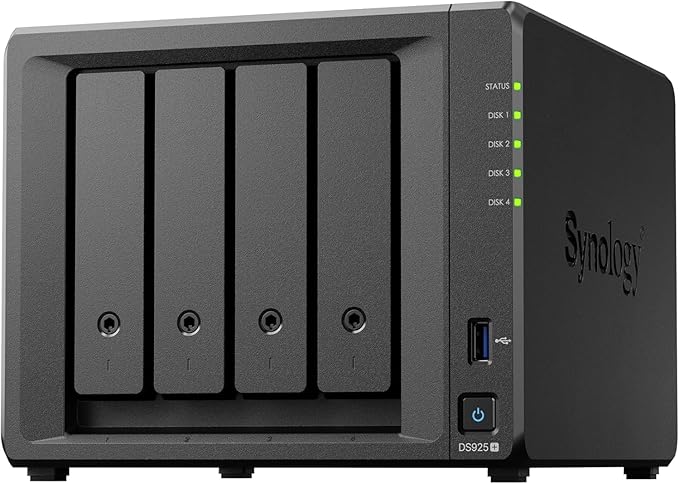 DS925+
|
 DS1525+
|
 DS1825+
|
|
|---|---|---|---|---|---|---|---|---|---|
| Bays | 1 | 2 | 2 | 4 | 4 | 2 | 4 | 5 | 8 |
| CPU | Realtek RTD1619B | Realtek RTD1619B | Intel Celeron | Realtek RTD1619B | Intel Celeron | AMD Ryzen R1600 | AMD Ryzen R1600 | AMD Ryzen V1500B | AMD Ryzen R1600 |
| RAM | 1 GB | 2 GB | 2 GB | 2 GB | 2 GB | 4 GB | 4 GB ECC | 8 GB ECC | 8 GB ECC |
| Network | 1GbE | 1GbE | 2.5GbE + 1GbE | 1GbE | 2.5GbE + 1GbE | 2.5GbE x2 | 2.5GbE x2 | 1GbE x4 | 2.5GbE x2 |
| M.2 Slots | 0 | 0 | 2 | 0 | 2 | 2 | 2 | 2 | 2 |
| Mwave Price | $269 (Scorptec) | $479 (PLE Computers) | $599 (PLE Computers) | $635 (Scorptec) | $819 (Scorptec) | $869 | $995 (Scorptec) | $1,285 | $1,765 (Mwave) |
| Scorptec Price | $269 | $479 (PLE Computers) | $599 (PLE Computers) | $635 | $819 | $869 | $995 | $1,285 (Mwave) | $1,765 (Mwave) |
| PLE Price | $269 (Scorptec) | $479 | $599 (PLE Computers) | $635 (Scorptec) | $819 (Scorptec) | $869 | $995 (Scorptec) | $1,285 (Mwave) | $1,765 (Mwave) |
Prices last verified: 18 March 2026. Always check retailer before purchasing.
Best Overall. Synology DS225+
The DS225+ is the Synology to buy in 2026 for most Australian home users and prosumers. At $549 from Scorptec or $585 from Mwave, it replaces the long-running DS225+ with the same Intel Celeron platform. Hardware transcoding for Plex, 2.5GbE networking (plus a 1GbE port), and two M.2 NVMe cache slots in a quiet two-bay enclosure.
What makes the DS225+ the default recommendation is the full DSM experience. Docker support via Container Manager, Synology Drive for private cloud sync, Hyper Backup for automated offsite backups, Active Backup for Business, and Surveillance Station with two free camera licences. The Intel CPU handles Plex transcoding for a single 1080p stream comfortably. Critical for streaming to devices that don't support direct play. For a deeper look at how Synology compares to QNAP, see our Synology vs QNAP Australia comparison.
| CPU | Intel Celeron (4-core, 2.0 GHz) |
|---|---|
| RAM | 2 GB DDR4 (not user-upgradeable) |
| Drive Bays | 2x 3.5" SATA (hot-swappable) |
| M.2 Slots | 2x NVMe (cache or storage pool) |
| Network | 1x 2.5GbE + 1x 1GbE RJ45 |
| USB | 2x USB 3.2 Gen 1 |
| Mwave Price | $585 |
| Scorptec Price | $549 |
| PLE Price | $599 |
Pros
- Intel CPU with hardware transcoding. Handles Plex and video conversion
- 2.5GbE networking. Future-proofed for faster home networks
- Full DSM software suite including Docker, Drive, Hyper Backup
- Two M.2 NVMe slots for SSD cache or storage pool
- Widely stocked by Australian retailers. No wait times
Cons
- 2 GB RAM not upgradeable. Heavy Docker users may feel limited
- Only two bays. Maximum raw capacity around 48 TB
- M.2 NVMe slots still require Synology-approved drives for new storage pools
- No 10GbE option or PCIe slot for expansion
Best Four-Bay. Synology DS925+
The DS925+ is the four-bay pick for buyers who need more capacity and data protection than two bays can offer. At $995 from Scorptec or $1,029 from Mwave, the AMD Ryzen R1600 CPU, 4 GB ECC RAM (upgradeable to 16 GB), and dual 2.5GbE ports justify the step up from the DS425+. Four bays in SHR-1 with 8 TB drives (~$785 each for Synology HAT3320-8T at Scorptec) gives roughly 24 TB usable. The ECC RAM protects against memory errors. A genuine concern for 24/7 operation with irreplaceable data. For drive recommendations, see our Best NAS Hard Drive Australia guide.
The DS925+ also supports the DX525 expansion unit ($879 Mwave), adding five more bays without data migration. If your storage needs grow, you're not rebuilding from scratch. A key advantage over the DS425+.
| CPU | AMD Ryzen R1600 (2-core/4-thread, 2.6 GHz) |
|---|---|
| RAM | 4 GB DDR4 ECC (upgradeable to 16 GB) |
| Drive Bays | 4x 3.5" SATA (hot-swappable) |
| M.2 Slots | 2x NVMe (cache or storage pool) |
| Network | 2x 2.5GbE RJ45 |
| Expansion | 1x eSATA (supports DX525) |
| Mwave Price | $1,029 |
| Scorptec Price | $995 |
Pros
- 4 GB ECC RAM upgradeable to 16 GB. Handles Docker, VMs, and multitasking
- Dual 2.5GbE with link aggregation. 5 Gbps combined throughput
- DX525 expansion support. Grow to 9 bays without replacing the NAS
- Mature, well-stocked model at all major AU retailers
Cons
- No hardware transcoding. Plex transcoding is CPU-only (use direct play)
- No 10GbE built-in
- At $995+ before drives, it's a significant investment
- M.2 NVMe restrictions. Only Synology-certified NVMe SSDs
Best Budget. Synology DS223
The DS223 suits buyers who want Synology's software without the Plus-series price. At $479 from PLE or $489 from Mwave and Scorptec, it delivers a solid two-bay experience with a Realtek RTD1619B quad-core CPU and 2 GB RAM. No Docker, no transcoding. But for file sharing, Time Machine backup, Synology Drive sync, and Hyper Backup to the cloud, it does the job reliably. DSM runs smoothly on this hardware for core NAS tasks.
If your budget is tighter, the DS223j at $319-$339 drops to 1 GB RAM but is arguably too compromised for 2026 workloads. The extra $140-$170 for the DS223 is well spent. The single-bay DS124 at $269-$289 exists as a dead-simple backup target, but offers no drive redundancy.
| CPU | Realtek RTD1619B (4-core, 1.47 GHz) |
|---|---|
| RAM | 2 GB DDR4 (not upgradeable) |
| Drive Bays | 2x 3.5" SATA |
| Network | 1x 1GbE RJ45 |
| USB | 3x USB 3.2 Gen 1 |
| PLE Price | $479 |
| Mwave Price | $489 |
| Scorptec Price | $489 |
Pros
- Full DSM experience. Synology Drive, Hyper Backup, Synology Photos
- Cheapest two-bay Synology with 2 GB RAM
- Low power consumption. 15W typical, runs silent
- Strong stock availability at all major AU retailers
Cons
- No Docker support. ARM-based CPU limits container options
- No hardware transcoding. Plex requires direct play only
- 1GbE networking only. Capped at ~112 MB/s
- No M.2 NVMe slots
Best for Plex. Synology DS425+
The DS425+ is the four-bay model for buyers who want Intel hardware transcoding with four drive bays. At $819 from Scorptec, $899 from Mwave, or $999 from PLE, it uses the same Intel Celeron as the DS225+. Plex transcoding, 2.5GbE plus 1GbE, and two M.2 NVMe slots. It comfortably transcodes a single 1080p stream for devices that don't support direct play, though high-bitrate 4K HDR content will still push the CPU hard.
The trade-off versus the DS925+ is clear: the DS425+ gives you transcoding but only 2 GB non-upgradeable RAM and no expansion option. The DS925+ gives you upgradeable ECC RAM, dual 2.5GbE, and DX525 expansion, but no transcoding. Choose based on whether media streaming or storage growth is your priority.
| CPU | Intel Celeron (4-core, 2.0 GHz) |
|---|---|
| RAM | 2 GB DDR4 (not upgradeable) |
| Drive Bays | 4x 3.5" SATA (hot-swappable) |
| M.2 Slots | 2x NVMe |
| Network | 1x 2.5GbE + 1x 1GbE RJ45 |
| Scorptec Price | $819 |
| Mwave Price | $899 |
| PLE Price | $999 |
Pros
- Intel hardware transcoding. Best Plex experience in a four-bay Synology
- 2.5GbE networking out of the box
- Four bays with SHR for media libraries
- Two M.2 NVMe slots for SSD cache
Cons
- 2 GB RAM not upgradeable. Limits Docker headroom
- No expansion support. Four bays is your ceiling
- Small price gap to DS925+ ($819 vs $995) which offers more upgrade potential
- Single 2.5GbE vs dual on the DS925+
Premium Two-Bay. DS725+ and Business Models. DS1525+, DS1825+
The DS725+ ($869, Mwave and Scorptec) is a niche pick. A two-bay NAS with AMD Ryzen R1600, 4 GB upgradeable RAM, and dual 2.5GbE. It suits buyers who want compute performance for Docker containers (Home Assistant, Pi-hole) in a compact form factor. But at $869, you're only $126 from the four-bay DS925+ with the same CPU and RAM plus two extra bays and expansion support. Don't buy the DS725+ purely for storage. It only makes sense if you specifically need a two-bay form factor with Plus-series power.
The DS1525+ (5-bay, $1,285 Mwave / $1,399 Scorptec) and DS1825+ (8-bay, $1,799 Scorptec) are the business workhorses. Both offer 8 GB ECC RAM upgradeable to 32 GB and DX525 expansion support. The DS1525+ runs the Ryzen V1500B with four 1GbE ports; the newer DS1825+ upgrades to the Ryzen R1600 with dual 2.5GbE. For small businesses running Active Backup across multiple PCs, Synology Drive for team collaboration, and Hyper Backup for offsite replication, these are the right starting points. For more on Synology in the Australian market, see our Synology NAS Australia overview.
Value Models and Rackmount
Synology's value-series models (DS124, DS223j, DS423) use Realtek ARM CPUs and limited RAM. They run DSM competently for basic tasks but lack Docker, transcoding, and M.2 NVMe slots. The DS423 ($635 Scorptec, $699 Mwave) is the standout here. Four bays with SHR redundancy, priced below the DS425+. The DS124 ($785-$999) and DS223j ($785-$999) are too compromised to recommend when the DS223 at~$785 offers a far better experience.
For rackmount, the RS422+ ($1,484 Mwave, $1,499 Scorptec) is the entry point. A 1U, four-bay unit. The RS822+ ($2,086 Mwave) and RS1221+ ($2,366 Mwave) scale up to eight bays. The desktop DS1823xs+ ($3,312 Mwave) delivers eight bays with Ryzen V1780B and 10GbE built in for businesses without rack infrastructure. Business rackmount models are rarely held in retailer stock. Even when listed as available, expect 2-3 days for the distributor dropship process. Always request a formal quote for business purchases. Resellers can access distributor pricing support that never appears on the website.
The Drive Compatibility Question
In April 2025, Synology locked new Plus-series models to Synology-branded drives. The enthusiast community reacted with justified fury, and Synology reversed course with DSM 7.3 in October 2025. Restoring third-party 3.5-inch HDD and 2.5-inch SATA SSD support on desktop Plus-series models. You can now use IronWolf, WD Red, and Toshiba N300 drives in the DS225+, DS425+, DS925+, and other desktop Plus models without restriction.
Limitations that remain: M.2 NVMe SSDs still require drives from Synology's Hardware Compatibility List for cache or storage pool creation. Enterprise and rackmount models (RS, FS, SA, XS series) continue to enforce stricter drive compatibility. Always check the HCL for your specific model before purchasing drives.
NAS hard drive prices have risen significantly from 2025 levels globally. And Australian buyers are seeing prices run 10-20% above US retail equivalents due to smaller stock allocations and freight costs. For specific AU pricing and recommendations by capacity, see the Best NAS Hard Drive Australia guide, or the AU pricing section below.
🇦🇺 Australian Buyers: What You Need to Know
If you plan to access your Synology remotely. Synology Drive sync, Photos while travelling, surveillance monitoring. Your NBN upload speed is the bottleneck. A typical NBN 100 plan delivers 20-56 Mbps upload in practice, translating to 2.5-7 MB/s for remote file access. Fine for documents and photos, but video streaming may need transcoding to lower bitrates. Another reason the Intel-based DS225+ and DS425+ often suit home users better than the AMD-based DS925+ for remote media access.
Watch out for CGNAT (Carrier-Grade NAT). Some ISPs on fixed wireless, satellite NBN, or budget MVNOs place customers behind CGNAT, blocking direct remote access. Synology's QuickConnect relay works around it but with reduced performance. Confirm you have a public IPv4 address if remote access matters to you.
For non-technical users who want private cloud backup without DSM or RAID, Synology's BeeStation range. The 4 TB ($489 Mwave) and BeeStation Plus 8 TB ($749-$769). Are sealed appliances with automatic phone and PC backup. No configuration needed. The trade-off: zero flexibility, no expansion, no redundancy. A single drive failure means data loss without an external backup.
Buying Tips and Consumer Rights
Where to buy: Scorptec and PLE list the widest Synology range with competitive pricing. Mwave is reliable. For first-time buyers, choose a specialist where you can get pre-sales guidance. Not Amazon where the price is better but the support is nonexistent. Synology's smaller catalogue means AU distributors hold higher inventory levels, so most models are available without backorder delays.
Budget for drives separately. Every Synology NAS ships diskless. A DS225+ ($549) plus two 4 TB drives (~$538 each) totals $1,147. A DS925+ ($995) plus four 8 TB drives (~$980 each) totals $2,991. Don't over-buy on bays. Two is plenty for most home users, four for prosumers, five or eight for business. Ask about warranty before buying: "If this fails, what's your process? Can I get an advanced replacement?" In Australia, your warranty claim goes to the retailer, not Synology. And Synology has no service centre here. Business buyers: request a formal quote. Resellers can access distributor and vendor pricing support that never appears on the website.
Australian Consumer Law note: ACL protections apply when purchasing from Australian retailers. Your warranty claim is against the place of purchase, not the manufacturer. A dead NAS is a minor failure under ACL. The retailer can offer repair or replacement and is not obligated to provide an immediate refund. Expect 2-3 weeks for the standard warranty chain (retailer to distributor to Synology in Taiwan, then back). A NAS is not a backup. Plan your data protection strategy around the assumption that hardware will eventually fail. For official information, visit accc.gov.au.
Which Synology Should You Actually Buy?
The decision simplified:
- "Cheapest Synology for backup.". DS223 ($479).
- "Proper NAS with Docker, transcoding, fast networking.". DS225+ ($549).
- "Four bays and I use Plex.". DS425+ ($819).
- "Four bays with upgrade headroom.". DS925+ ($995).
- "Small business, multiple users, need to scale.". DS1525+ ($1,285) or DS1825+ ($1,799).
- "Just works, never see a settings screen.". BeeStation Plus 8 TB (~$1699).
The DS225+ and DS925+ cover 80% of buyers. Pick based on how many bays you need and whether transcoding matters. DSM is the same across the entire Plus range. The experience is consistent regardless of model. Gone are the days of waiting for Black Friday to buy tech in Australia. Retailers run rolling sale events throughout the year, and in 2026 with storage supply chain constraints tightening, the stock might not be there when you finally decide to pull the trigger.
Related reading: our AU retailer guide.
Use our free NAS Sizing Wizard to get a personalised NAS recommendation.
See also: our complete Synology ecosystem guide.
Is the Synology DS225+ worth the extra money over the DS223?
Yes, for most buyers. The DS225+ adds Intel hardware transcoding (essential for Plex), 2.5GbE networking, two M.2 NVMe cache slots, and Docker support. The price gap is $60-$110 depending on the retailer. Unless your NAS will only do basic file sharing with no transcoding or containers, the DS225+ is the better investment.
Can I use Seagate IronWolf or WD Red drives in a new Synology NAS?
Yes. Since DSM 7.3 (October 2025), Synology restored full third-party 3.5-inch HDD support on desktop Plus-series models. IronWolf, WD Red Plus, WD Red Pro, and Toshiba N300 all work without restriction. The only remaining restriction is M.2 NVMe SSDs, which require Synology-certified models. Enterprise and rackmount models maintain stricter compatibility requirements.
What is the total cost of a Synology NAS setup in Australia?
A typical home setup costs $1,000-$1,200 all-in. DS225+ ($549) plus two 4 TB drives ($299 each at Scorptec) totals $1,147. A DS223 ($479) with two 4 TB drives comes to $1,077. A four-bay DS925+ ($995) with four 8 TB drives ($499 each) totals $2,991. NAS drive prices have risen 30-40% since early 2025 due to global supply constraints. Budget accordingly.
Should I buy a Synology NAS from Amazon Australia?
Amazon AU works if you're technically confident and don't need support. Their returns process is excellent. But if your NAS fails and you need a replacement, Amazon may not have stock. They'll push to give you a credit rather than sourcing a like-for-like unit. Specialist retailers like Scorptec or PLE can access distributor and vendor stock to find replacements. For first-time buyers or business-critical deployments, buy from a specialist.
How does Synology warranty work in Australia?
Synology has no service centre in Australia. Claims go through the retailer, who escalates to their distributor (BlueChip or MMT), who escalates to Synology in Taiwan. Expect 2-3 weeks minimum. Consumer models carry 3-year warranty (extendable to 5). Under ACL, your claim is against the retailer, not Synology. Advanced replacements are generally unavailable. Some resellers will let you buy a replacement at full price and refund you when the faulty unit returns.
DS425+ or DS925+. Which four-bay Synology should I buy?
DS425+ ($819) for Plex. Its Intel Celeron handles 1080p transcoding that the DS925+'s AMD Ryzen cannot. DS925+ ($995) for everything else. Upgradeable ECC RAM, dual 2.5GbE link aggregation, DX525 expansion support, and stronger multi-threaded performance. The DS925+ is more future-proof; the DS425+ is the better media server.
Can I access my Synology NAS remotely over NBN?
Yes, via QuickConnect or direct DDNS. Upload speed is the bottleneck. NBN 100 delivers 20-56 Mbps upload, roughly 2.5-7 MB/s for remote access. Fine for documents and photos, but video streaming may need transcoding. If your ISP uses CGNAT (common on fixed wireless and budget MVNOs), direct DDNS won't work. You'll need QuickConnect's relay. Check with your ISP for a public IPv4 address.
Is a two-bay or four-bay NAS better for home use?
Two bays is sufficient for most home users. Two drives in SHR give single-drive redundancy. If one fails, your data is protected while you replace it. Two 8 TB drives in SHR give roughly 8 TB usable, plenty for years of photos, documents, and backups. Four bays suit users who need more than 16 TB, want dual-drive redundancy (SHR-2), or run a home office with multiple users.
Looking for the best NAS across all brands? Our comprehensive guide covers Synology, QNAP, Asustor, and more with live Australian pricing.
Read the Best NAS Australia Guide