The best NAS under $1,000 for most Australian buyers in 2026 is the Synology DS425+ ($819). A 4-bay Intel Celeron unit with hardware transcoding, 2.5GbE, and the full DSM software suite. For QNAP buyers or anyone who wants more RAM out of the box, the TS-464 ($999) is the hardware-leading alternative at the top of the bracket. This guide compares every NAS model in the~$989-$1,000 AU range across five brands. Synology, QNAP, Asustor, UGREEN, and TerraMaster. With current AU pricing, use-case recommendations, and the specific differences that actually matter between models at similar price points.
For a broader overview of this topic, see our NAS buying guide hub.
In short: The Synology DS425+ ($819 at Scorptec) is the best all-round NAS under $1,000 in Australia. 4 bays, Intel Celeron, 2.5GbE, and Synology's DSM software, which remains the easiest to live with long-term. For raw value with more RAM and PCIe expandability, the QNAP TS-464 ($999 at Scorptec) packs 8GB and dual 2.5GbE out of the box. Budget-conscious buyers should look at the Asustor AS5404T ($799 at Scorptec) for a 4-bay Celeron unit at a lower price point.
What $500-$1,000 Gets You in a NAS in 2026
This is the bracket where NAS hardware makes a genuine leap. Below $500, you are looking at ARM processors, 1-2GB of RAM, and limited app support. Our best NAS under $500 guide covers that territory. Once you cross the $500 mark in Australia, you start seeing Intel Celeron and AMD Ryzen processors with hardware transcoding, 2-8GB of RAM, 2.5 Gigabit Ethernet, NVMe cache slots, and the processing headroom to run Docker containers, Plex Media Server with transcoding, and surveillance camera feeds simultaneously.
Every model in this guide is diskless. You supply your own hard drives. Factor in an additional $300-$700 for drives depending on capacity. NAS-grade HDDs like the Seagate IronWolf or WD Red Plus are essential for reliability in a 24/7 NAS environment. Drive prices have risen significantly from early 2025 levels, so budget accordingly.
The sweet spot in this bracket is a 4-bay NAS with an Intel Celeron or equivalent processor, 2-4GB of RAM (upgradeable), and at least one 2.5GbE port. That combination handles home media, family photo backup, Docker apps, and light business workloads without breaking a sweat. If you only need two bays, the higher-end 2-bay models in this range offer premium hardware that will last years. Check our best 2-bay NAS guide for those options.
Quick Comparison: NAS Models $500-$1,000 in Australia
NAS Models $500-$1,000 AUD. February 2026
 Synology DS425+
|
 Synology DS423
|
 Synology DS725+
|
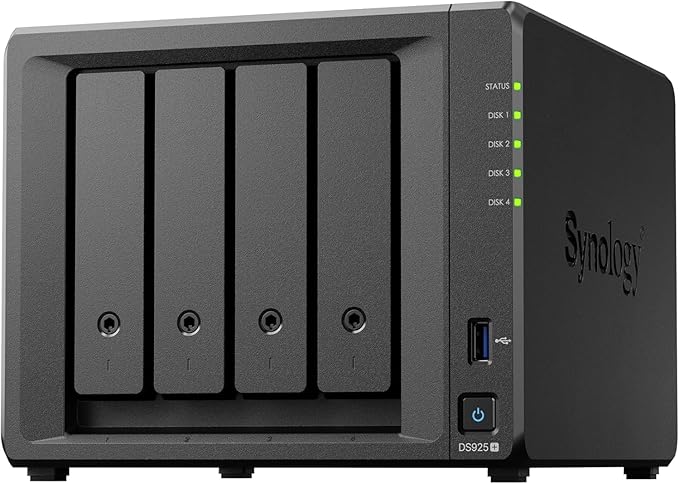 Synology DS925+
|
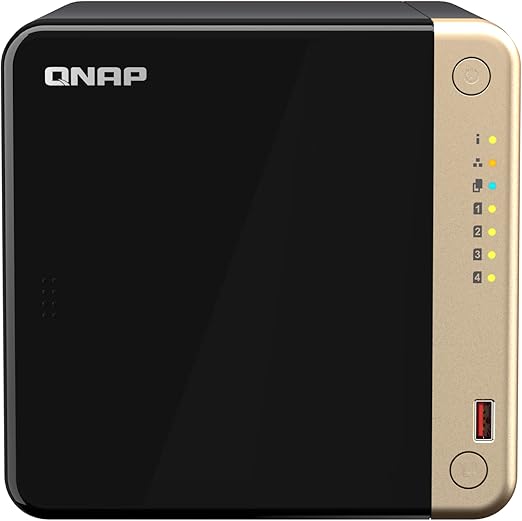 QNAP TS-464
|
 QNAP TS-462
|
 QNAP TS-264
|
 Asustor AS5404T
|
 Asustor AS6804T
|
|
|---|---|---|---|---|---|---|---|---|---|
| Bays | 4 | 4 | 2 | 4 | 4 | 4 | 2 | 4 | 4 |
| CPU | Intel Celeron | RTK1619B | AMD Ryzen R1600 | AMD Ryzen R1600 | Celeron N5095 | Celeron N4505 | Celeron N5095 | Celeron N5105 | Celeron N5105 |
| RAM | 2GB | 2GB | 4GB | 4GB | 8GB | 4GB | 8GB | 4GB | 4GB |
| Network | 1x 2.5GbE + 1x 1GbE | 2x 1GbE | 2x 2.5GbE | 2x 2.5GbE | 2x 2.5GbE | 1x 2.5GbE | 2x 2.5GbE | 2x 2.5GbE | 2x 2.5GbE |
| NVMe Slots | 2 | 0 | 2 | 2 | 2 | 0 | 2 | 2 (M.2 2280) | 2 (M.2 2280) |
| Best AU Price | $819 | $635 | $869 | $995 | $989 (Scorptec) | $889 (Scorptec) | $819 | $879 (Mwave) | $2,175 (Mwave) |
| Retailer | Scorptec | Scorptec | Scorptec / Mwave | Scorptec | Scorptec | PLE | PLE | Scorptec | Scorptec |
Prices last verified: 10 March 2026. Always check retailer before purchasing.
Prices are from the major Australian retailers as of February 2026. NAS pricing in Australia is fairly uniform across retailers. Most operate on 3-5% margins, so you will rarely find dramatic price differences between Scorptec, Mwave, and PLE. The real difference between retailers is stock availability and after-sales support, not price. For a product that stores your data, the retailer relationship matters when something goes wrong.
Synology DS425+. The Best All-Rounder Under $1,000
The Synology DS425+ is the model that suits the widest range of buyers in this bracket. It is the 2025 successor to the long-running DS423+ line, and it brings 2.5GbE networking as standard. Something Synology has been criticised for omitting on previous Plus-series models. At $819 from Scorptec ($899 at Mwave, $999 at PLE), it sits right in the middle of this guide's price range and delivers exactly what most home and small office users need.
| CPU | Intel Celeron (quad-core, 2.0GHz) |
|---|---|
| RAM | 2GB DDR4 (expandable) |
| Drive Bays | 4x 3.5"/2.5" SATA |
| M.2 Slots | 2x NVMe (cache/storage) |
| Network | 1x 2.5GbE + 1x 1GbE |
| USB | 2x USB 3.2 Gen 1 |
| AU Price (Scorptec) | $819 |
| AU Price (Mwave) | $899 |
| AU Price (PLE) | $999 |
Synology's DSM operating system is the single biggest reason to buy a Synology NAS. It is polished, intuitive, and requires less technical knowledge than QNAP's QTS or Asustor's ADM. Synology Photos is a genuine Google Photos / iCloud replacement, Synology Drive handles file sync across devices, and Hyper Backup makes offsite backups straightforward. For users who want a NAS that works reliably without constant tinkering, DSM remains the gold standard. Read more in our best Synology NAS guide.
The DS425+ handles Plex hardware transcoding for 1-2 simultaneous streams, runs Docker containers comfortably, and supports Synology's Surveillance Station for up to 2 cameras (included licences). The 2GB default RAM is the main limitation. Plan to upgrade to 4-8GB if running multiple Docker containers or heavy Plex usage. Synology charges a premium for its own branded RAM, but third-party SODIMM modules work fine.
Pros
- DSM software is the most polished NAS operating system available
- 2.5GbE finally standard on Synology's 4-bay Plus model
- Excellent photo backup via Synology Photos
- Strong Docker and Plex transcoding support
- Two M.2 NVMe slots for SSD caching or storage
Cons
- Only 2GB RAM out of the box. Needs upgrading for heavier workloads
- Only one 2.5GbE port (second port is 1GbE)
- No PCIe expansion slot for 10GbE upgrades
- More expensive than equivalent Asustor or QNAP hardware
Synology DS423. Budget 4-Bay Without the Plus Features
The Synology DS423 at $635 from Scorptec ($699 at Mwave) is Synology's value-oriented 4-bay model. It runs the same DSM software as the DS425+ but uses an ARM-based RTK1619B processor instead of an Intel Celeron. This makes it significantly cheaper but also means no hardware transcoding for Plex, no Docker support (Synology restricts Container Manager to Plus-series models), and less processing headroom overall.
The DS423 suits buyers who want Synology's software experience for straightforward file storage, photo backup via Synology Photos, and Time Machine backups. Without the overhead of Docker or Plex transcoding. It is a solid choice for households that primarily need reliable networked storage with an excellent mobile app ecosystem. If you think you might want Docker or Plex later, spend the extra $184 and get the DS425+ instead. The ARM processor is a hard limitation you cannot upgrade around.
| CPU | Realtek RTD1619B (quad-core, 1.7GHz ARM) |
|---|---|
| RAM | 2GB DDR4 (not upgradeable) |
| Drive Bays | 4x 3.5"/2.5" SATA |
| M.2 Slots | None |
| Network | 2x 1GbE |
| AU Price (Scorptec) | $635 |
| AU Price (Mwave) | $699 |
Pros
- Full Synology DSM experience at the lowest 4-bay price
- Synology Photos, Drive, and Hyper Backup all supported
- Low power consumption. ARM processor sips power
- Dual 1GbE with link aggregation
Cons
- No Docker / Container Manager support (ARM-based value series)
- No hardware transcoding for Plex
- RAM is not upgradeable
- No M.2 NVMe cache slots
- Only 1GbE networking. No 2.5GbE
Synology DS725+. Premium 2-Bay with Ryzen Power
The Synology DS725+ at $869 from Scorptec and Mwave is an unusual proposition: a 2-bay NAS priced near 4-bay competitors. What you get for that price is an AMD Ryzen R1600 processor with 4GB of RAM, dual 2.5GbE, and two M.2 NVMe slots. Hardware that is significantly more powerful than the 4-bay DS425+.
The DS725+ suits buyers who prioritise processing performance over raw storage capacity. If you are running Docker containers, virtual machines, or heavy Plex transcoding and only need two drive bays, this is the most powerful 2-bay NAS available from Synology. It pairs well with a DX525 expansion unit if you need more bays later, though that adds significant cost. For most buyers spending $869, the DS425+ at $819 with double the drive bays is the better value. Unless you specifically need the Ryzen processing headroom.
| CPU | AMD Ryzen R1600 (dual-core, 2.8GHz) |
|---|---|
| RAM | 4GB DDR5 (expandable to 24GB) |
| Drive Bays | 2x 3.5"/2.5" SATA |
| M.2 Slots | 2x NVMe |
| Network | 2x 2.5GbE |
| AU Price (Scorptec / Mwave) | $869 |
Synology DS925+. Just Over $1,000 but Worth Mentioning
The Synology DS925+ at $995 from Scorptec ($1,029 at Mwave) sits right at the ceiling of this guide's budget. It is the 4-bay version of the DS725+'s Ryzen platform, delivering dual 2.5GbE, 4GB of RAM (expandable to 24GB), two M.2 NVMe slots, and a PCIe expansion slot for 10GbE upgrades. If you can stretch your budget to $995, the DS925+ is the most future-proof Synology NAS in this price range.
The difference between the DS425+ ($819) and the DS925+ ($995) is the Ryzen R1600 processor versus the Celeron, double the base RAM, dual 2.5GbE ports (both full speed), and the PCIe expansion slot. For small business use, the DS925+ is the better investment. For home users doing photo backup and occasional Plex, the DS425+ handles those workloads just fine. Read our detailed DS925+ review for the full breakdown.
| CPU | AMD Ryzen R1600 (dual-core, 2.8GHz) |
|---|---|
| RAM | 4GB DDR5 (expandable to 24GB) |
| Drive Bays | 4x 3.5"/2.5" SATA |
| M.2 Slots | 2x NVMe |
| Network | 2x 2.5GbE |
| PCIe Expansion | 1x PCIe 3.0 (for 10GbE card) |
| AU Price (Scorptec) | $995 |
| AU Price (Mwave) | $1,029 |
QNAP TS-464. The Hardware King
The QNAP TS-464 at $999 from Scorptec ($1,099 at PLE) is the best-specified NAS hardware under $1,000 in Australia. It ships with 8GB of RAM (double the Synology DS425+'s 2GB), an Intel Celeron N5095 quad-core processor, dual 2.5GbE ports, two M.2 NVMe slots, and an HDMI 2.0 output for direct media playback. On paper, it beats every Synology in this bracket on specifications. Read our full QNAP NAS guide for more detail on the QNAP lineup.
The TS-464 runs QNAP's QTS operating system, which is more feature-rich but less polished than Synology's DSM. QTS offers more flexibility for advanced users. Native HDMI output, more extensive virtualisation support, and broader hardware compatibility. But the interface is busier and the learning curve is steeper. QNAP has also had more publicised security incidents than Synology, though both vendors have improved significantly in recent years. If you are comfortable with a slightly more technical platform, the TS-464's hardware advantage is genuine.
| CPU | Intel Celeron N5095 (quad-core, 2.9GHz burst) |
|---|---|
| RAM | 8GB DDR4 (expandable to 16GB) |
| Drive Bays | 4x 3.5"/2.5" SATA |
| M.2 Slots | 2x NVMe 2280 (PCIe Gen 3) |
| Network | 2x 2.5GbE |
| HDMI | 1x HDMI 2.0 (4K output) |
| USB | 2x USB 3.2 Gen 2, 1x USB 2.0 |
| AU Price (Scorptec) | $999 |
| AU Price (PLE) | $1,099 |
Pros
- 8GB RAM out of the box. No immediate upgrade needed
- Dual 2.5GbE for link aggregation or network separation
- HDMI 2.0 output for direct media playback without Plex transcoding
- Two M.2 NVMe slots for SSD caching
- Intel Celeron N5095 handles Plex transcoding and Docker well
Cons
- QTS is less intuitive than Synology DSM for beginners
- QNAP's historical security issues may concern some buyers
- At $999 it is $180 more than the Synology DS425+
- No PCIe expansion slot for 10GbE upgrades
QNAP TS-462. Budget QNAP 4-Bay with Celeron
The QNAP TS-462 at $919 from PLE is a trimmed-down version of the TS-464. It uses a dual-core Celeron N4505 instead of the quad-core N5095, ships with 4GB of RAM instead of 8GB, and has a single 2.5GbE port instead of dual. The dual-core processor is a meaningful step down for Plex transcoding and Docker workloads.
The TS-462 makes sense for QNAP buyers who want 4 bays and QTS at a lower price point and do not need heavy transcoding or multi-container Docker setups. For basic file serving, backup, and light app usage, the dual-core Celeron is adequate. But if you are spending $919 and want QNAP, the extra $80 to get the TS-464 at $999 from Scorptec is almost certainly worth the upgrade in processor and RAM.
| CPU | Intel Celeron N4505 (dual-core, 2.9GHz burst) |
|---|---|
| RAM | 4GB DDR4 (expandable) |
| Drive Bays | 4x 3.5"/2.5" SATA |
| M.2 Slots | None |
| Network | 1x 2.5GbE + 1x 1GbE |
| HDMI | 1x HDMI 2.0 |
| AU Price (PLE) | $919 |
QNAP TS-264. Powerful 2-Bay from QNAP
The QNAP TS-264 at $819 from PLE ($917 at Mwave, $949 at Scorptec) is QNAP's premium 2-bay offering. It packs the same Celeron N5095 and 8GB of RAM as the 4-bay TS-464, with dual 2.5GbE and two M.2 NVMe slots. Like the Synology DS725+, it is a lot of hardware for a 2-bay unit.
At $819 from PLE, it costs the same as the Synology DS425+. Which gives you 4 bays instead of 2. Unless you specifically need QNAP's QTS features, the HDMI output, or you are certain 2 bays is all you will ever need, the DS425+ is the better buy at the same price. Two bays means a single RAID 1 mirror with no room to grow without buying an expansion unit.
Asustor AS5404T (Nimbustor 4 Gen2). Best Value 4-Bay
The Asustor AS5404T at $799 from Scorptec ($879 at Mwave) is the cheapest 4-bay NAS with a quad-core Intel Celeron and 2.5GbE networking in this guide. It runs Asustor's ADM operating system, which is functional but less refined than DSM or QTS. What makes the AS5404T compelling is the price. At $799, it undercuts the Synology DS425+ by $20 while offering the same Celeron N5105 processor, 4GB of RAM, and dual 2.5GbE ports. Read our Asustor NAS Australia guide for the full brand breakdown.
Asustor's ADM supports Docker (via Portainer), Plex hardware transcoding, and a solid selection of first-party apps. The gaming-inspired Nimbustor design with its diamond-pattern chassis is distinctive. Love it or hate it. The AS5404T also includes two M.2 2280 NVMe slots and HDMI 2.0 output. Where Asustor falls short is software polish and the smaller app ecosystem compared to Synology. The mobile apps are functional but not in the same league as Synology Photos or DS File.
| CPU | Intel Celeron N5105 (quad-core, 2.9GHz burst) |
|---|---|
| RAM | 4GB DDR4 (expandable to 16GB) |
| Drive Bays | 4x 3.5"/2.5" SATA |
| M.2 Slots | 2x NVMe 2280 |
| Network | 2x 2.5GbE |
| HDMI | 1x HDMI 2.0 |
| AU Price (Scorptec) | $799 |
| AU Price (Mwave) | $879 |
Pros
- Cheapest 4-bay Celeron NAS with 2.5GbE in Australia
- 4GB RAM and dual 2.5GbE match more expensive competitors
- Docker, Plex transcoding, and HDMI output all supported
- Two M.2 NVMe slots for SSD caching
Cons
- ADM software is less polished than Synology DSM
- Smaller app ecosystem and weaker mobile apps
- The Nimbustor design is polarising
- Asustor is distributed exclusively through Dicker Data in AU. Smaller support channel than Synology or QNAP
Asustor AS6804T (Lockerstor 4 Gen2). Asustor's Step-Up Model
The Asustor AS6804T at~$1698 from Scorptec ($1,013 at Mwave) is Asustor's Lockerstor line, which sits above the Nimbustor. It shares the same Celeron N5105, 4GB RAM, and dual 2.5GbE as the AS5404T but adds a more professional chassis design and additional USB 3.2 Gen 2 (10Gbps) ports. The Scorptec price of $775 actually makes it cheaper than the AS5404T at the same retailer, which is an unusual pricing situation. Worth checking stock availability as this may indicate a clearance or promotional pricing.
At the $775 Scorptec price, the AS6804T is outstanding value. At Mwave's $1,013 pricing, it competes directly with the Synology DS925+ and loses on software alone. Check current stock and pricing before deciding. This is a model where shopping around across Scorptec, Mwave, and PLE ($849) can save you hundreds.
Asustor AS5402T (Nimbustor 2 Gen2). Budget 2-Bay with Celeron
The Asustor AS5402T at $639 from Scorptec ($789 at Mwave) is a 2-bay NAS with the same Celeron N5105 and dual 2.5GbE found in the 4-bay models above. If you only need 2 bays and want Intel transcoding support on a budget, it is a strong option. However, the 4-bay AS5404T is available at $799. And 4 bays gives you dramatically more storage flexibility with RAID 5 protection. Unless space or budget is genuinely tight, the 4-bay model is the better buy.
UGREEN DH4300 Plus. The Newcomer
UGREEN launched in Australia in early 2026 with the DH4300 Plus, a 4-bay NAS priced at approximately AU$595-$629. It runs UGOS Pro, includes dual 2.5GbE networking, 8GB DDR4 RAM, and a quad-core ARM Cortex-A55 processor. Available directly from UGREEN AU, Scorptec, and PLE. Note: not listed on Amazon AU.
At $595-$629 the DH4300 Plus competes directly with the Asustor AS5404T (~$762) and undercuts the DS425+ ($819). The hardware spec is competitive. The honest caveat is that UGOS Pro is a newer platform than Synology DSM or QNAP QTS. If you rely on a mature app ecosystem (Plex, Surveillance Station, Active Backup), Synology or QNAP still has the edge. If you want strong hardware at a lower price and are comfortable with a developing software platform, the DH4300 Plus is worth considering.
The higher-spec DXP range (DXP4800 Plus, DXP6800 Pro, DXP2800) is available on UGREEN's global website but has not reached Australian retail due to supply shortages. Do not order DXP models expecting local support or warranty coverage.
UGREEN DH4300 Plus in Australia: Available now via UGREEN AU, Scorptec, and PLE at approximately AU$595-$629 (drive-less). Not on Amazon AU. The DXP range (DXP4800 Plus, DXP6800 Pro) remains unavailable in Australia as of March 2026.
TerraMaster and Other Options in This Bracket
Several TerraMaster models land in the $500-$1,000 range in Australia. The TerraMaster F4-425 at $659 from Scorptec offers a 4-bay Celeron N5095 unit at a competitive price, and the F4-425 Plus at $899 adds a hybrid bay design. The F4-424 Pro at $1,099 from Scorptec ($1,100 at Mwave) pushes into small business territory with a Core i3 and 32GB of RAM.
TerraMaster hardware specifications are competitive, but the TOS operating system is less mature than DSM, QTS, or even ADM. TerraMaster is distributed through DSTech in Australia with limited presence compared to the Big Three. For buyers who prioritise hardware specifications over software ecosystem, TerraMaster offers genuine value. For most buyers in this bracket, the proven software platforms from Synology, QNAP, and Asustor are the safer choice.
Which NAS Should You Buy? Use Case Recommendations
Home Media and Photo Backup
The Synology DS425+ ($819) is the pick. DSM's Synology Photos app is the best photo management solution on any NAS platform, and Plex hardware transcoding handles home media needs without fuss. If your household primarily streams direct-play content (no transcoding needed) and wants the simplest setup experience, this is the model. For a deeper look at all options, see our best NAS Australia overall guide.
Plex and Docker Power User
The QNAP TS-464 ($999) gives you 8GB of RAM and a quad-core Celeron out of the box. Enough to run Plex, multiple Docker containers, and still serve files without slowdowns. The HDMI output is also useful for direct media playback to a TV without needing a Plex client. See our best NAS for Plex guide and Docker on NAS guide for more detail.
Small Business / Home Office
The Synology DS925+ ($995) is the strongest business-oriented option in this bracket. The Ryzen processor, expandable RAM, PCIe slot for 10GbE, and Synology's Active Backup for Business suite make it a genuine small office server. For businesses with 5-20 users sharing files and running centralised backup, the DS925+ handles the load. Request a formal quote from your retailer. Business NAS purchases can often attract pricing support from distributors that never appears on the website. Check our best NAS for small business guide for the full picture.
Budget-First Buyer
The Asustor AS5404T ($799) delivers 4 bays, a Celeron processor, and dual 2.5GbE at the lowest price in this guide. It handles Plex, Docker, and file serving capably. The software is not as refined as Synology's, but at $799 with equivalent hardware, it is a genuine value proposition. If you are buying a first NAS and want to learn, buy from a specialist like Scorptec or PLE where you can get genuine pre-sales guidance.
🇦🇺 Australian Buyers: What You Need to Know
Every NAS in this bracket supports 2.5GbE, which is a genuine performance upgrade over 1GbE. But only if your router, switch, or access point also supports 2.5GbE. Most Australian homes still run 1GbE networking, so factor in a 2.5GbE switch ($100-$160) if you want to take full advantage. Our NAS networking guide covers this in detail.
For remote access, NBN upload speeds remain the bottleneck. On a typical NBN 100/20 plan, you get roughly 17-20 Mbps of real-world upload. Enough for streaming a single 1080p video remotely or syncing files, but too slow for multiple concurrent users or large file uploads. If you are on an NBN plan with CGNAT (common on some providers), remote access via Synology QuickConnect or QNAP myQNAPcloud can work around the issue, but a proper VPN or DDNS setup may require contacting your ISP for a public IP.
RAID, Drives, and Total Cost
A 4-bay NAS in this bracket is best configured with RAID 5 (or Synology's SHR equivalent), which gives you the capacity of 3 drives with the ability to survive one drive failure. With 4x 8TB NAS drives. Currently around $350-$500 each for Seagate IronWolf or WD Red Plus. You are looking at approximately $1,400-$2,000 in drives on top of the NAS enclosure.
Total system cost for a capable 4-bay NAS with drives in Australia in 2026: $1,600-$3,000 depending on drive size and NAS model. This is a meaningful investment, but compared to cloud storage subscriptions for the same capacity (8-16TB usable), a NAS pays for itself within 2-3 years. The best NAS hard drive guide has the latest drive pricing and recommendations.
Warranty, ACL, and Where to Buy
Australian Consumer Law protections apply when purchasing from Australian retailers. Your warranty claim goes to the retailer, not the manufacturer. Synology, QNAP, and Asustor do not have service centres in Australia. The standard warranty process runs through the full chain: retailer to distributor to vendor in Taiwan, then back again. Expect 2-3 weeks minimum for a resolution. Always buy from an authorised Australian retailer for full ACL coverage. For official information on your consumer rights, visit accc.gov.au.
For NAS devices in this bracket, the standard manufacturer warranty is 3 years, extendable to 5 years on most Plus-series models. Before buying, ask your retailer: "If this unit fails, what is your process? Can I get an advanced replacement?" The answer tells you more about the value of buying from that retailer than the price on the website. Advanced replacements are not officially supported by most NAS vendors in Australia, but some resellers will let you purchase a replacement at full price and refund you when the faulty unit comes back.
Australian NAS pricing is currently running 10-20% above US levels, driven by lower stock allocations, higher freight costs, and smaller market volumes. Scorptec, PLE, and Mwave are the most reliable retailers for NAS in Australia. They list most models, hold stock (or can order from distributors like BlueChip and Dicker Data within days), and have established after-sales processes. Amazon AU has started holding NAS stock directly, often at competitive prices, but their support model means you are on your own if a unit fails with your data inside it.
A NAS is not a backup. Plan for hardware failure, plan for a 2-3 week replacement window, and build your data protection strategy around the assumption that your NAS will eventually fail. Offsite backup, cloud sync, or a secondary NAS should be part of every storage plan.
Exploring other budgets? If you need to stay under $500, the best NAS under $500 guide covers entry-level 2-bay options. For businesses or power users with a larger budget, our best business NAS under $2,000 guide covers 5-bay and 8-bay units with enterprise-grade features, hot-swap bays, and higher-core-count processors.
Use our free NAS Sizing Wizard to get a personalised NAS recommendation.
Is a NAS under $1,000 powerful enough for Plex transcoding?
Yes. Every Intel Celeron and AMD Ryzen-powered NAS in this bracket supports hardware transcoding through Intel Quick Sync or equivalent. The Synology DS425+, QNAP TS-464, and Asustor AS5404T all handle 1-2 simultaneous 1080p transcoding streams comfortably. For 4K transcoding, you generally want direct play (no transcoding) as even these processors struggle with real-time 4K transcode. See our best NAS for Plex guide for detailed transcoding benchmarks.
Should I buy a Synology or QNAP NAS under $1,000?
For most buyers, Synology offers the smoother experience. DSM is easier to set up, Synology Photos is excellent, and the mobile apps are more polished. QNAP offers better hardware for the money. The TS-464 ships with 8GB RAM and HDMI output. And more flexibility for advanced users. If you want things to just work, go Synology. If you want more hardware capability and do not mind a learning curve, go QNAP. Our Synology vs QNAP comparison covers this in detail.
Do I need 2.5GbE networking on my NAS?
2.5GbE delivers 2.5x the throughput of standard 1GbE. Roughly 280 MB/s versus 112 MB/s in real-world file transfers. If you regularly transfer large files, run Plex, or have multiple users accessing the NAS simultaneously, 2.5GbE makes a noticeable difference. However, you also need a 2.5GbE switch and compatible devices to benefit. If your entire network is 1GbE, the NAS will work fine. You just will not see the speed advantage until you upgrade your networking. See our NAS networking guide.
How much does a complete NAS setup cost in Australia including drives?
For a 4-bay NAS in this bracket with 4x 8TB NAS-grade drives (Seagate IronWolf or WD Red Plus), budget approximately $1,600-$3,000 total. The NAS enclosure is $635-$999 and the drives add $1,400-$2,000 depending on capacity. NAS-grade drive prices have risen significantly from early 2025 levels due to global supply constraints. Check our best NAS hard drive guide for current drive pricing.
Is the Synology DS425+ worth the upgrade over the DS423?
Yes, for most buyers. The DS425+ ($819) has an Intel Celeron with hardware transcoding, Docker support, and 2.5GbE networking. The DS423 ($635) uses an ARM processor that cannot run Docker or transcode Plex. And the RAM is not upgradeable. The $184 difference buys you a meaningfully more capable device. The only scenario where the DS423 is the better choice is if you exclusively need file storage and photo backup with no plans for Docker, Plex, or advanced apps.
Can I access my NAS remotely over the internet?
Yes. Synology QuickConnect, QNAP myQNAPcloud, and Asustor EZ-Connect all offer relay-based remote access without port forwarding. These work even behind CGNAT, which is common on some Australian NBN connections. For faster and more secure access, setting up a VPN or using Tailscale is recommended. Keep in mind that NBN upload speeds limit remote performance. A typical NBN 100 plan delivers only 17-20 Mbps upload, which caps remote streaming to around 1080p. See our NAS remote access guide for setup instructions.
Where is the best place to buy a NAS in Australia?
Scorptec, PLE, and Mwave are the most reliable NAS retailers in Australia. They list the full range, hold stock or can order quickly through distributors like BlueChip and Dicker Data, and have established warranty processes. Pricing is similar across all three due to low NAS margins (3-5%). Avoid buying from sellers with no physical AU presence if after-sales support matters to you. For a detailed breakdown, see our where to buy NAS Australia guide.
Looking for the full picture? Our Best NAS Australia guide covers every price bracket and use case with real AU pricing.
Read the Full Guide →