Finding genuine NAS deals in Australia requires understanding when and where to buy. Not just waiting for a sale banner to appear. Most Australian NAS retailers operate on 3-5% margin, which means pricing is remarkably uniform across Scorptec, PLE, Mwave, and other specialist stores. A Synology DS925+ sits at $995-$1,029 everywhere. A QNAP TS-464 hovers around $999-$1,099. The real savings come from timing your purchase around Australia’s retail sale calendar, knowing which retailers offer price-matching and open-box deals, and understanding when NOT to buy. Particularly around new model launch cycles. In 2026, with HDD and SSD prices rising sharply from 2025 levels, the total cost of a NAS build matters more than ever.
In short: Gone are the days of waiting for one or two annual sale events. Australian tech retailers run rolling promotions throughout the year. EOFY (June), Click Frenzy, Black Friday/Cyber Monday, Boxing Day, and Amazon Prime Day all deliver genuine NAS discounts. Expect 5-15% off during major events. For the best deal, compare prices across specialist NAS retailers, request a formal quote for business purchases, and avoid buying within 4-6 weeks of a known new model launch. The price you see today will not be dramatically different in six months. But the stock might not be there.
Why NAS Prices Are So Uniform in Australia
Before chasing deals, it helps to understand why NAS pricing barely moves between retailers. Every NAS sold in Australia flows through the same supply chain: vendor (Synology, QNAP, Asustor) to distributor (BlueChip, Dicker Data, MMT) to reseller to you. When every store sources from the same two or three distributors at roughly the same wholesale cost, and operates on 3-5% margin, there simply is not much room for price differentiation. A $30 difference on a $1,000 NAS is the entire margin.
This means the headline price is rarely where you find genuine savings. The real value comes from timing (buying during sale events when vendors and distributors fund promotional pricing), bundling (NAS + drive packages that genuinely save money), and quoting (requesting formal quotes for business purchases, where resellers routinely sharpen pricing with distributor and vendor support). If a NAS is priced significantly below every other Australian store, that is a signal worth investigating. It may indicate grey import stock with different warranty implications.
The Australian Sale Calendar for NAS Buyers
Australian retailers run promotions far more frequently than they did five years ago. Tech is on sale roughly 50% of the year across various retailer events. If a competitor runs a sale, others typically follow within days. That said, certain periods consistently deliver the deepest NAS discounts.
EOFY Sales (June)
End of Financial Year is the single best time to buy a NAS in Australia for both home and business buyers. Retailers are clearing stock to hit annual targets. Distributors push promotional pricing to vendors. Business buyers get the added benefit of a tax-year write-off. EOFY discounts on NAS typically run 5-15% below standard pricing, with some retailers bundling drives at reduced rates. Scorptec, PLE, Mwave, and Umart all run substantial EOFY events. For small business NAS deployments, timing a purchase for late June can save hundreds of dollars across a multi-unit order.
Black Friday and Cyber Monday (Late November)
Black Friday has become a legitimate sale event in Australia, not just an American import. Specialist IT retailers participate heavily, and NAS brands often fund promotional pricing through their distributors specifically for Black Friday. In previous years, Synology Plus series models have appeared at 8-12% below standard pricing, and QNAP Intel-based models have seen similar discounts. Amazon AU is particularly aggressive during Black Friday, sometimes matching or undercutting local specialist pricing. But remember, you trade post-sales support for that price advantage. Check our best NAS picks before the event so you can move quickly when prices drop.
Click Frenzy (May and November)
Click Frenzy runs twice annually and features discounts from major Australian IT retailers. NAS discounts during Click Frenzy tend to be more modest than EOFY or Black Friday. Typically 5-10%. But it is a reliable time to find deals on entry-level models like the Synology DS223 or QNAP TS-233. Accessory bundles (NAS + drives, NAS + UPS) sometimes offer better value than the standalone NAS discount.
Boxing Day (26 December)
Boxing Day sales from Australian IT retailers are genuine but often mirror late November pricing. If you missed Black Friday, Boxing Day is your second chance. Retailers clear remaining stock before the new year. NAS stock availability can be hit-or-miss by late December. Popular models sell through during Black Friday and may not be restocked before January.
Amazon Prime Day AU (Typically February or October)
Amazon Prime Day is exclusive to Prime members and has featured NAS deals in previous years. Amazon AU has started holding NAS stock directly in 2026, sometimes at prices 10-20% below local retailers. The trade-off is clear: Amazon offers zero pre-sales advice and zero post-sales NAS-specific support. If a NAS fails, Amazon will not ship an advanced replacement, will not work through the warranty process with you, and for discontinued models may simply issue a credit. Leaving you with vulnerable drives and no NAS. Prime Day suits technically confident buyers who have a solid backup strategy in place.
Retailer-Specific Rolling Sales
Scorptec, PLE, Mwave, and Umart each run their own rotating sales. New quarter promotions, winter price drops, summer deals, and payday sales. These are less predictable but worth monitoring. Sign up for email newsletters from your preferred retailer to catch NAS-specific promotions. Scorptec in particular runs periodic NAS bundles (NAS + compatible drives at a bundled discount) that represent genuine value. For example, Scorptec currently lists an Asustor NAS + HDD 2025 Spring Bundle at $664 and a QNAP NAS + WD HDD 2025 Spring Bundle at $628. Both bundled below the cost of buying components separately.
Retailer Price-Match and Quote Policies
Several Australian IT retailers offer price-matching, which is particularly useful in a market where NAS margins are razor-thin and pricing is already close. Key retailers to know:
Scorptec
Scorptec offers price-matching against other authorised Australian retailers on in-stock items. They carry one of the deepest NAS ranges in Australia across Synology, QNAP, Asustor, TerraMaster, and UGREEN. Their storefront in Melbourne allows walk-in purchases. Current pricing examples: Synology DS225+ at $549, DS925+ at $995, DS1525+ at $1,399, QNAP TS-464 at~$1233, Asustor AS5404T at~$1233.
PLE Computers
PLE is WA-based with national shipping and a strong price-match policy against authorised Australian resellers. Their NAS range covers Synology, QNAP, and Asustor. Current examples: Synology DS225+ at $599, DS425+ at $999, QNAP TS-464 at $1,099, QNAP TS-233 at~$989, Asustor Drivestor 2 Lite at~~$989.
Mwave
Mwave lists extensive NAS ranges from Synology, QNAP, Asustor, and TerraMaster. They are Sydney-based with national shipping. Mwave offers a price-beat guarantee on competitor pricing. Current examples: Synology DS225+ at $585, DS925+ at $1,029, DS1525+ at $1,285, QNAP TS-264 at~$1233, Asustor AS5404T at~$1233.
Umart
Umart is Queensland-based with multiple storefronts across QLD, NSW, and VIC. They carry NAS models from the major brands and offer competitive pricing. Umart is worth checking if you are in Queensland and want the option of in-store pickup to avoid shipping costs and delays.
Business and government buyers: Always request a formal quote rather than buying at listed retail price. Resellers love business and education deals. They will sharpen pricing to compete with other quotes. Distributors and vendors routinely provide pricing support for quoted deals that never appears on the website. During non-sale periods, a quote can get you close to sale pricing. During sale periods, a quote can beat it.
Open-Box, Refurbished, and Bundle Deals
Open-box and refurbished NAS units are an underutilised source of savings in Australia. These are units that have been returned, used as demo stock, or have damaged packaging but are otherwise functional. The savings can be substantial. Typically 10-25% below new pricing. And Australian Consumer Law protections still apply when purchasing from an Australian retailer.
PLE Ex-Demo Stock
PLE regularly lists ex-demo NAS units at meaningful discounts. For example, PLE currently has an ex-demo Asustor Lockerstor 6 Gen2 (AS6706T) listed at $1,214. Compared to $1,349 new at PLE or $1,400 at Mwave. That is a genuine saving on a high-performance 6-bay NAS. Ex-demo units from PLE come with full ACL protections since PLE is the seller. Check PLE’s ex-demo section regularly as stock changes frequently and popular models sell fast.
Scorptec and Mwave Clearance
Both Scorptec and Mwave run clearance sections that occasionally include NAS units, particularly end-of-line models being replaced by newer versions. When a new NAS generation launches, the previous generation often appears at 10-20% off as retailers clear remaining stock. This is an excellent time to buy. The outgoing model is a known quantity with proven reliability, and the new model may not offer meaningful improvements for your use case.
NAS + Drive Bundles
Several retailers offer NAS + drive bundles that provide genuine savings over buying separately. Scorptec currently lists an Asustor NAS + HDD 2025 Spring Bundle at $664 and a QNAP NAS + WD HDD 2025 Spring Bundle at $628. These bundles ensure drive compatibility and typically offer 5-10% savings over individual purchases. Given that NAS-grade drives like Seagate IronWolf and WD Red have seen significant price increases in 2025-2026, bundled drive pricing can represent real value.
Grey Imports. Tempting Prices, Hidden Risks
Australian NAS pricing runs approximately 10-20% above US levels, driven by lower stock allocations, higher freight costs, and smaller market volumes. Brand managers actively work to prevent international stock from undercutting local pricing. This price gap makes grey imports tempting. Buying from Amazon US, eBay international sellers, or online-only stores that source stock outside official Australian distribution channels.
Grey import reality check: ACL applies to the seller, not the manufacturer. If you buy from an Australian-registered business, you have warranty rights regardless of where the stock originated. However, grey importers typically buy in bulk at a discount. When that batch sells through, there may be no replacement stock available. If you need a warranty replacement and the seller has none, you may end up with a credit for the cheap price you paid. While the replacement from official channels costs significantly more. For business-critical NAS deployments, the savings are rarely worth the support risk.
With officially distributed stock, a warranty claim escalates through the full chain: retailer to distributor (BlueChip, Dicker Data) to vendor (Synology, QNAP, Asustor in Taiwan). Grey import stock sits outside this chain entirely. The seller has no distributor relationship to escalate through, and the vendor may not recognise the unit as part of their Australian distribution. Some grey-sourced NAS units may also have firmware configured for a different region, which can affect update timing and in rare cases feature availability.
When Grey Imports Make Sense
Grey imports are a reasonable choice when the price difference is substantial (20%+ below official AU pricing), the NAS is not business-critical, you have robust backup strategies, and you are technically confident managing the warranty process yourself. They are a poor choice for business environments, first-time NAS buyers, or any deployment where the NAS holds the only copy of important data.
When NOT to Buy. New Model Launch Cycles
Buying at the wrong time can cost you more than missing a sale. NAS vendors follow predictable refresh cycles, and buying just before a new model launches means paying full price for outgoing hardware when the replacement is weeks away. Here is what to watch:
Synology
Synology typically announces and ships new models in January and February. The DS225+, DS425+, DS725+, DS925+, DS1525+, and DS1825+ all launched in this window. If you are shopping for a Synology NAS in November or December, check whether a new model has been announced. The outgoing model may drop in price once the replacement is confirmed. Or you may prefer to wait for the new hardware. Synology’s 2025-era Plus series introduced 2.5GbE networking as standard, making the upgrade from older models meaningful for users who have upgraded their home or office network.
QNAP
QNAP launches are less predictable than Synology but often cluster around CES (January) and Computex (May/June). QNAP also refreshes mid-cycle more frequently, with variants and updated memory configurations appearing throughout the year. The risk of buying at the wrong time is lower with QNAP because their product line is broader and refreshes are staggered.
Asustor
Asustor has been refreshing aggressively, with Gen2 and Gen3 variants appearing across their Drivestor, Lockerstor, and Flashstor lines. New models can appear at any time. Check the Asustor website for recently announced models before purchasing, particularly in the Lockerstor range where the Gen3 variants (Ryzen V3C14 CPU, 16GB RAM, dual 5GbE) represent a substantial upgrade over Gen2.
The Smart Approach
If a new model has just launched and the outgoing model is still available at a discount, that is often the best time to buy. The outgoing model is a known quantity with proven reliability, community guides, and established firmware maturity. The new model may take 3-6 months for all firmware features to stabilise. Unless the new model offers a specific feature you need (like 2.5GbE or a significantly faster CPU), buying the discounted outgoing model is frequently the smarter choice.
Best Value NAS at Each Price Point Right Now
Based on current Australian scraper pricing as of February 2026, here are the best value NAS picks at each price bracket. All prices are from authorised Australian retailers. For a deeper comparison, see our full best NAS Australia guide.
Under $300. Entry Level
The Synology DS124 at $269-$289 (Scorptec/PLE) is the cheapest way into the Synology ecosystem with full DSM 7 support. It is a single-bay unit with no redundancy, so it suits basic file storage and personal backup rather than anything critical. The Asustor Drivestor 2 Lite (AS1102TL) at $299 (Scorptec/PLE) adds a second bay for RAID 1 redundancy at a minimal price increase. For budget-focused buyers, see our best NAS under $300 guide.

| Synology DS124 | $269 (Scorptec) / $289 (PLE) |
|---|---|
| Asustor Drivestor 2 Lite AS1102TL | $299 (Scorptec / PLE) |
| QNAP TS-133 | $259 (PLE) / $299 (Scorptec) |
Under $500. Home and Personal
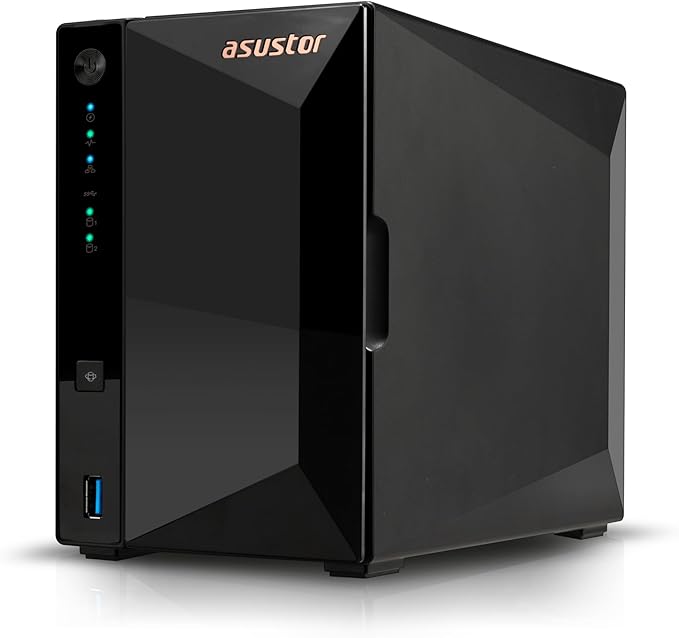
The Synology DS223 at $489 (Scorptec/Mwave) is the strongest home NAS in this bracket. Dual-bay, Realtek quad-core, 2GB RAM, and full DSM 7 including Synology Photos and Drive. The Asustor Drivestor 2 Pro Gen2 (AS3302T V2) at $389-$439 (PLE/Scorptec) offers 2.5GbE networking in a dual-bay form factor, which is notable at this price. The QNAP TS-233 at $469-$499 (Scorptec/PLE) adds dual 2.5GbE and 4GB RAM. For more options, see our best NAS under $500 guide.
| Synology DS223 | $489 (Scorptec / Mwave) |
|---|---|
| Asustor Drivestor 2 Pro Gen2 AS3302T V2 | $389 (PLE) / $439 (Scorptec / Mwave) |
| QNAP TS-233 | $469 (Scorptec) / $499 (PLE) |
| TerraMaster F2-425 | $459 (Scorptec) |
$500-$1,000. The Sweet Spot
This is where the best value lives for most Australian NAS buyers. The Synology DS225+ at $549-$599 (Scorptec/PLE) brings Intel Celeron, 2.5GbE, and the full DSM Plus feature set including Synology Drive, Active Backup, and snapshot replication. The Synology DS425+ at $819-$999 (Scorptec/PLE) extends to four bays with the same Plus-series capabilities. The QNAP TS-464 at $999-$1,099 (Scorptec/PLE) is the go-to for buyers who want four bays, Intel Celeron N5095, 8GB RAM, and dual 2.5GbE. Strong for Docker, Plex, and virtualisation workloads. For a full breakdown, see our best NAS under $1,000 guide.

| Synology DS225+ | $549 (Scorptec) / $585 (Mwave) / $599 (PLE) |
|---|---|
| Synology DS425+ | $819 (Scorptec) / $899 (Mwave) / $999 (PLE) |
| Synology DS925+ | $995 (Scorptec) / $1,029 (Mwave) |
| QNAP TS-464 | $999 (Scorptec) / $1,099 (PLE) |
| Asustor Lockerstor 4 Gen2 AS6804T | $775 (Scorptec) |
| TerraMaster F4-425 | $659 (Scorptec) |
Over $1,000. Business and Prosumer
The Synology DS1525+ at $1,285-$1,399 (Mwave/Scorptec) is a 5-bay Ryzen-powered NAS that suits growing storage needs and business deployments. The Synology DS1825+ at $1,799 (Scorptec) extends to 8 bays. The QNAP TS-473A at $1,369-$1,489 (Scorptec/PLE) offers Ryzen V1500B and 8GB RAM in a 4-bay form factor with strong virtualisation performance. The QNAP TS-664 at $1,549-$1,649 (PLE/Scorptec) adds 6 bays with Celeron and dual 2.5GbE. For business buyers, the formal quote approach mentioned above becomes essential at this price point. A 5% sharpening on a $1,500 NAS saves $75 with a single email.

| Synology DS1525+ | $1,285 (Mwave) / $1,399 (Scorptec) |
|---|---|
| Synology DS1825+ | $1,799 (Scorptec) |
| QNAP TS-473A | $1,369 (Scorptec) / $1,489 (PLE) |
| QNAP TS-664 | $1,549 (PLE) / $1,649 (Scorptec) |
| TerraMaster F4-424 Pro | $1,099 (Scorptec) / $1,100 (Mwave) |
The 2026 Storage Market. Why Timing Matters More Than Usual
The total cost of a NAS build is not just the enclosure. Drives represent a significant portion. In 2026, HDD and SSD prices have risen sharply from early 2025 levels. NAS-grade drives that were comfortably under $160 for 4TB models in early 2025 are now consistently above $200. This is driven by NAND supply constraints and surging AI-related demand across the storage industry. Synology’s own Plus Series 4TB drive (HAT3300-4T) is $299 at Scorptec, and their 8TB (HAT3320-8T) is $499.
Distributors are securing stock allocations further forward than usual, which signals ongoing supply chain uncertainty. For deal-seekers, this means drive bundles and sale-event pricing on drives matter as much as the NAS discount itself. When you find a good drive price, buy it. The price is more likely to go up than down in the current market. The same logic applies to the NAS enclosure: if the model you want is in stock and the price is reasonable, waiting for a theoretical future discount is a gamble against stock availability.
NBN context: If you plan to use your NAS for remote access or cloud sync, factor in your NBN upload speed. A typical NBN 100 plan delivers about 40-50 Mbps upload. Roughly 5-6 MB/s. Initial cloud backups of large libraries will take days or weeks. Some NBN connections also use CGNAT, which blocks inbound connections and makes remote access without a VPN or relay service difficult. Check your connection type before relying on remote NAS access. See our NAS remote access guide for setup details.
ACL Protections and Why They Matter for Deal-Hunting
When chasing the cheapest price, it is easy to overlook after-sales support. Australian Consumer Law protections apply when purchasing from Australian retailers. And the place of purchase is responsible for warranty claims, not the manufacturer. Synology, QNAP, and Asustor do not have service centres in Australia. Your warranty claim goes to the retailer, who escalates through their distributor to the vendor in Taiwan. Expect 2-3 weeks minimum for a resolution.
This is why buying from a specialist like Scorptec or PLE. Even if the price is $20-40 more than the cheapest option. Can be the better deal in the long run. A specialist retailer can access distributor and vendor stock to find you a replacement. Amazon can only offer what is in their warehouse. Before buying from any retailer, ask: "If this unit fails, what is your warranty process? Is an advanced replacement available?" The answer tells you more about the value of buying from that retailer than the price on the screen. For more on Australian warranty specifics, see our where to buy a NAS in Australia guide.
This article contains general consumer guidance and is not legal advice. For official information on your consumer rights under Australian Consumer Law, visit accc.gov.au.
If you're looking at end-of-life units, our Netgear ReadyNAS Australia guide explains what to know before buying a discontinued model in the AU market.
Before you buy, our RAID Calculator shows usable capacity for your target drive configuration. Useful for confirming a deal actually delivers the storage you need.
When is the best time to buy a NAS in Australia?
EOFY (June) consistently delivers the deepest NAS discounts in Australia, with 5-15% off across major retailers including Scorptec, PLE, and Mwave. Black Friday/Cyber Monday (late November) is the second-best window. However, Australian tech retailers now run rolling promotions throughout the year. If you need a NAS now, the price you see today will not be dramatically different in six months. In 2026’s constrained supply environment, the stock availability risk of waiting often outweighs the potential saving.
Is it safe to buy a NAS from Amazon Australia?
Amazon AU is a valid option for technically confident buyers who do not need pre-sales advice or hands-on post-sales support. Amazon’s return and refund process is excellent. However, if your NAS fails and you need a like-for-like replacement, Amazon may not have stock. Particularly for older or higher-end models. They will typically push to issue a credit rather than source a replacement. When you buy from a specialist reseller, they can access distributor and vendor stock through the official supply chain to find you a direct replacement. Amazon does not have this channel relationship.
Should I buy a NAS from a grey importer to save money?
Grey imports can save 10-20% but carry meaningful support risks. ACL applies to the seller regardless of stock origin, so you have warranty rights. The practical problem is that grey importers buy in limited batches. If that stock sells through and you need a warranty replacement, you may receive a credit for the cheap price you paid while the official replacement costs significantly more. Grey imports are reasonable for non-critical personal use with strong backups in place. They are a poor choice for business deployments, first-time NAS buyers, or any scenario where the NAS holds the only copy of important data.
Do Australian NAS retailers price-match each other?
Several do. Scorptec, PLE, and Mwave all offer forms of price-matching against other authorised Australian retailers on in-stock items. Because NAS margins are 3-5%, most retailers are already close to each other on price. The real savings come from requesting formal business quotes (where resellers can access distributor and vendor pricing support) and timing purchases around major sale events like EOFY and Black Friday.
Are NAS + drive bundles worth buying?
Yes, when available. Bundles from retailers like Scorptec typically offer 5-10% savings over buying the NAS and drives separately, and they guarantee drive compatibility. With NAS-grade drive prices rising significantly in 2025-2026, bundled drive pricing can represent real value. Scorptec currently lists NAS + HDD bundles starting from $628. The main drawback is limited choice. Bundles typically include a specific drive model and capacity, which may not match your preferred configuration.
Should I wait for a new NAS model or buy the current one on sale?
If the outgoing model is available at a discount and meets your requirements, buy it. Outgoing NAS models are proven hardware with mature firmware, established community guides, and known reliability. New models can take 3-6 months for all firmware features to stabilise. The exception is when the new model introduces a capability you specifically need. For example, the jump from 1GbE to 2.5GbE networking in Synology’s 2025-era Plus series was meaningful for users with upgraded home or office networks. Synology typically launches in January/February, so avoid buying in December if a refresh is expected.
How much can I realistically save during a NAS sale in Australia?
Expect 5-15% off during major sale events like EOFY and Black Friday. On a $1,000 NAS, that translates to $50-$150 in savings. Larger savings are possible on outgoing models being cleared for new releases (10-20% off) or on open-box and ex-demo units (10-25% off). Business buyers requesting formal quotes can often match or beat sale pricing at any time of year. Do not expect deep discounts beyond 15% on current-model NAS hardware. The margins simply do not allow it.
Need help choosing the right NAS for your budget? Our complete buying guide compares every major brand and model available in Australia right now.
Read the Full Guide →