A NAS running 24/7 in Australia costs anywhere from $25 to $200+ per year in electricity. And most buyers make this decision without knowing which number applies to their setup. The difference comes down to model, drive count, and whether power management is configured. This guide covers real measured wattage for current Synology and QNAP models, annual cost calculations by AU state, HDD vs SSD power trade-offs, and the specific power management settings that reduce running costs most. Figures are based on vendor specifications and independent measurements, not marketing claims. Use the NAS Power Cost Calculator to run the numbers for your specific setup.
In short: A typical 2-bay NAS (e.g. Synology DS225+) draws 5-8W idle and 15-25W active. At NSW rates (~$0.35/kWh), that is around $15-$25/year idle or $45-$75/year if the drives never spin down. Add two 4TB HDDs at ~5W each in active use and costs rise further. Enable HDD spin-down and scheduled sleep to cut running costs by 30-60%.
Why NAS Power Consumption Matters in Australia
Australian electricity prices are among the highest in the world for residential customers. NSW sits around $0.32-$0.38/kWh depending on your retailer and tariff; Victoria and Queensland are typically $0.26-$0.30/kWh. These rates make a meaningful difference when a device runs 8,760 hours a year. A NAS that draws 20W continuously costs about $61/year in NSW. Double that for a power-hungry 4-bay with four spinning drives and no sleep settings.
Electricity costs for NAS devices are often overlooked at purchase time. Buyers focus on the hardware price tag, then realise the ongoing cost compounds over the 5-8 year life of a typical NAS. A $786 DS425+ running at 25W idle in NSW racks up roughly $77 per year. Over five years that is another $385 on top of the hardware. Choosing a more efficient model or enabling spin-down settings is as real an investment as the hardware itself.
For solar households, the calculation changes. If your NAS runs during daylight hours, you may be self-consuming solar generation that would otherwise be exported at a low feed-in tariff (currently 5-8c/kWh for most AU retailers). A NAS consuming power during export hours has an effective electricity cost of 5-8c/kWh. Far lower than the buy rate. Time-of-use tariffs also matter: off-peak rates (typically 10pm-7am on some Ausgrid plans) can be 30-40% cheaper than peak. Scheduling backup jobs and major file transfers during off-peak periods is a practical saving.
Use the NTKIT Power Calculator to estimate your exact running cost at your state's current electricity rate: Power Calculator. The tool uses live verified AU electricity rates for NSW, VIC, QLD, SA, WA and ACT.
NAS Idle vs Active Power: What the Numbers Actually Mean
NAS power consumption is measured in watts (W) and reported at two key states: idle (drives spun up but no read/write activity) and active (drives under read/write load). Vendors also report a hibernation or sleep figure when all drives have spun down. These three figures are what you need to estimate real-world running costs.
The NAS enclosure itself. CPU, RAM, network interface, fans. Accounts for a significant portion of idle draw. For a Synology DS225+, the enclosure alone draws roughly 4-5W. Each hard drive adds another 3-6W when spun up and 0.5-1.5W when spun down. SSDs eliminate the spin-down/active difference: they draw 0.5-3W regardless of activity state, making them inherently more energy-efficient for idle-heavy NAS use cases.
The distinction between idle and active power matters for time-of-use billing. If your NAS is idle 90% of the time. Typical for a home media server or personal backup device. The idle figure is what drives your annual bill. If you run Plex 24/7 or have a surveillance NAS with 8 cameras constantly recording, active power consumption is more relevant.
Real Wattage: Key Models Measured
The following figures are based on vendor specifications and independent third-party measurements. Vendor specs are generally accurate for idle and hibernation but can understate active power under sustained load. Where ranges are given, the lower figure reflects drives spun down (hibernation mode) and the upper figure reflects active read/write with drives at full speed. Drive count and drive model affect the total. Figures below assume the indicated number of WD Red Plus or Seagate IronWolf drives.
NAS Model Wattage: Idle, Active and Hibernation
 DS225+ (2-bay)
|
 DS425+ (4-bay)
|
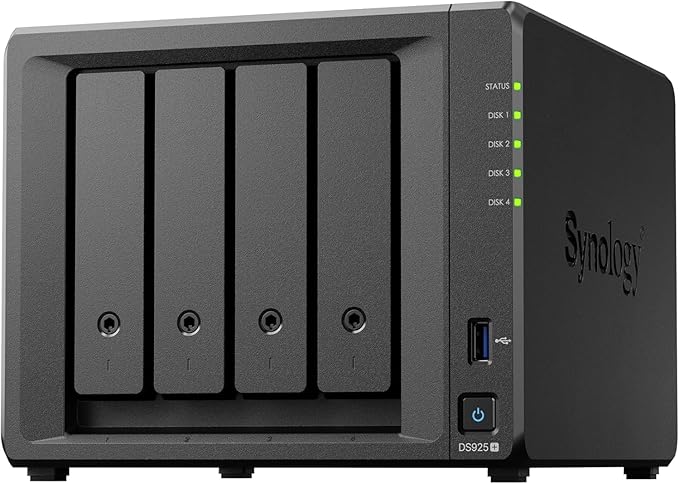 DS925+ (4-bay)
|
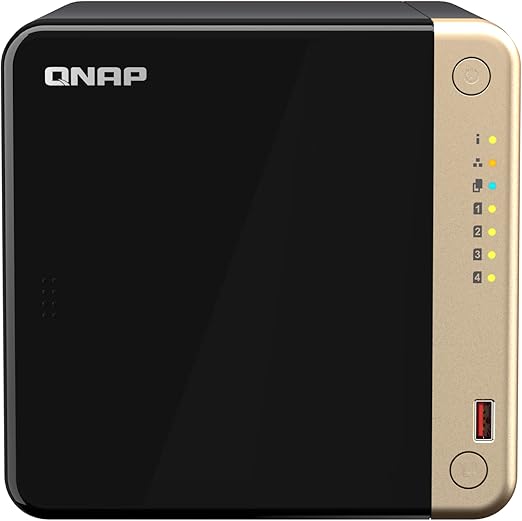 TS-464 (4-bay)
|
 TS-233 (2-bay)
|
AS3304T (4-bay) | |
|---|---|---|---|---|---|---|
| Hibernation / Sleep (W) | 0.8W | 1.2W | 1.5W | 2.1W | 0.8W | 1.0W |
| Idle. Drives spun up (W) | 5.5W | 15W | 18W | 17W | 5.5W | 14W |
| Active. Sustained R/W (W) | 18W | 28W | 33W | 31W | 12W | 26W |
| Max rated (W) | 25W | 35W | 40W | 40W | 18W | 30W |
| CPU platform | ARM (Realtek) | ARM (Realtek) | AMD x86 | Intel x86 | ARM (Realtek) | Intel x86 |
| Drive bays | 2 | 4 | 4 | 4 | 2 | 4 |
| AU price (approx.) | $599 (PLE Computers) | $819 (Scorptec) | ~$994 | ~$989 | $399 (PLE Computers) | $585 (Mwave) |
Prices last verified: 16 March 2026. Always check retailer before purchasing.
The DS225+ is notably efficient for a 2-bay NAS, owing to Synology's ARM platform which draws far less than Intel or AMD x86 CPUs. The DS925+ and TS-464 both use more powerful processors. You pay for that performance in electricity, drawing 3x more than the DS225+ under load. For users who do not need transcoding or heavy compute, the ARM-based 2-bay models are the most cost-efficient long-term option.
Annual Electricity Cost by AU State
Australian electricity rates vary significantly by state. The following calculations use mid-2026 residential single-rate tariffs as a baseline. Time-of-use customers will see different results depending on when their NAS is most active. All figures assume 8,760 hours/year operation (24/7) at the stated idle wattage with drives spun up. In practice, spin-down settings reduce actual consumption by 30-60% for typical home use.
Annual Running Cost by State (2026 Rates, 24/7 at Idle. Drives Spun Up)
| NSW (~$0.35/kWh) | VIC (~$0.28/kWh) | QLD (~$0.28/kWh) | SA (~$0.42/kWh) | WA (~$0.31/kWh) | |
|---|---|---|---|---|---|
| DS225+ idle (5.5W) | $17/yr | $13/yr | $13/yr | $20/yr | $15/yr |
| DS225+ active (18W) | $55/yr | $44/yr | $44/yr | $66/yr | $49/yr |
| DS425+ idle (15W) | $46/yr | $37/yr | $37/yr | $55/yr | $41/yr |
| DS425+ active (28W) | $86/yr | $69/yr | $69/yr | $103/yr | $76/yr |
| DS925+ idle (18W) | $55/yr | $44/yr | $44/yr | $66/yr | $49/yr |
| DS925+ active (33W) | $101/yr | $81/yr | $81/yr | $121/yr | $90/yr |
| TS-464 idle (17W) | $52/yr | $42/yr | $42/yr | $63/yr | $46/yr |
| TS-464 active (31W) | $95/yr | $76/yr | $76/yr | $114/yr | $84/yr |
SA users note: South Australia has the highest residential electricity rates in Australia (~$0.42/kWh). Running a 4-bay NAS with four spinning drives and no sleep settings can cost $120-$160/year in SA. Nearly double the same setup in VIC or QLD. Power management is especially important for SA-based NAS owners.
Hard Drive Power Draw: HDD vs SSD in a NAS
The drives inside a NAS often contribute more to total power consumption than the NAS enclosure itself. A 4-bay NAS with four 8TB HDDs draws approximately 18-24W from the drives alone when active. Replace those with four 4TB SSDs and the drive contribution drops to 2-6W. The enclosure power stays the same. The difference is entirely in the storage media.
For NAS use cases dominated by idle time. Personal backup, media storage, time capsule replacement. HDDs with spin-down configured are often cheaper to run long-term than SSDs, because HDDs drop to 0.5-1W per drive when hibernating. SSDs idle at 0.5-1.5W per drive but never truly spin down. Over a 5-year period with typical home use (3-4 hours of actual activity per day, 20 hours idle), the electricity cost difference is negligible. SSDs win on silence, shock resistance, and write endurance for write-heavy workloads.
NAS Drive Power Draw: HDD vs SSD Side by Side
 WD Red Plus 4TB
|
 Seagate IronWolf 4TB
|
 WD Red Plus 8TB
|
Seagate IronWolf 6TB
|
WD Red NAS SSD 4TB SSD | Samsung 870 EVO 4TB SSD | |
|---|---|---|---|---|---|---|
| Drive type | HDD | HDD | HDD | HDD | SATA SSD | SATA SSD |
| Active read/write (W) | 5.3W | 5.0W | 6.4W | 5.0W | 2.0W | 3.0W |
| Idle. Spun up (W) | 3.3W | 3.2W | 4.1W | 3.0W | 0.6W | 0.5W |
| Standby / spin-down (W) | 0.4W | 0.5W | 0.5W | 0.5W | 0.6W | 0.5W |
| 4x drives idle total | 13.2W | 12.8W | 16.4W | 12W | 2.4W | 2.0W |
| 4x drives active total | 21.2W | 20W | 25.6W | 20W | 8.0W | 12W |
| Annual idle cost NSW (35c/kWh) | $40/yr | $39/yr | $50/yr | $37/yr | $7/yr | $6/yr |
The numbers make a compelling case for SSD in small NAS deployments where cost per TB is acceptable. A 2-bay NAS with two 4TB SSDs draws as little as 6-8W total system idle. Comparable to a 2-bay HDD NAS with drives in hibernation. The trade-off is price: 4TB NAS SSDs cost $300-$500 each versus $130-$180 for an equivalent NAS HDD. For pure home backup use, the SSD running cost saving rarely justifies the upfront premium. For a write-heavy workload like 24/7 surveillance recording, SSDs earn their keep through write endurance, not just power savings. For a deep dive on drive selection see Best NAS Hard Drives Australia.
Power Management: Spin-Down, Scheduled Sleep and Wake-on-LAN
The biggest lever for reducing NAS running costs is power management configuration. Most NAS devices from Synology, QNAP and Asustor support three key features:
- HDD spin-down: Configures drives to park and spin down after a period of inactivity (typically 10-30 minutes). Reduces drive power draw from 3-5W per drive to 0.4-0.8W per drive. Synology calls this HDD Hibernation in DSM; QNAP calls it HDD Standby in QTS. Enable in DSM under Control Panel > Hardware and Power > HDD Hibernation.
- Scheduled sleep / deep sleep: Powers down the NAS entirely on a schedule. Useful for NAS devices that are only accessed during business hours or overnight backup windows. The NAS draws 0.8-2W in deep sleep. Set a wake schedule 10 minutes before your backup job to ensure drives are spun up when needed.
- Wake-on-LAN (WoL): Allows the NAS to be woken remotely from a sleep state with a network packet. WoL requires the NAS to support it (most Synology and QNAP models do) and your router or switch to allow magic packet broadcasts. Useful for accessing a sleep-scheduled NAS on demand without leaving it running 24/7.
Spin-down and surveillance NAS: If you are using your NAS for IP camera recording (Synology Surveillance Station or QNAP QVR Pro), do NOT enable HDD spin-down. Surveillance workloads require constant write access. Drives spinning down and up repeatedly causes premature head wear and risks dropped frames. Leave drives running 24/7 for surveillance NAS deployments and budget accordingly for higher running costs.
For typical home NAS use (media storage, backup, occasional file access), spin-down combined with a scheduled sleep window can cut electricity consumption by 50-70%. A DS425+ that would otherwise cost $86/year in NSW at idle drops to $30-$50/year with aggressive power management. A saving of $35-$55 per year, every year.
2-Bay vs 4-Bay vs 8-Bay: Running Cost Comparison
Bay count is the single biggest predictor of NAS running cost. More bays mean more drives, more drive power draw, larger fans, and often a more powerful CPU platform. The following comparison uses representative models from AU retail stock, configured with WD Red Plus drives at each capacity point. All annual cost figures use NSW rates ($0.35/kWh) and assume 24/7 operation at idle with drives spun up. The realistic baseline for a home NAS with no aggressive power management configured.

| DS225+ (2-bay, ARM) | 5.5W idle + 2x 4TB HDD (6.6W) = ~12W total. NSW: ~$37/yr idle, ~$55/yr active |
|---|---|
| DS425+ (4-bay, ARM) | 15W idle + 4x 4TB HDD (13.2W) = ~28W total. NSW: ~$86/yr idle, ~$105/yr active |
| DS925+ (4-bay, AMD x86) | 18W idle + 4x 4TB HDD (13.2W) = ~31W total. NSW: ~$95/yr idle, ~$120/yr active |
| DS1825+ (8-bay, Intel x86) | ~35W idle + 8x 4TB HDD (26.4W) = ~61W total. NSW: ~$187/yr idle, ~$220/yr active |
| TS-433 (4-bay, ARM) | ~12W idle + 4x 4TB HDD (13.2W) = ~25W total. NSW: ~$77/yr idle, ~$95/yr active |
| TS-873A (8-bay, AMD) | ~45W idle + 8x 4TB HDD (26.4W) = ~71W total. NSW: ~$218/yr idle, ~$250/yr active |
The jump from 2-bay to 4-bay adds roughly $40-$55/year in running costs in NSW. Mostly from the additional drives. The jump from 4-bay ARM (DS425+) to 8-bay Intel/AMD (DS1825+) adds another $90-$100/year. For home users who do not need 8 bays of capacity, the electricity cost of a large NAS is a strong argument for sticking with 4 bays and expanding capacity per bay using higher-capacity drives.
Higher capacity per drive = lower cost per TB: A single 8TB drive draws only ~1W more than a 4TB drive but stores twice the data. Choosing 8TB drives over 4TB in a 2-bay NAS gives you the same running cost for double the storage. For power-sensitive deployments, maximise capacity per drive rather than adding bays.
WD Red Plus vs Seagate IronWolf: Power Draw Side by Side
WD Red Plus and Seagate IronWolf are the two dominant NAS-class HDD lines in Australia. Both are designed for 24/7 operation, use CMR recording (not SMR), and carry 3-year warranties. Their power consumption is comparable. The differences are small enough that drive selection should be based on compatibility, price and availability rather than wattage alone.
At current pricing, 4TB IronWolf and WD Red Plus drives are closely matched. The annual running cost difference between them is less than $5/year even in a 4-bay setup. Drive selection should be based on price, availability, and platform compatibility rather than wattage. For current AU pricing on both lines, see the Best NAS Hard Drive Australia guide.
The WD Red Pro and Seagate IronWolf Pro lines carry 5-year warranties and are rated for higher workloads (180TB/year sustained write). They draw slightly more power (6-8W active vs 5-6W for standard) but the difference over a year is only $5-$10. The Pro lines are worth considering for NAS devices that see heavy daily write activity. Surveillance, frequent large backup jobs, or business file servers. For typical home use, the standard lines are appropriate and more cost-effective.
UPS Sizing for Your NAS
An Uninterruptible Power Supply (UPS) protects a NAS from power outages and brownouts. For NAS specifically, a UPS serves two purposes: keeping the NAS running through brief outages, and providing a clean shutdown signal so the NAS can close open files safely before power is lost. A NAS that loses power mid-write can corrupt a RAID volume. A risk that a UPS eliminates for a modest investment.
Sizing a UPS requires knowing the total load in watts and the runtime you need. For home NAS use, 5-10 minutes of runtime is typically sufficient to ride through brief outages or allow a clean shutdown. Business NAS deployments may want 15-30 minutes. UPS capacity is measured in VA (volt-amperes) and watts. A typical home NAS with four HDDs draws 25-40W. A 650VA/360W UPS provides 10+ minutes of runtime at that load. For an 8-bay NAS with 6+ drives drawing 60-80W, step up to a 1000VA/600W UPS.
Calculate your UPS runtime precisely with the NTKIT UPS Runtime Estimator: UPS Runtime Estimator. Input your NAS wattage and UPS capacity to get estimated runtime in minutes.
| 2-bay NAS + 2x HDD (~20W total) | Recommended UPS: 650VA/360W. Runtime at 20W: ~60 min. More than enough for a clean shutdown. |
|---|---|
| 4-bay NAS + 4x HDD (~35W total) | Recommended UPS: 650VA/360W. Runtime at 35W: ~30 min. Add modem/router to same UPS for remote access during outage. |
| 4-bay NAS + 4x HDD + switch (~50W total) | Recommended UPS: 1000VA/600W. Runtime at 50W: ~30 min. |
| 8-bay NAS + 8x HDD (~70W total) | Recommended UPS: 1000VA/600W. Runtime at 70W: ~20 min. |
| 8-bay NAS + 8x HDD + 10GbE switch (~100W total) | Recommended UPS: 1500VA/900W or 2000VA/1200W for 30+ min runtime. |
Synology DSM and QNAP QTS both support USB and network UPS communication (NUT protocol). Connect a compatible UPS via USB and configure the NAS to automatically shut down safely when battery level drops to 20-30%. APC, Eaton and CyberPower are the most commonly stocked UPS brands in Australia and are compatible with NUT. Check the UPS manufacturer's compatibility list before purchasing. Synology publishes a compatibility list on their support site.
Time-of-Use Tariffs and Solar: Reducing Your NAS Running Cost
For Australian households on time-of-use (TOU) electricity tariffs, the cost of running a NAS varies significantly by time of day. Peak rates on Ausgrid (Sydney) networks can reach $0.58/kWh during 2-9pm on weekdays; shoulder rates are around $0.22/kWh; off-peak (10pm-7am) around $0.16/kWh. Scheduling backup jobs, media processing, and large file transfers to off-peak windows can cut the effective running cost of a NAS by 50-60% compared to a flat-rate tariff consumer.
For solar households, the NAS is an ideal load to run during peak generation hours (roughly 10am-2pm) when solar output exceeds household consumption. Rather than exporting at 5-8c/kWh feed-in tariff, self-consuming at that effective rate versus paying 35c/kWh buy rate means the NAS effectively costs far less to run during solar-generating hours. Aligning media encoding, full backup jobs and cloud sync to 10am-2pm can substantially reduce net electricity cost for solar households.
Synology's DSM task scheduler allows you to configure backup jobs to run at specific hours. QNAP's QTS has a similar scheduler under Backup Station. Set large backup jobs to run during off-peak or solar window hours. For surveillance NAS deployments where drives must run 24/7, time-of-use scheduling does not help. The load is constant by nature.
Which NAS Has the Lowest Running Cost for Home Use?
For home users who want the lowest possible electricity cost, ARM-based 2-bay NAS devices are the clear winner. The Synology DS225+ draws only 5.5W idle. Less than an LED bulb. With two drives in hibernation, total system draw drops under 2W. Over a year in NSW, that is under $6 in electricity. Even fully active at 18W, the DS225+ costs only $55/year. Available from major AU retailers from around $539, it pays for itself in electricity savings compared to a 4-bay x86 NAS within 2-3 years.
For users who need 4-bay capacity, the DS425+ (ARM-based) is significantly more efficient than the DS925+ (AMD x86) for idle-heavy workloads. The DS425+ costs roughly $40/year less to run in NSW than the DS925+. Choose the DS925+ only if you need transcoding, virtualisation, or heavy Docker workloads. Its x86 CPU earns its electricity cost only when under load. For the full picture on which model suits which use case, see the Best NAS Australia guide.
The QNAP TS-233 is worth noting for pure power efficiency. Its ARM-based platform draws as little as 5.5W idle with two drives, comparable to the DS225+. Available from around~$538, it is the most affordable path to a low-power 2-bay NAS in Australia. QNAP's QTS software is more feature-rich but also more complex than Synology DSM, which can be a consideration for first-time NAS users.
For those deciding between a dedicated NAS versus a repurposed PC or mini PC, the NAS wins on power consumption every time. An old PC running as a home server draws 60-150W continuously. A dedicated NAS draws 5-25W. The electricity savings alone can justify a NAS purchase within 1-2 years for most households. For broader context on the NAS value proposition, see our guide to NAS vs Cloud Storage Australia and What Is a NAS?
Power Consumption for Business NAS: What Changes
Business NAS deployments have different power consumption profiles from home NAS. Key differences:
- Higher drive counts: Business NAS typically runs 4-12 bays, all populated. Drive count is the dominant cost factor. A fully populated DS1525+ (5-bay) with 5x 8TB IronWolf draws 45-65W active.
- 24/7 active duty: Unlike home NAS where drives spend most time in hibernation, a business NAS serving 5-20 users has drives spinning continuously. Budget for active-state power, not idle.
- Redundant power supplies: Higher-end rackmount NAS (RS1221RP+, TS-832PXU-RP) include dual power supplies. The redundant PSU draws a small baseline load even when not in active use. Typically 5-15W additional.
- Business electricity tariffs: Commercial customers in Australia often pay $0.18-$0.35/kWh depending on contract and load profile. Always check your actual business electricity rate before calculating NAS running costs. It may be lower than the residential rate used in this guide's examples, or higher if you are on a small business plan.
For small business NAS deployments, the DS1525+ or QNAP TS-664 represent the sweet spot. Both offer 5-6 bays with capable x86 platforms, draw 25-45W active with a full load of NAS-class HDDs, and cost $80-$140/year to run in NSW at typical rates. The DS1525+ starts from $1,234 at major AU retailers including Mwave, Scorptec and PLE. For business deployments, purchasing from a specialist reseller rather than a consumer-focused retailer gives you access to genuine pre-sales guidance and a better warranty support pathway.
Further Reading
Power consumption is one factor in choosing the right NAS setup. For the full picture, these guides cover the decisions that surround a NAS purchase:
- Best NAS Australia 2026. Model recommendations across all use cases and budgets
- Synology NAS Australia. Full Synology ecosystem guide including model lineup and DSM features
- Synology vs QNAP. Head-to-head comparison of the two dominant brands
- NAS Remote Access and VPN Australia. Configure access to your NAS from outside your network
- Where to Buy a NAS in Australia. Retailer guide, price comparison tips, and ACL advice
- NAS vs Cloud Storage Australia. Total cost of ownership comparison including power costs
- 3-2-1 Backup Strategy. Protect your data with a proper backup architecture
- NAS RAID Explained. How RAID works, which level to choose, and what it protects against
- Best NAS Hard Drives Australia. IronWolf vs WD Red and other NAS-rated drive options
- What Is a NAS?. Start here if you are new to NAS
Use our free Old PC vs NAS Calculator to compare running costs of repurposing an old PC against buying a NAS.
How much does a NAS cost to run per year in Australia?
A typical 2-bay home NAS (e.g. Synology DS225+) with two 4TB hard drives costs $15-$55/year in NSW at current electricity rates ($0.35/kWh), depending on whether drives are configured to spin down. A 4-bay NAS (e.g. DS425+) with four drives runs $46-$86/year at idle to active. An 8-bay business NAS with a full drive complement can cost $150-$220/year. Enabling HDD spin-down and scheduled sleep can reduce running costs by 30-60%.
Does enabling HDD spin-down actually save money?
Yes, meaningfully so. A 4TB NAS HDD draws 3-5W when spun up and only 0.4-0.8W when parked and spun down. In a 4-bay NAS, configuring spin-down after 20 minutes of inactivity can save 10-16W during the 18-20 hours per day the NAS is typically idle. Over a year in NSW, that is a saving of $30-$50 per year. The trade-off is a 5-15 second delay when waking drives. Acceptable for most home use cases. Not suitable for surveillance NAS or constant-write workloads.
Is it cheaper to run a NAS with SSDs or HDDs?
It depends on your use pattern. SSDs draw 0.5-2W per drive versus 3-5W for HDDs when spun up. In a 4-bay NAS running 24/7, SSDs save roughly $40-$55/year in drive power at NSW rates compared to HDDs. However, 4TB NAS SSDs cost $300-$500 each versus $130-$180 for 4TB NAS HDDs. A $700-$1,300 upfront premium for four drives. The electricity saving does not justify the price premium for most home users over a 5-year period. SSDs are worth it for write-heavy workloads, silent operation, or environments where reliability under vibration matters.
What size UPS do I need for my NAS?
For a 2-bay home NAS drawing 15-20W total, a 650VA/360W UPS provides 30-60 minutes of runtime. Far more than needed for a clean shutdown. For a 4-bay NAS drawing 30-40W, a 650VA/360W UPS gives 15-25 minutes. For an 8-bay NAS with full drive complement drawing 60-80W, use a 1000VA/600W UPS for 15-20 minutes runtime. Add your router and switch to the same UPS so network access is maintained during the outage. Use the NTKIT UPS Runtime Estimator to calculate your specific scenario.
How do WD Red Plus and Seagate IronWolf compare on power consumption?
WD Red Plus and Seagate IronWolf draw nearly identical power at equivalent capacities. Both 4TB variants draw approximately 5W active and 3-3.3W idle when spun up, dropping to 0.4-0.5W in standby. At 4 drives in a 4-bay NAS, the annual running cost difference between IronWolf and WD Red Plus is under $5/year at NSW electricity rates. Choose whichever is better priced or more readily available. Power consumption should not be a deciding factor between these two drives.
Does a NAS use more power with more hard drives installed?
Yes. Hard drives are the dominant power consumer in most NAS configurations. Each additional NAS HDD adds 3-6W active and 0.4-0.8W in standby. A fully populated 4-bay NAS draws roughly 12-20W more than the same NAS with no drives installed. This is why 8-bay NAS devices cost significantly more to run than 2-bay devices even with comparable CPUs. The drives account for most of the difference. For users who do not need 4 bays of capacity, a fully populated 2-bay NAS with high-capacity drives is more power-efficient than a partially filled 4-bay.
What is the most power-efficient NAS for home use in Australia?
ARM-based 2-bay NAS devices offer the lowest running costs. The Synology DS225+ draws only 5.5W idle with drives spun up and under 2W in deep sleep. As little as $6-$17 per year in NSW depending on usage pattern. The QNAP TS-233 is similarly efficient and starts from around $340 at Australian retailers. For home users who do not need transcoding or virtualisation, ARM-based 2-bay NAS devices are the clear choice for power efficiency. Avoid x86 4-bay or 8-bay models unless you actively need the compute power. You will pay for the CPU in electricity every year regardless of whether you use it.
Can I reduce NAS running costs with solar power?
Yes. For solar households, running the NAS during peak generation hours (roughly 10am-2pm) means self-consuming solar that would otherwise be exported at the low feed-in tariff (currently 5-8c/kWh for most AU retailers). Scheduled backup jobs, media encoding, and cloud sync tasks can be timed to daylight hours using Synology DSM's task scheduler or QNAP QTS task manager. On a time-of-use tariff, shifting NAS-heavy tasks to off-peak hours (typically 10pm-7am on Ausgrid network plans) can halve the effective electricity cost per kWh for those operations.
Is it worth buying a NAS instead of using cloud storage to save power costs?
The economics depend on how much storage you need. For 1-4TB of data, cloud storage (Google One, iCloud+, Backblaze) costs $3-$15/month ($36-$180/year) with zero electricity overhead. A NAS with 4-8TB capacity costs $40-$100/year in electricity plus hardware amortisation. For 8TB or more of data, cloud costs become $20-$60/month ($240-$720/year). At which point a NAS's running cost ($40-$80/year) looks very attractive. The crossover point is typically around 4-8TB for most Australian households. See the full analysis in the NAS vs Cloud Storage guide.
Does running a NAS 24/7 noticeably affect electricity bills?
For a 2-bay home NAS drawing 10-15W with drives configured to spin down, the impact is modest. Around $1-$3 per month added to your electricity bill. A 4-bay NAS without power management running 24/7 at 30-40W adds $7-$12/month in NSW. This is noticeable on a bill but not dramatic. The bigger risk is an older or power-hungry NAS drawing 60-80W. Those can add $20-$25/month. Always check the rated wattage of any NAS you are considering against your electricity rate before purchasing.
Should I turn my NAS off when not in use?
For home users, a scheduled sleep window (e.g. 11pm-7am if no overnight backups run) is a good compromise. The NAS is available when needed but powered down during unused hours. Manually powering off and on a NAS daily is generally not recommended: the repeated spin-up/spin-down cycles create mechanical stress on hard drives, and repeated file system mounts create a small risk of file system errors over time. A scheduled sleep with a clean wake sequence is safer and more convenient. Most NAS devices support this via a built-in scheduler in DSM or QTS.
Does a NAS use electricity during backup jobs overnight?
Yes, and active power draw is significantly higher than idle. A DS425+ drawing 15W at idle spikes to 25-30W during a sustained backup job with all drives active. If your NAS runs a 2-hour overnight backup at 28W then idles for the remaining 22 hours at 15W, actual daily consumption averages roughly 16W. At NSW rates, that is around $50/year. Meaningfully less than the $86/year for constant active load. Scheduling backups to off-peak tariff windows saves additional money for time-of-use customers.
Estimate your NAS running cost at current Australian electricity rates. The NTKIT Power Calculator uses live verified state rates for NSW, VIC, QLD, SA, WA and ACT.
Open Power Calculator