AI features on NAS devices are no longer a marketing checkbox. But the gap between Synology, QNAP, and UGREEN is substantial, and only one platform is genuinely ready to run local AI workloads on hardware that most Australians can actually buy. In 2026, all three brands advertise some form of AI capability, ranging from photo recognition and smart search through to local large language model inference. The reality is more nuanced: Synology offers polished, consumer-ready AI tools baked into DSM with no technical overhead; QNAP goes significantly further with dedicated AI acceleration hardware and support for running local LLMs; and UGREEN NASync is an interesting new entrant with AI ambitions that currently outpace its ecosystem maturity. Which one suits you depends less on the marketing and more on what you actually plan to do with it.
In short: For most Australian home users and SMBs who want AI photo organisation and smart search without any technical setup, Synology is the safe choice. The DS925+ ($1,029 at Mwave) runs these features well on modest hardware. If you want to run local LLMs, AI inference, or build custom AI workflows, QNAP's TS-464 or TS-473A with a dedicated AI accelerator card is the only platform that can actually do it. UGREEN NASync is worth watching but not ready to lead on AI in 2026.
What 'AI Features' Actually Means on a NAS in 2026
The term 'AI' is used loosely across all three brands, so it helps to define the categories clearly before comparing them:
- Photo AI (recognition and tagging): Automatically identifying faces, objects, scenes, and locations in your photo library. All three brands offer some version of this.
- Smart search: Natural-language or semantic search across your files. Finding a document by describing what it contains rather than knowing its filename.
- On-device LLM inference: Running a local large language model (like Llama, Mistral, or similar open-weight models) directly on the NAS hardware. No cloud, no subscription, no data leaving your network. This requires dedicated hardware acceleration or a powerful CPU.
- AI-assisted surveillance: Object detection, person detection, and licence plate recognition in security camera footage, processed locally.
- Workflow automation with AI: Using AI models to classify, tag, or route files automatically as they arrive on the NAS.
The distinction matters because Synology's AI strengths sit firmly in the first two categories, QNAP competes seriously across all five, and UGREEN is currently strongest in the first category with aspirations toward the others.
Synology AI Features. Polished But Bounded
Synology's AI story in 2026 centres on Photos (the DSM photo management application) and the broader DSM 7.x intelligent search capabilities. Synology Photos uses on-device machine learning to automatically recognise faces, tag subjects, and identify scenes. All processed locally on the NAS without any data going to Synology's servers. For a family photo library or a small business with a media archive, this works genuinely well and requires zero configuration beyond enabling the feature.
The Universal Search function in DSM 7.x has been extended with semantic capabilities, meaning you can search across files in ways that go beyond exact filename matching. This is quietly useful for knowledge workers with large document libraries.
Synology also offers AI-driven features in Surveillance Station. The DVA1622 desktop NVR (a dedicated device rather than a standard NAS) supports deep video analytics including person and vehicle detection. For standard DS-series NAS units, Surveillance Station includes some motion-based AI detection but the more powerful analytics are reserved for DVA hardware.
The practical hardware requirement for Synology's photo AI is modest. The DS225+ (from $585 at Mwave, or $599 at PLE and Scorptec) with its Intel Celeron CPU handles face recognition and object tagging reasonably well for libraries under 50,000 photos. The DS425+ (from $899 at Mwave, $999 at PLE) is more comfortable for larger libraries. The DS925+ (from $1,029 at Mwave) with its quad-core CPU is the point where AI processing stops feeling like a background chore.
What Synology does not offer in 2026 is any pathway to running local LLMs or custom AI inference workloads on standard DSM hardware. There is no Synology-supported container or package for Ollama, llama.cpp, or similar tools in the way QNAP has formalised. Technically sophisticated users can run Docker containers on Plus-series hardware, but this is firmly in DIY territory and Synology does not document or support it as an AI use case.
Pros
- Photo AI (face recognition, object tagging) works well out of the box with zero configuration
- Processes everything locally. No cloud dependency or subscription required
- DSM semantic search is genuinely useful for document-heavy workloads
- Runs adequately on modest hardware. DS425+ handles most home/SMB photo libraries
- Surveillance Station AI detection available on standard NAS hardware (with limitations)
Cons
- No supported pathway to local LLM inference or custom AI model hosting
- Surveillance deep video analytics require dedicated DVA hardware, not standard NAS
- M.2 NVMe drive restrictions still apply on Plus series. Affects potential AI cache/storage setups
- AI features are deliberately bounded. Power users will hit the ceiling quickly
- No AI acceleration hardware options or expansion cards from Synology
Synology Models Relevant to AI. AU Pricing

| DS225+ | 2-bay, Intel Celeron J4125, 2GB DDR4 (expandable to 6GB). From $585 (Mwave) / $599 (PLE, Scorptec) |
|---|---|
| DS425+ | 4-bay, Intel Celeron J4125, 2GB DDR4 (expandable to 6GB). From $899 (Mwave) / $999 (PLE) / $819 (Scorptec) |
| DS725+ | 2-bay, AMD Ryzen R1600, 4GB DDR4 (expandable to 32GB). From $869 (Mwave, Scorptec) |
| DS925+ | 4-bay, AMD Ryzen R1600 (quad-core), 4GB DDR4 (expandable to 32GB). From $1,029 (Mwave) / $995 (Scorptec) |
| DS1525+ | 5-bay, AMD Ryzen V1500B, 8GB DDR4 (expandable). From $1,285 (Mwave) / $1,399 (Scorptec) |
| DS1825+ | 8-bay, AMD Ryzen V1500B, 4GB DDR4 (expandable). From $1,799 (Scorptec) |
The DS725+ and DS925+ are worth highlighting specifically for AI workloads within Synology's ecosystem. Their AMD Ryzen R1600 CPUs handle multi-threaded AI indexing noticeably better than the Intel Celeron-based DS225+ and DS425+. If photo AI performance matters to you. Particularly if your library is large or you're running Surveillance Station alongside Photos. The step up to Ryzen is worth the premium. The DS925+ at around $1,029 from Mwave is the recommended entry point for serious Synology AI use.
QNAP AI Features. The Most Capable Platform
QNAP is the most technically ambitious of the three brands when it comes to on-device AI in 2026, and the gap between QNAP and its competitors on this axis is significant. The platform's AI story has two distinct layers: the built-in AI features of QTS/QuTS Hero, and the hardware-accelerated AI capabilities unlocked by QNAP's dedicated AI expansion cards.
QTS built-in AI features mirror and extend what Synology offers. QuMagie (QNAP's photo management app) includes face recognition, object detection, and location-based organisation. AI-powered search works across files and photos. QNAP's Surveillance Station implementation includes video analytics that rival Synology's DVA hardware on standard QNAP NAS. Person detection, vehicle detection, and intrusion alerts are available across a wider range of standard QNAP models without requiring a specialised device.
The AI accelerator layer is where QNAP pulls away. QNAP's QM2 series expansion cards and the dedicated AI Core PCIe accelerator cards allow supported NAS models to run inference workloads using on-board NPU hardware rather than the main CPU. This is the foundation for running local LLMs, image generation models, and custom AI inference pipelines without cloud services.
More practically, QNAP officially supports Container Station for running Ollama, Open WebUI, and similar LLM serving frameworks as Docker containers. For a technically confident user, deploying a local instance of Llama 3 or Mistral on a QNAP TS-473A. Available from $1,369 at Scorptec or $1,489 at PLE. Is a documented and supported workflow, not a workaround. The Ryzen V1500B-based models have the CPU performance to run smaller quantised LLMs (7B parameter models at 4-bit quantisation) at acceptable speeds for interactive use.
QNAP's AI Hub application in QTS provides a unified interface for managing AI models, monitoring GPU/NPU utilisation, and deploying AI-powered applications from the App Center. This is a genuine differentiator. No other NAS vendor has a comparable framework for managing local AI workloads in 2026.
The trade-off is the characteristic QNAP complexity. Setting up a local LLM on QNAP requires comfort with Docker, Container Station, and some command-line interaction. Synology's photo AI, by contrast, just works. Both approaches are valid. They serve different users.
Pros
- Supports local LLM inference via Container Station and Ollama. Officially documented
- AI accelerator PCIe cards available for supported models. Hardware-level NPU support
- AI Hub application provides unified AI model management within QTS
- Surveillance Station video analytics on standard NAS hardware. No dedicated DVA device needed
- QuTS Hero ZFS platform well-suited for AI data pipelines requiring data integrity
- Widest range of CPU options. Ryzen and higher-end processors for heavier AI workloads
Cons
- Significantly steeper learning curve. AI features require technical confidence to deploy
- QNAP pricing has increased nearly 100% since 2020-2021. AI-capable models carry a premium
- Production delays on some models due to global chip/RAM shortages. Verify stock before planning
- AI Hub and accelerator ecosystem still maturing. Documentation can be inconsistent
- QTS interface complexity can overwhelm less technical users before they reach the AI features
QNAP Models Relevant to AI. AU Pricing
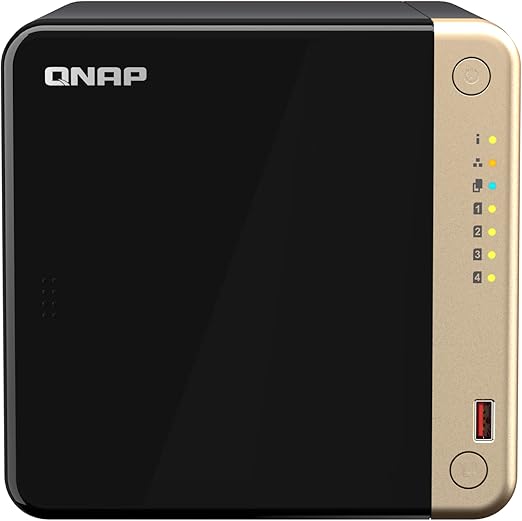
| TS-264-8G | 2-bay, Intel Celeron N5095, 8GB DDR4. From $819 (PLE) / $917 (Mwave) / $949 (Scorptec). Suitable for basic AI features and photo indexing. |
|---|---|
| TS-464-8G | 4-bay, Intel Celeron N5095, 8GB DDR4. From $989 (Scorptec) / $1,099 (PLE). M.2 NVMe slots for SSD cache; good entry point for AI workloads. |
| TS-473A-8G | 4-bay, AMD Ryzen V1500B, 8GB DDR4. From $1,369 (Scorptec) / $1,489 (PLE). Recommended for local LLM inference and AI-heavy workloads. |
| TS-664-8G | 6-bay, Intel Celeron N5095, 8GB DDR4. From $1,549 (PLE) / $1,599 (Scorptec). More storage bays for AI dataset storage. |
| TS-673A-8G | 6-bay, AMD Ryzen V1500B, 8GB DDR4. From $1,699 (PLE). Best balance of storage capacity and AI processing power in the QNAP consumer range. |
| TVS-H874X-I9-64G | 8-bay, Intel Core i9, 64GB DDR4. $8,999 (Scorptec). High-end option for serious AI workloads; supports GPU/NPU acceleration cards. |
QNAP stock note: QNAP has been running 3-6 months behind on production for some models due to global chip and RAM shortages. The TS-473A and TS-673A in particular can have lengthy wait times once sold out. Check stock at Scorptec or PLE before committing to a project timeline. A purchase made now may not arrive for several months if stock has depleted.
UGREEN NASync AI Features. Ambitious but Early
UGREEN entered the NAS market with the NASync range in 2023-2024 and has been aggressive in positioning AI as a core feature. The two models available through UGREEN's Australian store. The DH2300 (from $340) and the DH4300 Plus (from $595). Include UGREEN's own NAS OS with built-in photo recognition, face tagging, and smart search capabilities comparable to Synology Photos.
For its price point, the DH2300 is a surprisingly capable device for AI photo management. The Realtek-based hardware handles photo indexing reasonably well for smaller libraries, and UGREEN's software interface is clean and approachable. Arguably closer to Synology's ease of use than QNAP's complexity.
The DH4300 Plus at $595 uses an Intel Celeron N5105 processor and 8GB of DDR4, giving it legitimate processing headroom for AI tasks. UGREEN has been vocal about AI roadmap ambitions including on-device LLM support and expanded AI automation features. But as of March 2026, these remain largely roadmap items rather than shipping features in the current firmware.
The biggest practical concern for Australian buyers is UGREEN's support and distribution situation. UGREEN does not yet have an official Australian distributor for the NASync range. The products are available through UGREEN's own Australian web store, but warranty claims go through international channels. A meaningful consideration for a device that stores your data. The Need to Know IT team expects this to change in 2026 as UGREEN's Australian presence matures, but until official local distribution is in place, factor the support risk into your decision.
UGREEN's software ecosystem is also much younger than either Synology DSM or QNAP QTS. Third-party app support, community resources, and integration with other services are all more limited. If you're comfortable with the ecosystem immaturity and the current support situation, UGREEN NASync offers compelling hardware at a strong price point. But don't buy it primarily for AI features that haven't shipped yet.
Pros
- DH4300 Plus offers genuinely capable hardware (Celeron N5105, 8GB RAM) at a competitive $595 AU price
- Photo AI and smart search work well for the price. Clean, approachable interface
- Strong AI roadmap with on-device LLM ambitions
- DH2300 at $340 is an accessible entry point for basic NAS with AI photo features
- Hardware specs punch above the price compared to Synology and QNAP equivalents
Cons
- No official Australian distributor yet. Warranty claims go through international channels
- Software ecosystem significantly less mature than Synology or QNAP
- Advanced AI features (local LLMs, AI automation) are roadmap items, not current shipping features
- Limited third-party app support and community resources
- Only two NAS models available in Australia. Very limited range for specific requirements
UGREEN NASync Models Available in Australia

| DH2300 | 2-bay, Realtek CPU, 4GB DDR4. $340 (UGREEN AU store). Entry-level AI photo features for smaller libraries. |
|---|---|
| DH4300 Plus | 4-bay, Intel Celeron N5105, 8GB DDR4. $595 (UGREEN AU store). Best UGREEN option for AI workloads currently available in AU. |
Head-to-Head: AI Feature Comparison
Synology vs QNAP vs UGREEN. AI Features Comparison 2026
| Synology | QNAP | UGREEN NASync | |
|---|---|---|---|
| Photo face recognition | Yes. Built into Synology Photos | Yes. QuMagie | Yes. Built into UGREEN NAS OS |
| Object/scene tagging | Yes | Yes | Yes (basic) |
| Semantic/smart search | Yes. DSM Universal Search | Yes. QTS search | Yes (basic) |
| Local LLM inference | No official support | Yes. Via Container Station / Ollama | Roadmap only. Not available March 2026 |
| AI acceleration hardware | No | Yes. AI Core PCIe cards for supported models | No |
| Surveillance AI (person/vehicle detection) | DVA hardware only for advanced features; basic on standard NAS | Yes. On standard NAS hardware | No |
| AI model management UI | No dedicated interface | Yes. AI Hub in QTS | No |
| Setup complexity for AI features | Very low. Just enable in app | Medium to high. Requires technical confidence | Low |
| Ecosystem maturity | High. DSM 7.x is mature | High. QTS/QuTS is mature | Low. Software still maturing |
| AU distributor / warranty | BlueChip + MMT. Strong local support | BlueChip primary. Solid local support | No AU distributor yet. International warranty process |
| Entry price for AI-capable model (AU) | DS225+ from $585 | TS-264-8G from $819 | DH4300 Plus from $595 |
Choosing the Right Platform for Your AI Use Case
The right answer depends more on what you actually plan to do with AI features than on any abstract comparison of specs and feature lists.
If you want AI photo organisation and smart search. Synology
Synology Photos with on-device face recognition and object tagging is the most polished, accessible AI experience of the three. It works reliably, requires no technical configuration, and processes everything locally. The DS425+ at around $899 from Mwave handles most home and small-business photo libraries comfortably. The DS925+ at $1,029 is the recommended step-up for larger collections or users running Surveillance Station simultaneously.
Don't overpay for QNAP's complexity if photo AI and smart search are your primary requirements. Synology does this better from a user experience standpoint, and the DS425+ costs less than the comparable TS-464-8G.
If you want to run local LLMs or custom AI workloads. QNAP
QNAP is the only platform of the three that can genuinely deliver local LLM inference as a supported, documented capability in 2026. The TS-473A-8G from $1,369 at Scorptec is the minimum recommended specification for running quantised 7B parameter models interactively. Its AMD Ryzen V1500B processor handles the workload where Celeron-based models struggle. Expect to allocate 16GB RAM for comfortable LLM operation; QNAP's RAM upgrade options make this achievable.
The TS-673A-8G at $1,699 from PLE adds two additional drive bays. Useful if you're storing large AI datasets or model weights alongside your standard NAS workload. For users who want AI acceleration hardware, the TVS-H874X range at $8,999 from Scorptec supports PCIe GPU/NPU cards for significantly faster inference, though this is a substantial investment.
Be realistic about the technical overhead. Running a local LLM on QNAP requires comfort with Container Station, Docker, and at least basic command-line usage. If those terms are unfamiliar, this use case isn't for you yet.
If budget is tight and photo AI is the main requirement. UGREEN DH4300 Plus
The UGREEN DH4300 Plus at $595 delivers capable photo AI features on solid hardware (Intel Celeron N5105, 8GB DDR4) at a price that undercuts the Synology DS425+ and QNAP TS-464. If the core requirement is photo organisation and smart search, and you're comfortable accepting a less mature software ecosystem with limited third-party app support, UGREEN is worth considering.
Don't buy it for AI features that haven't shipped yet. UGREEN's roadmap for local LLMs and advanced AI automation is interesting, but as of March 2026 these are promises, not products. Buy what's available today and evaluate future capabilities when they actually land in firmware.
The support caveat is real: UGREEN doesn't yet have an official Australian distributor, which means warranty claims go through international channels. For a device that stores your data, this is a non-trivial risk. Australian Consumer Law protections apply when purchasing from UGREEN's Australian store, but the practical process of getting a warranty replacement will be slower and less straightforward than going through a local distributor-backed channel. Always ask the retailer about their warranty process before purchasing. The answer matters more than the sticker price.
NBN and Remote AI Access. A Practical Note
One frequently overlooked consideration for Australian NAS users interested in AI features is the practical reality of remote access. If you want to access your NAS's AI-powered search, photo library, or local LLM remotely. Whether from another site, a mobile device away from home, or a remote worker's laptop. Your NBN connection becomes a constraint.
Typical NBN 100 plans provide around 20Mbps upload in real-world conditions (often less during peak hours). Serving a photo library with AI metadata, streaming video for Surveillance Station remote monitoring, or even using a remote UI for a locally-hosted LLM is bandwidth-intensive. The latency and upload constraints of standard NBN plans make some of these use cases genuinely impractical without a plan upgrade.
CGNAT (Carrier-Grade NAT) is also relevant here. Some NBN providers use CGNAT, which means your connection doesn't get a routable public IP address. Making direct inbound connections to your NAS impossible without a relay service or VPN workaround. Both Synology (QuickConnect) and QNAP (myQNAPcloud) offer relay services that work around CGNAT, but these add a cloud intermediary to what you might have assumed was a purely local AI setup. Check with your ISP whether you're behind CGNAT before assuming direct remote access will work.
Buying in Australia. What to Know
Synology is distributed in Australia by BlueChip and Multimedia Technology (MMT), both of which maintain strong stock levels and have dedicated senior product managers with years of tenure. This distribution stability is a genuine advantage for Australian buyers. Synology models are almost always available, pricing is stable, and the warranty chain works as expected. Both BlueChip and MMT put significant work into supporting Synology in the Australian market.
QNAP is distributed primarily by BlueChip, which has been the brand's anchor through a period of significant vendor leadership change in Australia. The QNAP ANZ team has been rebuilt with new staff since late 2024, and while the distribution channel has been maintained well by BlueChip, buyers should be aware that vendor-side promotions and incentives are less active than they were prior to this transition. Pricing has increased substantially. Nearly 100% above 2020-2021 levels. And some models are running 3-6 months behind on production due to global chip and RAM shortages.
UGREEN has no official Australian distributor for NASync as of March 2026. Products are available through UGREEN's own Australian online store, which is legitimate but lacks the warranty and support infrastructure of a full distributor-backed channel. This is expected to change in 2026, but it hasn't yet. For business-critical deployments, this is a meaningful risk.
Australian NAS pricing is currently running 10-20% above US levels across all three brands, driven by lower stock allocations, higher freight costs, and the smaller Australian market. The meaningful differences between local retailers like Scorptec, PLE, and Mwave are rarely price. They operate on 3-5% NAS margin and pricing is uniform. The real differentiator is what happens when something goes wrong. For business deployments, always request a formal quote. Resellers can access pricing support from distributors and vendors that never appears on the website.
Australian Consumer Law: When purchasing NAS devices from Australian retailers, ACL protections apply. Your warranty claim goes to the retailer, not the manufacturer. Synology and QNAP have no service centres in Australia; the warranty chain runs from retailer to distributor to vendor in Taiwan and back, typically taking 2-3 weeks minimum. A failed NAS is classified as a minor failure under ACL. The retailer can offer repair or replacement rather than an immediate refund. Advanced replacements are not officially supported by most NAS vendors, though some resellers will arrange an informal purchase-and-refund process. Ask your retailer about their warranty process before you need it. This is general guidance only. For official information on your rights, visit accc.gov.au.
Related reading: our Synology brand guide, our Synology vs QNAP comparison, and our NAS vs cloud storage comparison.
Free tools: NAS Sizing Wizard and AI Hardware Requirements Calculator. No signup required.
Related reading: our NAS explainer and our UGREEN brand guide.
Can I run a local LLM like Llama or Mistral on a Synology NAS?
Not through any officially supported Synology workflow in 2026. Technically, Docker containers can be run on Plus-series NAS models with adequate RAM, and llama.cpp or Ollama can be deployed manually. But Synology does not document or support this as a use case, there is no App Center package for it, and performance on Celeron-based hardware is poor for anything beyond very small models. If running local LLMs is your primary goal, QNAP's TS-473A or TS-673A with Container Station is the purpose-built option. Synology's AI strengths are in photo recognition, smart search, and media organisation. Not LLM inference.
Does QNAP's AI acceleration hardware work with all NAS models?
No. QNAP's AI Core PCIe expansion cards require a NAS with an available PCIe slot. This rules out most entry-level and mid-range desktop NAS units without expansion capability. Models like the TS-473A and TS-673A have PCIe expansion options, and the TVS-H874X range is designed with this in mind. Before buying a QNAP NAS specifically for AI acceleration, check that the specific model has a compatible PCIe slot and that QNAP's AI Core card is supported for that model. The QNAP compatibility list on their website is the authoritative reference.
Is UGREEN NASync available through retailers like Scorptec or PLE in Australia?
As of March 2026, UGREEN NASync is sold through UGREEN's own Australian online store (nas-au.ugreen.com) rather than through major retail chains like Scorptec, PLE, or Mwave. The DH2300 is priced at $340 and the DH4300 Plus at $595 through this channel. UGREEN does not yet have an official Australian distributor for the NASync range, which means the products don't flow through the distributor-backed retail chain that Synology and QNAP use. This is expected to change in 2026, but until a local distributor is in place, warranty and support go through UGREEN's international process rather than a local distributor. Australian Consumer Law still applies for purchases from UGREEN's Australian store.
How much RAM does a QNAP NAS need to run AI workloads comfortably?
For basic photo AI, face recognition, and smart search: 8GB is adequate and is the standard RAM on QNAP's Celeron-based models like the TS-464-8G and TS-664-8G. For running local LLMs via Container Station: 16GB is the practical minimum for comfortable operation with 7B parameter models at 4-bit quantisation; 32GB is recommended if you want to run larger models or run LLM inference alongside other NAS workloads. QNAP's QuTS Hero ZFS operating system requires at least 8GB to install, and deduplication workloads benefit from 16GB+. The TS-473A-8G ships with 8GB and can be upgraded. Check QNAP's memory compatibility list for approved modules before purchasing third-party RAM.
Does Synology's drive compatibility restriction affect AI setups?
Partly. Synology reversed the third-party HDD restrictions with DSM 7.3 in October 2025, restoring support for Seagate and Western Digital 3.5-inch HDDs on desktop Plus-series models. This means standard NAS drives for primary storage are no longer a concern on current consumer models. However, M.2 NVMe SSD restrictions remain in place. Only drives on Synology's Hardware Compatibility List can be used for new cache or storage pool creation on Plus-series models. For AI workloads that benefit from NVMe caching (faster index access, AI model storage on fast media), this restriction is relevant. Enterprise and rackmount models (RS, XS, SA series) still have stricter drive compatibility requirements. Check the Synology compatibility list for your specific model before purchasing NVMe drives for AI use.
Which NAS is best for AI-assisted home photo management in Australia in 2026?
Synology is the best choice for AI photo management for most Australian home users. Synology Photos offers reliable face recognition, object tagging, and smart search that works out of the box without any technical configuration, and processes everything locally without sending data to any cloud service. The DS425+ at around $899 from Mwave or $819 from Scorptec handles libraries of up to around 100,000 photos comfortably. The DS925+ at $1,029 from Mwave is recommended for larger libraries or users who also run Surveillance Station. UGREEN's DH4300 Plus at $595 is a capable budget alternative if cost is the primary constraint, but Synology's more mature software ecosystem and stronger Australian distribution and warranty support make it the safer long-term choice for most users.
Should I wait for UGREEN to get an Australian distributor before buying a NASync?
That depends on your risk tolerance. Without a local distributor, warranty claims on UGREEN NASync go through international channels. Slower and less straightforward than the retailer-to-distributor-to-vendor chain that Synology and QNAP use. For a device that stores your data, this matters. If UGREEN's hardware and price point appeal to you, and you're comfortable with a DIY approach to any warranty issues that might arise, buying now is reasonable. If you're deploying the NAS in a business context or storing irreplaceable data without a robust off-site backup strategy, waiting until local distribution is confirmed is the more prudent approach. Either way, have a solid backup plan. A NAS is not a backup regardless of which brand it is.
Looking for a deeper guide to the best NAS for home or SMB use in Australia? The Need to Know IT team covers the full range of Synology, QNAP, and UGREEN models with real AU pricing and honest assessments of what each platform actually delivers.
See the Best NAS Guide for Australia →