QNAP is the power-user's NAS brand. Wider product range, deeper hardware connectivity, and more technical capability than any other NAS manufacturer, at the cost of a more complex setup experience and a security track record that requires active management. This guide covers the full 2026 QNAP range. TS and TVS desktop models through rackmount enterprise. With direct recommendations by use case (home backup, Plex, Docker, virtualisation, video editing, and business), and an honest comparison against Synology for buyers deciding between them. Australian pricing, distributor information, and warranty details are in the AU section below.
For a broader overview of this topic, see our complete QNAP ecosystem guide.
In short: QNAP suits technical users, IT professionals, and businesses with specific connectivity or performance requirements. If you need Thunderbolt, 10GbE built-in, mixed HDD/SSD bays, virtualisation, or ZFS data integrity. QNAP almost certainly has a model that fits better than anything else. If you want a simple, low-maintenance NAS for home backup or basic file sharing, Synology's smaller range will get you to a decision faster. QNAP NAS units are stocked by PLE, Scorptec, and Mwave in Australia, with pricing running 10-20% above US levels.
Who QNAP Is For. And Who It Isn't
QNAP targets the more technical end of the NAS market. Where Synology captures mainstream buyers with simplicity and polish, QNAP takes the opposite approach: a comprehensive product catalogue with a solution for almost every conceivable use case. This makes QNAP the brand IT professionals reach for when a client has a specific requirement. Thunderbolt 4 for a video editing workflow, 10GbE or 25GbE connectivity without expensive add-on cards, a mix of HDD and NVMe bays in one enclosure, or enterprise-grade ZFS data integrity at NAS prices.
The typical QNAP buyer in Australia falls into one or more of these categories:
- IT professionals and managed service providers with specific client requirements
- Technical home users who want deep control over their NAS environment. Docker, VMs, custom apps
- Video editors and content creators who need Thunderbolt connectivity for direct editing from NAS
- Commercial and enterprise buyers looking for high-speed connectivity at a fraction of the Dell/HPE/Lenovo price
- Software developers and enthusiasts who use the NAS as a development and testing platform
- Users with virtualisation requirements. VMware, Hyper-V, or container-based workloads
QNAP is not the best choice for first-time NAS buyers who want a plug-and-play experience, or for non-technical users who just need a basic backup and file sharing box. QNAP's interface (QTS) is powerful but cluttered compared to Synology's DSM, and the sheer size of the product range creates decision fatigue. If someone asks "I just want a NAS. Which one should I get?" the answer is usually Synology. If someone asks "I need a NAS that does this specific thing," the answer is often QNAP.
QNAP Product Range. Current Models in Australia (March 2026)
QNAP's product catalogue is significantly larger than any competitor's, which is simultaneously an advantage for technical buyers and a source of confusion for everyone else. Below is an overview of the key model lines currently stocked by Australian retailers, organised by use case rather than model number. Because that's how real buying decisions work.
Entry-Level / Home NAS (Under $700)
QNAP's entry-level models use ARM-based processors and are designed for basic file storage, backup, and light media serving. These units don't have the CPU power for virtualisation or heavy Docker workloads, but they handle the fundamentals competently.
QNAP Entry-Level NAS. AU Pricing (March 2026)
 TS-133
|
 TS-233
|
 TS-216G
|
 TS-433
|
|
|---|---|---|---|---|
| Bays | 1 | 2 | 2 | 4 |
| CPU | ARM 4-core 1.8GHz | ARM 4-core 2.0GHz | ARM 4-core 2.0GHz | ARM 4-core 2.0GHz |
| RAM | 2GB | 2GB | 4GB | 4GB |
| Network | 1GbE | 1GbE | Dual 2.5GbE | 2.5GbE |
| AU Price (from) | $259 (PLE) | $399 (PLE) | $499 (PLE/Scorptec) | $639 (Scorptec) |
| Best For | Single-drive backup | Basic home NAS | Home NAS with fast network | Family/home media server |
The standout here is the TS-216G at $499. It's the only entry-level 2-bay NAS from any brand with dual 2.5GbE ports, which matters if you're connecting to a modern network with 2.5GbE switches or Wi-Fi 6E/7 access points. The TS-233 at $399 is QNAP's direct competitor to the Synology DS223, though it lacks the 2.5GbE connectivity that the Synology DS225+ ($585) now offers.
Mid-Range / Prosumer NAS ($800-$1,700)
This is where QNAP truly differentiates itself. Intel Celeron and AMD Ryzen processors enable Docker, virtualisation, hardware-accelerated transcoding, and serious multitasking. Most models include dual 2.5GbE, and several offer M.2 NVMe slots for SSD caching or tiered storage.
QNAP Mid-Range NAS. AU Pricing (March 2026)
 TS-264-8G
|
 TS-462-4G
|
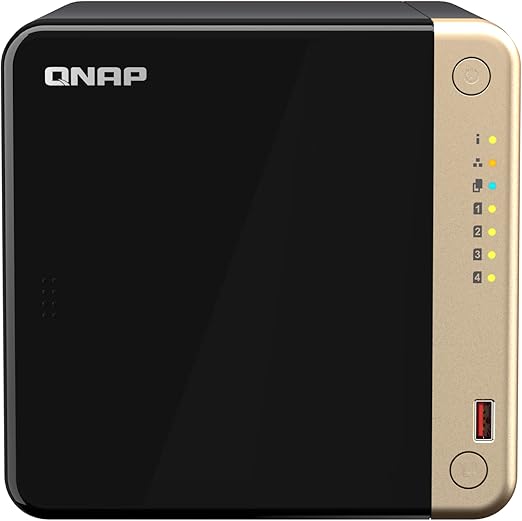 TS-464-8G
|
 TS-473A-8G
|
 TS-664-8G
|
 TS-673A-8G
|
|
|---|---|---|---|---|---|---|
| Bays | 2 | 4 | 4 | 4 | 6 | 6 |
| CPU | Celeron N5095 4C | Celeron N4505 2C | Celeron N5095 4C | Ryzen V1500B 4C/8T | Celeron N5095 4C | Ryzen V1500B 4C/8T |
| RAM | 8GB | 4GB | 8GB | 8GB | 8GB | 8GB |
| Network | Dual 2.5GbE | 2.5GbE | Dual 2.5GbE | 2.5GbE | Dual 2.5GbE | Dual 2.5GbE |
| M.2 Slots | 2 | 2 | 2 | 2 | 2 | 2 |
| AU Price (from) | $819 (PLE) | $889 (Scorptec) | $989 (Scorptec) | $1,369 (Scorptec) | $1,549 (PLE) | $1,699 (PLE) |
| Best For | Compact powerhouse | Budget 4-bay | Popular 4-bay | Ryzen performance | Growing storage | High-performance 6-bay |
The TS-464-8G at $989 (Scorptec) is QNAP's volume seller in this segment. A quad-core Celeron with 8GB RAM, dual 2.5GbE, two M.2 NVMe slots, and HDMI output. It directly competes with the Synology DS925+ ($995) but adds HDMI and a slightly more powerful out-of-the-box CPU. For users who need more grunt, the TS-473A-8G with its AMD Ryzen V1500B delivers noticeably stronger multi-threaded performance at $1,369. This is the model IT providers typically reach for when a client has virtualisation or container-heavy workloads.
High-End / Business NAS ($1,700+)
QNAP's high-end desktop and rackmount models are where the brand genuinely competes with Dell, HPE, and Lenovo. At a fraction of the cost. Built-in 10GbE, Intel Xeon processors, and support for QuTS Hero (ZFS) position these as serious infrastructure products.

| TS-h973AX-32G (9-bay, Ryzen, 32GB, 10GbE) | $1,699 (PLE) / $2,567 (Mwave 32GB) |
|---|---|
| TS-932PX (9-bay, Alpine, 4GB, 10GbE SFP+) | $1,089 (PLE) |
| TVS-H874T (8-bay, Core i9, 64GB, 10GbE) | $8,999 (Scorptec) |
| TVS-h1288X (12-bay, Xeon, 16GB) | $6,199 (Scorptec) |
| TS-1273AU-RP (12-bay rack, Ryzen, 8GB) | $4,599 (Scorptec) / $5,255 (Mwave) |
| TS-1673AU-RP (16-bay rack, Ryzen, 16GB) | $6,199 (Scorptec) / $6,599 (Mwave) |
The TS-h973AX deserves special mention. Its unusual 9-bay configuration. Five 3.5" HDD bays, two 2.5" SSD bays, and two M.2 NVMe slots. Creates a natural tiered storage setup in a single unit. With AMD Ryzen, 10GbE, and QuTS Hero support, it's one of the most versatile QNAP models available. At $1,699 (PLE, 32GB), it undercuts comparable enterprise solutions by thousands of dollars.
Stock reality for high-end models: Business and rackmount QNAP models are rarely held in retailer stock. Even when listed as "in stock," expect 2-3 days for the retailer to process through their distributor's dropship chain. QNAP production is currently 3-6 months behind on some models due to global chip and RAM shortages. If you're looking at a high-end QNAP NAS, check stock before planning. A February order might not arrive until April or even August.
QTS vs QuTS Hero. Which Operating System?
QNAP is unique among NAS vendors in offering two distinct operating systems. Understanding the difference is essential before buying, because switching between them requires a full reinitialisation. All data must be backed up first, and drives are not cross-compatible between the two file systems.
QTS (Standard. Ext4)
QTS is QNAP's standard operating system, built on Linux with the ext4 file system. It's suitable for home users, prosumers, and general small business use. Key features include:
- Lower RAM requirements. Works well on NAS models with 2-4GB RAM
- Qtier auto-tiering (automatically moves frequently accessed data to SSD, cold data to HDD)
- SSD caching with write cache capability
- Broad app compatibility through QNAP's App Center
- RAID 0, 1, 5, 6, 10, 50, 60 support
- HDMI output for direct media playback on compatible models
Choose QTS if: The NAS is for home use, basic SMB file sharing and backup, or you don't have specific enterprise data integrity requirements.
QuTS Hero (Enterprise. ZFS)
QuTS Hero is QNAP's enterprise-grade operating system built on the 128-bit ZFS file system. It targets commercial, enterprise, and advanced technical users who prioritise data integrity above all else. Key advantages over QTS:
- End-to-end checksums and self-healing: Automatically detects and repairs silent data corruption during scheduled scrubs. The kind of bitrot that ext4 can't detect
- Inline deduplication and compression: Significant storage savings for virtualised environments and repetitive data
- RAID-TP (triple parity): Tolerates 3 simultaneous drive failures. Not available in QTS
- SnapSync: Near-real-time snapshot-based disaster recovery between QuTS Hero NAS devices
- WORM (Write Once, Read Many): For compliance and data immutability
- RAM-based ARC read caching: More RAM directly equals better read performance
Choose QuTS Hero if: Data integrity, deduplication, compliance (WORM), or virtualisation performance are priorities. Minimum 8GB RAM required to install; 16GB+ recommended for deduplication; 32GB+ for heavy workloads. Don't install QuTS Hero on a 4GB NAS and expect miracles. ZFS is RAM-hungry by design.
Pros
- QuTS Hero's ZFS offers enterprise-grade data integrity not available from any other consumer NAS vendor
- Self-healing detects and repairs silent data corruption that ext4 simply cannot
- RAID-TP tolerates 3 drive failures. Critical for large arrays
- Inline deduplication saves significant storage in virtualised environments
Cons
- Switching between QTS and QuTS Hero requires full reinitialisation. All data must be backed up
- ZFS requires significantly more RAM. 16GB minimum for deduplication to work properly
- Not all QNAP apps are compatible with QuTS Hero
- More complex to manage than QTS. Aimed at experienced administrators
QNAP's QSW Network Switches. The Overlooked Ecosystem
Most articles about QNAP focus exclusively on NAS. This misses one of the brand's most compelling differentiators: QNAP manufactures its own network switches under the QSW brand, and they solve a real problem that NAS buyers hit constantly.
The problem: you buy a NAS with 2.5GbE or 10GbE ports, then discover your existing gigabit switch can't take advantage of them. Traditional enterprise switches with 10GbE ports cost $1,000-$3,000 and are overkill for a home or small office that needs 3-5 fast ports. QNAP's QSW switches fill this gap with smaller, purpose-built switches at accessible prices.
| QSW-1105-5T (5-port 2.5GbE unmanaged) | $159 (Scorptec) |
|---|---|
| QSW-2104-2T (4x 2.5GbE + 2x 10GbE) | $299 (Scorptec. Out of stock) |
| QSW-M2-2P-384A (Dual M.2 NVMe + 10GbE card) | $399 (Scorptec) |
The QSW-1105-5T at $159 is particularly noteworthy. Five 2.5GbE ports in a compact fanless design gives any NAS with 2.5GbE ports a proper high-speed backbone. Pair it with a QNAP TS-464 or TS-216G and you've got a single-vendor networking and storage solution that no other NAS brand can offer. Synology doesn't manufacture network switches. ASUSTOR doesn't either. This is a genuine QNAP advantage.
For users who need 10GbE, QNAP also offers PCIe expansion cards like the QXG-10G2T (dual 10GbE) at $649 (Scorptec, out of stock at time of writing) and the QXG-25G2SF-CX6 (dual 25GbE SFP28) at $799. Allowing compatible QNAP NAS units to be upgraded beyond their built-in ports.
Where to Buy QNAP NAS in Australia
QNAP NAS units are available through a range of Australian retailers. Most Australian retailers operate on 3-5% NAS margin, which keeps pricing remarkably uniform across major stores. The real difference between retailers is stock depth, pre-sales knowledge, and what happens when something goes wrong.
Recommended Retailers
Full-range specialists (most models listed, some NAS expertise):
- Scorptec. Largest QNAP range in Australia. Lists 86 QNAP products including NAS, switches, expansion units, and accessories. Good for finding specific models.
- PLE Computers. Stocks 14 of the most popular QNAP NAS models. Generally competitive pricing and reliable stock.
- Mwave. Lists 40 QNAP products including some older and enterprise models not available elsewhere.
QNAP-focused specialists:
- QNAP Shop and NAS Marketplace. QNAP-focused retailers with deeper pre-sales knowledge than general tech stores.
If you're buying a NAS for the first time, buy from a specialist like Scorptec or PLE where you can get genuine pre-sales guidance. Amazon AU has started holding NAS stock directly in 2026, often at competitive prices. But their support model means you're on your own if a unit fails with your data inside it. Zero pre-sales advice, zero post-sales technical support, and if the model goes out of stock, they'll push a credit rather than sourcing a replacement.
Business and Government Purchasing
For business, education, and government buyers, always request a formal quote rather than buying at listed retail price. Resellers can request pricing support from distributors and vendors. Discounts that never appear on the website but are routinely available for quoted deals. During non-sale periods, a quote may get pricing close to sale prices. For non-urgent purchases, requesting a quote is always worth the effort.
AU Distribution and Supply Chain
QNAP products reach Australian retailers through two distributors:
- BlueChip IT (BCIT). QNAP's strongest supporter and most important asset in Australia. BlueChip holds the deepest NAS stock in the country. Almost every QNAP model is available at any time, with air freight from Taiwan filling gaps in 2-3 weeks. During a period of significant QNAP leadership upheaval from late 2024 through 2025, BlueChip provided a business-as-usual front that kept the brand on track in Australia.
- Dicker Data. Also distributes QNAP (and now Asustor). Tends to hold limited stock and works on a project basis, ordering stock to fill specific deals. How they balance two competing NAS brands long-term remains to be seen.
QNAP has undergone a complete turnover of regional leadership since late 2024. The ANZ team has been replaced with new, untested staff who are still building understanding of the local landscape. The practical impact for buyers: no vendor-led promotions, no reseller incentive programs, and a flat, volume-based pricing model. This contrasts with the pre-2024 era of aggressive promotional pricing and heavy market investment.
QNAP Pricing in Australia. What to Expect
Australian NAS pricing is currently running approximately 10-20% above US levels, driven by lower stock allocations, higher freight costs, and smaller market volumes. This applies across all NAS brands, not just QNAP.
More specific to QNAP: pricing has increased nearly 100% since 2020-2021. If you're replacing an older QNAP NAS, expect the current equivalent model to cost roughly double what you originally paid. This combines global cost increases with QNAP's leadership-driven removal of reseller incentives and promotional pricing.
Gone are the days of waiting for Black Friday to buy tech. Australian retailers run rolling sale events throughout the year. EOFY, Click Frenzy, seasonal promos, and quarterly deals. If you need a NAS now, buy it now. The price won't be dramatically different in six months, and in 2026, the stock might not be there. NAS-grade drive prices have also risen significantly from early 2025 levels, so factor HDD costs into your total budget.
Warranty, ACL, and Support. The Australian Reality
Australian Consumer Law protections apply when purchasing from Australian retailers. Your warranty claim goes to the retailer, not QNAP directly. QNAP does not have service centres in Australia. The warranty process flows through the full chain: retailer → distributor → QNAP (Taiwan) → back again. Expect 2-3 weeks minimum for resolution. For official information on your consumer rights, visit accc.gov.au.
Warranty Periods
QNAP's warranty periods align with industry norms:
- Consumer / entry NAS (sub-$1,000): 3 years
- Mid-range / prosumer ($1,000-$2,000): 3 years, extendable to 5
- Commercial / enterprise ($2,000+): 5 years
These align with NAS-class HDD warranty periods (3 years for standard, 5 years for Pro/enterprise drives).
Support Channels
QNAP has no local phone support in Australia. Customers must lodge an online support ticket and can request remote support if needed. Some users have reported success calling QNAP's US office to speak with a technician, though this may incur international phone charges and is not a guaranteed service channel.
Neither the reseller nor the distributor will typically get involved in technical after-sales support. For troubleshooting, users rely on QNAP's ticket system, remote sessions, the QNAP community forums, and third-party resources.
Critical advice: Before buying, ask your retailer: "If this fails, what's your process? Can I get an advanced replacement?" Advanced replacements (receiving a replacement unit before returning the faulty one) are generally not officially supported. Some resellers will let you purchase a replacement at full price and refund you when the faulty unit is returned. But only if you arrange this in advance. The answer to this question tells you more about the value of buying from that retailer than the price on the sticker.
A NAS Is Not a Backup
A NAS alone is not a backup. ACL protects the hardware purchase, not the data stored on it. If the NAS fails, your data is at risk regardless of warranty. Plan for a 2-3 week replacement window as the realistic timeline, and build your data protection strategy around the assumption that your NAS will eventually fail. Offsite backup (cloud sync to a service like Backblaze B2, or a second NAS at a different location) is not optional. It's essential.
QNAP and NBN. Remote Access Considerations
Australian NBN connections introduce two specific challenges for NAS users that are worth understanding before setting up remote access to a QNAP NAS.
Upload speed limitations: A typical NBN 100/20 plan delivers around 17-20 Mbps upload, while NBN 100/40 plans offer around 35-40 Mbps. If you're accessing your NAS remotely. Syncing files, backing up a laptop, or streaming media while away from home. Your experience is limited by this upload speed. For large file transfers or multi-user remote access, this becomes a genuine bottleneck. QNAP's myQNAPcloud service works within these limits but can't overcome them.
CGNAT (Carrier-Grade NAT): Some NBN providers place customers behind CGNAT, which blocks direct incoming connections to your NAS. This breaks remote access via direct IP, DDNS, and some VPN configurations. QNAP's myQNAPcloud relay service can work around this, but performance is reduced because traffic routes through QNAP's servers rather than directly to your NAS. If direct remote access is important, confirm with your ISP that you have a public IP address. Or can request one. Some providers offer this free on request; others charge a small monthly fee.
Security. Past Incidents and Current Best Practices
QNAP has had several high-profile security incidents, including ransomware attacks targeting NAS devices exposed directly to the internet. These incidents were concerning but, in practice, most affected customers recovered without permanent data loss. QNAP's helpdesk was eventually able to unlock affected devices, and the incidents drove wider adoption of QNAP's snapshot technology as a defence mechanism.
The more important takeaway: any NAS exposed directly to the internet is a potential target, regardless of brand. The right response is proper security practices, not avoiding a specific vendor:
- Disable UPnP on your router. Don't let the NAS open ports automatically
- Use VPN for remote access instead of exposing ports directly (QNAP includes a built-in VPN server in QTS)
- Keep QTS/QuTS Hero firmware updated. Enable auto-update if possible
- Use strong, unique credentials and enable 2-factor authentication
- Configure snapshots as a ransomware recovery mechanism
- Disable any services you're not actively using
QNAP vs Synology. The Honest Comparison
Every QNAP buyer inevitably compares with Synology. Here's the unvarnished truth about when each brand makes more sense:
QNAP vs Synology. Decision Framework
| QNAP | Synology | |
|---|---|---|
| Best For | Specific technical requirements, connectivity, power users | General SMB, simplicity, first-time NAS buyers |
| Product Range | Very large. Dozens of current models | Focused. Fewer models, clearer lineup |
| Connectivity | 2.5GbE, 10GbE, 25GbE, Thunderbolt 4 built-in on many models | 1GbE/2.5GbE standard; 10GbE via add-on card |
| Operating System | QTS (ext4) or QuTS Hero (ZFS) | DSM (Btrfs or ext4) |
| Software Polish | Powerful but cluttered interface | Clean, intuitive, Apple-like experience |
| Network Switches | Full QSW switch lineup available | No switch products |
| AU Support | Online tickets, no AU phone support | Online tickets, no AU phone support |
| Typical AU Pricing | Competitive; 100% increase since 2020-21 | Stable; slightly premium on equivalent specs |
| Learning Curve | Steeper. More options means more complexity | Gentler. Designed for mainstream users |
IT providers often default to Synology for general SMB deployments and bring QNAP into the conversation when a client has a specific requirement. That pattern tells you exactly where each brand fits. QNAP's bigger product range means more choice. But also more confusion. If you know exactly what you need, QNAP probably has a model that fits better than anything else. If you're not sure what you need, Synology's simpler lineup will get you to a decision faster.
Choosing the Right QNAP Model. Use Case Guide
Given QNAP's large catalogue, the most useful approach is to start from the use case and work backwards to the model. Rather than browsing the full range and trying to pick.
Home Backup and File Sharing
The TS-233 ($399, PLE) handles basic home backup and file sharing competently. For a faster network connection, the TS-216G ($499, PLE/Scorptec) with dual 2.5GbE is a better investment. Especially if your router or switch supports 2.5GbE. The TS-433 ($639, Scorptec) is the 4-bay equivalent for households with larger storage needs.
Home Media Server and Plex
The TS-464-8G ($989, Scorptec) is the go-to model. The Intel Celeron N5095 supports hardware-accelerated Plex transcoding, 8GB RAM handles multiple streams, and HDMI output allows direct media playback. The two M.2 NVMe slots can be used for SSD caching to improve media server responsiveness.
Video Editing / Content Creation
QNAP is the only NAS brand offering Thunderbolt 4 connectivity on current models. The TVS-H874T and TVS-H874T (pricing available on request from Scorptec) provide direct Thunderbolt 4 and 10GbE connections for high-bandwidth video workflows. If Thunderbolt isn't needed but 10GbE is, the TS-h973AX at $1,699 (PLE, 32GB variant) delivers a cost-effective solution with its hybrid bay layout.
Small Business File Server
The TS-473A-8G ($1,369, Scorptec) suits most small business file server deployments. AMD Ryzen with 8 threads handles concurrent user access well, and the 2.5GbE port is a step up from gigabit. For businesses needing more capacity, the TS-664-8G ($1,549, PLE) adds two more bays. Both support QuTS Hero if ZFS data integrity is a priority.
Virtualisation and Containers
Any QuTS Hero-compatible model with 16GB+ RAM suits virtualisation workloads. The TS-h973AX-32G ($2,567, Mwave) is a strong starting point with its Ryzen CPU, 32GB RAM, 10GbE, and mixed bay configuration. For heavier workloads, the TVS-H874T ($8,999, Scorptec) with its Core i9 and 64GB RAM handles multiple VMs and containers simultaneously.
Rackmount / Enterprise
The TS-1273AU-RP 12-bay rackmount ($4,599, Scorptec) and TS-1673AU-RP 16-bay ($6,199, Scorptec) are QNAP's volume sellers in the rackmount space. Both feature redundant power supplies, AMD Ryzen V1500B, and 2.5GbE + 10GbE connectivity. These models have started challenging Dell, HPE, and Lenovo as cheaper alternatives with high-speed connectivity built in rather than requiring expensive add-on cards.
QNAP Expansion and Accessories
QNAP offers a wide range of expansion units and accessories for growing storage needs:
- TR-004 (4-bay USB-C DAS/expansion): $429-$449 (Scorptec, PLE). Connects to any computer or QNAP NAS via USB-C
- TR-002 (2-bay USB-C DAS/expansion): $329-$343 (Scorptec, Mwave)
- TL-D800C (8-bay USB JBOD): $899 (Scorptec) / $1,118 (Mwave)
- QM2-2P-384A (Dual M.2 NVMe PCIe card): $399 (Scorptec). Add NVMe SSD caching or storage to compatible NAS models
🇦🇺 Australian Buyers: Where to Buy, Pricing, and Warranty
Where to Buy QNAP NAS in Australia
QNAP is distributed in Australia through Synnex Australia, with stock at all major NAS retailers: Scorptec, PLE, Mwave, and DeviceDeal. Pricing is remarkably uniform across retailers (3-5% margin), so stock availability and retailer service are the deciding factors.
Pricing Reference (March 2026)
- TS-233 (2-bay, ARM): ~$399 at Scorptec/PLE. Entry backup/file share only
- TS-464-8G (4-bay, Intel N5095): ~$989 at Scorptec. Plex, Docker, general use
- TS-473A-8G (4-bay, AMD Ryzen R1600): ~$1,369 at Scorptec. Business file server
- TVS-H874-i5 (8-bay, Intel Core i5): ~$2,999. Video editing, virtualisation
Warranty and ACL
QNAP carries a 3-year manufacturer warranty on consumer/SMB NAS units. Under Australian Consumer Law, your retailer is also liable for major failures beyond the manufacturer warranty period. QNAP's past ransomware incidents (Deadbolt, eCh0raix) do not affect warranty coverage. See the NAS security guide for hardening steps to take on any QNAP NAS.
Related reading: our NAS buyer's guide and our Synology vs QNAP comparison.
Related reading: our QNAP NAS setup guide and our best 8-bay NAS Australia.
Use our free NAS Sizing Wizard to get a personalised NAS recommendation.
Where can I buy QNAP NAS in Australia?
QNAP NAS units are stocked by Scorptec (largest range. 86 products), PLE Computers (14 popular models), and Mwave (40 products including enterprise). Specialist stores like QNAP Shop and NAS Marketplace focus exclusively on QNAP. Pricing is remarkably uniform across major retailers due to thin 3-5% margins. The real difference is stock depth and post-sales support quality.
Is QNAP better than Synology for home use?
For straightforward home backup and file sharing, Synology is generally the better choice. Its DSM interface is cleaner, the product range is easier to navigate, and setup is more intuitive. QNAP becomes the better choice when you have specific technical requirements: Thunderbolt connectivity, 10GbE built-in, hardware-accelerated Plex transcoding with HDMI output, or advanced features like ZFS through QuTS Hero. If you're asking "which NAS should I just buy?" the answer is usually Synology. If you're asking "which NAS does this specific thing?" it's often QNAP.
What is the difference between QTS and QuTS Hero?
QTS uses the ext4 file system and suits most home and general business users. It works well even on NAS models with only 2-4GB RAM. QuTS Hero uses the ZFS file system, offering enterprise-grade data integrity, self-healing, inline deduplication, RAID-TP (triple parity), and WORM compliance. QuTS Hero requires a minimum of 8GB RAM to install, with 16GB+ recommended for deduplication and 32GB+ for heavy workloads. Switching between the two requires a full reinitialisation. All data must be backed up first.
Does QNAP have warranty support in Australia?
QNAP does not have service centres in Australia. Warranty claims go through the retailer you purchased from, who escalates to their distributor (BlueChip or Dicker Data), who escalates to QNAP in Taiwan. The standard resolution is replacement rather than repair. Expect 2-3 weeks minimum for the full process. Consumer NAS models have a 3-year warranty; enterprise models typically have 5 years. Australian Consumer Law protections apply when purchasing from Australian retailers. For official ACL information, visit accc.gov.au.
Can I access my QNAP NAS remotely on an Australian NBN connection?
Yes, but with caveats. NBN upload speeds limit remote access performance. A typical NBN 100/20 plan only delivers around 17-20 Mbps upload. QNAP's myQNAPcloud service enables remote access, but if your ISP uses CGNAT (Carrier-Grade NAT), direct connections will be blocked and traffic must route through QNAP's relay servers, reducing performance. Check with your ISP whether you have a public IP address, or can request one. Using the QNAP VPN server (built into QTS) with a public IP provides the most secure and fastest remote access method.
Is QNAP safe to use after the ransomware attacks?
QNAP has experienced several ransomware incidents targeting NAS devices exposed to the internet. Most affected customers recovered their data, and QNAP improved its security practices and firmware in response. The key point: any NAS directly exposed to the internet is a potential target, regardless of brand. Proper security practices matter far more than brand choice. Disable UPnP, use VPN for remote access, keep firmware updated, enable 2FA, use strong passwords, and configure snapshots as a recovery mechanism.
Why are QNAP NAS prices so much higher than a few years ago?
QNAP pricing has increased nearly 100% since 2020-2021. This reflects a combination of factors: global chip and RAM shortages driving up production costs, QNAP's internal leadership changes that removed reseller incentives and promotional pricing, higher international freight costs, and Australia's smaller market volume resulting in lower priority stock allocations. Australian NAS pricing across all brands is currently running 10-20% above US levels.
Which QNAP NAS is best for Plex media server?
The TS-464-8G ($989, Scorptec) is the most popular choice. Its Intel Celeron N5095 supports hardware-accelerated Plex transcoding (including 4K), 8GB RAM handles multiple simultaneous streams, two M.2 NVMe slots enable SSD caching for faster media access, and HDMI output allows direct playback to a TV. The 4-bay configuration provides enough storage for a substantial media library with RAID 5 protection.
Should I buy QNAP from Amazon Australia?
Amazon AU offers competitive NAS pricing and excellent returns/refund policies. However, Amazon provides zero pre-sales advice and zero post-sales technical support. If a NAS fails, Amazon may not have replacement stock. Especially for less common or high-end models. And will push to issue a credit rather than sourcing a direct replacement. When you buy from a specialist reseller like Scorptec or PLE, they can access distributor and vendor stock through BlueChip or Dicker Data to find you a replacement. Amazon can only offer what's in their warehouse. For first-time NAS buyers or business-critical deployments, a specialist retailer is worth the small price premium.
Are QNAP's QSW network switches worth buying?
If you're buying a QNAP NAS with 2.5GbE or 10GbE ports, a QSW switch is one of the most practical upgrades available. Traditional enterprise switches with 10GbE ports cost $1,000-$3,000 and are overkill for a small setup. The QSW-1105-5T ($159, Scorptec) gives you five 2.5GbE ports in a fanless design. Enough to connect your NAS, workstation, and a few other devices at 2.5x gigabit speed. No other NAS vendor manufactures its own network switches, making this a genuine QNAP ecosystem advantage.
What happens to my data if my QNAP NAS fails under warranty?
Australian Consumer Law protects your hardware purchase, not the data stored on it. If your NAS fails, the warranty process addresses the NAS unit. Replacement or repair. But your data is your responsibility. The standard warranty timeline is 2-3 weeks. During that time, if you don't have a backup, your data sits on drives with no NAS to read them. This is why a NAS is not a backup. Maintain offsite backups (cloud sync, second NAS at another location, or external drives stored elsewhere) and plan for hardware failure as a matter of when, not if.
Looking for specific QNAP model comparisons, setup guides, or help choosing between QNAP and Synology for your use case? Browse the full Need to Know IT library for Australian-focused NAS guides.
Explore All NAS Guides →