Hardware transcoding on a NAS means the processor handles video conversion using dedicated silicon rather than raw CPU cycles. And on a Plex media server, it is the difference between smooth playback for three streams and a box that falls over on one. Most NAS units sold in Australia today use Intel Celeron or Intel Core CPUs with Quick Sync Video, which can decode and encode H.264 and HEVC at a fraction of the CPU load required for software transcoding. The catch: Plex requires a Plex Pass subscription to unlock hardware transcoding, and not every NAS CPU is created equal when it comes to 4K HDR.
In short: Hardware transcoding on Plex requires a Plex Pass subscription (AU$9.99/month or AU$219.99 lifetime) and a NAS with an Intel CPU that includes Quick Sync Video. Intel Celeron J4125, N5095, N5105, and N100 all support Quick Sync and handle 1080p transcoding without issue. For 4K HDR tone-mapping, you need a newer CPU such as the Intel N305 or a mid-range i3/i5. You also need at least gigabit ethernet between your NAS and your TV. Without it, even direct play of 4K will stutter.
What Is Hardware Transcoding and Why Does It Matter?
When a Plex client requests a video, Plex checks whether the client can play the file directly. If the codec, resolution, bitrate, or container format is not supported by the client device, Plex converts. Or transcodes. The file on the fly. Software transcoding does this conversion using the main CPU, which is expensive: a single 1080p transcode can consume 80-100% of a quad-core Celeron, leaving nothing for other workloads. Hardware transcoding offloads that work to dedicated hardware inside the CPU. Intel calls this Quick Sync Video.
Quick Sync handles H.264 and HEVC decode and encode at very low CPU overhead. On a Celeron J4125 or N5095, a single 1080p transcode consumes roughly 15-25% CPU versus 80-100% for software. That means you can run three or four simultaneous streams where you previously could run one. For households with multiple viewers or mixed devices. A smart TV that direct plays, a phone that needs a smaller bitrate, a tablet on a lower-resolution setting. Hardware transcoding makes the difference between a usable system and a frustrating one.
Intel Quick Sync vs Software Transcoding: The Real-World Numbers
Software transcoding on a Celeron J4125 (the CPU in the Synology BeeStation Plus and several mid-range QNAP units) can handle roughly one simultaneous 1080p transcode before the stream starts dropping frames. With Quick Sync enabled, the same CPU can handle three to five 1080p streams comfortably. For 4K content at 40-80 Mbps, software transcoding is not viable at all on a low-power NAS CPU. The hardware cannot keep up with decode speed. Hardware transcoding with Quick Sync can handle 4K decode on newer Celerons, but 4K HDR tone-mapping (converting HDR colour space for non-HDR displays) requires more horsepower.
The practical implication for Australian buyers is straightforward: if you intend to run Plex and transcode, only Intel CPU NAS units are worth considering. ARM-based NAS units. Including most entry-level Synology models with Realtek CPUs (DS124, DS223, DS223J), QNAP ARM units (TS-133, TS-233, TS-433), and Asustor Drivestor models. Do not have Quick Sync. They will fall back to software transcoding, which is severely limited. If your clients all support direct play, an ARM NAS works fine. If any client needs transcoding, buy Intel.
ARM NAS units cannot hardware transcode for Plex. The Synology DS223, DS225+, DS124, QNAP TS-133, TS-233, and all Asustor Drivestor models use ARM or Realtek CPUs with no Quick Sync equivalent. Software transcoding on these units is limited to one 1080p stream at best. If Plex transcoding is a priority, these models are not suitable regardless of price.
Which NAS CPUs Support Hardware Transcoding?
Intel Quick Sync is available across a wide range of Celeron, Pentium, and Core CPUs. For NAS use, the relevant CPUs in currently available Australian models fall into three tiers:
- Entry Quick Sync (1080p, limited 4K): Intel Celeron J4105, J4125. Found in the Synology BeeStation Plus ($769 Mwave). These handle H.264 and HEVC up to 1080p well. 4K decode is possible but HDR tone-mapping is not.
- Mid Quick Sync (4K decode, limited tone-mapping): Intel Celeron N5095, N5105, N100. Found in the QNAP TS-264 ($917 Mwave, $819 PLE Computers), Asustor AS5402T ($789 Mwave), AS5404T ($879 Mwave), AS6702T ($781 Mwave), Asustor Nimbustor 2 Gen2 (~$819 Scorptec), Asustor Nimbustor 4 Gen2 ($799 Scorptec), TerraMaster F2-425 (~$762 Scorptec), TerraMaster F4-425 ($699 Scorptec). These handle 4K decode and most HDR content, but HDR tone-mapping to SDR can still tax the CPU.
- Upper Quick Sync (4K + HDR tone-mapping): Intel N305, Core i3, i5. Found in the TerraMaster F4-424 Pro ($1,099 Scorptec, Core i3), TerraMaster F8 SSD Plus ($1,299 Scorptec, i3 N305). These can handle multiple simultaneous 4K transcodes including HDR tone-mapping.
Synology's current plus-series desktop units. The DS225+ ($585 Mwave, $599 PLE Computers) and DS425+ ($899 Mwave, $999 PLE Computers). Use Intel Celeron CPUs with Quick Sync. The DS225+ suits a two-person household running two or three simultaneous Plex streams; the DS425+ gives you four bays for storage growth alongside the same transcoding capability. The DS925+ ($1,029 Mwave, $995 Scorptec) uses an AMD Ryzen R1600 CPU. AMD has its own video acceleration (VCE/VCN), but Plex's hardware transcoding support for AMD on NAS is not as mature as Intel Quick Sync, and support varies by Plex version and platform.
Plex Pass: The Required Subscription
Plex hardware transcoding is locked behind Plex Pass. Without it, Plex will fall back to software transcoding regardless of what CPU your NAS has. Plex Pass costs approximately AU$9.99 per month, AU$39.99 per year, or AU$219.99 for a lifetime subscription (prices fluctuate with exchange rates. Check Plex's website for current AUD pricing). The lifetime subscription pays for itself in under two years and is the standard recommendation for committed Plex users.
Plex Pass also unlocks mobile sync (downloading content to a phone or tablet for offline playback), live TV and DVR features if you have a compatible tuner, enhanced parental controls, and hardware-accelerated video quality analysis. For the purposes of this guide, the hardware transcoding unlock is the primary reason NAS users purchase Plex Pass.
4K Transcoding: What You Actually Need
4K transcoding is significantly more demanding than 1080p, and the requirements split into two distinct scenarios:
4K direct play requires no transcoding at all. Your NAS streams the raw 4K file to a client that can handle it natively. Modern Apple TV 4K, Nvidia Shield, recent Samsung and LG smart TVs, and most current streaming devices. For direct play, any NAS with sufficient network throughput works. A 4K HDR file at 80 Mbps needs roughly 10 MB/s of sustained network bandwidth. Gigabit ethernet delivers 125 MB/s. More than enough for a single 4K stream and several simultaneous 1080p direct plays. You need gigabit ethernet between your NAS and your router, and gigabit ethernet to the room where you're streaming 4K. Wi-Fi, even Wi-Fi 6, introduces latency and throughput variability that causes buffering with high-bitrate 4K files.
4K transcoding is what happens when a client cannot direct play 4K. A phone on a lower-resolution setting, a browser, an older TV. Transcoding a 4K HEVC HDR file in real time requires significantly more hardware grunt. The Celeron J4125 cannot reliably transcode 4K in real time even with Quick Sync enabled. The N5095/N5105 generation handles 4K decode via Quick Sync but may struggle with HDR-to-SDR tone-mapping on high-bitrate files. For reliable 4K transcoding, look at the N305, Core i3, or Core i5 tier. Or accept that your 4K library is best served by devices that direct play it.
NBN and remote streaming: On a standard NBN 100 plan, typical upload speed is 17-20 Mbps. Enough for one 1080p remote Plex stream but not enough for remote 4K streaming. NBN 250 and NBN 1000 plans offer higher upload (25 Mbps and up to 50 Mbps respectively), making remote 1080p streaming more reliable. Some connections are also behind CGNAT (Carrier-Grade NAT), which blocks direct inbound connections unless you use Plex Relay or a VPN. For local network streaming, NBN speeds are irrelevant. Everything happens over your LAN. For remote access to your Plex server from outside the home, check whether your ISP assigns a real public IP or CGNAT before setting expectations.
Recommended NAS Models for Plex in Australia
The following models are currently available from Australian retailers and suit Plex hardware transcoding at different price points and use cases.
Budget: Synology DS225+. 2-Bay Intel Celeron

| CPU | Intel Celeron 2.0GHz Quad-Core (Quick Sync enabled) |
|---|---|
| RAM | 2GB DDR4 (expandable) |
| Bays | 2 x 3.5" SATA |
| Network | 2.5GbE + 1GbE |
| AU Price (Mwave) | $585 |
| AU Price (PLE Computers) | $599 |
| AU Price (Scorptec) | $599 |
The DS225+ suits a one or two-person household running Plex with two to three simultaneous 1080p streams or one 4K direct play stream. The Intel Celeron CPU with Quick Sync handles H.264 and HEVC transcoding at 1080p without strain. The 2.5GbE port is a meaningful upgrade from the 1GbE found in many previous-generation models. It has headroom for future network upgrades and handles simultaneous NAS file access alongside Plex streaming without contention. Two bays limit storage expansion; if you anticipate more than 16-20TB of media, the DS425+ is a better fit from the start.
Pros
- Intel Celeron with Quick Sync. Hardware transcoding works
- 2.5GbE future-proofs the network connection
- Synology DSM is polished and Plex installs from the Package Centre
- Compact two-bay footprint for smaller spaces
- Available at multiple Australian retailers with full ACL coverage
Cons
- Only two bays. Limited storage growth
- 2GB RAM is tight if running Plex alongside other packages
- No 4K HDR tone-mapping capability from this CPU generation
- Australian pricing is higher than US by approximately 15%
Mid-Range: QNAP TS-464. 4-Bay with Celeron N5095
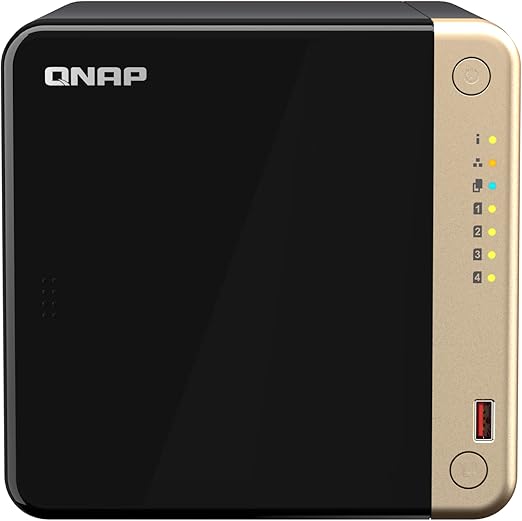
| CPU | Intel Celeron N5095 2.9GHz Quad-Core (Quick Sync) |
|---|---|
| RAM | 8GB DDR4 |
| Bays | 4 x 3.5" SATA + 2 x M.2 NVMe |
| Network | Dual 2.5GbE |
| AU Price (PLE Computers) | $1,099 |
| AU Price (Scorptec) | $1,099 |
The TS-464 steps up to a Celeron N5095 CPU. A meaningful generational jump from the J4125. With 8GB RAM included and four bays for a proper media library. The N5095's Quick Sync generation handles 4K HEVC decode more reliably than the J4125, making it suitable for households where the majority of clients direct play 4K and occasional 1080p transcoding is needed for less capable devices. Two M.2 NVMe slots allow an SSD cache tier, which improves metadata lookups and small file performance. Useful when Plex is building thumbnails and analysing a large library. QNAP's Plex app installs from the App Center and runs Plex Media Server directly on the NAS.
Pros
- Celeron N5095 Quick Sync handles 4K decode and multiple 1080p simultaneous streams
- 8GB RAM included. No need to upgrade immediately
- Four bays plus M.2 cache slots for a complete storage setup
- Dual 2.5GbE supports link aggregation for higher throughput
- In stock at PLE Computers and Scorptec
Cons
- QNAP's QTS interface has more complexity than Synology DSM
- At $1,099 it is a significant outlay for a home media server
- HDR tone-mapping at 4K is still a stretch for the N5095 at high bitrates
Mid-Range Alternative: Asustor Nimbustor 4 Gen2 (AS5404T)

| CPU | Intel Celeron N5105 2.0GHz Quad-Core (Quick Sync) |
|---|---|
| RAM | 4GB DDR4 |
| Bays | 4 x 3.5" SATA |
| Network | Dual 2.5GbE |
| AU Price (Mwave) | $879 |
| AU Price (Scorptec) | $799 |
The AS5404T uses the Celeron N5105, closely related to the N5095, with Quick Sync for H.264 and HEVC hardware transcoding. Asustor's ADM platform has solid Plex support and the Nimbustor line is designed as a media-oriented NAS. It includes HDMI output for local playback if needed. At $799 from Scorptec, it undercuts the QNAP TS-464 meaningfully for similar transcoding capability. The trade-off is 4GB rather than 8GB RAM standard, which may require a RAM upgrade if running Plex alongside other packages. Asustor is distributed by Dicker Data in Australia, so Australian stock is generally available and warranty claims go through local channels.
Higher End: TerraMaster F4-424 Pro. Core i3 for 4K HDR

| CPU | Intel Core i3 (12th Gen) Quad-Core with Quick Sync |
|---|---|
| RAM | 32GB DDR4 |
| Bays | 4 x 3.5" SATA + 2 x M.2 NVMe |
| Network | 2.5GbE |
| AU Price (Scorptec) | $1,099 |
The F4-424 Pro is the step change for serious Plex users who want reliable 4K HDR transcoding. The 12th-generation Core i3 includes Intel's Xe graphics tier within Quick Sync, which handles HDR tone-mapping reliably. Converting HDR10 to SDR for clients that cannot process HDR natively. With 32GB of RAM pre-installed, this unit can handle Plex, a Synology-equivalent NAS OS, and other server workloads simultaneously without memory pressure. At $1,099 from Scorptec, it matches the QNAP TS-464 on price but delivers substantially more transcoding headroom. TerraMaster's TOS platform is less polished than Synology DSM or QNAP QTS, which is worth factoring in if you value ease of setup.
Comparison: Quick Sync Tiers at a Glance
NAS Hardware Transcoding Comparison. Australia 2026
|
DS225+
|
TS-464
|
AS5404T
|
F4-424 Pro
|
|
|---|---|---|---|---|
| CPU | Celeron 2.0GHz | Celeron N5095 | Celeron N5105 | Core i3 12th Gen |
| Quick Sync tier | Entry | Mid | Mid | Upper |
| 1080p streams (HW) | 3-4 | 4-5 | 4-5 | 6+ |
| 4K HEVC decode | Limited | Yes | Yes | Yes |
| 4K HDR tone-mapping | No | Partial | Partial | Yes |
| RAM included | 2GB | 8GB | 4GB | 32GB |
| Bays | 2 | 4 | 4 | 4 |
| AU Price (approx.) | $599 (PLE Computers) | $989 (Scorptec) | $879 (Mwave) | $760 (Mwave) |
Prices last verified: 16 March 2026. Always check retailer before purchasing.
Network Requirements: Gigabit Is the Minimum
Hardware transcoding handles the CPU side of Plex streaming. But the network path is equally important. For 4K direct play, you need sustained throughput of 80-100 Mbps from your NAS to the streaming device. On gigabit ethernet (1GbE), which delivers roughly 940 Mbps real-world throughput, a single 4K stream uses around 10% of your total link capacity. Comfortable. On Wi-Fi, even Wi-Fi 6 (802.11ax) operating in the 5GHz band under ideal conditions, real-world throughput to a smart TV or streaming device will typically be 200-400 Mbps. That is enough for 4K in many cases, but interference, distance, and building materials reduce this significantly, introducing stuttering on high-bitrate files.
The Need to Know IT team's recommendation for 4K Plex streaming: wire your NAS to your router with ethernet, and wire the room where you watch 4K. The modern NAS models in this guide all include at least 2.5GbE ports. If your router supports 2.5GbE, the link between your NAS and router can handle multiple simultaneous 4K streams with room to spare. For most households, gigabit ethernet switches cost under $30 and a run of Cat6 cable from your NAS to your living room resolves buffering issues permanently.
Setting Up Plex Hardware Transcoding on Your NAS
The setup process is similar across Synology, QNAP, and Asustor:
- Install Plex Media Server from your NAS's package/app centre. On Synology, this is the Package Centre; on QNAP, the App Center; on Asustor, the App Central.
- Sign in to your Plex account and claim the server from app.plex.tv. Your NAS needs to be connected to the internet for this step.
- Activate Plex Pass on your Plex account. Hardware transcoding will not activate without it.
- Enable hardware transcoding in Plex settings. In the Plex web UI, go to Settings > Transcoder. Tick 'Use hardware acceleration when available'. If your NAS CPU supports Quick Sync and Plex detects it, the option will work immediately.
- Test with a remote client. Play a file and check the Plex dashboard (accessible from the web UI or the Plex app). If you see 'hw' next to the transcode session, hardware acceleration is active.
On QNAP, there is an additional step: the QNAP Plex app requires you to grant access to the Intel GPU device within the container settings. On newer QNAP firmware this is handled automatically, but on older QTS versions you may need to manually add the device in the Container Station or Plex app settings.
What to Do If Hardware Transcoding Is Not Working
If the Plex dashboard shows software transcoding even with an Intel CPU NAS and Plex Pass, check the following in order:
- Plex Pass active? Confirm at plex.tv/account that Plex Pass is active on the account signed into your server.
- Hardware transcoding enabled in settings? Settings > Transcoder > Use hardware acceleration when available must be ticked.
- Plex Media Server version current? Older versions have bugs with Quick Sync detection. Update to the latest release from the package centre.
- QNAP GPU device access? On QNAP, check that the Plex container has access to /dev/dri. This is required for Quick Sync pass-through.
- Arm CPU? If your NAS has a Realtek or ARM CPU, hardware transcoding is not available. Verify your CPU model against the list in this guide.
Buying in Australia: What to Know
Australian NAS pricing is currently running approximately 10-20% above US retail levels, driven by lower stock allocations, higher air freight costs, and a smaller market. For the models in this guide, this means the DS225+ at $585-$599 AUD compares to approximately US$340 in the United States. A meaningful premium, but local stock availability, Australian Consumer Law protections, and genuine warranty support justify the difference for most buyers.
Australian Consumer Law protections apply when purchasing from Australian retailers. For a device that holds your media library. And potentially irreplaceable personal files. Buying from an Australian authorised retailer gives you ACL coverage: the right to a repair, replacement, or refund if the unit is not of acceptable quality. Grey imports may be cheaper but carry no guaranteed ACL protection and can have region-restricted firmware.
Mwave, PLE Computers, and Scorptec carry the widest range of NAS units in Australia with genuine pre-sales knowledge. Most retailers operate on 3-5% NAS margin, which is why pricing is uniform across stores. The meaningful difference between retailers is what happens when something goes wrong. And with a NAS, that matters.
UGREEN does not yet have an official Australian distributor as of early 2026, meaning warranty claims currently go through international channels. The UGREEN NASync range (DXP2800 from $630, DXP4800 from $990) includes Intel CPUs with Quick Sync and is competitively priced, but factor in the warranty support gap before committing. If you need local warranty support, Synology, QNAP, Asustor, and TerraMaster are better served in Australia.
Australian Consumer Law note: ACL protections apply to NAS units purchased from Australian authorised retailers. Covering your right to a repair, replacement, or refund if the unit fails within its expected lifespan. Warranty periods (typically 2-3 years) and ACL protections are separate: ACL applies regardless of the warranty term if the failure is within a reasonable timeframe for that class of product. Always buy from an AU retailer for full ACL coverage.
Use our free Plex Media Planner to check if your NAS can handle your library.
Related reading: our NAS buyer's guide and our Synology vs QNAP comparison.
Do I need Plex Pass for hardware transcoding on a NAS?
Yes. Plex hardware transcoding is locked behind Plex Pass regardless of what hardware your NAS has. Without Plex Pass, Plex falls back to software transcoding even if your NAS CPU includes Intel Quick Sync Video. Plex Pass costs approximately AU$9.99/month, AU$39.99/year, or AU$219.99 as a one-time lifetime purchase. The lifetime option is the standard recommendation for committed Plex users. It pays for itself in under two years.
Can a Synology DS225+ or DS425+ hardware transcode 4K?
The DS225+ and DS425+ use Intel Celeron CPUs with Quick Sync, which can handle 4K HEVC decode to a limited extent. They will manage 4K direct play without issue (no transcoding required) and can transcode 4K H.264 to lower resolutions. However, 4K HDR to SDR tone-mapping. Converting HDR colour space for non-HDR displays. Is unreliable on this CPU generation at high bitrates. If 4K HDR transcoding is important, a newer Intel N305 or Core i3 platform is a better choice, such as the TerraMaster F4-424 Pro ($1,099 at Scorptec).
What is the difference between Quick Sync generations for Plex?
Intel Quick Sync has improved significantly across CPU generations. The Celeron J4105/J4125 (Gemini Lake) can hardware transcode H.264 and HEVC up to 1080p but is limited for 4K. The Celeron N5095/N5105 (Jasper Lake) adds stronger 4K HEVC decode and better HDR handling. The N100, N305, and 12th-generation Core i3/i5 (Alder Lake and Raptor Lake) include Intel Xe graphics with full HDR tone-mapping and can handle multiple simultaneous 4K streams. For most Australian households running a mixed library with 1080p content, the N5095/N5105 generation is a reasonable minimum. For heavy 4K HDR use, move to the N305 or Core i3 tier.
Will Wi-Fi work for 4K Plex streaming from a NAS?
For 4K direct play, Wi-Fi can work under ideal conditions. Wi-Fi 6 in the 5GHz band with a strong signal can deliver 300-500 Mbps, well above the 80-100 Mbps needed for a single 4K stream. In practice, walls, distance, and interference reduce throughput and introduce latency spikes that cause buffering on high-bitrate files. For reliable 4K streaming, ethernet is strongly preferred. The NAS should be connected via ethernet always. Streaming devices. Apple TV, Nvidia Shield, smart TVs. Benefit from ethernet where possible. If Wi-Fi is the only option, a Wi-Fi 6 or Wi-Fi 6E access point close to the streaming device (not a distant router) is the best mitigation.
Can I stream Plex remotely over NBN?
Remote streaming over NBN is possible but depends on your plan's upload speed. Standard NBN 100 (the most common plan in Australia) provides around 17-20 Mbps upload. Enough for one remote 1080p stream at medium quality but not 4K. NBN 250 and NBN 1000 plans offer higher upload speeds (25 Mbps and up to 50 Mbps respectively), enabling multiple remote 1080p streams. A second issue is CGNAT: some ISPs place residential connections behind Carrier-Grade NAT, which prevents direct inbound connections. In this case, remote Plex access goes through Plex Relay (Plex's own relay infrastructure), which caps bandwidth and can affect quality. Contact your ISP to confirm whether you have a real public IP address before planning remote Plex access.
Does the QNAP TS-264 support hardware transcoding for Plex?
Yes. The QNAP TS-264 uses a Celeron N5095 CPU (2.9GHz quad-core) with Intel Quick Sync Video. It supports hardware transcoding in Plex with Plex Pass active. The TS-264-8G (8GB RAM) is available at PLE Computers for $819 and Mwave for $917. On QNAP, you may need to confirm the Plex container has access to the Intel GPU device (/dev/dri). Newer QTS firmware handles this automatically. The TS-264 is a two-bay unit; for more storage capacity, the TS-464 (four bays, same CPU generation, $1,099) is the natural step up.
Is the Synology BeeStation Plus good for Plex?
The BeeStation Plus ($769 at Mwave) is a single-bay unit with an Intel Celeron J4125. One of the older Quick Sync generations. It supports Plex hardware transcoding for 1080p content, but it is not designed as a Plex server. It runs Synology's BeeStation software rather than full DSM, which limits the packages and customisation available. It is better positioned as a personal cloud backup device. If Plex is the primary use case, the DS225+ ($585) is a more capable and better-supported option for approximately $184 less.
Choosing a NAS for Plex is only part of the decision. You also need to size your storage correctly for your media library. See the NAS sizing guide to work out how many bays and how much capacity your Plex setup requires.
Use the NAS Sizing Wizard