The single biggest performance upgrade you can make to an existing NAS setup is not more RAM or faster drives. It is your network connection. Most Australian homes and small offices are running Gigabit Ethernet (1GbE), which caps real-world file transfers at roughly 112 MB/s regardless of how fast your NAS drives are. For anyone working with large video files, managing a Plex media server, editing photos from a NAS, or running a small business file server, that 1GbE ceiling is the bottleneck you feel every day. Upgrading to 2.5GbE or 10GbE removes that ceiling and lets your NAS hardware actually perform to its potential. This guide covers everything Australian buyers need to know: which standard to choose, what hardware you need, what it costs, and how to avoid the common mistakes.
In short: For most Australian home and prosumer users, 2.5GbE is the practical sweet spot. It delivers 2.5x the speed of Gigabit Ethernet, works over existing Cat5e cabling, and costs under $200 for a switch plus adapter. 10GbE is worth it for video editors, photographers with large catalogues, and business file servers where multiple users access the NAS simultaneously. Budget roughly $150-$180 for a NAS 10GbE adapter card and $400+ for a 10GbE switch in Australia.
Why Your NAS Feels Slow (and Why It Is Not the NAS)
A common frustration among Australian NAS owners is that file transfers feel sluggish despite buying a capable NAS with fast drives. The culprit is almost always the network, not the NAS itself. A modern 4-bay NAS running RAID 5 with four NAS-grade hard drives can sustain sequential read speeds of 400-500 MB/s internally. But if your NAS is connected to your router with a standard Gigabit Ethernet cable, the maximum throughput is approximately 112 MB/s. Less than a quarter of what the drives can deliver.
The issue is compounded in Australia because most ISP-supplied routers (the ones that come with your NBN connection) only have 1GbE Ethernet ports. Even premium consumer routers from ASUS, Netgear, and TP-Link typically only include 1GbE LAN ports unless you specifically buy a model with multi-gig support. This means your entire local network. Every device talking to your NAS. Is capped at Gigabit speeds regardless of your NBN plan or internet speed.
NBN speed vs LAN speed: Your NBN plan speed (e.g., NBN 100 or NBN 250) affects your internet connection, not your local network. LAN speed is determined by your router, switches, and Ethernet cables. A 100 Mbps NBN connection has nothing to do with the 1 Gbps cap between your PC and your NAS. Upgrading your LAN to 2.5GbE or 10GbE will not make your internet faster, but it will dramatically improve NAS file transfers, Plex streaming, and local backups.
Understanding the Speed Tiers: 1GbE vs 2.5GbE vs 5GbE vs 10GbE
Multi-gig Ethernet refers to network speeds above the traditional 1 Gbps Gigabit standard. Here is how the tiers compare in real-world terms for NAS users.
Ethernet Speed Tiers for NAS
| 1GbE | 2.5GbE | 5GbE | 10GbE | |
|---|---|---|---|---|
| Link Speed | 1 Gbps | 2.5 Gbps | 5 Gbps | 10 Gbps |
| Real-World Transfer | ~112 MB/s | ~280 MB/s | ~560 MB/s | ~1,100 MB/s |
| Minimum Cabling | Cat5e | Cat5e | Cat5e (short runs) | Cat6 (55m) / Cat6a (100m) |
| NAS Adapter Cost (AU) | Built-in | $40-$70 | Rare | $149-$179 |
| Switch Cost (AU) | $30-$60 | $149-$250 | $200-$350 | $400-$800+ |
| Best For | Basic use | Home/prosumer sweet spot | Niche | Video editing, business |
5GbE exists but is uncommon in NAS hardware and switches, making it a poor target for upgrades. The practical choice for Australian buyers is between 2.5GbE and 10GbE. If you are unsure which you need, 2.5GbE is the answer for the vast majority of home users. It delivers a noticeable improvement at a fraction of the cost of 10GbE.
2.5GbE: The Sweet Spot for Most Australians
2.5 Gigabit Ethernet has emerged as the practical upgrade path for Australian home and prosumer NAS users. The reasons are straightforward: it works over the Cat5e cabling already installed in most Australian homes, it does not require expensive switches, and the performance gain over 1GbE is immediately noticeable.
Most houses built or cabled in the last 15 years have Cat5e Ethernet in the walls. Cat5e is certified for Gigabit Ethernet, but it comfortably handles 2.5GbE at the distances found in a typical Australian home (under 50 metres). This means you can upgrade to 2.5GbE without pulling new cables. A significant cost saving. However, Cat5e does not reliably support 10GbE, so if 10GbE is your goal, you will likely need Cat6 or Cat6a cable runs.
What You Need for a 2.5GbE NAS Setup
A complete 2.5GbE upgrade requires three things: a NAS with a 2.5GbE port (or a NAS that accepts a 2.5GbE adapter), a 2.5GbE switch, and a 2.5GbE network adapter for your PC or laptop. Many newer NAS models from Synology and QNAP already include built-in 2.5GbE ports, eliminating the first requirement.

| NAS with 2.5GbE | Synology DS225+, DS423, DS925+, QNAP TS-464, TS-264. All have built-in 2.5GbE |
|---|---|
| 2.5GbE Switch | QNAP QSW-1105-5T (5-port) ~$149 AU at Mwave, PLE, Scorptec |
| PC USB Adapter | QNAP QNA-UC5G1T or generic RTL8156 USB-C 2.5GbE adapter ~$40-$70 AU |
| PC PCIe Adapter | TP-Link TX201 2.5GbE PCIe card ~$39 AU at PLE, Scorptec |
| Total Upgrade Cost | ~$190-$220 AU (switch + PC adapter) |
If your NAS already has a 2.5GbE port (most models released from 2023 onwards do), the upgrade cost is just a switch and a PC adapter. Under $220. That is the most cost-effective performance upgrade you can make to your NAS workflow. For a photography workflow with large RAW files or a Plex server transcoding 4K content, the difference between 112 MB/s and 280 MB/s is immediately obvious.
10GbE: For Video Editors, Photographers, and Business
10 Gigabit Ethernet delivers roughly 1,100 MB/s of real-world throughput. Fast enough to edit video directly from a NAS without copying files to a local SSD first. For video editors working with 4K or 6K footage, photographers batch-processing thousands of RAW files, or businesses with 5-20 users accessing the same file server, 10GbE transforms the NAS from a slow storage box into a genuinely responsive shared drive.
The trade-off is cost. 10GbE switches start at around $400 AU for a basic unmanaged model and climb quickly. You need Cat6 cabling (good for 10GbE up to 55 metres) or Cat6a (good for 10GbE up to the full 100-metre specification). And you need a 10GbE adapter in both the NAS and the PC, adding $150-$180 per device.
NAS 10GbE Adapter Options in Australia
Both Synology and QNAP sell first-party 10GbE expansion cards for their NAS models. These are the safest option because they are guaranteed compatible and supported by the NAS vendor. Third-party cards (such as those based on the Aquantia AQC107 chipset) can work but may not be officially supported and could cause issues after firmware updates.

| Synology E10G22-T1-Mini | 10GbE RJ45, fits DS925+/DS1525+/RS series. ~$179 AU at Mwave, PLE, Scorptec |
|---|---|
| QNAP QXG-10G1T | 10GbE RJ45 PCIe card for QNAP NAS. ~$149 AU at Mwave, Scorptec |
| QNAP QXG-10G2SF-X710 | Dual SFP+ 10GbE card. ~$329 AU (for fibre/DAC connections) |
| PC 10GbE PCIe Card | ASUS XG-C100C or TP-Link TX401. ~$129-$169 AU at PLE, Scorptec, Amazon AU |
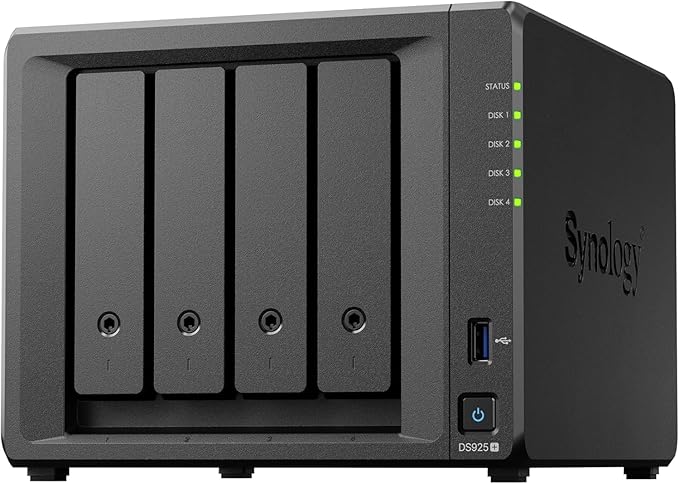
The Synology DS925+ and DS1525+ both have a dedicated PCIe slot for the E10G22-T1-Mini card, making them particularly good choices if you know you want 10GbE capability. On the QNAP side, models like the TS-464 and TS-673A accept QXG series cards in their PCIe expansion slots. QNAP has the widest range of 10GbE-ready NAS models in Australia, with the QXG card lineup covering RJ45, SFP+, and even 25GbE options for enterprise use.
BlueChip and Dicker Data are the primary Australian distributors for these network expansion cards, supplying retailers like Scorptec, PLE, and Mwave. Because NAS accessories carry the same thin 3-5% retail margins as the NAS units themselves, pricing is remarkably uniform across Australian retailers. Shopping around might save you $5-10 on a network card. Not enough to justify buying from a retailer with poor support.
10GbE: RJ45 vs SFP+. Which Connection Type?
10GbE comes in two physical connection types: RJ45 (the same plug as standard Ethernet, just faster) and SFP+ (a smaller connector that uses fibre optic cables or Direct Attach Copper/DAC cables). For most Australian home and small business users, RJ45 is the right choice. It uses the same cables and plugs you already know, and it works with your existing Cat6/Cat6a cable runs.
SFP+ has advantages in specific scenarios: it uses less power, generates less heat, and SFP+ switches can be cheaper than RJ45 10GbE switches. However, SFP+ requires either fibre optic patch cables or DAC cables, which are point-to-point connections with limited length. For a direct NAS-to-PC connection in the same room, a DAC cable is cheap and effective. For runs through walls, SFP+ adds complexity that most home users do not need.
Cabling: What Is Already in Your Walls
Before spending money on switches and adapters, check what Ethernet cabling you have. The cable category is printed on the outer jacket. Look for markings like "Cat5e", "Cat6", or "Cat6a" along the cable run.
| Cat5e | Supports 1GbE (certified) and 2.5GbE (works reliably at home distances). Does NOT support 10GbE. |
|---|---|
| Cat6 | Supports up to 10GbE at distances up to 55 metres. Good enough for most Australian homes. |
| Cat6a | Supports 10GbE at the full 100-metre distance. Required for long commercial cable runs. |
| Cat7/Cat8 | Overkill for NAS networking. No practical advantage over Cat6a for 10GbE in a home or small office. |
The key takeaway: if your home has Cat5e, you can upgrade to 2.5GbE without re-cabling. If you want 10GbE, you need Cat6 at minimum, and ideally Cat6a for runs over 55 metres. Re-cabling a house is expensive (typically $150-$300 per point for a licensed cabler in Australia), so this is a significant factor in the 2.5GbE vs 10GbE decision. For many Australians, the cabling already installed in their home makes the decision for them. Cat5e means 2.5GbE is your practical ceiling without re-cabling.
Switches: The Missing Piece in Your Network
Unless you are doing a direct NAS-to-PC connection (which limits access to one device at a time), you need a multi-gig switch. This is the device that sits between your NAS, PCs, and router, allowing all devices to communicate at the higher speed. Your existing router stays in place for internet and Wi-Fi. The multi-gig switch handles the fast local traffic.
2.5GbE Switches Available in Australia
The QNAP QSW series of unmanaged multi-gig switches has become the go-to option for Australian NAS users upgrading from 1GbE. These are simple, plug-and-play, fanless switches that require no configuration.
| QNAP QSW-1105-5T | 5-port 2.5GbE, unmanaged, fanless. ~$149 AU |
|---|---|
| QNAP QSW-2108-2T | 8x 2.5GbE + 2x 10GbE uplink ports. ~$299 AU |
| Netgear MS305 | 5-port 2.5GbE, unmanaged. ~$119 AU |
| TP-Link TL-SG105-M2 | 5-port 2.5GbE, unmanaged. ~$99 AU |
The QSW-1105-5T at around $149 is the most commonly recommended option among Australian NAS communities. It is available from Mwave, PLE, Scorptec, and Amazon AU. For users who want a mix of 2.5GbE ports with a couple of 10GbE uplinks (useful if your NAS has a 10GbE card but your PCs are 2.5GbE), the QSW-2108-2T is the logical step up.
10GbE Switches Available in Australia
10GbE switches are significantly more expensive than their 2.5GbE counterparts. This is the main reason 10GbE adoption remains limited to professionals and businesses in Australia.
| QNAP QSW-M2108R-2C | 8x 2.5GbE + 2x 10GbE combo (RJ45/SFP+). ~$449 AU (managed) |
|---|---|
| QNAP QSW-M2106R-2S2T | 6x 2.5GbE + 2x 10GbE RJ45 + 2x SFP+. ~$529 AU (managed) |
| Netgear XS505M | 5-port 10GbE (4x 10GbE + 1x SFP+). ~$499 AU |
| MikroTik CRS305-1G-4S+IN | 4x SFP+ 10GbE + 1x 1GbE. ~$279 AU (cheapest 10GbE switch, SFP+ only) |
The MikroTik CRS305 is popular among enthusiasts because it is the cheapest way to get 10GbE switching, but it only has SFP+ ports. No RJ45. You need DAC cables or SFP+ transceivers, which adds cost and limits flexibility. For a straightforward RJ45 10GbE setup, expect to spend $450 or more on the switch alone.
Complete Upgrade Scenarios with AU Pricing
Here are three typical upgrade paths for Australian NAS users, with approximate costs based on current pricing at Mwave, PLE, and Scorptec.
Scenario 1: Home User. 2.5GbE Upgrade ($190-$220)
You have a NAS with built-in 2.5GbE (e.g., Synology DS225+ or QNAP TS-464), a desktop PC, and Cat5e cabling. You want faster file transfers and smoother Plex streaming.

| QNAP QSW-1105-5T Switch | ~$149 |
|---|---|
| TP-Link TX201 PCIe 2.5GbE Adapter (for PC) | ~$39 |
| Total | ~$188 AU |
| Result | 2.5x faster transfers (280 MB/s vs 112 MB/s) |
Scenario 2: Prosumer. 10GbE NAS + 2.5GbE Network ($370-$430)
You have a Synology DS925+ or QNAP TS-464 with a PCIe slot, and you want 10GbE between the NAS and a mixed-speed network. Your PCs have 2.5GbE, but you want the NAS link to be 10GbE for headroom and multi-user access.
| Synology E10G22-T1-Mini or QNAP QXG-10G1T | ~$149-$179 |
|---|---|
| QNAP QSW-2108-2T Switch (2x 10GbE + 8x 2.5GbE) | ~$299 |
| Total | ~$448-$478 AU |
| Result | 10GbE NAS uplink, 2.5GbE to PCs. Ideal for multiple simultaneous users |
Scenario 3: Video Editor / Business. Full 10GbE ($750-$1,000+)
You are a video editor or running a small business file server and need end-to-end 10GbE between your workstation and the NAS. You have Cat6 or Cat6a cabling.
| NAS 10GbE Card | ~$149-$179 |
|---|---|
| PC 10GbE PCIe Card (e.g., ASUS XG-C100C) | ~$129-$169 |
| 10GbE Switch (e.g., Netgear XS505M) | ~$499 |
| Cat6a Patch Cables (if needed) | ~$15-$30 |
| Total | ~$792-$877 AU |
| Result | ~1,100 MB/s transfers. Edit 4K video directly from the NAS |
Direct connection shortcut: If only one PC needs 10GbE access to the NAS, you can skip the switch entirely. Run a single Cat6 cable directly between the 10GbE port on the NAS and a 10GbE card in your PC. Configure a static IP on both devices for the 10GbE interface. This gives you full 10GbE speed for under $350 total. Other devices continue accessing the NAS via the standard 1GbE or 2.5GbE port through your normal network.
Which NAS Models Support Multi-Gig Networking in Australia?
Not every NAS supports network upgrades. You need either built-in multi-gig ports or a PCIe expansion slot to add a network card. Here is what is available from the major brands as of early 2026. For the full range of options, see the Best NAS Australia 2026 guide.
Synology
Synology has been slower to adopt built-in multi-gig ports than QNAP, but the latest Plus series models have caught up. The DS225+ has a single 2.5GbE port. The DS925+ and DS1525+ both feature built-in 2.5GbE plus a dedicated expansion slot for the E10G22-T1-Mini 10GbE card. Synology's rackmount RS series models all support 10GbE cards. Value-series models (DS124, DS223j) are stuck on 1GbE with no upgrade path. If network speed matters, avoid Synology's J-series.
QNAP
QNAP has the widest range of 10GbE-ready NAS models in Australia. Most QNAP models with Intel processors include one or two PCIe expansion slots, and the QXG series of network cards covers every standard: 2.5GbE, 5GbE, 10GbE (RJ45 and SFP+), and even 25GbE for enterprise deployments. The TS-464 and TS-473A are popular prosumer choices with PCIe slots. QNAP also makes the QSW switch line, giving them a unique position as the only NAS vendor offering a complete networking upgrade ecosystem. NAS, cards, and switches from one brand.
Power Consumption: What Multi-Gig Adds to Your Electricity Bill
Network upgrades do increase NAS power consumption slightly. A 10GbE RJ45 adapter card (copper) typically adds 5-8 watts to your NAS’s idle power draw. An SFP+ card adds 2-4 watts. A 5-port 2.5GbE switch like the QNAP QSW-1105-5T draws approximately 9-12 watts. A 10GbE switch draws considerably more. 20-40 watts depending on the model and port count.
At Australian electricity rates (roughly $0.30-$0.35/kWh depending on your state), an always-on 2.5GbE switch adds approximately $25-$35 per year to your electricity bill. A 10GbE switch adds $50-$100 per year. These are minor costs relative to the equipment investment, but worth factoring into the total cost of ownership.
Common Mistakes to Avoid
Upgrading your NAS network is straightforward if you avoid these common pitfalls.
Buying 10GbE hardware with Cat5e cabling. Cat5e does not support 10GbE. You will get link errors, dropped connections, or the connection will negotiate down to a lower speed. Check your cabling before buying 10GbE equipment. Cat6 is required for runs up to 55 metres, and Cat6a for runs up to 100 metres.
Forgetting you need an adapter on the PC side too. A 10GbE NAS card is only half the equation. Your PC also needs a 10GbE adapter, and most desktops do not have one. Budget for adapters on both ends.
Expecting your NAS drives to keep up with 10GbE. A 2-bay NAS in RAID 1 with spinning hard drives will max out at roughly 200-250 MB/s sequential read. Well under the 1,100 MB/s that 10GbE can deliver. 10GbE is most beneficial with 4+ bay NAS arrays in RAID 5/6 or with NAS SSD caching enabled. A 2-bay NAS paired with 10GbE is paying for speed you cannot use. For a basic NAS setup, 2.5GbE is more than enough.
Confusing NBN speed with LAN speed. Upgrading your NBN plan will not make your NAS faster on your local network. Your NAS transfers data over your LAN, which is a completely separate network from your internet connection. Conversely, upgrading your LAN to 10GbE will not make your internet faster.
Buying a third-party 10GbE card without checking compatibility. Synology and QNAP both maintain compatibility lists for network cards. Using an unsupported card may work initially but could break after a firmware update, leaving you with no support from the NAS vendor. Stick with first-party cards (Synology E10G series, QNAP QXG series) unless you are comfortable troubleshooting driver issues.
Where to Buy NAS Networking Hardware in Australia
NAS network cards, switches, and adapters are available from the same Australian retailers that sell NAS devices. Pricing is uniform within a few dollars across the major stores, so the decision should be based on stock availability and support quality rather than price alone.
Recommended retailers: Scorptec and PLE are full-range specialists that stock most Synology and QNAP accessories, including network cards. Mwave carries the popular models. DeviceDeal and QNAP Shop are worth checking for QNAP-specific accessories. Amazon AU typically matches or beats local pricing on switches and PC network adapters, though their NAS accessory range is thinner.
Australian Consumer Law note: ACL protections apply when purchasing from Australian retailers. Network cards and switches purchased from overseas sellers or grey-market channels may not carry the same consumer protections. For networking hardware that your NAS depends on, buying locally is worth the peace of mind.
Do You Actually Need to Upgrade?
Not everyone needs multi-gig networking. If your NAS usage consists primarily of occasional file backups, streaming a single 1080p Plex stream, or storing documents, 1GbE is perfectly adequate. The upgrade is most justified for these use cases:
Video editing from NAS: Absolutely upgrade. Editing 4K footage requires sustained read speeds that 1GbE cannot deliver. 10GbE is the target; 2.5GbE is a meaningful improvement.
Photography workflows: If you are importing, culling, and editing large RAW files stored on a NAS, 2.5GbE makes the experience noticeably smoother. 10GbE is beneficial for batch operations on thousands of files.
Plex with multiple 4K streams: A single 4K HDR remux stream peaks at roughly 80-100 Mbps, well within 1GbE. But two or three simultaneous 4K streams, combined with other NAS traffic, can saturate a 1GbE link. 2.5GbE provides comfortable headroom.
Business file servers with multiple users: When 5-20 people are reading and writing files to the same NAS simultaneously, 1GbE becomes a shared bottleneck. 10GbE on the NAS uplink, even with 1GbE or 2.5GbE at the desktops, dramatically improves the experience for everyone.
Large backup operations: If you are backing up terabytes of data to or from your NAS, the transfer time on 1GbE is painful. A 4TB backup takes roughly 10 hours on 1GbE, 4 hours on 2.5GbE, or under 1 hour on 10GbE.
Our File Transfer Speed Estimator calculates real-world LAN throughput across 1GbE, 2.5GbE, and 10GbE connections, and our Network Upgrade ROI Calculator models whether upgrading your switch is worth it for your workload.
Will upgrading my NAS to 10GbE make my internet faster?
No. Your internet speed is determined by your NBN plan and your ISP. Upgrading to 10GbE only affects local network (LAN) speeds. The transfers between your NAS, PCs, and other devices within your home or office. Your NBN connection is completely separate from your LAN. Even NBN 1000 plans deliver roughly 250 Mbps upload, which is a fraction of what 10GbE can handle.
Can I use my existing Cat5e cables for 10GbE?
No. Cat5e does not reliably support 10GbE. You will experience link errors, disconnections, and degraded performance. Cat5e is fine for 1GbE and 2.5GbE, but 10GbE requires Cat6 (up to 55 metres) or Cat6a (up to 100 metres). If your home is wired with Cat5e and you do not want to re-cable, 2.5GbE is your practical upgrade ceiling.
Is 2.5GbE worth the upgrade from 1GbE?
Yes, for most NAS users it is one of the best value upgrades available. A 2.5GbE switch and PC adapter costs under $220 AU total and delivers 2.5 times the throughput of Gigabit Ethernet. If you regularly transfer large files, stream 4K content from Plex, or work with photos and video, the difference is immediately noticeable. For basic document storage and occasional backups, 1GbE is still adequate.
Do I need a special switch, or can I use my existing router?
Most ISP-supplied routers and standard consumer routers only have 1GbE Ethernet ports. To take advantage of 2.5GbE or 10GbE, you need a multi-gig switch. The switch connects between your router and your NAS/PCs. Your router continues handling internet traffic and Wi-Fi; the switch handles the fast local traffic. You do not need to replace your router.
Can I connect my NAS directly to my PC with 10GbE without a switch?
Yes. A direct connection with a single Cat6 or Cat6a cable between your NAS and PC is the cheapest way to get 10GbE. You configure static IP addresses on both 10GbE interfaces (e.g., 192.168.2.1 and 192.168.2.2). The NAS remains accessible to other devices on your normal network through its standard Ethernet port. This is a common setup for video editors who need maximum speed from one workstation.
Which NAS brands support 10GbE expansion cards in Australia?
Both Synology and QNAP sell first-party 10GbE expansion cards for their NAS models. Synology offers the E10G22-T1-Mini (~$179 AU) which fits the DS925+, DS1525+, and rackmount RS series. QNAP offers the QXG-10G1T (~$149 AU) and other QXG cards for models with PCIe slots. QNAP has the wider range of 10GbE-ready models. Asustor also supports PCIe network cards in some models, though the card selection is more limited.
How much faster is 10GbE than 2.5GbE in practice on a NAS?
In theory, 10GbE is four times faster than 2.5GbE (1,100 MB/s vs 280 MB/s). In practice, your NAS drives are the limiting factor. A 4-bay NAS in RAID 5 with spinning hard drives typically maxes out at 400-500 MB/s sequential read, so 10GbE gives you roughly 1.5-2x the speed of 2.5GbE in this scenario. To fully saturate 10GbE, you need a NAS with SSD caching or an all-SSD storage pool. For a 2-bay NAS, 2.5GbE is usually sufficient because the drives themselves cannot exceed 280 MB/s anyway.
Where can I buy NAS 10GbE cards and multi-gig switches in Australia?
Scorptec, PLE, Mwave, and Amazon AU all stock Synology and QNAP network expansion cards. QNAP QSW switches are available at the same retailers. Pricing is very uniform across Australian stores. Expect to pay within $5-10 of the same price everywhere due to the thin 3-5% margins in this category. For QNAP-specific accessories, QNAP Shop and NAS Marketplace are specialist alternatives. Always buy from an Australian authorised retailer for full ACL warranty coverage.
Will a 2.5GbE or 10GbE upgrade help with NAS remote access over the internet?
No. Remote access speed is limited by your NBN upload speed, not your LAN speed. A typical NBN 100 plan offers approximately 20-40 Mbps upload (depending on your technology type), and some connections face CGNAT restrictions that complicate remote access entirely. Upgrading your local network to 10GbE will not make remote access faster. For remote NAS performance, your NBN plan and whether you have a public IP address are the relevant factors.
Not sure which NAS suits your networking needs? Start with the full buying guide to find the right NAS for your budget and use case in Australia.
Read the Best NAS Australia 2026 Guide →