Australian schools need centralised, reliable storage that works within procurement budgets, integrates with existing directory services, handles BYOD traffic from hundreds of devices, and keeps student data private under state and federal regulations. All while being manageable by an IT department that is often a single person. A network-attached storage (NAS) device addresses every one of these requirements. It provides on-premises file sharing, automated backups for administration systems, surveillance camera recording, and media production storage without the ongoing per-user or per-GB subscription costs that make cloud storage untenable at school scale. Whether you run a 200-student primary school or a 1,500-student secondary college, a properly configured NAS is one of the highest-value infrastructure investments an Australian school can make.
In short: A 4-bay NAS like the Synology DS425+ ($819 at Scorptec) or QNAP TS-464 ($999 at Scorptec) suits most primary schools and smaller secondaries. Larger schools generating heavy media production or surveillance footage should look at the 5-bay Synology DS1525+ ($1,399 at Scorptec) or the QNAP TS-473A ($1,369 at Scorptec). Budget approximately $2,000-$4,500 total including NAS-grade drives, configure RAID 5 or SHR for redundancy, integrate with your existing Active Directory or LDAP, and follow the 3-2-1 backup strategy for administration data.
Why Schools Need a NAS
Schools generate a surprising volume of data. Staff shared drives hold curriculum documents, reports, and assessment records. Administration systems store enrolment data, attendance records, financial information, and HR files. Media production classes create video projects measured in tens or hundreds of gigabytes. Surveillance cameras run 24/7, generating footage that must be retained for weeks or months depending on your state's requirements. Student home drives, if you provide them, add further load. All of this needs to be stored somewhere reliable, accessible on the local network, and protected from hardware failure, ransomware, and unauthorised access.
Many schools still rely on ageing tower servers running Windows Server, often managed by a single IT coordinator who also handles printer jams, projector cables, and student laptop repairs. These servers work. Until they don't. A failed RAID controller on a ten-year-old Dell PowerEdge at 3pm on a Friday is the kind of crisis that can lose years of administration data and weeks of staff goodwill. A modern NAS from Synology or QNAP provides the same file-sharing functionality with dramatically better reliability, lower power consumption, easier management through a web interface, and built-in backup and replication tools that don't require a Windows Server licence.
What Schools Actually Store on a NAS
| Data Type | Typical Size | Retention | Notes |
|---|---|---|---|
| Staff shared drives (curriculum, reports) | 50-500 GB | Ongoing | Core daily use. Every teacher accesses this |
| Student home drives | 500 MB-2 GB per student | Academic year | Optional but valuable for BYOD environments |
| Administration data (enrolment, attendance, finance) | 1-20 GB | 7+ years | Most critical data. Backup daily, encrypt at rest |
| Media production projects (video, audio, design) | 50-500 GB per term | 1-2 years | Largest files by far. 4K video projects dominate |
| Surveillance footage | 500 GB-2 TB per week | 30-90 days typical | Depends on camera count and resolution |
| Application backups (TASS, Compass, Sentral, SIMON) | 5-50 GB | Daily snapshots retained 30-90 days | Practice management and SIS database backups |
| Staff email archives and correspondence | Varies | 7 years recommended | If not using cloud-based email exclusively |
A typical secondary school with 800 students, a media production program, and 30 surveillance cameras might need 8-16 TB of usable storage to cover active data plus a rolling retention window. A smaller primary school without heavy media or surveillance may only need 2-4 TB. The key is to provision more than you think you need. Storage consumption in schools trends upward every year as curricula become more digital and media-intensive.
Student Data Privacy and DET Compliance
Student data privacy in Australia is governed by overlapping federal and state legislation. The federal Privacy Act 1988 applies to all schools with annual turnover exceeding $3 million, plus all independent and Catholic schools regardless of turnover. Government schools are typically covered by state privacy legislation and their Department of Education and Training (DET) policies. In practice, every school in Australia has legal obligations around how student personal information is collected, stored, accessed, and disclosed.
State DET frameworks. Such as Victoria's Information Security Management Framework (ISMF), NSW's Cyber Security Policy, and Queensland's Information Security Policy. Impose specific requirements on government schools regarding data classification, access control, encryption, and incident reporting. While the details vary by state, the practical requirements for a NAS are consistent: restrict access to student data based on role, log who accesses what and when, encrypt sensitive data at rest and in transit, and maintain secure backups that are tested regularly.
Cloud storage is not automatically compliant. Some state DET policies restrict where student data can be stored geographically. If your cloud provider hosts data outside Australia. Or reserves the right to process data in overseas data centres. You may not meet your state's requirements. A NAS keeps data physically within your school, which simplifies compliance significantly. If you use cloud backup as your offsite copy, verify that the provider stores data exclusively in Australian data centres.
Active Directory and LDAP Integration
Most schools with more than a handful of staff run some form of directory service for user authentication. Typically Microsoft Active Directory (AD) integrated with their Windows domain, or increasingly, Azure AD (Entra ID) for cloud-first environments. Both Synology DSM and QNAP QTS can join an existing AD domain as a member server, meaning users log in to NAS shared folders with the same credentials they use for everything else. No separate passwords to manage, no separate user accounts to create and delete when staff or students arrive and leave.
For schools that don't run a full AD environment. Common in smaller primary schools. Both platforms can also act as an LDAP server or a lightweight directory controller. Synology's Directory Server package and QNAP's built-in LDAP service let you create and manage user accounts directly on the NAS, with group-based permissions controlling who can access staff-only folders, student areas, or administration shares. This is far more manageable than trying to set folder permissions on a shared PC or relying on everyone having their own login to a Windows server.
The practical benefit for a time-poor school IT coordinator is significant. When a new teacher starts, you add them to the 'Teaching Staff' group in AD (or on the NAS itself), and they automatically get access to the correct shared folders. When they leave, you disable their account and access is revoked everywhere. For student accounts, you can script bulk creation at the start of each year and bulk deletion at the end. This is basic identity management. But it is the foundation of every security and ransomware protection strategy.
BYOD and Hundreds of Concurrent Devices
BYOD (Bring Your Own Device) is standard in most Australian secondary schools and increasingly common in primary schools. This means the NAS needs to handle connections from a mix of Windows laptops, Chromebooks, macOS devices, iPads, and occasionally Android tablets. Often hundreds of them on the same network during school hours. Both Synology and QNAP support SMB (Windows file sharing), AFP (legacy macOS), and NFS (Linux) protocols, plus web-based file access through their respective portals (Synology File Station and QNAP File Station).
The NAS itself is rarely the bottleneck in a BYOD environment. The network is. A school running 500 devices on a single Gigabit Ethernet backbone will see congestion long before the NAS struggles. If you are deploying a NAS specifically to serve student file access or media projects, ensure your switching infrastructure can handle the load. The NAS should be connected via at least a 2.5GbE link (standard on the Synology DS925+ and QNAP TS-464), or ideally 10GbE if your budget and switching infrastructure support it. For schools where students are primarily accessing cloud-hosted applications (Google Workspace, Microsoft 365) and only staff use the NAS directly, a standard Gigabit connection is usually sufficient.
Surveillance Storage on a NAS
Schools are one of the most common use cases for NAS-based surveillance. Synology Surveillance Station and QNAP QVR Pro both turn a NAS into a network video recorder (NVR), recording footage from IP cameras across the school. This is significantly cheaper than a dedicated NVR appliance. Especially when you already have a NAS for file storage and backups. For a deeper look at camera-specific NAS options, see our best NAS for surveillance Australia guide.
The catch is licensing. Synology includes two free camera licences with every NAS. Each additional camera licence costs approximately $95 AUD (Scorptec pricing). A school with 30 cameras needs 28 additional licences. Roughly $2,660 in licensing alone. QNAP QVR Pro includes eight free camera licences, with additional licences available at a lower per-camera cost. For schools with more than a handful of cameras, the QNAP licensing model is substantially cheaper over the life of the deployment.
Surveillance tip: Do not run surveillance recording and general file storage on the same volume if you can avoid it. Surveillance writes are continuous, sequential, and high-throughput. They will degrade the performance of the volume for random-access file-sharing workloads. If your NAS has enough bays, dedicate separate drives (or a separate volume) to surveillance. Alternatively, consider a second smaller NAS dedicated to surveillance if your camera count exceeds 15-20.
Backup for School Administration Systems
Your school's administration system. Whether it is TASS, Compass, Sentral, SIMON, Edumate, or another student information system (SIS). Is the single most critical data asset in the school. It contains enrolment records, attendance data, assessment results, parent contact information, medical alerts, and financial records. Losing this data is not just an inconvenience; it is a potential compliance failure and an operational catastrophe.
A NAS provides the ideal local backup target for your SIS. Configure your administration server to run nightly database dumps to the NAS. Synology Hyper Backup or QNAP Hybrid Backup Sync can then replicate those backups to a second offsite location. Another NAS at a different campus, a cloud storage provider (Synology C2, Backblaze B2, or an Australian-hosted provider), or an encrypted USB drive that rotates off-site weekly. This is the 3-2-1 backup strategy in practice: three copies of your data, on two different media types, with one copy off-site. It is the minimum responsible backup approach for any school.
Both Synology and QNAP also support snapshot technology, which lets you take point-in-time copies of shared folders and revert files or entire folders to a previous state. This is invaluable when a staff member accidentally overwrites a file, or when ransomware encrypts a shared drive. A scenario that is increasingly common in Australian schools. Snapshots can be scheduled hourly during school hours and retained for days or weeks at minimal additional storage cost.
Media Production and Large File Workflows
Media production classes are the most storage-intensive workload in most secondary schools. A single 4K video project can exceed 50 GB. A class of 25 students working on video assignments over a term can easily generate 500 GB to 1 TB of data. If your school offers media, film, or digital arts subjects at VCE, HSC, or QCE level, the NAS needs to handle large file transfers from editing workstations (typically iMacs or Windows PCs running Premiere Pro, DaVinci Resolve, or Final Cut Pro).
For this workload, the NAS's network speed and drive throughput matter more than raw capacity. A 4-bay NAS connected via Gigabit Ethernet will cap out at roughly 110 MB/s. Meaning a 50 GB project file takes over seven minutes to transfer. Upgrading to a NAS with 2.5GbE (like the Synology DS925+ or QNAP TS-464) roughly doubles that speed. For dedicated media production environments, a NAS with 10GbE connectivity and NVMe SSD caching provides near-local-drive performance over the network. The Synology DS1525+ and QNAP TS-473A both support 10GbE expansion cards and dual M.2 NVMe slots for SSD caching.
Which NAS to Buy for Your School
The right NAS depends on your school's size, workload, and budget. Below are practical tiers based on typical Australian school scenarios. All prices are current Scorptec pricing as of February 2026. For business, education, and government buyers, always request a formal quote rather than buying at listed retail price. Resellers can request pricing support from distributors and vendors, and discounts that never appear on the website are routinely available for education purchases.
Primary School or Small Secondary (Under 500 Students)
The Synology DS425+ suits smaller schools that need staff file sharing, administration backups, and light surveillance. Four bays running SHR (Synology Hybrid RAID) with 4 x 8 TB NAS-grade drives provide approximately 24 TB of usable storage with single-drive redundancy. Synology's DSM interface is straightforward enough for a non-specialist IT coordinator to manage, and the Active Directory integration works reliably out of the box.

| Model | Synology DS425+ |
|---|---|
| Bays | 4 |
| CPU | AMD Ryzen R1600 (2-core, 4-thread) |
| RAM | 2 GB DDR4 ECC (expandable) |
| Network | 2x 2.5GbE RJ45 |
| M.2 Slots | 2x NVMe (SSD cache) |
| AU Price (Scorptec) | $819 (diskless) |
The QNAP TS-464 is the main alternative at this tier. It offers an Intel Celeron N5095 processor with 8 GB RAM, dual 2.5GbE ports, and an HDMI output that can be useful for displaying dashboards or surveillance feeds in a staff room. QNAP's QVR Pro surveillance software includes eight free camera licences. A significant advantage over Synology's two free licences if your school runs even a handful of cameras.
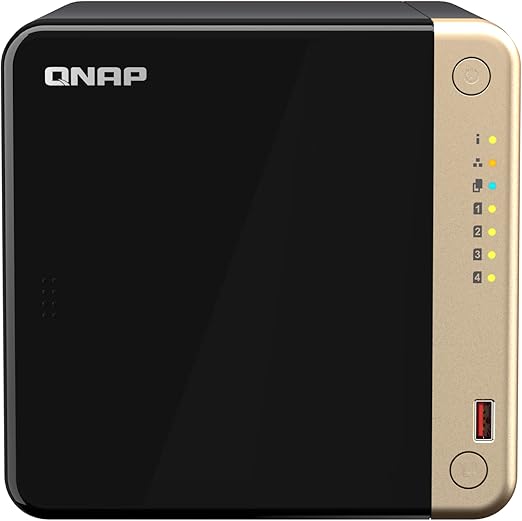
| Model | QNAP TS-464-8G |
|---|---|
| Bays | 4 |
| CPU | Intel Celeron N5095 (4-core) |
| RAM | 8 GB DDR4 (expandable to 16 GB) |
| Network | 2x 2.5GbE RJ45 |
| M.2 Slots | 2x NVMe (SSD cache or storage pool) |
| AU Price (Scorptec) | $999 (diskless) |
Medium to Large Secondary (500-1,500 Students)
Larger schools with media production programs, heavy surveillance, or multi-campus requirements need more bays and more processing power. The Synology DS1525+ provides five bays in a desktop form factor, with an AMD Ryzen R1600 processor, dual 2.5GbE ports, and support for expansion units (DX525) to add another five bays later. Five bays running SHR with 5 x 16 TB drives give you approximately 58 TB usable. Enough for substantial media production storage, surveillance retention, and administration backups on a single unit.

| Model | Synology DS1525+ |
|---|---|
| Bays | 5 (expandable to 15 with 2x DX525) |
| CPU | AMD Ryzen R1600 (2-core, 4-thread) |
| RAM | 8 GB DDR4 ECC (expandable to 32 GB) |
| Network | 2x 2.5GbE RJ45 |
| M.2 Slots | 2x NVMe (SSD cache) |
| AU Price (Scorptec) | $1,399 (diskless) |
The QNAP TS-473A is the 4-bay alternative with significantly more processing power. Its AMD Ryzen V1500B quad-core processor and 8 GB RAM handle heavier concurrent workloads. Useful when dozens of staff are accessing files while surveillance records and backups run simultaneously. It supports 10GbE via PCIe expansion, making it a strong choice for schools with media production labs that need higher throughput.

| Model | QNAP TS-473A-8G |
|---|---|
| Bays | 4 |
| CPU | AMD Ryzen V1500B (4-core) |
| RAM | 8 GB DDR4 (expandable to 64 GB) |
| Network | 2x 2.5GbE RJ45 |
| PCIe Slot | 1x PCIe Gen 3 (for 10GbE or M.2 expansion) |
| AU Price (Scorptec) | $1,369 (diskless) |
Comparison: NAS Models for Schools
NAS for Schools. Model Comparison
| Synology DS425+ | QNAP TS-464-8G | Synology DS1525+ | QNAP TS-473A-8G | |
|---|---|---|---|---|
| AU Price (Scorptec, diskless) | $819 | $989 (Scorptec) | $1,285 (Mwave) | $1,489 (PLE Computers) |
| Drive Bays | 4 | 4 | 5 (exp. to 15) | 4 |
| CPU | Ryzen R1600 | Celeron N5095 | Ryzen R1600 | Ryzen V1500B |
| RAM | 2 GB ECC | 8 GB | 8 GB ECC | 8 GB |
| Network | 2x 2.5GbE | 2x 2.5GbE | 2x 2.5GbE | 2x 2.5GbE |
| Free Surveillance Licences | 2 | 8 | 2 | 8 |
| 10GbE Support | No (no PCIe slot) | No (no PCIe slot) | Via E10G adapter | Via PCIe Gen 3 |
| Best For | Small school, tight budget | Small school with cameras | Growing school, expandable | Media production, power users |
Prices last verified: 28 March 2026. Always check retailer before purchasing.
Budget Realities: School Procurement
School procurement in Australia operates on tight budgets with long approval cycles. IT spending competes with maintenance, staffing, and classroom resources. A NAS purchase needs to be justified in terms that a principal or school council understands: data protection, compliance, reduced ongoing costs, and longevity.
The total cost of a NAS deployment includes the NAS unit itself, drives, any additional RAM, network cabling or switching upgrades, and surveillance camera licences if applicable. Here is a realistic breakdown for a typical government secondary school:
| Component | Budget Estimate | Notes |
|---|---|---|
| NAS unit (e.g. Synology DS1525+) | $1,399 | Scorptec pricing, Feb 2026 |
| Drives (5 x 8 TB NAS-grade) | $1,500-$2,500 | Seagate IronWolf or WD Red Plus |
| Additional RAM (if needed) | $80-$200 | Most models ship with sufficient RAM for school workloads |
| Surveillance licences (Synology, 10 cameras) | $760 | 8 additional licences at ~$95 each |
| UPS (uninterruptible power supply) | $200-$500 | Essential. Protects against power outages and surges |
| Network switch port (if upgrading to 2.5/10GbE) | $150-$400 | Only if your existing switching needs upgrading |
| Total estimated deployment | $3,500-$5,500 | One-time cost, 5-7 year lifecycle |
Compare this to a cloud storage subscription at $10-$15 per user per month. A school with 100 staff paying $12/user/month spends $14,400 per year. $72,000 over five years. A NAS deployment at $4,500 pays for itself in under four months. Even accounting for drives, electricity, and eventual replacement, on-premises NAS storage is dramatically cheaper than cloud subscriptions at school scale. This is the argument that gets budget approval.
For government school procurement, always request a formal quote through your state's approved purchasing panel or directly from education-focused resellers. Resellers can request pricing support from distributors and vendors. Discounts that never appear on the website are routinely available for education deals. Dicker Data and BlueChip both have established education sales teams. If you have a relationship with an IT integrator or managed service provider (MSP), they can often bundle NAS hardware with deployment and configuration services under a single purchase order.
Australian Consumer Law protections apply when purchasing from Australian authorised retailers. For a device that stores your school's data, buying from an Australian retailer with genuine pre-sales and post-sales support is worth every cent over chasing the cheapest price on Amazon AU. Specialist retailers like Scorptec and PLE offer genuine NAS expertise. Amazon offers a lower price but zero technical support if something goes wrong with 16 TB of your school data inside the unit.
IT Staffing Realities in Australian Schools
The single biggest constraint in school IT is not budget. It is staffing. Many Australian schools operate with a single IT coordinator (sometimes called an ICT technician, network manager, or e-learning coordinator) who is responsible for everything: network infrastructure, student devices, staff support, printer management, AV equipment, and. Somewhere in the middle of all that. Server and storage management. Some schools share an IT person across two or three campuses. Others rely entirely on an external MSP who visits fortnightly.
This reality directly affects which NAS platform to choose. Synology's DSM is widely regarded as the more intuitive interface for non-specialist administrators. Its setup wizards, built-in security advisors, and straightforward shared folder permissions make it manageable for someone who is not a dedicated systems administrator. QNAP's QTS is more flexible and feature-rich but has a steeper learning curve. It rewards technical skill but can overwhelm someone who only touches the server interface once a month.
If your school's IT coordinator is comfortable with networking and server management, either platform will work well. If they are more of a generalist who manages IT alongside other duties, Synology is the safer choice for day-to-day manageability. If your school uses an external MSP, check which platform they are experienced with. The MSP's familiarity matters more than the platform's theoretical advantages.
NBN and Remote Access Considerations
Australian schools on NBN connections face the same limitations as any other NBN customer. A typical NBN 100 connection delivers approximately 40 Mbps upload speed (the actual achievable throughput, not the theoretical maximum). This means remote access to files on the NAS. Whether for staff working from home or for off-campus backups. Is limited by the school's upload bandwidth. Transferring a 10 GB database backup off-site over NBN 100 takes approximately 30-40 minutes.
Some schools on NBN fixed wireless or satellite connections have upload speeds as low as 5-10 Mbps, making off-site replication of large datasets impractical in real time. In these cases, schedule offsite backups to run overnight when bandwidth demand is lowest, or use a USB drive rotation for your offsite copy.
CGNAT (Carrier-Grade NAT) can also block direct remote access to a NAS. If your school's NBN connection uses CGNAT. Common on some RSPs. You won't be able to port-forward to the NAS for remote access. Both Synology QuickConnect and QNAP myQNAPcloud provide relay-based remote access that works around CGNAT, but performance is slower than a direct connection. For schools that need reliable remote access, confirm your RSP can provide a static IP or request a CGNAT exemption.
Security Hardening for a School NAS
Schools are attractive ransomware targets because they often have limited IT security resources, large numbers of users with varying levels of security awareness, and data they cannot afford to lose. A NAS connected to a school network without proper hardening is a risk. Follow these baseline steps as a minimum:
Disable default admin accounts. Create a new admin user with a strong, unique password and disable the built-in 'admin' account. Both Synology and QNAP support this. Enable two-factor authentication for all admin-level accounts. Disable unused services. If you don't need FTP, SSH, or Telnet access, turn them off. Enable automatic security updates so the NAS firmware stays patched. Configure IP auto-blocking to lock out IP addresses after repeated failed login attempts. Enable immutable snapshots where supported. These create point-in-time copies that cannot be deleted or modified, even by an admin account compromised by ransomware. For a comprehensive guide, see our NAS security and ransomware protection article.
Related reading: our NAS buyer's guide.
Use our free Backup Storage Calculator to size your backup storage correctly.
Can a NAS replace our school's Windows file server?
In most cases, yes. Both Synology DSM and QNAP QTS support SMB/CIFS file sharing, which is the same protocol Windows Server uses for shared folders. They can join an Active Directory domain, apply NTFS-style permissions, and serve files to Windows, macOS, and Chromebook clients simultaneously. The main scenario where a NAS cannot directly replace a Windows server is if your school runs applications that require Windows Server specifically. Such as certain SIS platforms or print management software that needs a Windows service. In that case, the NAS acts as a backup target and secondary file store rather than a full server replacement.
How many surveillance cameras can a school NAS handle?
A 4-bay NAS like the Synology DS425+ or QNAP TS-464 can comfortably handle 10―20 cameras recording at 1080p. At 4K resolution, reduce that to 8-12 cameras before the CPU and throughput become limiting factors. For schools with 30+ cameras, consider a dedicated NAS for surveillance separate from your file-sharing and backup NAS. The Synology DS1525+ or QNAP TS-473A can handle higher camera counts. Remember that Synology includes only 2 free camera licences ($95 each for additional), while QNAP includes 8 free licences. A meaningful cost difference for schools with many cameras.
Is a NAS secure enough for student personal information?
A properly configured NAS is as secure as any on-premises storage solution. Both Synology and QNAP support AES-256 volume encryption, user-level access controls, audit logging, automatic firmware updates, IP auto-blocking, and two-factor authentication for admin accounts. The NAS is only as secure as your configuration and your network. A NAS on a flat, unsegmented network with the default admin account enabled and no firewall is not secure regardless of the hardware. Follow the security hardening steps outlined above and keep the firmware updated. For most school environments, a hardened NAS provides equivalent or better security than a Windows file server that is not being actively maintained by a dedicated sysadmin.
Should a school use RAID 5 or RAID 6?
For a 4-bay NAS, RAID 5 (or Synology SHR) provides single-drive redundancy and is the standard recommendation. You lose one drive's worth of capacity to redundancy but gain the ability to survive a single drive failure without data loss. For a 5-bay or larger NAS with critical data, RAID 6 (or SHR-2) adds two-drive redundancy at the cost of more capacity. Given that schools cannot afford data loss and may not have an IT person on-site to immediately replace a failed drive, RAID 6 or SHR-2 provides a valuable safety margin on larger arrays. RAID is not a backup. You still need offsite copies via the 3-2-1 backup strategy.
What drives should a school buy for a NAS?
Always use NAS-grade drives. The two main options are Seagate IronWolf and WD Red Plus. Both are designed for 24/7 operation in multi-bay NAS enclosures with vibration tolerance, error recovery controls, and 3-year warranties. Avoid desktop drives (WD Blue, Seagate Barracuda). They are not designed for always-on NAS duty and have higher failure rates in this environment. For capacity, 8 TB drives offer the best price-per-TB in Australia as of early 2026. NAS-grade drive prices have risen significantly from early 2025 levels. Budget accordingly and shop around. HDD prices are currently volatile due to global supply constraints.
Can multiple school campuses share a single NAS?
Technically yes, but it depends on your inter-campus connectivity. If your campuses are connected via a dedicated WAN link or VPN with sufficient bandwidth, remote sites can access the NAS over the network. Both Synology and QNAP support site-to-site VPN and NAS-to-NAS replication, allowing each campus to have its own NAS with automated synchronisation. For schools connected only via NBN, bandwidth limitations (especially upload speeds of 40-56 Mbps on NBN 100) make real-time file access from a remote campus impractical. The better approach is a NAS at each campus with scheduled replication of critical data between them.
Do I need a UPS for a school NAS?
Absolutely. A UPS (uninterruptible power supply) is not optional for a NAS running RAID. A sudden power loss during a write operation can corrupt the RAID array, potentially making all data inaccessible. Both Synology and QNAP NAS units support UPS monitoring via USB. When the UPS reports a power failure, the NAS safely shuts down before the battery runs out. A basic UPS suitable for a NAS costs $200-$500 AUD. Given that it protects thousands of dollars of hardware and irreplaceable school data, this is not where you cut the budget.
Running a small business NAS setup at your school? Our guide covers the broader picture for Australian SMBs including schools, clinics, and offices.
Read: Best NAS for Small Business Australia →