Australian real estate agencies handle massive volumes of high-resolution property photography, drone video, 3D virtual tours, and sensitive client documents. Yet most still rely on a patchwork of personal laptops, USB drives, and cloud subscriptions that were never designed for structured, secure business storage. A network-attached storage (NAS) device centralises all of this data in your office, makes it accessible to every agent and admin staff member over the network, and provides the redundancy and backup automation needed to protect both your marketing assets and your legal obligations under the Privacy Act 1988. Whether you run a single-office boutique agency or a multi-branch franchise operation, a NAS replaces the chaos of scattered files with a structured, searchable, and secure storage system that agents can access from the office, from home, or from an open inspection via their phone.
In short: A 4-bay NAS in the $800-$1,000 range (diskless) suits most single-office real estate agencies. The Synology DS425+ at $819 or the QNAP TS-464 at $999 from Scorptec are strong options. Pair with 4 x 4TB or 4 x 8TB NAS-grade drives in RAID 5/SHR for redundancy, configure remote access via VPN or Tailscale for agents in the field, and implement a 3-2-1 backup strategy for your CRM database. Budget $1,800-$3,500 total including drives.
Why Real Estate Agencies Need a NAS
A typical Australian real estate agency lists dozens to hundreds of properties per year. Each listing generates a substantial data footprint: 30-80 high-resolution photos (each 8-25 MB from a professional DSLR or mirrorless camera), a drone video walkthrough (500 MB-2 GB per property), floor plans, 3D Matterport or similar virtual tour data (1-5 GB per property), and a collection of vendor documents including contracts of sale, section 32 statements or Form 1 disclosures, and correspondence. Multiply that across a year of listings and your agency is generating hundreds of gigabytes to several terabytes of data annually.
Most of this data currently lives in a combination of places: the photographer's delivery folder on Dropbox or Google Drive, the agent's laptop, the agency's CRM system, and maybe a USB drive in someone's desk drawer. This scattered approach creates three problems. First, no single source of truth. Agents waste time searching for the latest version of a floor plan or hero image. Second, no redundancy. If a laptop fails or a USB drive is lost, that data may be gone permanently. Third, no access control. Anyone with the Dropbox link can access every file, with no audit trail of who viewed or downloaded what.
A NAS solves all three problems. It provides a central repository where every listing's assets are stored in a structured folder hierarchy. It runs RAID redundancy so a single drive failure does not mean data loss. And it offers user-level permissions so that agents see their own listings, admin staff can access templates and compliance documents, and the principal can oversee everything. For agencies looking to build a proper small business storage infrastructure, a NAS is the foundation.
The Real Estate Data Problem: What You Actually Store
Before selecting a NAS, it helps to understand the volume and types of data an agency generates. This determines the capacity you need and the RAID configuration that makes sense.
| Data Type | Typical Size Per Listing | Annual Volume (100 Listings) | Notes |
|---|---|---|---|
| Property photos (RAW + edited JPEG) | 500 MB, 2 GB | 50-200 GB | RAW files from photographers are large but essential for re-editing |
| Drone video (4K) | 500 MB, 2 GB | 50-200 GB | Increasingly standard for higher-end listings |
| 3D virtual tours (Matterport etc.) | 1-5 GB | 100-500 GB | Post-COVID expectation for most markets |
| Floor plans and marketing collateral | 10-50 MB | 1-5 GB | PDFs, InDesign files, brochure layouts |
| Vendor/buyer documents | 5-20 MB | 500 MB, 2 GB | Contracts, Form 1/Section 32, ID copies |
| CRM database backups | 500 MB, 5 GB | Ongoing (daily backups) | Most critical data asset. Protect at all costs |
A single-office agency handling 100 listings per year should budget for 300 GB-1 TB of new data annually. That number increases substantially if you retain RAW photo files and uncompressed drone footage. A 4-bay NAS with 4 x 8TB drives in RAID 5 gives you roughly 24 TB of usable capacity. Enough to store a decade or more of listing data without needing to archive or delete anything. For agencies doing high-volume drone and 3D work, photography-focused NAS configurations with more capacity are worth considering.
Privacy Act Obligations for Real Estate Agencies
Real estate agencies are not exempt from the Privacy Act 1988. If your agency has annual turnover exceeding $3 million, or if you handle personal information as part of a Commonwealth contract, you are bound by the Australian Privacy Principles (APPs). Even agencies below the turnover threshold handle sensitive personal information. Identification documents, financial statements, tenancy applications with employment history and references. And have ethical (if not always legal) obligations to protect that data.
APP 11 requires you to take reasonable steps to protect personal information from misuse, interference, loss, and unauthorised access. Storing client identification documents on an agent's personal laptop with no password or encryption does not meet this standard. A NAS with user-level access controls, encrypted shared folders, and automated backups demonstrates that your agency takes data protection seriously. If a data breach occurs, the OAIC will consider what steps you had in place to prevent it. Having a properly configured NAS with access logging and encryption is a meaningful defence.
Document retention matters. Real estate legislation varies by state, but agencies are generally required to retain transaction records for a minimum of 3-7 years depending on the jurisdiction. In NSW, agents must keep records for 3 years after a transaction. In Victoria, records must be retained for 3 years. Trust account records must be kept for 7 years in most states. A NAS provides the capacity and reliability to retain these records indefinitely at negligible ongoing cost.
Remote Access for Agents in the Field
Real estate agents are rarely at their desks. They are at inspections, auctions, listing presentations, and vendor meetings. They need access to property files, contracts, and CRM data from their phone or tablet. This is where a NAS earns its keep. But it is also where Australian internet infrastructure creates a specific challenge that most international guides do not mention.
The CGNAT Problem on Australian NBN Connections
Many Australian NBN connections use Carrier-Grade NAT (CGNAT), which means your office does not have a public IP address. Without a public IP, traditional port forwarding and VPN server setups will not work. You cannot connect to your NAS from outside because the internet cannot route traffic directly to your office. This affects a significant number of NBN connections, particularly those on lower-tier plans or with certain RSPs.
There are three practical solutions for real estate agencies. First, Synology's QuickConnect or QNAP's myQNAPcloud relay services work around CGNAT by routing traffic through the vendor's relay servers. This is the simplest option but adds latency and bandwidth limitations. Second, overlay VPN services like Tailscale or ZeroTier create direct peer-to-peer connections that punch through CGNAT without any port forwarding. This is the current best-practice approach and gives agents seamless access to the NAS from any device. Third, you can request a static public IP from your RSP (some charge $5-15/month extra) and run a standard VPN server directly on the NAS. For a detailed walkthrough of all three approaches, see our NAS remote access and VPN guide.
NBN upload speed reality check: Even if you solve the CGNAT problem, remember that a standard NBN 100/20 plan gives you only 20 Mbps upload. That translates to roughly 2.5 MB/s when an agent tries to download a large file from the NAS remotely. A 2 GB drone video would take around 13 minutes to transfer. For quick access to contracts and individual photos this is fine, but if agents regularly need to pull large video files remotely, consider syncing frequently-accessed folders to a cloud service as a complement to the NAS rather than relying solely on direct remote access.
Mobile Access Apps
Both Synology and QNAP offer mobile apps that give agents file access from their phones. Synology's DS File app and QNAP's Qfile app let agents browse folders, preview images, and share files directly from the NAS. Synology Photos and QNAP's QuMagie provide gallery-style browsing of property images with AI-powered search. Genuinely useful when an agent at a listing presentation needs to quickly pull up comparable property photos. For agencies that want their NAS to feel like a cloud drive, Synology Drive and QNAP's Qsync provide desktop sync clients similar to Dropbox, keeping selected folders synchronised between the NAS and each agent's laptop.
Multi-Office File Synchronisation
Franchise groups and multi-branch agencies face an additional challenge: keeping files consistent across offices. If the head office updates a listing's marketing materials, every branch that might show that property needs the updated files. Manual file sharing via email or USB is error-prone and slow.
Both Synology and QNAP support NAS-to-NAS folder synchronisation. A NAS in each office can be configured to sync designated shared folders, so a file saved at the head office appears at the branch office within minutes. Synology's Drive ShareSync and QNAP's Hybrid Backup Sync both support this. The limitation is bandwidth. NBN upload speeds of 20-40 Mbps mean large sync jobs (hundreds of photos from a new listing) may take time to propagate. For agencies where branch offices need real-time access to the same files, a cloud-hybrid approach using Synology Drive or a shared cloud tier may be more practical than pure NAS-to-NAS sync.
CRM and Database Backup Strategy
Your CRM is your agency's most valuable digital asset. Whether you use Agentbox, Rex, VaultRE, Eagle, or another platform, the database containing your contacts, listing history, buyer enquiries, and vendor relationships represents years of accumulated business intelligence. Losing it would set your agency back significantly.
Cloud-hosted CRMs (which most modern real estate CRMs are) handle their own backups on the vendor's infrastructure. However, you should still maintain local exports of your CRM data on the NAS as an independent backup. Most CRMs allow scheduled data exports in CSV or similar formats. Store these on the NAS daily. If the CRM vendor has an outage, a billing dispute, or goes out of business, your data export on the NAS ensures continuity.
For agencies using locally-installed software or maintaining local databases, the NAS becomes your primary backup target. Configure automated nightly backups from the server running the CRM to the NAS using the NAS's built-in backup tools. Then implement a 3-2-1 backup strategy: three copies of your data, on two different media types, with one copy offsite. The NAS is your primary local copy. An encrypted cloud backup (using Synology's Hyper Backup to Backblaze B2 or similar) provides the offsite copy. This protects you against fire, theft, or a catastrophic NAS failure.
Recommended NAS Models for Real Estate Agencies
The right NAS depends on your agency's size, the volume of media you handle, and whether you operate from one office or several. Below are specific models suited to different agency profiles, with current Australian pricing from Scorptec.
Boutique or Solo Agent: Synology DS225+
The Synology DS225+ is a 2-bay unit that suits a sole agent or very small team where the primary need is centralised backup and basic file sharing. At $549 from Scorptec, it is the most affordable entry point into business-grade NAS storage. Two bays limit you to RAID 1 (mirroring), meaning you lose half your raw capacity to redundancy. Two 8TB drives give you 8TB usable. That is still adequate for a solo operator's needs. The DS225+ runs Synology DSM 7 with full access to Synology Drive, QuickConnect for remote access, and Hyper Backup for automated offsite backups.

| Model | Synology DS225+ |
|---|---|
| Bays | 2 |
| RAM | 2 GB DDR4 (expandable) |
| Network | 2x 1GbE |
| AU Price (Scorptec) | $549 |
| Best For | Solo agents, small backup-focused setups |
Pros
- Lowest entry cost for a Synology Plus-series NAS
- Full DSM 7 feature set including Synology Drive and Photos
- Compact and quiet. Fits under a desk or in a cupboard
- Synology's ecosystem of mobile apps ideal for agents on the go
Cons
- Only 2 bays. Limited to RAID 1 with 50% capacity overhead
- No M.2 SSD cache slots
- Not ideal if your agency grows beyond 3-4 users
Single-Office Agency (3-10 Staff): Synology DS425+ or QNAP TS-464
This is the sweet spot for most Australian real estate agencies. A 4-bay NAS provides the right balance of capacity, redundancy, and cost. The Synology DS425+ at $819 and the QNAP TS-464 at $999 are both excellent choices. Four bays allow RAID 5 (or Synology's SHR), giving you one-drive redundancy with approximately 75% of raw capacity available as usable storage. With 4 x 8TB NAS-grade drives, that is roughly 24TB usable. Enough for thousands of listings worth of photos, videos, and documents.
The Synology DS425+ benefits from Synology's polished DSM interface and strong mobile app ecosystem. Synology Drive is particularly well-suited to real estate workflows. Agents can sync listing folders to their laptops and access everything offline, with changes syncing back to the NAS when they reconnect. The QNAP TS-464 offers an Intel Celeron processor, 8GB RAM, and dual 2.5GbE network ports for faster local file transfers. It also includes two M.2 NVMe SSD slots for read/write caching, which helps when multiple agents are accessing large photo folders simultaneously. For a deeper look at both, see our small business NAS guide.
4-Bay NAS Comparison for Real Estate Agencies
 Synology DS425+
|
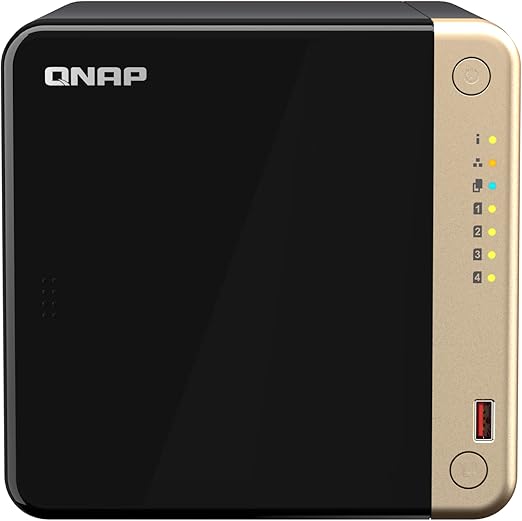 QNAP TS-464
|
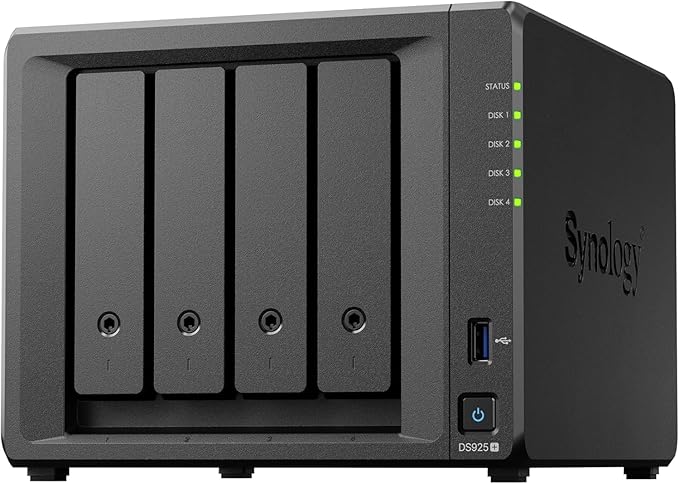 Synology DS925+
|
|
|---|---|---|---|
| AU Price (Scorptec) | $819 | $989 (Scorptec) | $995 |
| Bays | 4 | 4 | 4 |
| RAM | 2 GB DDR4 (expandable) | 8 GB DDR4 (expandable to 16 GB) | 4 GB DDR4 (expandable to 16 GB) |
| Network Ports | 2x 1GbE | 2x 2.5GbE | 2x 1GbE |
| M.2 SSD Slots | No | 2x NVMe | 2x NVMe |
| Remote Access | QuickConnect + Synology Drive | myQNAPcloud + Qsync | QuickConnect + Synology Drive |
| Best For | Budget-conscious single office | Offices needing faster LAN and SSD caching | Agencies wanting Synology ecosystem with room to grow |
Prices last verified: 10 March 2026. Always check retailer before purchasing.
The Synology DS925+ at $995 sits between the DS425+ and the QNAP TS-464 as a premium Synology option. It offers NVMe SSD caching slots that the DS425+ lacks, AMD Ryzen processing power, and support for a DX525 expansion unit if you outgrow four bays. For an agency that wants Synology's software ecosystem but with higher performance headroom, the DS925+ is the model to consider.
Multi-Branch Agency or High-Volume Media
Agencies operating multiple offices or producing exceptionally high volumes of drone video and 3D tour content should consider a 5-bay or larger NAS. The Synology DS1525+ at $1,399 from Scorptec provides five bays, AMD Ryzen processing, and support for 10GbE networking via an expansion card. Five bays in RAID 5 give you four drives of usable capacity while retaining single-drive redundancy. Combined with 12TB or 16TB drives, you can build 48-64TB of usable storage. Enough for even the most media-intensive agencies.
For multi-branch operations, deploy a NAS at each office and configure folder synchronisation between them. The head office NAS acts as the primary repository, with branch office NAS units syncing key folders. Each office gets local-speed access to files while maintaining consistency across locations. Business NAS models and expansion units are rarely held in retailer stock. Even when listed as available, expect 2-3 days for the retailer to process through their distributor. Request a formal quote rather than buying at listed retail price; resellers can request pricing support from distributors and vendors for business deals.
Choosing Drives for a Real Estate NAS
The NAS unit is sold without drives (diskless). You need to buy NAS-grade hard drives separately. Use drives rated for 24/7 operation in a multi-user NAS environment. The Seagate IronWolf or WD Red Plus product lines are the standard choices. Desktop drives like Seagate Barracuda or WD Blue are designed for single-user desktop PCs and will fail sooner in a NAS that runs around the clock with multiple users reading and writing simultaneously.
NAS-grade drive prices have risen significantly from early 2025 levels. Drives that were comfortably under $160 for 4TB are now consistently above $200. Budget accordingly. For a 4-bay real estate NAS, a practical starting configuration is 4 x 4TB NAS drives (approximately $1,000-$1,200 total for drives) giving you roughly 12TB usable in RAID 5. If your agency produces heavy video and 3D content, step up to 4 x 8TB drives (approximately $1,600-$2,000 for drives) for roughly 24TB usable.
Australian Consumer Law protections apply when purchasing NAS hardware and drives from Australian retailers. If a drive fails within a reasonable period, you are entitled to a repair, replacement, or refund regardless of the manufacturer's warranty period. Buy from an Australian authorised retailer. Scorptec, PLE, Mwave, or similar. For full ACL coverage. Avoid grey imports for business-critical storage hardware.
Setting Up Your Agency NAS: Key Configuration Steps
A NAS out of the box is just hardware. To make it work as the backbone of your agency's storage, you need to configure it correctly. If you have an IT provider, involve them. If not, both Synology and QNAP provide guided setup wizards that walk you through the essentials.
Folder Structure for Real Estate
Create a logical folder structure that mirrors your workflow. A proven approach for real estate agencies is to organise by year and address. For example: /Listings/2026/42-Smith-Street-Richmond/Photos, /Listings/2026/42-Smith-Street-Richmond/Video, /Listings/2026/42-Smith-Street-Richmond/Documents. Separate shared folders for templates, marketing collateral, compliance documents, and CRM backups keep everything organised. Set folder permissions so that agents can read and write to active listings but only the principal or admin can modify archived listings or compliance files.
User Accounts and Permissions
Create individual user accounts for every staff member. Never share accounts. Set folder-level permissions so agents can access listing files, admin staff can access templates and compliance folders, and sensitive documents (trust account records, staff HR files, vendor financial statements) are restricted to principals and authorised admin only. Both Synology DSM and QNAP QTS support granular folder and file permissions. This is not just good practice. It is a requirement under APP 11 of the Privacy Act for agencies above the $3 million turnover threshold.
Encryption and Physical Security
Enable encryption on shared folders containing client documents and financial records. Both Synology and QNAP support AES-256 folder-level encryption, which protects data at rest if the NAS or its drives are physically stolen. Real estate offices are often in retail strips or shared buildings with foot traffic. Physical theft is a genuine risk. Place the NAS in a locked cupboard or server closet, not under a reception desk. Store encryption keys in a password manager, not on a sticky note attached to the unit.
Automated Backups and the 3-2-1 Rule
RAID is not a backup. RAID protects you from a single drive failure, but it does not protect you from ransomware, accidental deletion, fire, flood, or theft of the NAS itself. You need a proper backup strategy. The 3-2-1 approach is the industry standard: three copies of your data, two different media, one offsite. Your NAS is the primary copy. Use Synology Hyper Backup or QNAP Hybrid Backup Sync to schedule nightly encrypted backups to an offsite destination. A cloud storage service like Backblaze B2, Wasabi, or an external USB drive that you rotate offsite weekly.
Networking Considerations
A NAS is only as fast as the network connecting it to your computers. Most real estate offices run Gigabit Ethernet (1GbE) which delivers a theoretical maximum of approximately 125 MB/s. Adequate for standard file sharing and photo access. If multiple agents are simultaneously uploading large photo sets or editing video directly from the NAS, you may notice slowdowns.
For agencies doing heavy media work, the QNAP TS-464's dual 2.5GbE ports offer 2.5x the bandwidth of standard Gigabit Ethernet without requiring a network infrastructure upgrade. Just a compatible switch (QNAP sells affordable 2.5GbE switches from around $160). The Synology DS925+ can be upgraded to 10GbE with an add-in card for environments where multiple users regularly transfer large files. For most agencies, standard 1GbE is perfectly adequate. Do not over-invest in networking unless you have a documented bottleneck.
What About Cloud Storage Instead?
Cloud storage services like Google Workspace, Microsoft 365, and Dropbox Business are viable for real estate agencies, and many agencies use them successfully. However, there are trade-offs. Cloud storage incurs ongoing subscription costs that compound year over year. Google Workspace Business Standard at $21.60/user/month for a 10-person agency is $2,592/year, or nearly $13,000 over five years. A NAS is a one-time capital expense of $2,000-$4,000 that lasts 5-7 years with no recurring fees beyond electricity (a NAS draws roughly $30-60 per year in power).
Cloud also depends entirely on your internet connection. NBN outages, which are not uncommon in regional and outer-suburban areas where many agencies operate, render cloud storage inaccessible. A NAS on your local network remains fully operational during an internet outage. For agencies that want the convenience of cloud access with the resilience and cost-effectiveness of local storage, a hybrid approach works well: use the NAS as the primary repository and sync selected folders to a cloud service for remote access and offsite redundancy.
Surveillance Station: A Bonus for Office Security
Both Synology and QNAP NAS units double as network video recorders (NVR) for IP security cameras. Synology Surveillance Station includes two free camera licences and QNAP Surveillance Station includes eight. For a real estate office, this means you can record security footage from entrance cameras and store it on the NAS alongside your business data. No separate DVR or cloud subscription required. Additional camera licences from Synology cost $95 each from Scorptec. This is a practical bonus that adds tangible value beyond pure file storage.
Where to Buy in Australia
Australian NAS pricing is remarkably uniform across the major retailers. Most operate on 3-5% margin, leaving little room for price differentiation. The meaningful differences between retailers are stock depth, pre-sales advice, and post-sales support. For a business NAS purchase, buy from a specialist retailer like Scorptec, PLE, or DeviceDeal where you can get genuine pre-sales guidance rather than from Amazon AU where the price might be marginally lower but the support is nonexistent. If your agency is purchasing as a business, always request a formal quote. Resellers can request pricing support from distributors and vendors, often matching or beating sale pricing for quoted deals.
Gone are the days of waiting for Black Friday or EOFY to buy tech. Australian retailers run rolling sale events throughout the year. If you need a NAS now, buy it now. The price will not be dramatically different in six months, and in the current market, the stock might not be there. NAS-grade drives especially have been subject to supply constraints and price increases through 2025-2026.
Related reading: our NAS buyer's guide.
Use our free Backup Storage Calculator to size your backup storage correctly.
How much storage does a real estate agency actually need?
A single-office agency handling around 100 listings per year typically generates 300 GB-1 TB of new data annually, depending on how much video and 3D tour content you produce. A 4-bay NAS with 4 x 8TB drives in RAID 5 gives you roughly 24TB usable. Enough for over a decade of data without archiving. Start with 4 x 4TB drives if you want to keep costs down and upgrade individual drives as you need more space.
Can agents access the NAS from their phone at an open inspection?
Yes. Both Synology and QNAP offer mobile apps (DS File and Qfile respectively) that let agents browse, preview, and download files from the NAS on their phone. You will need to configure remote access via QuickConnect, myQNAPcloud, or a VPN service like Tailscale. If your office NBN connection uses CGNAT (common in Australia), Tailscale or the vendor's relay service are the simplest solutions. See our remote access guide for step-by-step instructions.
Is a NAS better than Google Drive or Dropbox for a real estate agency?
A NAS and cloud storage solve different problems and work well together. A NAS is a one-time purchase with no ongoing subscription fees, provides faster local access, works during internet outages, and keeps data under your physical control. Cloud storage provides easier remote access and built-in offsite redundancy but costs $2,000-$3,000+ per year for a mid-sized team and depends on internet availability. The best approach for most agencies is a NAS as the primary repository with selective cloud sync for remote access and offsite backup.
Do I need an IT person to set up and manage a NAS?
Modern NAS interfaces from Synology (DSM) and QNAP (QTS) are designed for non-technical users. The initial setup takes 30-60 minutes using the guided wizard. That said, getting the RAID configuration, backup schedules, remote access, and user permissions right from the start saves headaches later. If your agency does not have in-house IT confidence, spending $200-$500 on an IT professional for initial setup and configuration is a worthwhile investment. Day-to-day use requires no more technical skill than using a shared network drive.
What happens if the NAS fails or a drive dies?
If a single drive fails in a RAID 5 or SHR array, the NAS continues operating normally with reduced redundancy. Replace the failed drive and the NAS rebuilds the array automatically. No data loss. If the NAS unit itself fails (rare but possible), the drives can be moved to an identical replacement unit and the data recovered. This is why the 3-2-1 backup strategy matters. Even with RAID redundancy, maintain an offsite backup for disaster recovery. Australian Consumer Law protections apply to NAS hardware purchased from Australian retailers, so you are entitled to a repair, replacement, or refund if the unit fails within a reasonable period.
Should I buy the Synology DS425+ or the QNAP TS-464?
Both are capable 4-bay NAS units suited to a real estate agency. The Synology DS425+ at $819 is the more affordable option with Synology's polished software ecosystem, excellent mobile apps, and straightforward remote access via QuickConnect. The QNAP TS-464 at $999 offers more raw hardware. 8GB RAM, dual 2.5GbE ports, and M.2 SSD caching slots. Making it better suited to offices with heavier concurrent access or media-intensive workflows. If you value simplicity and mobile app quality, lean Synology. If you value hardware flexibility and faster local networking, lean QNAP.
Are there Privacy Act obligations for storing client data on a NAS?
If your agency has annual turnover exceeding $3 million, you are bound by the Australian Privacy Principles under the Privacy Act 1988. APP 11 requires reasonable steps to protect personal information from misuse, loss, and unauthorised access. A properly configured NAS with user-level access controls, encrypted shared folders, and access logging satisfies these requirements. Even agencies below the threshold handle sensitive client data (identification documents, financial statements, tenancy applications) and should treat data security as a business-critical obligation.
Need help choosing the right NAS setup for your real estate agency? Our small business NAS guide covers everything from model selection to RAID configuration for Australian offices.
Read the Small Business NAS Guide →