Australian lawyers have some of the longest and most complex document retention obligations of any profession. With minimum retention periods of seven years for general files, fifteen years for trust records, and indefinite retention for wills, deeds, and certain conveyancing documents. A network-attached storage (NAS) device gives your firm on-premises control over matter files, client correspondence, trust account records, court documents, and privileged communications. Unlike cloud-only solutions where data may traverse international servers, a NAS keeps everything physically within your office. Directly supporting your obligations under the Australian Solicitors' Conduct Rules, state-based legal profession legislation, and the Privacy Act 1988.
In short: A 4-bay NAS in the $550-$1,000 range (diskless) suits most solo practitioners and small firms. For firms with 3-10 lawyers, a Synology DS925+ at $995 or QNAP TS-464 at $999 from Scorptec provides the storage capacity, encryption, access controls, and remote access capabilities that legal practices require. Budget $2,000-$4,000 total including NAS-grade drives. Pair it with a solid 3-2-1 backup strategy and you have a system that satisfies both regulatory requirements and practical matter management needs for 5-7 years.
Why Law Firms Need On-Premises Storage
Legal practices generate and receive vast quantities of documents that must be stored securely, retained for defined periods, and produced on demand when required. Matter files, client instructions, correspondence, trust account records, court filings, contracts, discovery documents, and privileged legal advice all need to be accessible, organised, and protected. Most practice management software. Including LEAP, Smokeball, and Actionstep. Either stores data locally or synchronises with cloud infrastructure. A NAS supplements or replaces local PC storage with purpose-built hardware designed for always-on operation, data redundancy, and automated backups.
The risk of relying on a single desktop PC or an external hard drive for your firm's documents cannot be overstated. One hardware failure, one ransomware infection, or one stolen laptop can destroy years of matter files and trust records. A NAS with RAID redundancy means a single drive can fail without data loss, giving you time to replace the drive and rebuild the array. For a firm holding thousands of client files and decades of retained documents, this protection is not a technology luxury. It is a basic professional obligation. For a broader look at how NAS fits small professional practices, see our guide to NAS for small business in Australia.
Legal Professional Privilege and Data Sovereignty
Legal professional privilege is the cornerstone of the solicitor-client relationship, and how you store privileged communications has direct implications for whether that privilege holds up under scrutiny. When privileged documents are stored on cloud servers operated by third parties. Particularly servers located outside Australia. You introduce risks around who can access that data, whether foreign government agencies can compel disclosure, and whether your client can genuinely be assured their communications remain confidential.
A NAS keeps privileged files physically on your premises, under your direct control. You decide who has access, you manage the encryption keys, and you control the physical security of the device. This does not mean cloud storage is inherently incompatible with privilege obligations. But it does mean you need to conduct due diligence on any cloud provider's data sovereignty, encryption, and access policies. For many small firms, avoiding that complexity entirely by keeping data on a local NAS is the pragmatic choice. The Australian Solicitors' Conduct Rules (Rule 9. Confidentiality) require you to take reasonable steps to maintain confidentiality of client information, and demonstrating physical control over data storage is a straightforward way to meet that standard.
Data sovereignty matters. If your cloud provider stores data on servers in the United States, that data may be subject to US law enforcement access under the CLOUD Act. Regardless of where you or your client are located. For firms handling sensitive criminal defence, family law, or commercial litigation matters, keeping privileged documents on a locally controlled NAS eliminates this risk entirely.
Record-Keeping Obligations for Australian Lawyers
Legal record retention in Australia is governed by a combination of state and territory legal profession legislation, trust account regulations, taxation law, and professional conduct rules. The retention periods are longer and more varied than most other professions, which directly affects how you plan your NAS storage capacity. For a broader overview of compliance obligations across industries, see our guide on NAS compliance for Australian small businesses.
| Document Type | Minimum Retention Period | Governing Authority | Notes |
| General matter files | 7 years after matter concludes | State/territory legal profession acts | Includes correspondence, file notes, instructions |
| Trust account records | 7–15 years (varies by state) | Legal Profession Uniform Law / state acts | NSW/VIC: 7 years. QLD: 7 years. Some states require 15 years. |
| Wills and testamentary documents | Indefinite (or until returned to client) | Professional conduct rules | Must be stored securely — loss of a will is a serious professional liability |
| Deeds and original documents | Indefinite (or until returned to client) | Professional conduct rules | Safe custody obligations apply |
| Conveyancing files | 15 years minimum (some indefinite) | State-based requirements | Title-related documents may need indefinite retention |
| Tax and BAS records | 5–7 years | ATO requirements | Firm's own financial records plus client tax work |
| Employment and HR records | 7 years after employment ends | Fair Work Act / state legislation | Staff contracts, payroll, leave records |
| Court filings and transcripts | 7 years minimum | Varies by jurisdiction | Retain copies of all filed documents |
The practical takeaway is that law firms accumulate documents that must be retained for much longer than most businesses. A sole practitioner who has been operating for twenty years may have matter files spanning that entire period that cannot legally be destroyed. A NAS with expandable storage capacity. Starting at 4 bays and adding drives or expanding with additional units over time. Is a far more sustainable approach than filling external hard drives and hoping nothing fails.
Client Confidentiality and the Australian Solicitors' Conduct Rules
Rule 9 of the Australian Solicitors' Conduct Rules imposes a duty of confidentiality that survives the solicitor-client relationship. Meaning your obligation to protect client information continues after the matter concludes and after the client relationship ends. This has direct implications for how you store, back up, and eventually dispose of client data.
A NAS supports Rule 9 compliance through several mechanisms. First, user-level access controls ensure that only authorised staff can access specific matter folders. A paralegal working on conveyancing should not have access to criminal defence files. Second, encrypted shared folders (AES-256 on both Synology and QNAP) protect data at rest, so if the NAS is physically stolen, client data remains unreadable. Third, access logging creates an audit trail showing who accessed what files and when. Critical if you ever need to demonstrate that confidentiality was maintained during a complaint or investigation by your state law society.
Matter Management File Structures on a NAS
How you organise files on your NAS directly affects your firm's efficiency and your ability to locate documents quickly. Whether for an upcoming court hearing or a law society audit. A well-structured NAS folder hierarchy mirrors how legal practices have always organised physical files, but with the advantages of search, version control, and access logging.
A practical folder structure for a law firm NAS looks like this: a top-level shared folder for each practice area (e.g., "Conveyancing", "Family Law", "Commercial Litigation", "Criminal"), with subfolders for each matter using a consistent naming convention. Typically "[Matter Number] - [Client Surname] - [Brief Description]". Within each matter folder, use standardised subfolders: "Correspondence", "Instructions", "Court Documents", "Discovery", "Research", "Billing", and "File Notes". This structure works whether you have one lawyer or ten, and it scales cleanly as your firm grows.
Conflict search consideration: When opening new matters, firms must conduct conflict checks across existing clients and matters. If your NAS stores matter documents, maintaining a separate conflict register (a spreadsheet or database listing all clients, related parties, and matter descriptions) on the NAS makes this process faster and more reliable. Some practice management platforms like LEAP and Smokeball have built-in conflict search. But keeping a backup register on the NAS ensures you can still run checks even if your practice management software is offline.
Encryption Requirements for Legal Data
Encryption is not optional for a law firm NAS. Client files contain sensitive personal information, privileged communications, financial records, and in some practice areas (family law, criminal defence), information that could cause serious harm if disclosed. Both Synology DSM and QNAP QTS support AES-256 shared folder encryption, which encrypts data at rest on the NAS drives.
Enable encryption on every shared folder containing client data. Store your encryption keys separately from the NAS. In a password manager or a physically separate secure location. If the NAS is stolen and the encryption key is stored on a sticky note attached to the device, the encryption is worthless. For firms using remote access (which most will. See below), ensure that connections to the NAS use TLS/SSL encryption in transit as well. Synology's QuickConnect and QNAP's myQNAPcloud both support HTTPS connections, and you should enforce HTTPS-only access to prevent unencrypted data traversal. For a comprehensive look at protecting your NAS from threats, see our NAS security and ransomware protection guide.
Remote Access for Lawyers. Working from Home, Court, and Client Sites
Modern legal practice demands access to files from outside the office. Lawyers work from home, access documents at court, prepare for hearings at client sites, and collaborate with barristers who may be anywhere in the country. A NAS that only works within the office network is not practical for how lawyers actually work in 2026.
Both Synology and QNAP offer built-in remote access solutions. Synology's QuickConnect provides relay-based access without needing to configure your router, while Synology Drive (similar to Dropbox) allows selective file sync to laptops and mobile devices. QNAP's myQNAPcloud offers similar relay-based access, and QNAP's Qsync provides file synchronisation. For a more secure approach, both platforms support VPN server functionality. You can run an OpenVPN or WireGuard VPN server directly on the NAS, giving remote users encrypted tunnel access as if they were on the office network.
The CGNAT Problem on Australian NBN Connections
If your office internet is on an NBN plan using Carrier-Grade NAT (CGNAT), direct remote access to your NAS becomes significantly more complicated. CGNAT means your office does not have a unique public IP address. Multiple customers share the same IP. Which blocks direct VPN connections and port forwarding. This is increasingly common on budget NBN plans and some 4G/5G fixed wireless connections.
If you are affected by CGNAT, you have three options. First, contact your ISP and request a static public IP address. Most business-grade NBN plans include one, and some residential plans offer it for an additional monthly fee. Second, use Synology QuickConnect or QNAP myQNAPcloud relay services, which work around CGNAT by routing through the vendor's relay servers (slower, but functional). Third, use a third-party VPN tunnel service like Tailscale or ZeroTier, which establishes mesh connections that bypass CGNAT entirely. For a law firm that needs reliable remote access, spending an extra $10-$20 per month for a static IP is the simplest and most reliable solution.
Also consider NBN upload speeds when working remotely. A typical NBN 100 plan delivers only about 20-40 Mbps upload (with 20 Mbps being common on older FTTN connections). If multiple lawyers are accessing the NAS remotely while the office is also using the connection, large file transfers will be slow. For firms that rely heavily on remote access, upgrading to an NBN Business plan with symmetric upload speeds or choosing a fibre plan with higher upload capacity is worth the investment.
Recommended NAS Models for Australian Law Firms
The right NAS depends on the size of your firm and the volume of documents you manage. Prices below are from Scorptec as of February 2026 and are for the NAS unit only (diskless. Drives purchased separately).
Solo Practitioner or Small Practice (1-2 Lawyers)
The Synology DS225+ is a 2-bay NAS at $549 from Scorptec that suits solo practitioners and very small firms. Two bays configured in RAID 1 (mirroring) give you one drive of redundancy. If a drive fails, your data is safe on the mirror. With 2 x 8TB NAS-grade drives, you get 8TB usable storage, which is more than sufficient for a solo practice managing text-heavy matter files. The DS225+ runs Synology's DSM 7 operating system with Synology Drive for file sync, Hyper Backup for automated offsite backups, and built-in VPN server for secure remote access.

| Model | Synology DS225+ |
|---|---|
| Bays | 2 |
| AU Price (Scorptec) | $549 |
| RAID Configuration | RAID 1 (mirroring) |
| Usable Capacity (2 x 8TB) | ~8 TB |
| Suited For | Solo practitioners, barristers, 1-2 lawyer practices |
A 2-bay NAS has one limitation: no room to grow without replacing drives with larger ones. If you anticipate your firm growing or accumulating large volumes of scanned documents and discovery material, starting with a 4-bay unit is a better long-term investment.
Small Firm (2-5 Lawyers)
The Synology DS425+ at $819 and the Synology DS925+ at $995 from Scorptec are both 4-bay units that suit small firms. The DS425+ is the entry-level 4-bay with sufficient power for file serving, backup, and remote access. The DS925+ steps up with an AMD Ryzen R1600 processor, 4GB RAM (expandable), two M.2 NVMe SSD slots for caching, and dual 1GbE ports with link aggregation. Better suited for firms where multiple users access files simultaneously.
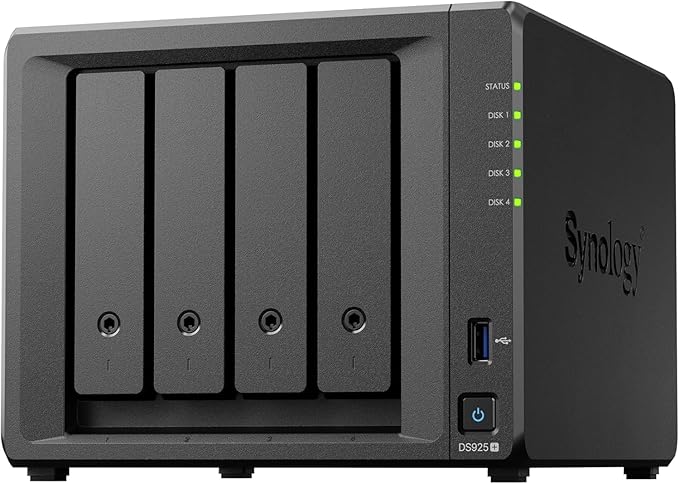
| Model | Synology DS925+ |
|---|---|
| Bays | 4 |
| CPU | AMD Ryzen R1600 (dual-core) |
| RAM | 4 GB DDR4 (expandable to 16 GB) |
| AU Price (Scorptec) | $995 |
| RAID Configuration | SHR or RAID 5 (one-drive redundancy) |
| Usable Capacity (4 x 8TB) | ~24 TB |
| Suited For | 2-5 lawyer firms, small partnerships |
The QNAP TS-464 at $999 from Scorptec is a strong alternative if your firm prefers QNAP's QTS interface or your IT provider has QNAP experience. It offers an Intel Celeron N5095 processor, 8GB RAM, two 2.5GbE network ports, and two M.2 NVMe SSD slots. The dual 2.5GbE ports are a genuine advantage for firms with 2.5GbE switches. A relatively inexpensive networking upgrade that provides noticeably faster file access compared to standard 1GbE.
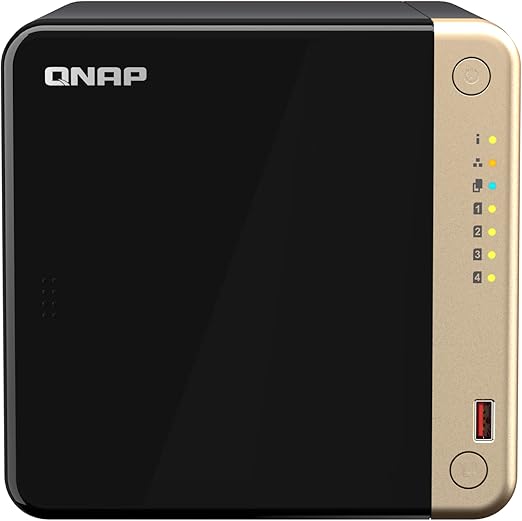
| Model | QNAP TS-464-8G |
|---|---|
| Bays | 4 |
| CPU | Intel Celeron N5095 (quad-core) |
| RAM | 8 GB DDR4 (expandable) |
| AU Price (Scorptec) | $999 |
| Network | 2 x 2.5GbE |
| Suited For | 2-5 lawyer firms wanting 2.5GbE networking |
Medium Firm (5-10+ Lawyers)
Firms with five or more lawyers, particularly those handling litigation with large discovery sets, should consider a Synology DS1525+ ($1,399 from Scorptec) with five bays or the Synology DS1825+ ($1,799) with eight bays. At this scale, RAID 6 or SHR-2 (two-drive redundancy) becomes appropriate. Losing two drives simultaneously without data loss provides a meaningful safety margin when you are storing decades of client files. These models also support 10GbE expansion cards, which matters if your firm is pushing large document sets across the network. Business models at this tier are sometimes ordered through distributors rather than held in retail stock. Request a formal quote from a specialist retailer like Scorptec, PLE, or DeviceDeal, and the reseller can request pricing support from distributors to sharpen the price.
Integration with Practice Management Software
Most Australian law firms use practice management software to manage matters, time recording, billing, and document generation. The three dominant platforms in the Australian market are LEAP, Smokeball, and Actionstep. How your NAS integrates with these platforms depends on whether the software is cloud-hosted, locally installed, or a hybrid model.
LEAP has moved heavily toward cloud-based infrastructure, with documents stored in LEAP's cloud environment. A NAS complements LEAP as a local backup target. Use Synology's Hyper Backup or QNAP's Hybrid Backup Sync to schedule nightly backups of any locally cached LEAP data and your firm's non-LEAP documents. You cannot use a NAS as LEAP's primary document store, but you can use it to ensure that if LEAP's cloud service is ever unavailable, you have a local copy of critical documents.
Smokeball also operates primarily in the cloud but maintains local file synchronisation. A NAS can serve as the backup destination for Smokeball's locally synced files, providing a second copy of all matter documents independent of Smokeball's cloud infrastructure.
Actionstep is fully cloud-based with no local file storage. Here, a NAS serves as your independent backup repository. Export matter documents periodically and store them on the NAS to maintain a local copy that is not dependent on Actionstep's continued operation or your internet connection.
For firms using locally installed software (less common in 2026 but still found in some established practices), a NAS can serve as the primary network file share where matter documents are stored and accessed. Map the NAS shared folders as network drives on each workstation, and the experience is identical to using a traditional file server. But with better redundancy, lower power consumption, and built-in backup tools.
Ransomware Protection for Law Firms
Law firms are high-value targets for ransomware because they hold sensitive client data, time-critical court documents, and trust account records. A ransomware attack that encrypts your firm's matter files the day before a trial deadline creates enormous pressure to pay the ransom. Which is exactly what attackers count on.
A properly configured NAS provides several layers of ransomware protection. Synology's Snapshot Replication and QNAP's snapshots create point-in-time copies of your data that cannot be modified by ransomware running on a connected PC. If ransomware encrypts files on the NAS, you can roll back to a snapshot taken before the attack. Immutable snapshots (available on both platforms) prevent even admin accounts from deleting snapshots within a defined retention period, which protects against sophisticated attacks that try to delete backups before encrypting data. For a detailed walkthrough, see our NAS security and ransomware protection guide.
Beyond snapshots, follow the 3-2-1 backup rule: three copies of your data, on two different media types, with one copy offsite. Your NAS is copy one. An automated backup to an external USB drive or a second NAS is copy two. An encrypted backup to a cloud service (Synology C2 or a generic S3-compatible provider) is the offsite copy three. If your NAS is destroyed by fire, flood, or theft, the offsite backup ensures your firm can recover.
Court Filing Backup and Document Versioning
Court filings represent some of the most time-sensitive and critical documents a law firm handles. Missing a filing deadline because the document was lost to a hardware failure is both a professional negligence issue and a potential disaster for your client. A NAS with versioning enabled means that every save of a court document creates a recoverable version. If a document is accidentally overwritten or corrupted, you can restore a previous version instantly.
Synology's DSM 7 supports file versioning through Synology Drive Server, which maintains previous versions of documents and allows one-click restoration. QNAP's Qsync offers similar versioning functionality. Enable versioning on all matter-related shared folders and set a retention policy that keeps at least 30 days of versions. The storage overhead is minimal for text-heavy legal documents but provides invaluable protection against accidental deletion, overwrites, and corruption.
Buying a NAS in Australia. Retailer and Pricing Context
NAS pricing in Australia is remarkably uniform across major retailers because margins are tight. Most operate at 3-5% on NAS hardware, leaving little room for significant price differences. The meaningful difference between retailers is stock availability, pre-sales technical knowledge, and after-sales support. For a law firm, buying from a specialist retailer like Scorptec or PLE. Where staff can provide genuine advice on which model suits your needs. Is worth more than saving $20 at a retailer that treats a NAS like any other box on a shelf.
Request a formal quote for any business NAS purchase. Resellers can request pricing support from distributors and vendors. Discounts that never appear on the website but are routinely available for quoted business deals. For a law firm buying a NAS, drives, and potentially a UPS, the total order value often justifies sharpened pricing.
Australian Consumer Law protections apply when purchasing from Australian authorised retailers. This gives you statutory warranty rights beyond the manufacturer's warranty. Including rights to repair, replacement, or refund if the product fails to meet consumer guarantees. For a device that stores your firm's client files, buying from an Australian retailer with ACL coverage is non-negotiable. Avoid grey imports or international purchases where ACL protections may not apply.
NAS Setup Checklist for Law Firms
Once you have your NAS and drives, configure these settings before storing any client data. If your firm does not have in-house IT capability, engage your IT provider to complete this initial setup. Getting the foundations right from day one avoids painful reconfiguration later.
| Configuration Item | Why It Matters | Priority |
| RAID configuration (SHR/RAID 5 for 4-bay, RAID 1 for 2-bay) | Drive redundancy — protects against single drive failure | Critical |
| Individual user accounts (no shared logins) | Audit trail, access control, Rule 9 compliance | Critical |
| Folder-level permissions per practice area | Separation of matters, confidentiality between teams | Critical |
| AES-256 shared folder encryption | Protects data at rest if NAS is stolen | Critical |
| Access logging enabled | Audit trail for law society compliance, data breach investigation | Critical |
| Automated backup schedule (3-2-1 strategy) | Offsite copy protects against fire, flood, theft, ransomware | Critical |
| Snapshot replication enabled | Point-in-time recovery from ransomware or accidental deletion | High |
| Remote access configured (VPN or QuickConnect/myQNAPcloud) | File access from home, court, client sites | High |
| UPS (uninterruptible power supply) connected | Prevents data corruption from sudden power loss | High |
| Firmware auto-update enabled | Security patches applied promptly | Medium |
Related reading: our NAS buyer's guide.
Real estate agencies share many document management and compliance challenges with legal firms. Our NAS for Real Estate Agencies guide covers listing media storage, AU data retention requirements, and the right hardware for a busy agency.
Our NAS Sizing Wizard helps size storage for legal document workloads and user counts, and our Backup Storage Calculator estimates the backup capacity needed to satisfy AU retention obligations.
Can a NAS replace our law firm's file server?
Yes. A modern 4-bay NAS from Synology or QNAP can serve as the primary file server for a small law firm. It supports SMB/CIFS file sharing (the same protocol used by Windows file servers), user-level access controls, and Active Directory integration for firms already using a Windows domain. For firms with 1-10 lawyers, a NAS is typically more reliable, more energy-efficient, and far less expensive to maintain than a traditional Windows server. The only scenario where a dedicated server is still necessary is if your practice management software requires a Windows Server environment. Check with your software vendor before committing.
How long do law firms need to keep client files in Australia?
The baseline is seven years after a matter concludes for general files. Trust account records must be retained for 7-15 years depending on your state or territory. Wills, deeds, and certain conveyancing documents should be retained indefinitely or until returned to the client. Given the low cost of storage. A 4TB NAS-grade drive costs around $299. Many firms choose to retain all files indefinitely rather than risk destroying documents prematurely. A properly configured NAS with RAID redundancy and offsite backups makes indefinite retention practical and affordable.
Is it safe to access my NAS remotely from court or client sites?
Yes, if configured correctly. The most secure option is running a VPN server on the NAS itself (both Synology and QNAP support OpenVPN and WireGuard) and connecting via VPN from your laptop or phone. This encrypts all traffic between your device and the NAS. If running a VPN is not practical, Synology QuickConnect and QNAP myQNAPcloud provide encrypted relay access. Avoid accessing your NAS over unencrypted HTTP, and always use strong passwords with two-factor authentication enabled. If your office NBN connection uses CGNAT, request a static IP from your ISP or use a mesh VPN service like Tailscale to bypass the CGNAT restriction.
What happens if my NAS is seized by law enforcement during a raid?
If your NAS is seized, having AES-256 encryption enabled on shared folders means the data cannot be accessed without the encryption key. However, you may be compelled to provide the key under certain circumstances. The more important protection is your 3-2-1 backup strategy. If the NAS is seized, your offsite backup ensures your firm can continue operating and accessing client files. Legal professional privilege may apply to data on the NAS, and any seizure should be immediately challenged if privileged material is at risk. This is a situation where having your data properly organised by matter and clearly labelled helps your legal team identify and claim privilege over specific documents quickly.
Should I buy a Synology or QNAP NAS for my law firm?
Both are excellent for legal practices. Synology's DSM interface is generally considered more intuitive and easier to manage without dedicated IT support. Making it a better fit for sole practitioners and small firms that self-manage their technology. QNAP offers more hardware flexibility (more RAM, more ports, 2.5GbE as standard on many models) and tends to provide better value at the mid-range. The QNAP TS-464 at $999 includes 8GB RAM and dual 2.5GbE, whereas the Synology DS925+ at $995 ships with 4GB RAM and 1GbE ports. If your firm has an IT provider, ask which platform they prefer. Their familiarity will save you time and money on support. For a detailed comparison, see our Synology vs QNAP breakdown.
How much does a complete NAS setup cost for an Australian law firm?
For a solo practitioner: a Synology DS225+ ($549) with 2 x 4TB NAS-grade drives (approximately $600) totals around $1,150. For a small firm (2-5 lawyers): a Synology DS925+ ($995) or QNAP TS-464 ($999) with 4 x 8TB NAS-grade drives (approximately $1,600-$2,000) totals around $2,600-$3,000. Add a UPS ($150-$300) and potentially an external USB drive for local backup ($150-$250). Annual running costs are minimal. Electricity is typically under $50 per year for a desktop NAS, and there are no subscription fees for the NAS operating system or built-in backup tools. Compare this to cloud storage subscriptions that can easily exceed $100-$300 per month for equivalent capacity.
Can I use a NAS to share large discovery documents with opposing counsel?
Yes. Both Synology and QNAP allow you to create password-protected file sharing links with expiry dates. This is useful for sharing large discovery sets that exceed email attachment limits. Upload the discovery documents to a dedicated shared folder on your NAS, generate a sharing link with a strong password and a 7-day expiry, and send the link and password separately to the opposing party. This keeps the documents under your control (you can revoke access at any time), avoids third-party file sharing services that may store copies of your documents, and provides an access log showing when the documents were downloaded. For very large discovery sets, ensure your NBN upload speed is sufficient. A typical 20Mbps upload will transfer about 9GB per hour.
Running a small business and want to understand how a NAS fits into your broader compliance and data management strategy?
Read Our Small Business NAS Guide →