Australian architecture and engineering practices generate some of the largest files in any professional workflow. A single Revit central model can exceed 500 MB, a SolidWorks assembly with full simulation data routinely hits 2-10 GB, and a coordinated BIM project with linked consultants’ models can push past 50 GB. Cloud storage works for documents and spreadsheets, but trying to open a 5 GB Revit model over a typical NBN connection at 40-50 Mbps upload is a non-starter. A properly configured NAS on your local network delivers the file access speed, version history, and multi-user concurrency that design software demands. Without the monthly subscription costs of cloud-based project servers.
In short: The Synology DS925+ ($995 at Scorptec) is the best starting point for small practices (2-5 users) running AutoCAD, Revit, or ArchiCAD. For larger teams or heavier SolidWorks/FEA workloads, the Synology DS1525+ ($1,399 at Scorptec) offers five bays and PCIe expansion for 10GbE. On the QNAP side, the TS-464 ($999 at Scorptec) suits budget-conscious firms, while the TS-473A ($1,369 at Scorptec) delivers PCIe-based 10GbE and 64 GB RAM expandability for concurrent multi-user access. Pair any of these with 10GbE networking if three or more people work on large files simultaneously.
Why Architects and Engineers Need a NAS
Design professionals face a unique combination of storage challenges that generic advice does not cover. The core issues are:
File sizes are extreme. AutoCAD DWG files range from 5 MB to 200 MB depending on drawing complexity and external references. Revit RVT files for medium commercial projects commonly sit at 200-500 MB, with large hospitals and infrastructure projects exceeding 1 GB per model. SolidWorks assemblies with FEA simulation data reach 2-10 GB regularly. ArchiCAD PLN files are typically 300 MB-2 GB for detailed architectural models. These are not one-off renders. They are working files opened and saved dozens of times per day by multiple team members.
Concurrent access is mandatory. Revit’s worksharing model requires a central file that multiple team members sync to simultaneously. AutoCAD and ArchiCAD use file locking and reference file systems that depend on reliable network access to a shared location. If the storage system cannot handle multiple users reading and writing large files at the same time, work stalls. A NAS with adequate CPU, RAM, and network throughput is the minimum viable solution for a multi-person practice. For a deeper comparison with direct-attached alternatives, see the NAS vs DAS guide.
Version control prevents catastrophic data loss. In architectural and engineering work, accidentally saving over a coordinated model or losing a week of design changes can cost tens of thousands of dollars in rework. NAS-based versioning through Synology Drive or QNAP’s Hybrid Backup Sync provides automatic file versioning without requiring the design team to manually manage save copies. This is not a luxury. It is project insurance.
Regulatory archival requirements are real. In Australia, the Building Code of Australia and various state building authorities require retention of project documentation. Engineering firms operating under Engineers Australia guidelines and professional indemnity insurance policies typically need to retain project files for 10+ years. A NAS with RAID protection and automated offsite backup provides a structured, searchable archive that a folder of external hard drives cannot match.
The 10GbE Question: When 1GbE and 2.5GbE Are Not Enough
Network speed is the single most overlooked factor when architects and engineers set up a NAS. A standard 1GbE connection delivers roughly 110 MB/s maximum. Which sounds fast until you consider that saving a 500 MB Revit central file takes nearly 5 seconds under ideal conditions, and longer when multiple users are syncing simultaneously. When three or four people are all working on Revit worksharing models, 1GbE becomes a genuine bottleneck that introduces sync delays, file lock conflicts, and the dreaded “central model is in use” errors.
Network Speed Impact on Design File Workflows
| 1GbE | 2.5GbE | 10GbE | |
|---|---|---|---|
| Max Throughput | ~110 MB/s | ~280 MB/s | ~1,000 MB/s |
| 500 MB Revit Sync | ~5 sec | ~2 sec | <1 sec |
| 5 GB SolidWorks Assembly Open | ~46 sec | ~18 sec | ~5 sec |
| 3 Users Concurrent Large Files | Congested | Tight | Comfortable |
| 5+ Users Concurrent Large Files | Unusable | Congested | Adequate |
| Typical AU Cost (NAS + Switch + Cards) | Built-in | Built-in on newer NAS | $500-$1,200 total |
For a practice of 1-2 people working primarily with AutoCAD DWG files under 100 MB, 2.5GbE (built into most current-generation NAS units) is sufficient. Once you add Revit worksharing with 3+ users, or SolidWorks assemblies being opened and saved frequently, 10GbE becomes a genuine productivity investment rather than a luxury. For a full breakdown of NAS networking options, switch selection, and cabling, see the NAS networking guide.
Budget tip: You do not need to upgrade every workstation to 10GbE. Identify the 2-3 team members who work with the largest files most frequently (typically the BIM manager and senior project architects) and upgrade those machines first. Everyone else can stay on 2.5GbE for general file access and smaller drawings. A QNAP QSW-1105-5T 5-port 2.5GbE switch ($159 at Scorptec) handles the general users, while a managed 10GbE switch connects the heavy hitters.
Best NAS Models for Architecture and Engineering Practices
Synology DS925+. Best for Small Practices (2-5 Users)
The Synology DS925+ suits small architecture and engineering practices that need reliable shared storage without enterprise complexity. The AMD Ryzen R1600 dual-core CPU, 4 GB RAM (expandable to 16 GB), four drive bays, and dual 2.5GbE ports handle AutoCAD and Revit file serving for 2-5 concurrent users comfortably. Two M.2 NVMe slots enable SSD caching, which dramatically improves random read performance when multiple users access different project folders simultaneously.
Synology Drive is the standout feature for design professionals. It provides automatic file versioning. Every save creates a recoverable version without any action from the user. When someone accidentally overwrites a coordinated Revit model or saves a broken AutoCAD drawing, you can roll back to any previous version in seconds. This alone justifies the Synology premium over cheaper alternatives. The DS925+ also supports Synology’s Active Backup for Business, which can image your entire workstation to the NAS. Meaning a catastrophic workstation failure does not mean lost work.
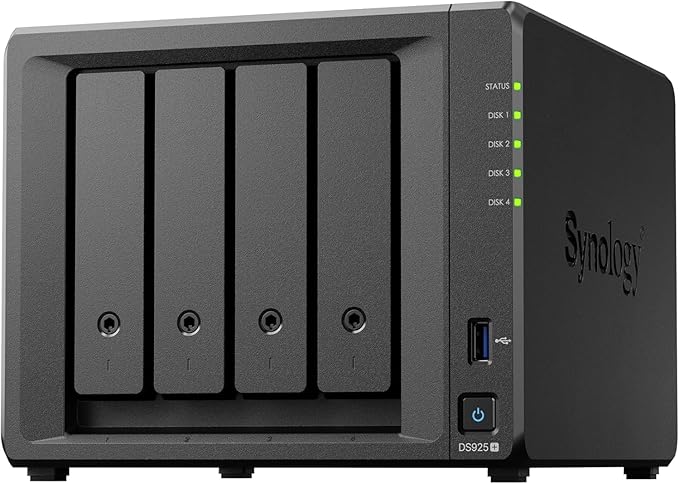
| CPU | AMD Ryzen R1600 (dual-core) |
|---|---|
| RAM | 4 GB DDR4 (expandable to 16 GB) |
| Drive Bays | 4x 3.5"/2.5" SATA |
| M.2 NVMe Slots | 2 |
| Network | 2x 2.5GbE RJ45 |
| 10GbE Option | Via expansion unit (no PCIe slot) |
| AU Price (Scorptec) | $995 |
Pros
- Synology Drive versioning is excellent for design file protection
- Dual 2.5GbE with link aggregation handles 2-4 concurrent users well
- Active Backup for Business included (workstation imaging)
- DSM interface is the easiest to manage without IT staff
- Strong AU stock availability. Almost always in stock at Scorptec and PLE
Cons
- No PCIe slot. 10GbE requires an external adapter or stepping up to DS1525+
- 4 GB RAM is tight for heavy concurrent access (upgrade to 16 GB if running 3+ users)
- Four bays limits raw capacity. May need expansion unit for firms with 10+ years of project archives
Synology DS1525+. Best for Growing Practices Needing 10GbE
The Synology DS1525+ steps up to five bays and adds a PCIe Gen 3 expansion slot, which is the key differentiator for architecture and engineering firms that need 10GbE. Drop in a Synology E10G18-T1 10GbE card ($289 at Scorptec) and you have a NAS that can sustain 500-700 MB/s reads to multiple workstations simultaneously. More than enough for a team of 5-10 running Revit worksharing, SolidWorks PDM, or ArchiCAD teamwork.
The fifth bay matters more than it appears. With five 16 TB drives in SHR (Synology Hybrid RAID), you get approximately 58 TB usable with single-drive redundancy. That is enough for 10+ years of project archives for a medium practice, with room for active projects. For firms with deeper archival needs, the DX517 expansion unit adds five more bays. Synology’s Hyper Backup can automate offsite replication to a second NAS at another office, a remote site, or Synology C2 cloud storage.

| CPU | AMD Ryzen R1600 (dual-core) |
|---|---|
| RAM | 8 GB DDR4 ECC (expandable to 32 GB) |
| Drive Bays | 5x 3.5"/2.5" SATA (expandable to 15 with 2x DX517) |
| M.2 NVMe Slots | 2 |
| Network | 2x 2.5GbE + 1x 1GbE RJ45 |
| PCIe Expansion | 1x PCIe Gen 3 x2 (for 10GbE card) |
| AU Price (Scorptec) | $1,399 |
Pros
- PCIe slot enables 10GbE. Essential for 3+ concurrent BIM users
- Five bays provides meaningful capacity for long-term project archival
- Expandable to 15 bays via DX517 units for growing firms
- ECC RAM support improves data integrity for mission-critical project files
- Synology Drive and Hyper Backup cover versioning and offsite replication
Cons
- PCIe Gen 3 x2 limits 10GbE to approximately 700 MB/s (not full wire speed)
- At $1,399 diskless, total cost with drives and 10GbE card approaches $3,500-$4,000
- Still a dual-core CPU. Heavy concurrent access from 8+ users may cause slowdowns
QNAP TS-464. Best Budget Option with PCIe Expansion
The QNAP TS-464 is the most affordable four-bay NAS that offers a PCIe expansion slot for 10GbE, making it a strong option for cost-conscious practices that know they will eventually need faster networking. The Intel Celeron N5095 quad-core CPU handles file serving and background tasks capably, and the 8 GB RAM (expandable to 16 GB) is sufficient for 2-4 concurrent users working with AutoCAD and smaller Revit models.
QNAP’s QTS operating system includes Hybrid Backup Sync for offsite backups and QNAP’s own file versioning through their Qsync utility. Qsync is functional but not as polished as Synology Drive. The versioning interface is less intuitive, and the conflict resolution when two users edit the same file is less graceful. For practices where the principal sets up the NAS and everyone else just maps a network drive, this is less of a concern. The TS-464 also supports QNAP’s HDMI output for direct display, which is occasionally useful for presentations in client meetings.
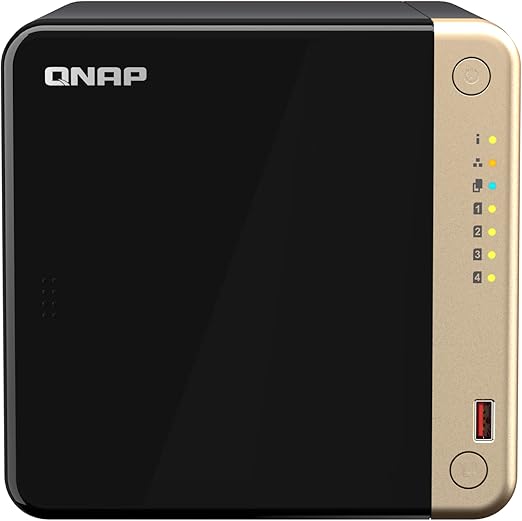
| CPU | Intel Celeron N5095 (quad-core) |
|---|---|
| RAM | 8 GB DDR4 (expandable to 16 GB) |
| Drive Bays | 4x 3.5"/2.5" SATA |
| M.2 NVMe Slots | 2 |
| Network | 2x 2.5GbE RJ45 |
| PCIe Expansion | 1x PCIe Gen 3 x2 |
| AU Price (Scorptec) | $999 |
Pros
- PCIe slot for 10GbE at a sub-$1,000 price point
- Quad-core CPU handles file serving and indexing well
- HDMI output useful for client presentations directly from the NAS
- Dual 2.5GbE with link aggregation for immediate use
Cons
- Qsync versioning is less refined than Synology Drive
- 16 GB RAM ceiling limits future expansion for heavy multi-user loads
- QNAP’s QTS has a steeper learning curve than Synology DSM
- Four bays limits long-term archival capacity
QNAP TS-473A. Best for Performance-Focused Engineering Firms
The QNAP TS-473A is the strongest pick for engineering firms running SolidWorks, Inventor, or other simulation-heavy CAD packages where file sizes routinely exceed 2 GB. The AMD Ryzen V1500B quad-core CPU outperforms the Celeron chips in the TS-464 and DS925+ for sustained multi-user file serving, and the RAM expands to 64 GB. Which matters when running QNAP’s SSD caching, snapshot replication, and file indexing simultaneously.
The PCIe Gen 3 x4 slot (rather than x2 on cheaper models) delivers closer to full 10GbE wire speed, which translates to genuine 800-900 MB/s reads when paired with a 10GbE card and a four-drive RAID 5 or RAID 10 array. For an engineering firm where 4-6 people regularly open and save multi-gigabyte assemblies, this level of throughput prevents the file access delays that cost billable hours.

| CPU | AMD Ryzen V1500B (quad-core, 2.2 GHz) |
|---|---|
| RAM | 8 GB DDR4 (expandable to 64 GB) |
| Drive Bays | 4x 3.5"/2.5" SATA |
| M.2 NVMe Slots | 2 |
| Network | 2x 2.5GbE RJ45 |
| PCIe Expansion | 1x PCIe Gen 3 x4 |
| AU Price (Scorptec) | $1,369 |
Pros
- AMD Ryzen V1500B is the strongest CPU in this class for sustained file serving
- 64 GB RAM expandability future-proofs for growing teams
- PCIe Gen 3 x4 delivers near-full 10GbE throughput
- Dual 2.5GbE with link aggregation works out of the box
Cons
- At $1,369, it is $370 more than the TS-464 for the same number of bays
- QNAP QTS requires more technical knowledge to configure optimally
- Synology Drive’s versioning remains superior to Qsync for file recovery workflows
- Four bays limits total capacity without an expansion unit
Version Control and Synology Drive for Design Files
Version control is non-negotiable in architecture and engineering. The consequences of losing a coordinated design model. Or worse, silently saving over it with a broken version. Can cost days or weeks of rework. Purpose-built version control systems like Autodesk Vault or SolidWorks PDM exist, but they carry significant licensing costs and require dedicated IT management that small-to-medium practices rarely have.
Synology Drive fills a practical middle ground. It provides automatic file versioning for any file type, including Revit’s RVT files, AutoCAD DWG and DXF files, ArchiCAD PLN files, and SolidWorks assemblies. Every time a file is saved, Synology Drive records a new version. If someone saves a broken model at 3pm, you can restore the 2:45pm version in under a minute. You control how many versions to keep and how long to retain them. Critical for meeting 10+ year archival requirements under professional indemnity insurance policies.
Synology Drive also handles the synchronisation workflow well. Team members can map the NAS as a network drive for direct file access (essential for Revit worksharing), while also running the Synology Drive desktop client for offline sync of selected folders. This means site visits with a laptop do not require constant VPN connectivity. Files sync when you are back on the office network or connected via QuickConnect.
QNAP’s equivalent is Qsync, combined with snapshots on QNAP’s Btrfs or ZFS file systems. Block-level snapshots are arguably more robust than file-level versioning for large binary files like Revit models, because they capture the exact state of the volume rather than individual file copies. However, restoring a single file from a snapshot is less intuitive than Synology Drive’s “right-click, browse versions” workflow. Practices without dedicated IT support will generally find Synology’s approach easier to live with day-to-day.
Remote Site Access: NBN, CGNAT, and VPN Considerations
Australian architecture and engineering firms increasingly need to access project files from site, from home, or from a client’s office. The challenge is that Australia’s NBN infrastructure and ISP configurations create specific obstacles that generic “just use a VPN” advice does not address.
NBN upload speed is the hard limit. On a typical NBN 100 plan (100 Mbps down / 20 Mbps up), your effective upload speed to the NAS from outside the office is roughly 20 Mbps. Which translates to approximately 2.4 MB/s. Downloading a 500 MB Revit model from the office NAS while on site will take about 3.5 minutes. That is workable for occasional access, but not for editing directly from the NAS remotely. NBN 250 and NBN 1000 plans offer 25 Mbps and 50 Mbps upload respectively, which improves things marginally but still cannot match local network speeds.
CGNAT blocks direct VPN connections. Many Australian ISPs, particularly on NBN fixed wireless and satellite connections, use Carrier-Grade NAT (CGNAT). This means your office does not have a public IP address, which prevents incoming VPN connections to your NAS. Synology’s QuickConnect and QNAP’s myQNAPcloud provide relay-based remote access that bypasses CGNAT. But at reduced speeds. If your office is on CGNAT and remote access is critical, contact your ISP about a static IP (typically $10-20/month extra) or switch to a provider that offers public IPs by default. For a full explanation of CGNAT and workarounds, see the NAS networking guide.
Practical remote workflow for design firms: Do not try to edit Revit or SolidWorks files directly from the NAS over a remote connection. The latency and bandwidth make it impractical. Instead, use Synology Drive or Qsync to sync project files to the laptop before leaving the office. Edit locally on site, then sync changes back when you return or connect to the office VPN. This “offline-first” approach avoids the frustration of working over slow NBN connections and protects against connectivity drops on site.
Project Archival: Meeting 10+ Year Retention Requirements
Professional indemnity insurance policies for Australian architects and engineers typically require project documentation to be retained for a minimum of 10 years after project completion. And some policies require 15 years or the life of the building. This means storage capacity planning is not just about active projects; it is about decades of archived data that must remain accessible and intact.
A NAS handles this better than ad hoc backup drives for several reasons. RAID protection ensures a single drive failure does not destroy your archive. Automated integrity checks (Synology’s Data Scrubbing, QNAP’s Storage and Snapshots health checks) detect and correct bit rot before it silently corrupts old files. And structured folder hierarchies with metadata make it possible to find a specific drawing from a 2019 project without manually searching through folders of external hard drives.
For archival, the 3-2-1 backup rule is essential: three copies of your data, on two different media types, with one copy offsite. A practical implementation for a small practice: active project files on the NAS (copy 1), NAS snapshots on the same device for quick recovery (copy 2, same media but different data state), and automated offsite backup via Synology Hyper Backup or QNAP Hybrid Backup Sync to a second NAS at a principal’s home or to cloud storage like Synology C2, Backblaze B2, or Wasabi (copy 3, offsite). This is not expensive to set up. A Synology DS425+ ($819 at Scorptec) as an offsite backup target at someone’s home is a one-time investment that protects decades of project data.
Storage Capacity Planning for Design Practices
Estimating storage needs for architecture and engineering firms requires accounting for both active projects and long-term archival. Here is a practical framework:
Annual Storage Growth by Practice Type
| Small Architecture (2-5 people) | Medium Architecture (5-15 people) | Engineering/Multidisciplinary (5-20 people) | |
|---|---|---|---|
| Active Project Data | 200 GB, 1 TB | 1, 5 TB | 2, 10 TB |
| Annual Archive Growth | 500 GB, 2 TB | 2, 8 TB | 5, 20 TB |
| 10-Year Archive Estimate | 5, 20 TB | 20, 80 TB | 50, 200 TB |
| Suggested Starting NAS | 4-bay (DS925+ or TS-464) | 5-bay (DS1525+) or 4-bay + expansion | 8-bay or rackmount |
These figures include Revit/AutoCAD/SolidWorks files, PDFs, consultant documents, photos, correspondence, and rendered images. They do not include video or drone survey footage, which can double the numbers. The critical takeaway is that a four-bay NAS with 4x 16 TB drives in RAID 5 provides approximately 43 TB usable. Which comfortably covers a small practice’s first 10 years of archival data. Medium and larger practices should plan for expansion from day one by choosing a NAS with expansion unit support (the DS1525+ supports two DX517 expansion units for up to 15 total bays).
Buying in Australia: Pricing, Retailers, and ACL Protections
NAS pricing across Australian retailers is remarkably uniform. Most retailers operate on 3-5% margins, which leaves little room for price variation. The real difference between retailers is stock availability, pre-sales knowledge, and post-sales support. For a device that stores your firm’s project data, the retailer relationship matters when something goes wrong.
Specialist retailers like Scorptec and PLE list the full NAS range and generally hold stock of the popular models covered in this guide. For business purchases, always request a formal quote. Resellers can request pricing support from distributors and vendors, and quoted prices are often at or near sale pricing without waiting for a promotional event. Business and government buyers should expect to receive sharpened pricing, especially on multi-unit purchases or bundled NAS + drive orders.
Amazon AU has started holding NAS stock directly in 2026 at prices sometimes 10-20% below local retailers. However, for a small business deploying a NAS to store mission-critical project data, Amazon’s lack of pre-sales guidance and limited post-sales support makes them a poor choice. If the NAS fails with 30 TB of project data inside, Amazon will not ship an advance replacement, will not work with you through the data recovery process, and for discontinued models may simply credit you and leave you with bare drives. Buy from a specialist who understands NAS and can support you through failures. For broader NAS buying advice for business use, see the best NAS for small business guide.
Australian Consumer Law protections apply when purchasing from Australian authorised retailers. This includes statutory guarantees that products are of acceptable quality, fit for purpose, and match their description. Protections that international purchases and grey imports do not guarantee. For a business-critical NAS deployment, ACL coverage is not optional.
Quick Setup Recommendations by Practice Size
Solo practitioner or 2-person practice (AutoCAD/ArchiCAD): Synology DS925+ ($995) with 2x 8 TB NAS drives in SHR mirror. Total cost approximately $1,700-$2,000 with drives. Use built-in 2.5GbE. Enable Synology Drive for versioning. Back up to an external USB drive weekly and cloud monthly.
Small practice, 3-6 people (Revit/ArchiCAD with worksharing): Synology DS1525+ ($1,399) with 10GbE card ($289), 4x 16 TB NAS drives in SHR. Total cost approximately $4,500-$5,500 with drives, 10GbE card, and a basic 10GbE switch. Upgrade RAM to 16-32 GB. Enable Synology Drive for versioning and Hyper Backup for offsite replication. This is the sweet spot for most Australian architecture practices.
Medium practice, 6-15 people (SolidWorks/Revit intensive): QNAP TS-473A ($1,369) with 10GbE card, 4x 16 TB NAS drives in RAID 5, plus a QNAP expansion unit for archival storage. Total cost approximately $5,000-$7,000. Upgrade RAM to 32-64 GB. Consider a dedicated 10GbE switch for the design team. For practices at this size, also consider whether SolidWorks PDM or Autodesk Vault licensing is justified alongside NAS storage. For video-heavy workflows like 3D rendering and walkthroughs, see the NAS for video editing guide.
Related reading: our NAS buyer's guide.
Our File Transfer Speed Estimator calculates LAN throughput for large CAD and BIM file transfers, and our NAS Sizing Wizard helps size storage for project archive and active collaboration workloads.
Can I run Revit worksharing directly from a NAS?
Yes. Revit worksharing works by placing the central model on a shared network location, which a NAS provides. The central model lives on the NAS, and each team member creates a local copy that syncs to the central model. The key requirement is network speed. Sync-to-central operations transfer the entire changed workset, which can be 50-200 MB per sync. On 1GbE, this is tolerable for 2 users but congested with 3+. A NAS with 2.5GbE or 10GbE is strongly preferable for worksharing teams of 3 or more.
Is a NAS better than Autodesk BIM 360 (ACC) for file storage?
They serve different purposes. Autodesk Construction Cloud (formerly BIM 360) is a cloud-based collaboration platform with model coordination, issue tracking, and clash detection. Features a NAS does not provide. However, ACC requires reliable internet connectivity (impractical on many Australian construction sites), carries per-user subscription costs ($300-$600/user/year), and gives you less control over data sovereignty. A NAS is better for local file serving, archival, and keeping project data under your direct control. Many practices use both: ACC for active collaboration with external consultants, and a NAS for internal storage, archival, and backup of the ACC data.
How much RAM does a NAS need for architecture and engineering file serving?
For 1-3 users working with AutoCAD and small Revit models, 4 GB is adequate. For 3-6 users with large Revit worksharing models or SolidWorks assemblies, upgrade to 8-16 GB. For 6+ concurrent users with heavy file access and SSD caching enabled, 16-32 GB is appropriate. The RAM is used primarily for file caching (keeping frequently accessed files in memory for faster reads) and running NAS services like Synology Drive or QNAP’s indexing. More RAM means more of your active project files stay cached in memory rather than being read from spinning drives every time.
Do I need SSD caching on my NAS for CAD work?
SSD caching makes the biggest difference when multiple users access many different files across the NAS (high random read workload). If your team is primarily working in 2-3 active project folders, the NAS’s built-in RAM cache handles this adequately. If you have 10+ active projects with users jumping between them, M.2 NVMe SSD caching will noticeably speed up file open times. A pair of 400 GB NVMe SSDs for read-write caching costs $200-$500 depending on brand, and both Synology and QNAP support hot-pluggable M.2 cache drives that can be added without downtime.
How do I protect my NAS data against ransomware?
Ransomware is a genuine threat to architecture and engineering firms. Encrypted project files with a ransom demand can halt a business. NAS-specific protections include: enabling Btrfs snapshots (Synology) or ZFS snapshots (QNAP) on an automated schedule, which creates read-only recovery points that ransomware cannot encrypt. Disable or limit admin account access over the internet. Use Synology’s or QNAP’s built-in firewall to restrict access by IP range. Most importantly, maintain an offsite backup that is not permanently connected to your network. If ransomware hits, it will encrypt everything it can reach, including a NAS that is always mounted as a network drive. An offsite NAS or cloud backup with versioning is your last line of defence.
Can I access my NAS from a construction site in regional Australia?
Yes, but with caveats. Synology QuickConnect and QNAP myQNAPcloud provide remote access without VPN configuration, but the speed depends entirely on the internet connection at both ends. On a 4G mobile connection in a regional area, expect 10-30 Mbps. Enough to download drawings and small files, but not to work directly on large Revit or SolidWorks models. The practical approach is to sync project files to your laptop before the site visit using Synology Drive or Qsync, work locally on site, and sync changes back at the office. If your office NBN uses CGNAT, you will need QuickConnect or myQNAPcloud relay rather than a direct VPN. Or contact your ISP about a static IP address.
What RAID level should I use for a NAS storing design files?
For a four-bay NAS, Synology’s SHR (Synology Hybrid RAID) with single-drive redundancy or RAID 5 is the standard choice. You lose one drive’s worth of capacity for redundancy but can survive a single drive failure without data loss. For critical project data, SHR-2 or RAID 6 (two-drive redundancy) is safer, especially with drives larger than 8 TB where rebuild times can exceed 24 hours. Never use RAID 0 (striping without redundancy) for production data. Remember that RAID is not backup. It protects against drive failure, not accidental deletion, ransomware, fire, or theft. You still need offsite backup regardless of your RAID level.
Setting up networking for your NAS? The NAS networking guide covers 10GbE switches, cabling, and VLAN configuration for Australian offices.
Read the Networking Guide →