Australian accounting firms are legally required to retain client records, working papers, and tax documentation for a minimum of five years under ATO record-keeping rules. And for up to seven years under Tax Practitioners Board (TPB) and APES 325 obligations. Making secure, reliable local storage a regulatory necessity, not a convenience. A network-attached storage (NAS) device gives your firm physical control over client data, practice management backups, lodgement records, and financial documents. Unlike pure cloud storage where your data lives on someone else’s infrastructure with recurring subscription costs, a NAS keeps everything on-premises under your direct control. For firms handling sensitive financial data governed by the Tax Agent Services Act 2009, the Privacy Act 1988, and professional standards like APES 325, local storage with proper backup is the foundation of a compliant data management strategy.
For a broader overview of this topic, see our NAS for Australian business guide.
In short: A 2-bay or 4-bay NAS from Synology or QNAP in the $549-$999 range (diskless) covers most Australian accounting firms with 1-20 staff. Pair it with NAS-grade drives, configure RAID 1 (mirroring) or SHR/RAID 5 for redundancy, set up encrypted offsite backups using the 3-2-1 backup strategy, and enable access logging. Budget approximately $1,000-$3,500 total including drives for a system that will last 5-7 years.
Why Accounting Firms Need a NAS
Every accounting practice in Australia generates data that must be stored securely and retained for defined periods. This includes client tax returns, BAS lodgements, working papers, financial statements, audit files, correspondence with the ATO, payroll records, and your firm’s own business records. Most accounting software. Including Xero, MYOB, QuickBooks, and Reckon. Either stores data in the cloud with local backups or operates entirely on local infrastructure. A NAS provides a central, always-on storage location that every authorised user in your office can access, with built-in redundancy that protects against drive failure.
The alternative. Relying on individual workstations, USB drives, or a single external hard drive. Is a single point of failure that puts your entire client base at risk. An accounting firm with 500 clients and five years of tax returns stored on one hard drive is one mechanical failure away from a professional indemnity nightmare. A NAS with RAID redundancy means a single drive can fail without data loss, giving you time to replace the failed drive and rebuild the array. For a firm where client trust and regulatory compliance are everything, this is baseline responsible data management.
Australian Regulatory Requirements for Accounting Data
Accounting data retention in Australia is governed by multiple overlapping regulations. Understanding which apply to your firm determines how you configure your NAS and how long you need to retain data. For a broader overview of NAS compliance for Australian small businesses, see our dedicated guide.
ATO Record-Keeping Requirements (5-Year Minimum)
The ATO requires all businesses. Including accounting firms. To retain records that explain all transactions and financial positions for five years from when the records were prepared or the transactions completed, whichever is later. For your clients’ records that you hold as their tax agent, this means retaining copies of lodged returns, supporting schedules, source documents provided by clients, and your working papers for a minimum of five years from the date of lodgement. If a client’s return is amended or subject to an audit, the clock resets. In practice, many firms retain records for seven years as a safety margin.
Tax Practitioners Board (TPB) Code of Professional Conduct
Registered tax agents and BAS agents must comply with the TPB’s Code of Professional Conduct under the Tax Agent Services Act 2009 (TASA). The Code requires agents to maintain adequate records of client engagements, act with integrity, and manage conflicts of interest. The TPB expects practitioners to demonstrate that client records were handled securely and can be produced if requested during a compliance audit. If you cannot produce records because your storage failed and you had no backup, that is a conduct issue that the TPB can investigate. A NAS with automated backups and versioning is the simplest way to demonstrate you meet this obligation.
APES 325. Record Keeping by Members in Public Practice
APES 325, issued by the Accounting Professional & Ethical Standards Board (APESB), applies to members of CPA Australia, CA ANZ, and IPA who are in public practice. It mandates that practitioners retain documentation relating to client engagements for a minimum of seven years from the date the engagement was completed. This is two years longer than the ATO’s minimum and catches firms that only plan for five years. APES 325 also requires that records be stored securely, with appropriate access controls, and that they can be retrieved in a reasonable timeframe. A NAS with structured folder hierarchies by client and financial year, combined with access logging, directly supports these requirements.
Seven years is the safe minimum for most accounting firms. Between ATO requirements (5 years), TPB obligations, and APES 325 (7 years), planning for seven-year retention covers all bases. Many firms retain records indefinitely because storage costs are trivial compared to the professional risk of premature destruction. A 4-bay NAS with 16TB of usable storage can hold decades of accounting data.
Privacy Act 1988 and Client Financial Data
Accounting firms with annual turnover exceeding $3 million are bound by the Australian Privacy Principles (APPs) under the Privacy Act. Even firms under the threshold should treat client financial data with equivalent care. A data breach involving client TFNs, bank account details, or financial statements is a reputational catastrophe regardless of whether the Privacy Act technically applies. APP 11 requires reasonable steps to protect personal information from misuse, loss, and unauthorised access. A NAS supports this through user-level access controls, encrypted shared folders, and audit logging. APP 8 restricts cross-border disclosure. Directly relevant if you are considering cloud storage hosted overseas.
What Data Your Accounting Firm Actually Needs to Store
Before choosing a NAS, understand the volume and type of data your firm generates. Accounting firms produce less raw data volume than imaging-heavy industries like healthcare or architecture, but the data is highly sensitive and subject to strict retention periods. This means you need reliable, well-organised storage rather than massive capacity.
| Data Type | Typical Size | Retention Period | Storage Notes |
|---|---|---|---|
| Client tax returns and lodgements | 5-50 MB per client per year | 7 years (APES 325) | PDFs, working papers, ATO correspondence |
| BAS lodgements and activity statements | 1-10 MB per client per quarter | 5 years (ATO) / 7 years (APES 325) | Quarterly or monthly depending on client |
| Working papers and audit files | 10-500 MB per engagement | 7 years (APES 325) | Larger for audit engagements, SMSF reviews |
| SMSF administration files | 20-200 MB per fund per year | 7 years minimum | Includes audit reports, member statements, investment records |
| Accounting software backups (Xero, MYOB, Reckon) | 50 MB-5 GB per backup | Ongoing | Daily backups of local databases; Xero exports for offline copy |
| Client correspondence and scanned documents | 1-20 MB per document | 7 years | Engagement letters, client ID verification, signed authorities |
| Payroll records (firm and clients) | Varies | 7 years after employment ends | STP records, payment summaries, super contribution records |
| Firm business records | Small | 5-7 years | Own BAS, GST, trust account records |
A sole practitioner or small firm (1-5 staff) with 200-500 clients will typically accumulate 50-200 GB of data over five years. A mid-sized firm (5-20 staff) with 500-2,000 clients may reach 500 GB-2 TB over the same period, especially with scanned source documents and SMSF files. These are modest storage volumes. A 2-bay NAS with 4-8 TB of usable capacity handles the smaller end, while a 4-bay unit with 8-16 TB of usable capacity gives mid-sized firms years of headroom.
Xero, MYOB, and QuickBooks. Why You Still Need Local Backups
Many accounting firms have migrated to cloud-based platforms like Xero, MYOB Business, or QuickBooks Online. These platforms store data on their servers, which creates a false sense of security. Yes, Xero runs on AWS infrastructure with redundancy and backups. But Xero’s terms of service do not guarantee data recovery in all circumstances, and if your Xero subscription lapses or your account is compromised, access to your data depends on Xero’s policies, not your own backup strategy.
The prudent approach is to maintain local backups of your cloud accounting data. Xero allows you to export all data in CSV and PDF formats. MYOB and QuickBooks both support local backup files. Schedule these exports regularly. Weekly or monthly depending on volume. And store them on your NAS. This gives you an independent copy of everything, regardless of what happens to the cloud provider. It also satisfies the APES 325 requirement that records be retrievable. If your cloud provider has an outage during a TPB audit, you can still produce records from your NAS.
Automate your cloud exports. Both Synology DSM and QNAP QTS support scheduled tasks that can pull data from cloud services. Synology’s Cloud Sync can connect to popular cloud storage providers, while QNAP’s Hybrid Backup Sync offers similar functionality. Set these up once, and your NAS will automatically maintain a local mirror of your cloud data without manual intervention.
Which NAS to Buy for an Accounting Firm
For Australian accounting firms, the decision typically comes down to Synology or QNAP. Both offer mature, business-grade platforms with the features accounting practices need: user access controls, encrypted shared folders, automated backup scheduling, Active Directory integration, and access audit logging. QNAP offers more hardware flexibility (RAM upgrades, PCIe expansion), while Synology’s DSM interface is widely regarded as more intuitive for non-technical users. For a detailed comparison, see our best NAS for small business Australia guide.
Sole Practitioner to Small Firm (1-5 Staff)
The Synology DS225+ is a 2-bay NAS that suits sole practitioners and small firms with modest storage needs. At $549 at Scorptec (February 2026), it runs Synology’s DSM 7 operating system with full support for encrypted shared folders, snapshot-based backups, and Synology Drive (a Dropbox-like file sync tool built into the NAS). Two bays configured in RAID 1 (mirroring) give you one drive of redundancy. If one drive fails, the other holds a complete copy of your data. With 2 x 4TB NAS-grade drives, you get approximately 4TB usable, which is more than enough for a sole practitioner managing 200-500 clients over a seven-year retention cycle.

| Model | Synology DiskStation DS225+ |
|---|---|
| Bays | 2 |
| CPU | Intel Celeron J4125 quad-core |
| RAM | 2 GB DDR4 (expandable) |
| Network | 2x 1GbE LAN |
| AU Price (Scorptec) | $549 |
| RAID Configuration | RAID 1 / SHR (mirroring) |
| Usable Storage (2 x 4TB) | ~4 TB |
| Total System Cost (with drives) | Approx. $1,100-$1,400 AUD |
Pros
- Lowest entry cost for a business-grade NAS with encryption and backup tools
- Synology DSM 7 is intuitive for non-technical accounting staff
- Synology Drive provides built-in file sync across office workstations
- Compact and quiet. Sits on a shelf in a small office
Cons
- Only 2 bays. Limited to RAID 1 (mirroring), no RAID 5 option
- Maximum raw capacity limited by 2 drive slots
- No 2.5GbE networking (1GbE only)
Small to Mid-Sized Firm (5-20 Staff)
Firms with more staff, higher client volumes, or SMSF administration workloads should step up to a 4-bay NAS. The Synology DS425+ ($819 at Scorptec) and the QNAP TS-464-8G ($999 at Scorptec) are both strong options. Four bays allow RAID 5 or Synology’s SHR, giving you one drive of redundancy while retaining approximately 75% of raw capacity as usable storage. With 4 x 8TB NAS-grade drives, you get roughly 24TB usable. Enough for a mid-sized firm’s data over a decade or more.
The Synology DS925+ ($995 at Scorptec) is worth considering if your firm runs multiple concurrent users accessing the NAS simultaneously during BAS season or EOFY. It offers a more powerful AMD Ryzen R1600 dual-core processor, 4GB RAM (expandable to 16GB), and dual M.2 NVMe slots for SSD caching. Features that make a noticeable difference when ten staff members are all pulling files at the same time. The DS925+ also supports 10GbE expansion via a PCIe slot, future-proofing the unit for office network upgrades.
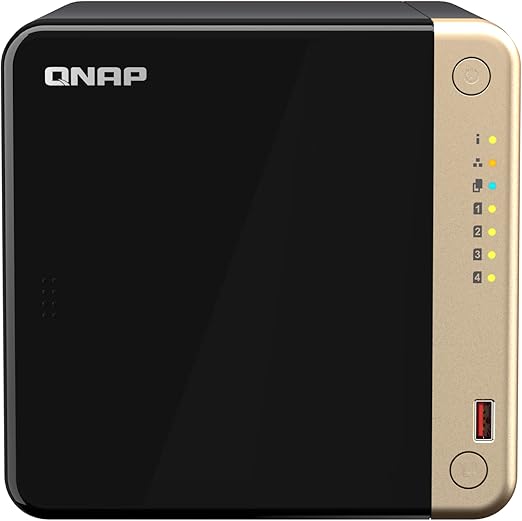
| Model | Synology DS925+ / DS425+ / QNAP TS-464-8G |
|---|---|
| Bays | 4 |
| AU Price (Scorptec) | DS425+ $819 / DS925+ $995 / TS-464 $999 |
| RAID Configuration | RAID 5, SHR, or RAID 10 |
| Usable Storage (4 x 8TB, RAID 5) | ~24 TB |
| Total System Cost (with drives) | Approx. $2,200-$3,500 AUD |
Pros
- RAID 5 / SHR provides single-drive redundancy with strong usable capacity
- 24TB+ usable storage is more than enough for most mid-sized accounting firms
- DS925+ and TS-464 both support M.2 SSD caching for better multi-user performance
- QNAP TS-464 includes 2.5GbE networking out of the box
Cons
- Higher upfront cost than a 2-bay unit
- RAID 5 only tolerates one drive failure. Replace failed drives immediately
- DS425+ lacks M.2 SSD slots and PCIe expansion
Comparison: NAS Models for Accounting Firms
NAS Models for Australian Accounting Firms (February 2026 Pricing)
|
Synology DS225+
|
 Synology DS425+
|
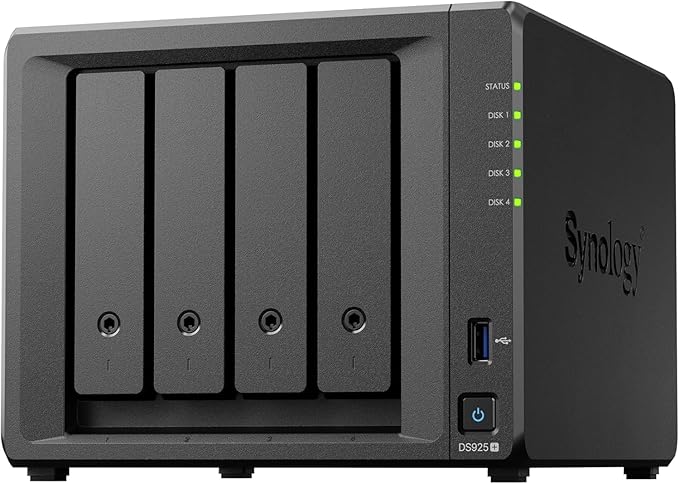 Synology DS925+
|
QNAP TS-464-8G
|
|
|---|---|---|---|---|
| AU Price (Scorptec) | $599 (PLE Computers) | $819 | $995 | $989 (Scorptec) |
| Drive Bays | 2 | 4 | 4 | 4 |
| Best For | Sole practitioner / 1-3 staff | Small firm / 3-10 staff | Mid-sized firm / 5-20 staff | Mid-sized firm / 5-20 staff |
| Max RAID Level | RAID 1 (mirror) | RAID 5 / SHR | RAID 5 / SHR | RAID 5 |
| M.2 SSD Cache Slots | No | No | 2x NVMe | 2x NVMe |
| Network | 2x 1GbE | 2x 1GbE | 2x 1GbE (10GbE via PCIe) | 2x 2.5GbE |
| RAM | 2 GB | 2 GB | 4 GB (expandable to 16 GB) | 8 GB (expandable to 16 GB) |
| Usable Storage (typical config) | 4 TB (2x4TB RAID 1) | 24 TB (4x8TB RAID 5) | 24 TB (4x8TB RAID 5) | 24 TB (4x8TB RAID 5) |
Prices last verified: 16 March 2026. Always check retailer before purchasing.
Client Data Security and Encryption
Accounting firms hold some of the most sensitive personal information of any profession. Tax file numbers, bank account details, financial statements, trust structures, and superannuation balances. A data breach involving this information is not just embarrassing; it exposes your clients to identity theft and financial fraud, and exposes your firm to TPB investigation, professional indemnity claims, and reputational destruction. For a deeper look at NAS security practices, see our NAS security and ransomware protection guide.
Encryption at Rest
Enable shared folder encryption on any folder containing client data. Both Synology and QNAP support AES-256 encryption at the folder level. This protects data at rest. If the NAS or its drives are physically stolen, the data is unreadable without the encryption key. For an accounting firm in a shared office building, a serviced office, or a home office, physical theft is a real risk. Many professional indemnity insurers now ask about encryption practices during policy renewal. Store your encryption keys separately from the NAS. In a password manager or a secure offsite location. Never written on a sticky note attached to the unit.
Access Controls and User Permissions
Create individual user accounts for every staff member who accesses the NAS. Do not share accounts. Set folder-level permissions so that accountants can access client files, administrative staff can access firm operational data, and junior staff cannot access everything a partner can. Both Synology DSM and QNAP QTS support granular folder permissions and can integrate with Active Directory or LDAP for firms using a domain environment. This is not just good practice. APES 325 requires that access to client records be restricted to authorised personnel, and the TPB expects you to demonstrate that controls are in place.
Ransomware Protection
Accounting firms are high-value targets for ransomware because they hold concentrated financial data for hundreds of clients. If ransomware encrypts your NAS, you lose access to every client file, every working paper, and every lodgement record simultaneously. Synology’s snapshot technology (available on Btrfs-formatted volumes) allows you to take scheduled, immutable snapshots of your data that ransomware cannot encrypt. QNAP offers similar snapshot functionality. Combined with offsite backups to a secondary NAS, a cloud target, or an external drive stored off-premises, snapshots give you a recovery path that does not involve paying a ransom. See our ransomware protection guide for detailed configuration steps.
Backup Strategy: The 3-2-1 Rule for Accounting Data
A NAS with RAID redundancy protects against drive failure but not against fire, theft, flood, ransomware, or accidental deletion. Your firm needs a proper backup strategy. And the industry standard is the 3-2-1 rule: three copies of your data, on two different media types, with one copy stored offsite.
For an accounting firm, this typically looks like:
Copy 1: Live data on your NAS (RAID-protected).
Copy 2: Automated backup to an external USB drive or a second NAS at a partner’s home or a different office location.
Copy 3: Encrypted cloud backup to a provider like Synology C2, Backblaze B2, or AWS S3. Both Synology Hyper Backup and QNAP Hybrid Backup Sync support encrypted, scheduled backups to these services.
For firms with multiple partners, a common approach is to place a second NAS at one partner’s home and use Synology’s NAS-to-NAS backup or QNAP’s RTRR (Real-Time Remote Replication) to maintain an offsite copy over the internet. This eliminates cloud storage subscription costs while maintaining geographic separation. If your office NBN connection has limited upload bandwidth (typical NBN 100 plans offer only 20-40 Mbps upload), schedule large backup jobs overnight to avoid impacting daytime productivity.
Remote Access for Accountants. Working from Home and CGNAT
The post-COVID reality is that many accounting staff work remotely at least part of the week, and principals often need to access client files from home during evenings and weekends. Especially during BAS and EOFY peak periods. A NAS supports remote access, but the method matters depending on your internet connection type.
If your office NBN connection has a public IP address (common on business NBN plans and some residential plans), you can set up a VPN directly on your NAS or router. Synology offers built-in VPN Server and Synology Drive apps that allow secure file access from any device. QNAP’s myQNAPcloud and QVPN provide equivalent functionality.
If your connection is behind CGNAT (Carrier-Grade NAT. Common on residential NBN connections from providers like Aussie Broadband, Superloop, and TPG), you cannot host a VPN directly because your router does not have a public IP address. In this case, you have two options: use Synology’s QuickConnect relay service (or QNAP’s myQNAPcloud) which tunnels connections through the vendor’s servers, or request a static public IP from your ISP (most business NBN plans include one, and some residential ISPs offer it for a small monthly fee). QuickConnect and myQNAPcloud work well for file access and are encrypted, but they route traffic through a third-party relay which adds latency and may not satisfy firms with strict data sovereignty policies.
BAS and EOFY peak load tip: During busy periods, multiple staff members accessing the NAS remotely over VPN simultaneously can saturate your office’s upload bandwidth. On a typical NBN 100 plan with 20-40 Mbps upload, four or five concurrent VPN users working with large files will feel slow. Consider upgrading to an NBN business plan with higher upload speeds, or use Synology Drive’s selective sync to cache working files locally on each staff member’s laptop, syncing changes back to the NAS when bandwidth allows.
Essential NAS Configuration for Accounting Compliance
A NAS out of the box is storage hardware. To meet accounting compliance requirements, you need to configure it properly. If your firm has an IT provider, have them handle the initial setup. If you are self-managing, follow these steps.
Folder Structure by Client and Financial Year
Organise your NAS with a clear folder hierarchy. A common approach for accounting firms is to structure folders by client name or number at the top level, with sub-folders for each financial year. Within each financial year folder, create sub-folders for tax returns, BAS, working papers, correspondence, and source documents. This structure makes it straightforward to locate records during a TPB audit or ATO review, and makes retention management simple. When a financial year falls outside your retention window, you can review and archive or delete the entire folder.
Access Logging and Audit Trails
Enable access logging on your NAS. Both Synology DSM and QNAP QTS can log file access events. Who accessed which file, when, and what action they performed (read, write, delete). These logs are valuable during a TPB compliance audit or if you need to investigate a potential data breach. Store logs on the NAS itself and include them in your backup strategy. Synology’s Log Center and QNAP’s System Logs both provide this functionality out of the box.
Automated Backups and Snapshot Scheduling
Configure automated backups immediately after initial setup. Synology’s Hyper Backup and QNAP’s Hybrid Backup Sync both support scheduled backups to external USB drives, remote NAS units, and cloud storage. Set backup frequency based on how much data your firm can afford to lose. Daily backups mean you lose at most one day of work. For critical data like practice management databases that change frequently, consider hourly snapshots using Btrfs snapshots (Synology) or QNAP’s snapshot manager.
Choosing the Right Drives for Accounting Data
The NAS unit is only half the equation. The drives you install determine your capacity, reliability, and long-term cost. For an accounting firm, use NAS-grade drives rated for 24/7 operation. Specifically the Seagate IronWolf or WD Red Plus product lines. Desktop drives (Seagate Barracuda, WD Blue) are not designed for the continuous operation of a multi-user NAS and will fail sooner.
NAS-grade drive prices have risen significantly from early 2025 levels. Drives that were comfortably under $160 for 4TB are now consistently above $200. Budget accordingly and factor drive costs into your total system cost. For a 2-bay system, a pair of 4TB Seagate IronWolf or WD Red Plus drives will cost approximately $400-$500. For a 4-bay system with 8TB drives, budget $1,200-$1,600 for the drive set.
Australian Consumer Law protections apply when purchasing NAS hardware and drives from Australian retailers. If a drive fails within a reasonable period (typically within its stated warranty period), you are entitled to a repair, replacement, or refund under the ACL. Buy from an Australian retailer like Scorptec, PLE, or DeviceDeal for full ACL coverage. Grey imports purchased from overseas may not carry the same protections.
Where to Buy and What to Expect
Australia’s NAS reseller space has relatively uniform pricing. Most retailers operate on 3-5% NAS margins, so you will not find dramatic price differences between stores. The real difference between retailers is stock depth, pre-sales knowledge, and post-sales support. For a device that stores your client data, the retailer relationship matters when something goes wrong.
Full-range specialists like Scorptec, PLE, and DeviceDeal list most Synology and QNAP models and can provide genuine pre-sales guidance. Amazon AU has started holding NAS stock directly in 2026 at competitive prices, but offers zero pre-sales advice and limited post-sales support. Not ideal for a firm that needs the unit running reliably. For business purchases, always request a formal quote rather than buying at listed retail price. Resellers can request pricing support from distributors and vendors. Discounts that never appear on the website but are routinely available for quoted business deals.
Use our free Backup Storage Calculator to size your backup storage correctly.
Related reading: our NAS buyer's guide.
How long do accounting firms need to keep client records in Australia?
The ATO requires a minimum of five years for business and tax records. However, APES 325 (which applies to CPA, CA ANZ, and IPA members in public practice) requires seven years from the date the engagement was completed. The TPB also expects practitioners to retain records for compliance purposes. The safe approach is to plan for seven-year retention as your baseline and retain records indefinitely where storage costs are negligible. A 4-bay NAS with 16-24 TB of usable storage can hold decades of accounting data for a typical firm.
Do I still need a NAS if my firm uses Xero or MYOB?
Yes. Cloud accounting platforms store your data on their servers, but you do not fully control that data. If your Xero subscription lapses, your account is compromised, or the service experiences an outage during a TPB audit, you need an independent local copy. A NAS lets you store regular exports from Xero, MYOB, or QuickBooks alongside your working papers, scanned source documents, and correspondence. It also stores the data that cloud accounting platforms do not hold. Engagement letters, signed authorities, client ID verification documents, and your working paper files.
What is CGNAT and why does it affect remote NAS access for accountants?
CGNAT (Carrier-Grade NAT) is a technology used by many Australian ISPs where multiple customers share a single public IP address. If your office or home internet connection is behind CGNAT, you cannot directly host a VPN or expose your NAS to the internet because incoming connections cannot reach your router. This is common on residential NBN plans. The workarounds are to use Synology QuickConnect or QNAP myQNAPcloud (which relay connections through vendor servers), request a static public IP from your ISP (often available on business plans or for a small monthly fee on residential plans), or use a third-party VPN service like Tailscale or ZeroTier that works through CGNAT.
How much storage does an accounting firm actually need?
Less than you might think. Accounting data is predominantly text-based documents. PDFs, spreadsheets, and database files. A sole practitioner with 200-500 clients will typically accumulate 50-200 GB over five years. A mid-sized firm with 500-2,000 clients and SMSF administration may reach 500 GB-2 TB. Even at the larger end, a 4-bay NAS with 24 TB usable (4 x 8TB in RAID 5) provides more than a decade of headroom. Start with 4TB or 8TB drives and you will have ample capacity for years.
Is a NAS secure enough for client tax file numbers and financial data?
A properly configured NAS is more secure than most alternatives used by small accounting firms (USB drives, shared desktops, unencrypted cloud storage). Enable AES-256 folder encryption, create individual user accounts with appropriate permissions, enforce strong passwords, enable two-factor authentication for DSM or QTS admin access, and keep the firmware updated. Synology and QNAP both issue regular security patches. Combined with an offsite backup strategy and immutable snapshots for ransomware protection, a NAS provides enterprise-grade data security at small business prices.
Can I use a NAS to back up multiple client MYOB company files?
Yes. MYOB AccountRight stores company files locally (or on a local server), and these files can be backed up directly to a NAS shared folder. Set up a scheduled task on your server or workstation to copy MYOB company files to the NAS daily. For MYOB Business (the cloud version), export data regularly and store exports on the NAS. Both Synology and QNAP support SMB/CIFS network shares that MYOB can write to natively. Create a dedicated shared folder with restricted access permissions for MYOB backups.
What happens if my NAS fails during tax season?
If you have followed the 3-2-1 backup strategy, a NAS hardware failure is an inconvenience, not a disaster. Your offsite backup (second NAS, external drive, or cloud) holds a recent copy of all data. Synology and QNAP desktop NAS units are generally available from Australian retailers within 1-3 business days. If your RAID array is intact on the drives, you can move the drives to a new NAS unit of the same model (or a compatible model) and the array will rebuild. For business-critical firms, consider purchasing an extended warranty from Synology or QNAP. Synology offers a 2-year uplift (EW201) that extends coverage from 3 to 5 years.
Looking for broader NAS guidance for your Australian small business? Read our complete guide covering data retention, privacy obligations, and NAS selection for compliance.
Read the Small Business Compliance Guide →