The best NAS for Plex in 2026 is a model with an Intel or AMD x86 CPU and Plex Pass. Hardware transcoding support is the single most important factor that separates a capable Plex NAS from one that struggles with simultaneous streams. This guide covers the Plex hardware requirements you actually need to understand, recommends the best NAS at each price tier from $549 to $1,500+, and explains the ARM vs x86 distinction that most buyers get wrong. Australian pricing, where to buy, and ACL warranty notes are in the AU section below.
For a broader overview of this topic, see our NAS buying guide hub.
In short: For local Plex streaming, almost any modern NAS with an Intel or AMD CPU handles direct play. For hardware transcoding. Needed when a device cannot play the original format. You need an Intel CPU with Quick Sync. For remote streaming, your NBN upload speed is the real bottleneck: NBN 100 plans deliver only 15-20 Mbps upload, limiting remote streams to 720p or lower-bitrate 1080p. Budget $820-$1,100 for a Plex-capable NAS, plus drives.
Why the CPU Matters More Than Anything for Plex
Plex on a NAS operates in two modes: direct play (sending the file as-is to your device. Almost zero CPU load) and transcoding (converting the stream in real time when the client device cannot handle the original format). Software transcoding hammers NAS-class CPUs. Hardware transcoding offloads the work to Intel Quick Sync. The single most important feature for a Plex NAS.
ARM-based NAS units (Synology DS223, QNAP TS-233) cannot hardware transcode at all. Direct play only. The moment a stream needs transcoding, they buffer and stutter. If you are building a Plex server, ARM is not the right tool. For a general-purpose NAS, see our Best NAS Australia guide.
Plex Pass required for hardware transcoding. Plex gates hardware transcoding behind its Plex Pass subscription (~$7.49/month or $179.99 lifetime). Without it, your NAS falls back to painfully slow software transcoding. Factor this cost in.
Best NAS for Plex. Top Picks at a Glance
Best NAS for Plex Australia 2026. Quick Comparison
 DS425+
|
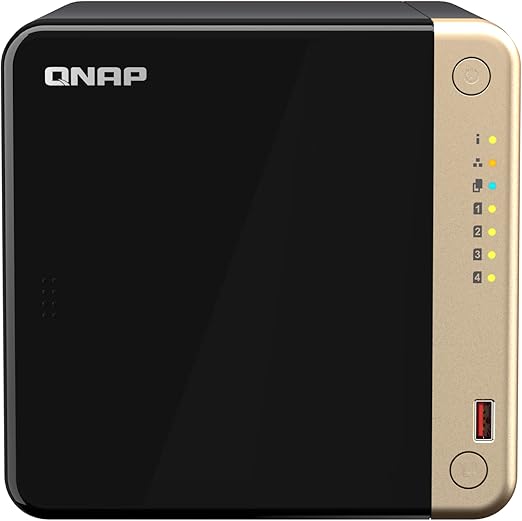 TS-464-8G
|
 AS6804T
|
 AS5404T
|
 DS225+
|
|
|---|---|---|---|---|---|
| Bays | 4 | 4 | 4 | 4 | 2 |
| CPU | Intel Celeron | Intel Celeron N5095 | Intel Celeron N5105 | Intel Celeron N5105 | Intel Celeron |
| RAM | 2GB | 8GB | 4GB | 4GB | 2GB |
| Quick Sync HW Transcode | Yes | Yes | Yes | Yes | Yes |
| Network | 2.5GbE + 1GbE | Dual 2.5GbE | Dual 2.5GbE | Dual 2.5GbE | 2.5GbE + 1GbE |
| HDMI Output | No | Yes | Yes | Yes | No |
| AU Price (approx) | $819-$899 | $989 (Scorptec) | $2,175 (Mwave) | $879 (Mwave) | $599 (PLE Computers) |
| Best For | Most Plex users | Power users | Best value Plex | Budget Plex | Small library |
Prices last verified: 16 March 2026. Always check retailer before purchasing.
Synology DS425+. Best Plex NAS for Most Australian Households
The DS425+ suits most Plex users in Australia. Its Intel Celeron with Quick Sync handles multiple 1080p transcodes, four bays allow RAID 5 or SHR for storage with redundancy, and Synology's DSM software makes Plex setup dead simple. At $819 from Scorptec or $899 from Mwave, it sits in a competitive bracket. PLE lists it at $999. Shop around. For more on Synology's range, see our Synology NAS Australia guide.
The DS425+ ships with 2GB RAM, which is tight for heavy Plex use. The Intel Quick Sync engine does the transcoding heavy lifting so RAM matters less than with software transcoding, but consider an upgrade if budget allows.
| CPU | Intel Celeron (4-core, 2.0GHz) with Quick Sync |
|---|---|
| RAM | 2GB DDR4 (expandable) |
| Drive Bays | 4x 3.5"/2.5" SATA + 2x M.2 NVMe |
| Network | 1x 2.5GbE + 1x 1GbE |
| AU Price (Scorptec) | $819 |
| AU Price (Mwave) | $899 |
| AU Price (PLE) | $999 |
Pros
- Intel Quick Sync hardware transcoding handles multiple 1080p streams
- Synology DSM is the best NAS OS for non-technical users
- 4 bays with SHR/RAID 5 and two M.2 slots for SSD cache
- 2.5GbE networking future-proofs local streaming
Cons
- 2GB RAM is tight. Upgrade recommended for heavy use
- No HDMI output. Cannot connect directly to a TV
- Single 2.5GbE port (not dual like QNAP/Asustor)
- Price premium over equivalent QNAP/Asustor hardware
QNAP TS-464. Best Plex NAS for Power Users
The TS-464 is the strongest hardware-per-dollar Plex NAS in Australia. Its Intel Celeron N5095 with Quick Sync handles 4K transcoding, it ships with 8GB RAM (four times the DS425+), has dual 2.5GbE ports, and an HDMI 2.0 output for plugging the NAS directly into a TV. At $1,099 from PLE, it costs more than the DS425+ but delivers significantly more hardware. The trade-off is QNAP's QTS software. More capable but less intuitive than DSM. See our Synology vs QNAP Australia guide for a detailed comparison.
| CPU | Intel Celeron N5095 (4-core, 2.9GHz burst) with Quick Sync |
|---|---|
| RAM | 8GB DDR4 (expandable to 16GB) |
| Drive Bays | 4x 3.5"/2.5" SATA + 2x M.2 NVMe |
| Network | 2x 2.5GbE |
| HDMI | HDMI 2.0 (4K@60Hz) |
| AU Price (PLE) | $1,099 |
Pros
- 8GB RAM out of the box. Excellent for multiple streams
- Dual 2.5GbE and HDMI 2.0 output
- N5095 Quick Sync handles 4K transcoding comfortably
- PCIe Gen 3 slot for future 10GbE upgrade
Cons
- QTS is more complex than Synology DSM
- QNAP has had more security advisories than Synology recently
- Fan noise under load can be noticeable in a living room
Asustor AS5404T. Best Value Plex NAS
The AS5404T starts at $799 from Scorptec. The lowest-priced 4-bay NAS with Intel Quick Sync transcoding in Australia. The Celeron N5105 handles 4K Plex transcoding cleanly, dual 2.5GbE covers fast local transfers, and HDMI 2.0 lets you plug directly into a TV for local Plex playback. ADM is less polished than DSM or QTS but handles Plex Media Server without issues. Asustor is distributed through Dicker Data, so retailer availability is narrower. Scorptec and Mwave are the reliable options. For buyers who want more headroom for Docker or heavy workloads alongside Plex, the AS6804T (AMD Ryzen V3C14, 16GB DDR5) steps up at $1,698 from Mwave.
| CPU | Intel Celeron N5105 (4-core, 2.0/2.9GHz) with Quick Sync |
|---|---|
| RAM | 4GB DDR4 (expandable to 16GB) |
| Drive Bays | 4x 3.5"/2.5" SATA + 2x M.2 NVMe |
| Network | 2x 2.5GbE |
| HDMI | HDMI 2.0 (4K@60Hz) |
| AU Price (Scorptec) | $799 |
| AU Price (Mwave) | $919 |
Pros
- Lowest price for N5105 Quick Sync in a 4-bay NAS
- Dual 2.5GbE and HDMI 2.0 included
- 4GB RAM expandable to 16GB
Cons
- ADM software less mature than DSM or QTS
- Narrower AU retailer availability
- Significant price variation between retailers. Shop around
Synology DS225+. Best 2-Bay Plex NAS
The DS225+ at $549 from Scorptec ($585 Mwave, $599 PLE) gives you Intel Quick Sync in a 2-bay form factor. Two bays limits you to RAID 1 (one drive for redundancy, usable capacity of a single drive). This suits Plex libraries under 10 TB. If your library is growing, start with a 4-bay. The cost difference is small relative to the flexibility gained. For drives, see our Best NAS Hard Drive Australia guide.
| CPU | Intel Celeron (4-core, 2.0GHz) with Quick Sync |
|---|---|
| RAM | 2GB DDR4 (expandable) |
| Drive Bays | 2x 3.5"/2.5" SATA + 2x M.2 NVMe |
| Network | 1x 2.5GbE + 1x 1GbE |
| AU Price (Scorptec) | $549 |
| AU Price (Mwave) | $585 |
| AU Price (PLE) | $599 |
Pros
- Lowest cost entry for Intel Quick Sync transcoding
- Synology DSM makes Plex setup effortless
- Compact footprint for a living room shelf
Cons
- Only 2 bays. Limited capacity and no RAID 5
- 2GB RAM is the bare minimum
- No HDMI output
What About the Synology DS925+?
The DS925+ ($995 Scorptec, $1,029 Mwave) is a popular NAS, but it uses an AMD Ryzen R1600 CPU without Intel Quick Sync. It relies on software transcoding, which is dramatically slower. If all your clients direct play (same codec, no subtitles), the DS925+ works fine. But for transcoding, the cheaper DS425+ or a QNAP/Asustor with N5105 will outperform it.
AMD vs Intel for Plex: If you see "Ryzen" or "AMD" in the NAS CPU, it does not support Intel Quick Sync hardware transcoding. This includes the DS925+ (Ryzen R1600), DS725+ (Ryzen R1600), and DS1525+ (Ryzen V1500B). These are excellent for file storage and business use. But for Plex transcoding, Intel is what you need.
NBN and Remote Plex Streaming. The Australian Bottleneck
When you stream Plex remotely, your home internet upload speed is the bottleneck. Most Australian households on NBN 100 get only 15-20 Mbps upload. A 1080p Blu-ray remux at 30-40 Mbps will not fit through that pipe. Plex must transcode down to fit your upload bandwidth.
NBN upload speeds and remote Plex quality:
- NBN 50/100 (~20 Mbps up): One 1080p stream at reduced bitrate (8-10 Mbps) or one 720p stream
- NBN 250 (~25 Mbps up): One comfortable 1080p stream
- NBN 1000 (~50 Mbps up): One high-quality 1080p stream or two lower-bitrate streams
- NBN FTTP 1000 (some plans 50-100 Mbps up): Best-case for remote Plex in Australia
This is why hardware transcoding matters so much for Australian Plex users. Remote access almost always triggers a transcode to fit within your NBN upload capacity. Set remote streaming quality limits in Plex settings to match your upload speed for smooth playback.
CGNAT blocks remote Plex access on some ISPs. Some Australian ISPs use Carrier-Grade NAT (CGNAT), meaning you share a public IP with other customers. Without your own public IP, port forwarding fails and Plex cannot accept remote connections. Aussie Broadband and Superloop generally provide a public IPv4 address by default. If your ISP uses CGNAT, request a public IP (some charge a small fee), use a VPN tunnel, or switch ISPs. Check before assuming remote access will work.
Plex Optimisation Tips for NAS
Move the Plex database to an M.2 SSD. Plex stores metadata and thumbnails in a database that gets hit constantly during browsing. On spinning disks, the interface feels sluggish. All recommended NAS units above have M.2 NVMe slots. Use one for the Plex database. The difference is immediately noticeable.
Enable hardware transcoding in Plex settings (Settings > Transcoder > "Use hardware acceleration when available"). Without this, Plex defaults to software transcoding regardless of your CPU. Requires Plex Pass.
Keep media in H.264/MKV or MP4. H.264 direct plays on virtually everything. H.265 (HEVC) saves disk space but triggers transcoding on more devices. The sweet spot for most libraries is H.264 at 1080p.
What About UGREEN and TerraMaster?
UGREEN has entered the NAS market with its NASync range, and the hardware specs are impressive. Several models use Intel N-series processors with Quick Sync. However, UGREEN does not yet have an official Australian distributor. Units come through Amazon AU and marketplace sellers with no established local warranty chain. Until a formal AU distribution deal is announced, the support risk is real. Watch this space.
TerraMaster offers strong hardware for the price. The F4-424 Pro ($1,099 Scorptec, $1,100 Mwave) packs an Intel Core i3 with 32GB RAM. Dramatically more horsepower than competitors at that price. The F4-425 ($659 Scorptec) uses an N5095 and competes with the Asustor Nimbustor 4. The trade-off is software maturity. TerraMaster's TOS is functional but lacks the depth of DSM or QTS. Distributed through DSTech with limited AU retail presence.
Storage and Drives for a Plex NAS
Media libraries grow faster than expected. A 4K remux is 50-80 GB. A 1080p rip is 5-15 GB. A full TV series can be 30-100 GB. Rough guide:
- Small library (100-200 movies): 4-8 TB. 2-bay with 2x 8TB in RAID 1
- Medium library (500+ movies, TV series): 12-24 TB. 4-bay with 4x 8TB in RAID 5
- Large library (4K remuxes): 40 TB+. 4-bay with 16-20 TB drives or step up to 5+ bays
A 4TB NAS drive that cost $149 in early 2025 is now pushing $220 in Australia. HDD prices are up 30-40% from recent lows and the storage market remains volatile. Budget for drives separately. See our Best NAS Hard Drive Australia guide for current pricing.
🇦🇺 Australian Buyers: Retailers, Pricing, and Consumer Rights
NAS pricing is remarkably uniform across major AU retailers. Most operate at 3-5% margin. The real difference is stock availability and what happens when something goes wrong. For first-time buyers, buy from a specialist like Scorptec or PLE where you get genuine pre-sales guidance. Not Amazon where the price may be better but the support is nonexistent.
Australian Consumer Law protections apply when purchasing from Australian retailers. Your warranty claim goes to the retailer, not the manufacturer. Synology, QNAP, and Asustor do not have service centres in Australia. Expect a 2-3 week warranty process through the retailer-distributor-vendor chain. A NAS is not a backup. Always maintain an offsite copy of important data. For more on your consumer rights, visit accc.gov.au.
Models to Avoid for Plex
ARM-based NAS: DS223 ($489), DS124 (~$444), DS223j (~$444), TS-233 ($399), TS-133 (~$399). No hardware transcoding. Fine for file storage (see our Best NAS Australia guide) but not Plex servers.
AMD-based Synology for transcoding: DS925+, DS725+, DS1525+. Outstanding NAS units for everything except Plex transcoding. Ensure all clients direct play or choose Intel instead.
1-bay NAS: No redundancy, limited storage. A single drive failure means your entire library is gone. Do not use for any media server deployment.
Free tools: Plex Media Planner and NAS Sizing Wizard. No signup required.
Can I run Plex on a Synology NAS?
Yes. Plex is available as a native package on Synology DSM. For hardware transcoding, you need a model with an Intel CPU (DS225+, DS425+) and a Plex Pass subscription. ARM-based models (DS223, DS124) can only direct play.
Is 2GB of RAM enough for Plex on a NAS?
For a small library with 1-2 simultaneous streams, 2GB works but is tight. Plex uses 300-500 MB and the NAS OS uses another 500 MB-1 GB. 4GB is more comfortable, 8GB gives real headroom. The DS225+ and DS425+ ship with 2GB; the QNAP TS-464 ships with 8GB.
Does Plex work over NBN for remote streaming?
Yes, but your upload speed is the limiting factor. NBN 50 and NBN 100 plans both offer around 20 Mbps upload, supporting one 1080p stream at reduced bitrate or one reliable 720p stream. NBN 250 and 1000 plans offer better headroom. Check that your ISP does not use CGNAT, which blocks incoming connections for remote Plex access. Aussie Broadband and Superloop generally provide a public IP by default.
What is CGNAT and why does it block Plex remote access?
CGNAT (Carrier-Grade NAT) means your ISP shares a single public IP among multiple customers. Without your own public IP, port forwarding does not work and Plex cannot accept incoming remote connections. Some ISPs use CGNAT by default. You can usually request a public IP (some charge a small fee), use a VPN tunnel, or switch ISPs.
Can a NAS play 4K content through Plex?
4K direct play works on all Intel-based NAS models recommended above. 4K transcoding is more demanding. Expect 1-2 simultaneous 4K transcode streams from an N5095-class processor. For the best 4K experience, ensure your playback device supports the codec natively (most modern smart TVs and Apple TV 4K handle H.265) to avoid transcoding.
Should I use RAID 5 or SHR for a Plex NAS?
For Synology, SHR (Synology Hybrid RAID) works like RAID 5 but allows mixed drive sizes. Ideal when upgrading drives incrementally. For QNAP and Asustor, RAID 5 is the standard for 4-bay units. Both provide one-drive fault tolerance with roughly 75% usable capacity. Never use RAID 0 for a Plex NAS.
Is it cheaper to build a Plex server with an old PC instead of a NAS?
In raw hardware cost, often yes. But a desktop PC draws 60-150W versus 20-40W for a NAS, adding $100-$300/year to your electricity bill at Australian rates. A NAS is purpose-built, quiet, and designed for 24/7 operation. At AU power prices, the NAS pays for itself in 2-3 years through power savings alone.
Do I need a Plex Pass for hardware transcoding on a NAS?
Yes. Plex gates hardware transcoding behind Plex Pass (~$7.49/month, $59.99/year, or $179.99 lifetime). Without it, your NAS falls back to software transcoding which is dramatically slower. If you are buying a NAS specifically for Plex, the lifetime pass is strongly recommended.
Looking for the right NAS beyond Plex? Our comprehensive guide covers every use case with live AU pricing.
Read the Full NAS Buying Guide →