Nextcloud on a NAS is the best private cloud setup for Australian households and small businesses willing to spend an afternoon on configuration. You get file sync, photo backup, calendar, contacts, and collaborative document editing. All hosted on hardware you own, with no monthly fees and no data leaving your premises. The hardware requirement is straightforward: you need an x86 NAS with at least 4GB RAM, ideally 8GB+, and a processor capable of running Nextcloud’s AIO (all-in-one) Docker stack without performance problems.
For a broader overview of this topic, see our NAS vs cloud comparison guide.
In short: Best overall. QNAP TS-464 ($999 Scorptec). Best Synology option. DS925+ ($889-$919). Best budget x86. QNAP TS-264 ($819 PLE). Minimum spec: x86 CPU, 8GB RAM, Docker support. ARM NAS units run Nextcloud but with AIO Docker image limitations.
What Nextcloud Needs from a NAS
Nextcloud AIO (the recommended installation method as of 2025-26) is a Docker-based deployment that runs the full Nextcloud stack in a single container group. It includes the Nextcloud server, a database (PostgreSQL or MariaDB), Redis cache, Collabora Office for document editing, and optionally a Talk signalling server. The resource requirements are higher than a single-container deployment:
- RAM: 4GB minimum for Nextcloud AIO; 8GB recommended for simultaneous use by 2-3 users with Office enabled. 16GB if you’re also running other services on the same NAS.
- CPU: x86 strongly recommended. Nextcloud AIO’s Docker images are x86-first; ARM builds exist but may lag behind releases or have feature gaps. An Intel Celeron N5105 handles 2-3 simultaneous Nextcloud users without issues.
- Storage: SSDs for the Nextcloud application and database (M.2 NVMe cache volumes work well). HDD volumes for user data storage. A 2-bay NAS with two HDDs can host Nextcloud data, but a 4-bay with HDD storage and NVMe cache gives meaningfully better responsiveness for Nextcloud’s database-heavy workloads.
- Network: Nextcloud’s file sync is not particularly bandwidth-intensive on the LAN, but uploads over your NBN connection matter for mobile clients and remote access. NBN upload speed is the real bottleneck for photo uploads from a remote location.
Best NAS for Nextcloud Australia 2026. Top Picks
1. QNAP TS-464. Best Overall for Nextcloud
The QNAP TS-464 is the best NAS for Nextcloud in Australia for most buyers. Its Intel Celeron N5105 (x86), 8GB DDR4 base RAM (expandable to 16GB), two M.2 NVMe slots for cache, and dual 2.5GbE make it the most capable Nextcloud host at the $999-$1,099 price point. Container Station provides full x86 Docker support. Nextcloud AIO deploys without issues and runs alongside other services comfortably with 8GB RAM. For 4-5 simultaneous Nextcloud users with Office and Talk enabled, upgrade to 16GB RAM ($60-$80 for a compatible SO-DIMM).
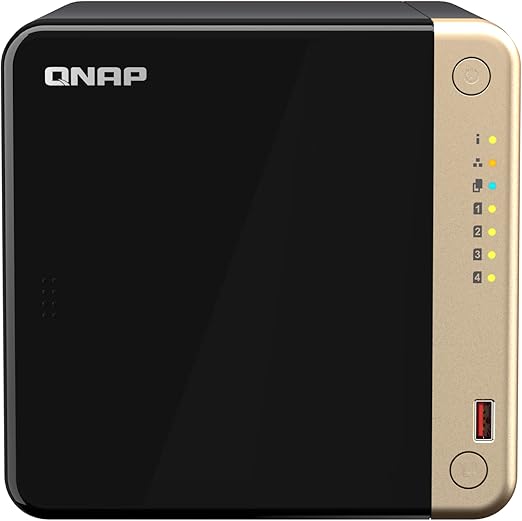
| AU Price | $999 (Scorptec), $1,099 (PLE) |
|---|---|
| CPU | Intel Celeron N5105 (x86, 4-core, 2.9GHz) |
| Base RAM | 8GB DDR4 (max 16GB) |
| M.2 cache | 2x NVMe. Excellent for Nextcloud DB performance |
| Docker | Container Station. Full x86, Nextcloud AIO verified |
| Best for | 1-5 users, full Nextcloud AIO stack, home lab |
2. Synology DS925+. Best Synology Option for Nextcloud
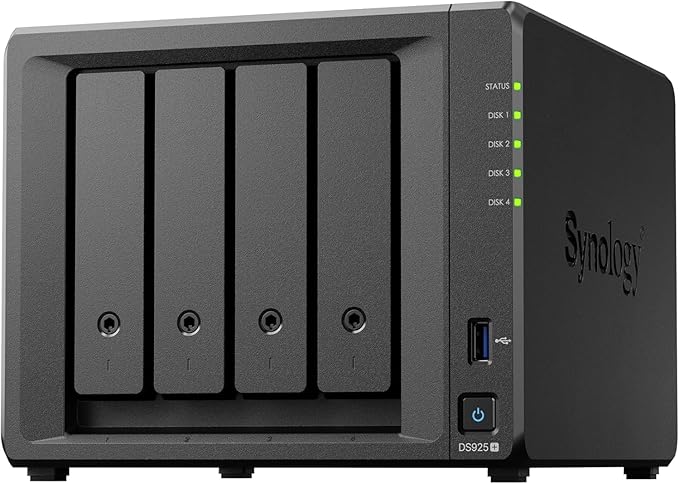
The Synology DS925+ runs Nextcloud via Container Manager with full x86 Docker support (AMD Ryzen R1600). At $889-$919 AU, it’s priced close to the TS-464 and brings DSM’s better interface alongside Nextcloud. One consideration: Synology’s DS925+ ships with 8GB DDR4 and supports up to 32GB. More headroom than the TS-464’s 16GB ceiling. For a Nextcloud deployment with 10+ users or heavy Office use, the DS925+’s 32GB ceiling is a meaningful advantage.
An important note for Synology Nextcloud users: Synology has first-party alternatives (Synology Drive for file sync, Synology Photos for photo management) that are tightly DSM-integrated and require zero Docker configuration. If your goal is “Dropbox replacement,” Synology Drive on a DS925+ is simpler and better integrated than Nextcloud on the same hardware. Nextcloud on Synology makes most sense when you need Nextcloud’s specific features. Collabora Office, Nextcloud Talk, or third-party Nextcloud apps. Rather than just file sync.
3. QNAP TS-264. Best 2-Bay Nextcloud Option
For a 2-bay Nextcloud deployment for 1-2 users, the QNAP TS-264 at $819 (PLE) is the minimum-viable x86 option. Its Intel Celeron N5095, 8GB DDR4, and dual 2.5GbE handle Nextcloud AIO without issues. The two M.2 NVMe cache slots let you run the Nextcloud database volume on fast storage while user data lives on HDDs. The constraint is drive capacity. Two bays limits your total storage to 2x the largest single drive (or 1x in RAID 1). For a personal Nextcloud with under 4TB of data, this is fine.
4. UGREEN DXP4800 Plus. Best RAM Headroom for Heavy Nextcloud
The UGREEN DXP4800 Plus at $1,259.99 ships with 16GB DDR4 and a 32GB ceiling. Making it the best-spec 4-bay option for a heavily-loaded Nextcloud instance running Office, Talk, and multiple user sessions simultaneously. The same Intel Celeron N5105 as the TS-464, but with double the base RAM. UGOS’s Dockge handles Nextcloud AIO cleanly. The trade-off versus the TS-464 is a higher price point and a less mature software ecosystem. For pure Nextcloud hosting where you’ll use every gigabyte of that 16GB, the DXP4800 Plus is compelling.
Nextcloud NAS Comparison Table
Best NAS for Nextcloud Australia 2026
|
QNAP TS-464
|
 Synology DS925+
|
 QNAP TS-264
|
 UGREEN DXP4800 Plus
|
|
|---|---|---|---|---|
| None | $999-$1,099 | $889-$919 | $819 (PLE) | $1,259.99 |
| None | N5105 (x86) | Ryzen R1600 (x86) | N5095 (x86) | N5105 (x86) |
| None | 8GB | 8GB | 8GB | 16GB |
| None | 16GB | 32GB | 16GB | 32GB |
| None | Yes (2 slots) | Via expansion | Yes (2 slots) | Yes (2 slots) |
| None | Container Station | Container Manager | Container Station | Dockge |
| None | Verified, works well | Works well | Works, 2-bay limit | Works well, 16GB RAM |
| None | ~5 (8GB) / ~10 (16GB) | ~10 (32GB max) | ~3 (8GB) | ~10 (16GB base) |
| None | myQNAPcloud relay | QuickConnect relay | myQNAPcloud relay | Tailscale needed |
Nextcloud and Australian NBN. What to Expect
CGNAT is the biggest practical challenge for Australian Nextcloud users. Nextcloud’s file sync and web interface rely on a stable URL that clients can reach. On a CGNAT connection (Aussie Broadband, TPG, and others), you don’t have a public IP address that clients can directly reach from outside your network. Port forwarding won’t work.
The solutions Australian Nextcloud users commonly use:
- Tailscale: Run Tailscale as a Docker container alongside Nextcloud. Devices with Tailscale installed can reach your Nextcloud instance over the Tailscale VPN mesh. Works on CGNAT, zero port forwarding required. Recommended approach for most setups.
- Cloudflare Tunnel: DDNS via Cloudflare’s free tunnel service creates a public URL for your Nextcloud that proxies through Cloudflare’s network. Works on CGNAT, free tier available. Adds Cloudflare as a middleman for all traffic.
- Static IP from ISP: Some AU ISPs (Aussie Broadband, Telstra business plans) offer static IP or non-CGNAT connections. Call your ISP to confirm whether you have CGNAT and whether a static IP is available.
NBN upload speed matters. Remote photo uploads from a mobile device, or syncing large files from a remote office, are limited by your NBN upload speed. FTTP NBN with 20-50 Mbps upload handles Nextcloud remote use well. HFC connections with 10-20 Mbps upload will feel slow for large file uploads remotely. FTTN/FTTC users may notice latency on large remote syncs. See our NAS remote access Australia guide for full CGNAT and NBN coverage.
Nextcloud on NAS vs Synology Drive or QNAP Qsync
Before choosing Nextcloud, it’s worth considering whether the NAS vendor’s native solution covers your needs:
- Synology Drive (Synology NAS). Excellent Dropbox replacement, deeply integrated, no Docker required, Windows/macOS/iOS/Android apps. Better for pure file sync than Nextcloud if you’re on Synology. No collaborative document editing.
- QNAP Qsync (QNAP NAS). Functional file sync, less polished than Synology Drive. Nextcloud on QNAP is often a better choice than Qsync for users wanting document collaboration.
- Nextcloud. Better if you need Collabora Office (collaborative editing), Nextcloud Talk (video calls), or cross-platform Nextcloud app ecosystem. More setup required but more capable for team workflows.
See our comparison of Synology Drive vs Dropbox and our NAS vs cloud storage cost comparison for context on the self-hosted vs subscription trade-off.
Australian Electricity Cost Consideration
A 4-bay NAS running Nextcloud 24/7 draws roughly 20-35W depending on drive count and activity. At AU electricity rates of $0.30-$0.35/kWh, that’s approximately $52-$107 per year in power costs. Over three years: $156-$321 in electricity. Compare this to Dropbox Plus at ~$228/year AUD or Google One 2TB at ~$159/year AUD. The self-hosted economics are competitive even before the privacy and data sovereignty benefits. See our NAS power consumption Australia guide for detailed calculations.
See all Docker-capable NAS units in Australia for home lab and self-hosted workloads, with current AU pricing.
Best NAS for Docker AustraliaNextcloud remote access requires an open port or a relay. Our NBN Remote Access Reality Checker checks whether your NBN ISP and plan support direct access or whether Cloudflare Tunnel is the better path.
Related reading: our NAS buyer's guide.
Free tools: NAS Sizing Wizard and Cloud vs NAS Cost Calculator. No signup required.
Can you run Nextcloud on a Synology NAS?
Yes. Synology NAS units with x86 processors (DS425+, DS925+, DS1525+, and higher) run Nextcloud via Container Manager (Docker). Nextcloud AIO deploys well on Synology. However, Synology also offers first-party alternatives: Synology Drive for file sync and Synology Photos for photo management, both of which are more tightly integrated with DSM and require zero Docker configuration. If you specifically need Nextcloud’s collaborative editing or Talk features, Nextcloud on Synology is a good option. If you just want file sync, Synology Drive may be simpler.
How much RAM does a NAS need to run Nextcloud?
A minimum of 4GB RAM for a single-user Nextcloud installation. 8GB is recommended for Nextcloud AIO with 2-3 simultaneous users and Collabora Office enabled. 16GB provides comfortable headroom for 5-10 users with all features running alongside other NAS services. The QNAP TS-464 (8GB base, 16GB max) and Synology DS925+ (8GB base, 32GB max) cover the full range of home and small business Nextcloud deployments.
Does Nextcloud work on a NAS with CGNAT in Australia?
Nextcloud requires a way for remote clients to reach your NAS. CGNAT blocks standard port forwarding. The recommended solutions for Australian CGNAT users are: Tailscale (free, runs as a Docker container alongside Nextcloud, works on all NAS brands), Cloudflare Tunnel (free tier, proxies Nextcloud through Cloudflare’s network), or requesting a non-CGNAT connection from your ISP. Synology’s QuickConnect relay does not support Nextcloud specifically. It only works with Synology’s own apps.
Can you run Nextcloud on an ARM NAS like a Synology DS225+?
Technically yes, but with limitations. Nextcloud AIO’s Docker images have ARM builds, but they may lag behind x86 releases and some sub-services (Collabora Office in particular) have limited ARM support. A DS225+ can run a basic Nextcloud file server but performance will be constrained and some AIO features may not work. For a reliable full-featured Nextcloud deployment, an x86 NAS (TS-264, TS-464, DS925+, or similar) is strongly recommended.
What is the cheapest NAS that can run Nextcloud in Australia?
The QNAP TS-264 at $819 (PLE) is the most affordable x86 NAS that can reliably run Nextcloud AIO for 1-2 users. It has an Intel Celeron N5095 (x86), 8GB DDR4, and two M.2 NVMe slots for fast database storage. For a single-user personal Nextcloud, the TS-264 is the minimum comfortable specification. ARM-based NAS units (like the QNAP TS-233 or Synology DS225+) are cheaper but have Docker compatibility limitations for Nextcloud AIO.