The best NAS for a home lab is the one that runs what you need without forcing you to fight the hardware. For most Australian home labbers, that means an x86 processor (for Docker compatibility), at least 4 bays (for storage capacity and RAID options), and a PCIe slot (for 10GbE if you’ve already got a fast switch). What it doesn’t mean is the most expensive unit on the shelf. The QNAP TS-464 at$989-$1442 and UGREEN DXP4800 Plus at comparable pricing hit the home lab sweet spot better than units costing twice as much.
In short: Best overall. QNAP TS-464 ($729-$779). Best value 6-bay. UGREEN DXP6800 Pro ($2,159.99). Best for Synology ecosystem. Synology DS925+ ($889-$919). Best TrueNAS / DIY. Custom build with QNAP or custom hardware. See full breakdowns below.
What a Home Lab NAS Actually Needs
Home lab requirements differ from typical household NAS needs in a few key ways. File sharing and photo backup are usually secondary. The NAS is a platform for running services. That changes what specs matter:
- x86 processor: Docker Hub images are predominantly x86-64. ARM NAS units can run Docker, but with compatibility restrictions that regularly block the image you need. An Intel Celeron N5105, N5095, or better removes that friction entirely.
- RAM headroom: Running Nextcloud, Home Assistant, Portainer, a VPN container, and Pi-hole simultaneously chews through RAM. 8GB is a reasonable minimum; 16GB gives comfortable room to grow. Check whether your target NAS has one or two RAM slots, and what the ceiling is.
- PCIe slot: If you have a 10GbE switch or plan to add one, a PCIe expansion slot lets you upgrade the NAS’s network adapter without replacing the whole unit. This is the difference between a 2-year home lab asset and a 5-year one.
- Storage bays: 4 bays minimum for a home lab. RAID 5 across four drives gives you one drive’s worth of redundancy with three drives’ worth of usable space. Six bays open up RAID 6 (two drive fault tolerance) for the paranoid.
Best NAS for Home Lab Australia 2026. Top Picks
1. QNAP TS-464. Best Overall Home Lab NAS
The QNAP TS-464 is the most popular 4-bay home lab NAS in Australia for good reason. It runs an Intel Celeron N5105 (x86, 4-core, 2.9GHz burst), ships with 8GB DDR4, has two M.2 NVMe cache slots, a PCIe 3.0 x2 expansion slot for 10GbE, and dual 2.5GbE ports. QTS gives you Container Station (full Docker), Virtualisation Station (lightweight VMs), and the full QNAP app ecosystem. At $729-$779 at Australian retailers (Mwave, PLE, Scorptec), it represents the best hardware-to-price ratio for a home lab 4-bay unit.
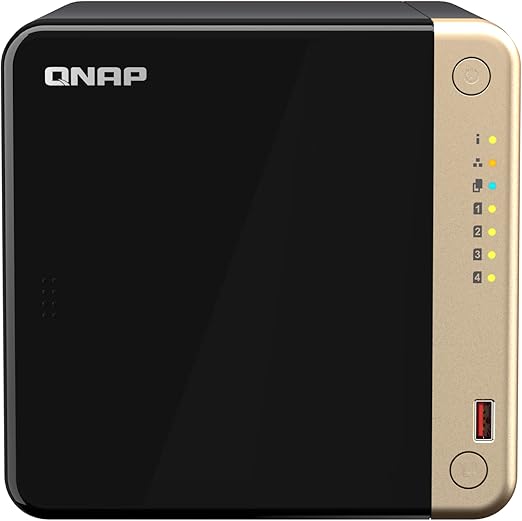
| CPU | Intel Celeron N5105 (4-core, up to 2.9GHz) |
|---|---|
| RAM | 8GB DDR4 (2 slots, max 16GB) |
| Bays | 4x SATA (hot-swap) + 2x M.2 NVMe |
| Network | 2x 2.5GbE + 1x PCIe 3.0 x2 (10GbE card) |
| AU Price | $729-$779 (Mwave, PLE, Scorptec) |
| Key feature | PCIe slot + dual 2.5GbE + x86 Docker + M.2 cache |
The PCIe 3.0 x2 slot is a differentiator at this price. Pair it with a QNAP QXG-10G1T 10GbE card (~$150-$200 AU) and you have a home lab NAS with 10GbE connectivity that cost under $1,000 before drives. That’s a compelling proposition for anyone with a 10GbE switch already in the rack. Read our full QNAP TS-464 review Australia for a detailed teardown.
2. Synology DS925+. Best for Synology Ecosystem
The Synology DS925+ is the right home lab NAS if you’re invested in Synology’s ecosystem. Synology Photos, Drive, Active Backup, and Hyper Backup. And want a 4-bay unit with a PCIe slot. It runs an AMD Ryzen R1600 (dual-core, better single-thread performance than Intel Celeron), has 8GB DDR4 (expandable to 32GB), and includes a PCIe 3.0 x2 slot for a 10GbE card or SSD. The DS925+ is $889-$919 in Australia. Pricier than the TS-464. But brings DSM’s superior first-party app integration.
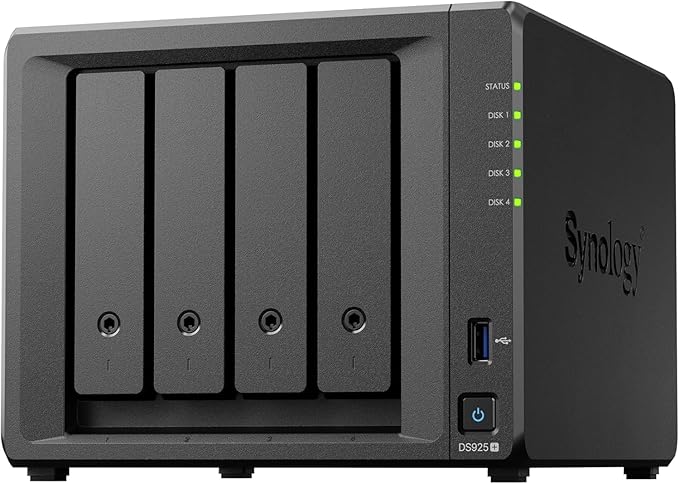
| CPU | AMD Ryzen R1600 (dual-core, 2.6-3.1GHz) |
|---|---|
| RAM | 8GB DDR4 (2 slots, max 32GB) |
| Bays | 4x SATA (hot-swap) + 2x M.2 NVMe (via PCIe or expansion) |
| Network | 2x 1GbE + 1x PCIe 3.0 x2 (10GbE or 25GbE card) |
| AU Price | $889-$919 (Mwave, Scorptec) |
| Key feature | DSM ecosystem + AMD Ryzen + 32GB max RAM |
Note the DS925+’s base network is 1GbE, not 2.5GbE. The 10GbE upgrade goes into the PCIe slot, so you lose the slot if you add 10GbE. This is a real trade-off versus the QNAP TS-464, which has dual 2.5GbE built in and a PCIe slot for 10GbE on top. For Synology loyalists, the DS925+ still wins on DSM quality. Read the full Synology DS925+ review Australia for more detail.
3. UGREEN DXP6800 Pro. Best Value 6-Bay
For home lab users who need 6-bay capacity without paying Synology or QNAP prices, the UGREEN DXP6800 Pro at $2,159.99 (UGREEN AU direct) is currently the best-value 6-bay option in Australia. It runs an Intel Celeron N5105 (same chip as the TS-464), has 8GB DDR4 (expandable to 32GB), dual 2.5GbE, two M.2 NVMe cache slots, and a PCIe 3.0 x4 slot. That’s more PCIe bandwidth than QNAP’s competing 6-bay units. UGOS’s Docker support (via Dockge) handles standard x86 containers without issues.
The caveat is UGOS’s relative immaturity vs DSM or QTS. For a home lab user primarily running Docker containers rather than NAS-specific apps, this is less of a limitation. The DXP6800 Pro review covers the UGOS software in detail.
4. QNAP TS-664. 6-Bay QNAP for Power Users
The QNAP TS-664 is the established 6-bay QNAP home lab unit, running an Intel Celeron N5105 with 8GB DDR4 (up to 16GB), a PCIe 3.0 x2 slot, and single 2.5GbE. It’s a mature QTS platform with excellent Container Station and Virtualisation Station support. The main limitations versus the UGREEN DXP6800 Pro are the 16GB RAM ceiling, single 2.5GbE, and narrower PCIe bandwidth. For Australians who want proven QNAP support infrastructure via Dicker Data over UGREEN’s newer AU service, the TS-664 is the safer enterprise pick.
5. Synology DS1525+. 5-Bay Synology for Serious Homelabs
The Synology DS1525+ brings a 5-bay layout with an AMD Ryzen R1600, 8GB DDR4 (expandable to 32GB), and a PCIe 3.0 x2 expansion slot. It’s positioned for SMB and serious home lab users who want DSM’s mature ecosystem at higher capacity. Available from Mwave and Scorptec in Australia, it sits at the $2,200-$2,400 mark. Competitive with the DXP6800 Pro but with Synology’s software advantage. For homes that need 5 bays with Synology, this is the benchmark.
What About TrueNAS for Home Lab?
TrueNAS Scale (the Linux-based, app-friendly version) is a legitimate home lab option for users who want to build their own system or repurpose existing server hardware. TrueNAS Scale runs Docker apps natively, has excellent ZFS support, and is free. The trade-off is complexity: it requires more configuration than any turnkey NAS OS, and hardware selection matters more because there’s no vendor-tested compatibility list.
Unraid is another popular platform for home lab users who want flexible per-disk storage management without traditional RAID striping constraints. Drives of different sizes work freely in the same array. If you are running Unraid, three calculators cover the key planning decisions: the Unraid Rebuild & Parity Check Estimator, the Unraid Cache Pool & SSD Endurance Calculator, and the Unraid Write Path Estimator.
For Australian home lab users, the practical case for TrueNAS Scale is strongest if you already have compatible hardware (mini PC, old workstation) or are building from scratch and want maximum control. If you’re buying new, the TS-464’s turnkey convenience and QTS’s Container Station cover 95% of home lab Docker use cases without the TrueNAS configuration overhead. See our full TrueNAS Australia guide for a detailed comparison.
Home Lab NAS Comparison Table
Best Home Lab NAS Australia 2026. At a Glance
|
QNAP TS-464
|
Synology DS925+
|
 UGREEN DXP6800 Pro
|
 Synology DS1525+
|
|
|---|---|---|---|---|
| None | $729-$779 | $889-$919 | $2,159.99 | $2,200-$2,400 |
| None | 4 | 4 | 6 | 5 |
| None | Celeron N5105 (x86) | Ryzen R1600 (x86) | Celeron N5105 (x86) | Ryzen R1600 (x86) |
| None | 16GB | 32GB | 32GB | 32GB |
| None | Yes (x2 Gen 3) | Yes (x2 Gen 3) | Yes (x4 Gen 3) | Yes (x2 Gen 3) |
| None | 2x NVMe | Via expansion | 2x NVMe | Via expansion |
| None | 2x 2.5GbE | 2x 1GbE | 2x 2.5GbE | 2x 1GbE |
| None | QTS (mature) | DSM (best-in-class) | UGOS (newer) | DSM (best-in-class) |
| None | Full x86 | Full x86 | Full x86 (Dockge) | Full x86 |
Australian Considerations for Home Lab NAS
CGNAT and remote access. Many Australian home lab setups involve remote access to self-hosted services. If you’re on CGNAT (Aussie Broadband, TPG, and others), port forwarding won’t work and you’ll need either Tailscale, WireGuard via a VPS, or Synology’s QuickConnect relay. Synology’s relay is the most turnkey; Tailscale via Docker works on any x86 NAS. Our NAS remote access Australia guide covers CGNAT solutions in detail.
Power costs. A 4-bay NAS running 24/7 at 20-30W costs $50-$85 per year in Australian electricity (at $0.30-$0.35/kWh). A 6-bay unit running at 35-45W costs $90-$130/year. This is modest for a home lab, but worth factoring if you’re running multiple NAS units or supplementary equipment. Scheduling HDD spin-down during off-hours significantly reduces consumption.
Retailer availability. The QNAP TS-464 is stocked at Mwave, PLE Computers, and Scorptec. The Synology DS925+ is at Mwave and Scorptec. Both carry standard 2-year Australian warranties through Dicker Data. UGREEN’s DXP6800 Pro is sold via UGREEN AU direct and Scorptec. See our where to buy NAS in Australia guide for a full retailer breakdown.
What to Look for in a Home Lab NAS. Checklist
- ✅ x86 processor (Intel Celeron N5105 or better, or AMD Ryzen)
- ✅ At least 8GB RAM base, expandable to 16GB+
- ✅ 4+ drive bays for RAID 5/6 flexibility
- ✅ PCIe slot for 10GbE upgrade (if you have or plan a 10GbE switch)
- ✅ M.2 NVMe cache slots (for random I/O acceleration)
- ✅ Docker support with x86 Container Station or equivalent
- ✅ AU retailer stock with 2-year local warranty
See our full comparison of NAS units suitable for Docker, home automation, and self-hosted services in Australia.
Best NAS for Docker — AustraliaRelated reading: our NAS buyer's guide.
Use our free NAS Sizing Wizard to get a personalised NAS recommendation.
What is the best NAS for a home lab in Australia?
The QNAP TS-464 is the best overall home lab NAS in Australia for 2026. At $729-$779, it offers an Intel Celeron N5105 (x86), 8GB DDR4 RAM, dual 2.5GbE, two M.2 NVMe cache slots, and a PCIe expansion slot for 10GbE. All in a 4-bay unit running QTS with full Docker (Container Station) support. For Synology ecosystem users, the DS925+ is the alternative at $889-$919.
Does a home lab NAS need an x86 processor?
For most home lab use cases, yes. Docker Hub images are predominantly x86-64, and many popular self-hosted applications (Nextcloud, Portainer, various monitoring tools) have limited or out-of-date ARM builds. An x86 NAS removes architecture compatibility friction entirely. ARM NAS units from Synology and Asustor can run Docker but with noticeable compatibility limitations for home lab workloads.
Can I use a NAS for TrueNAS or Proxmox in a home lab?
TrueNAS Scale can run on consumer NAS hardware in some cases, but it’s generally better suited to custom-built or repurposed server hardware where you control the full component selection. Proxmox is typically installed on a dedicated mini PC or server, not a NAS unit. QNAP’s Virtualisation Station can run lightweight VMs natively on the TS-464 and similar units, which covers most home lab VM use cases without needing a separate Proxmox box.
How do I access my home lab NAS remotely in Australia when I have CGNAT?
CGNAT blocks standard port forwarding. For home lab NAS remote access on CGNAT (common on Aussie Broadband, TPG, Leaptel, and others), the two most practical options are: (1) Tailscale. A zero-config WireGuard VPN that runs as a Docker container on any x86 NAS and works through CGNAT without any router configuration; or (2) Synology’s QuickConnect relay (Synology-only), which provides CGNAT-compatible access via Synology’s relay infrastructure without port forwarding. Tailscale works on any brand.
How many drive bays does a home lab NAS need?
Four bays is the recommended minimum for a home lab NAS in Australia. Four bays allows RAID 5 (one drive fault tolerance with three drives’ usable capacity) or RAID 10 (two drives’ usable capacity with full redundancy). Two-bay NAS units limit you to RAID 1 (mirroring) which is fine for backup but constrains capacity. Six bays or more unlock RAID 6 (two simultaneous drive fault tolerance), which is worth the step up for large storage pools where rebuild times are lengthy.