The best NAS for most Australian homes in 2026 is the Synology DS225+ ($549-$599). Two bays, 2.5GbE, Intel hardware transcoding, and the full DSM software suite, at a price that makes sense for anyone replacing iCloud, Google Photos, or Dropbox. This guide compares every home NAS worth buying across Synology, QNAP, Asustor, and UGREEN, with the specific decision logic for each use case. Backup, Plex, surveillance, and multi-user family setups. AU pricing, retailer guidance, and consumer rights are in the AU section below.
For a broader overview of this topic, see our complete home backup guide.
In short: For a household that wants reliable backup and file sharing, the Synology DS225+ ($549 at Scorptec) is the pick. It has 2.5GbE networking, a capable Intel CPU, and Synology’s software is the easiest to live with long-term. If you need four bays for a larger media library or want to run Plex with hardware transcoding, the QNAP TS-464 ($999 at Scorptec) gives you more hardware per dollar. First-time buyers on a tight budget should look at the Synology DS223 ($479 at PLE) or the QNAP TS-233 ($399 at PLE).
Why a Home NAS in 2026?
A NAS (Network Attached Storage) is a small box that sits on your home network and acts as your own private cloud. Instead of paying monthly fees to Google, Apple, or Dropbox, your files live on hardware you own, in your house, under your control. For Australian households, the practical benefits are straightforward:
Centralised backup. Every phone, laptop, and tablet in the house can back up automatically to the NAS. Photos, documents, school projects, tax records. All in one place, accessible from any device on your network.
Media streaming. Store your movie and music library on the NAS and stream to every TV, phone, and tablet in the house using apps like Plex or Jellyfin. No buffering, no internet dependency. For more detail on this use case, see our best NAS for Plex Australia guide.
Remote access. Access your files from anywhere. At work, on holiday, or from a relative’s house. Both Synology and QNAP offer remote access through their own relay services, which sidestep the CGNAT issue that affects many Australian NBN connections. Without a relay service, CGNAT blocks direct remote access to your NAS because your ISP doesn’t assign you a unique public IP address.
Surveillance. Most NAS units can record and manage IP camera feeds, turning your NAS into a home security system without monthly cloud subscription fees.
Top Picks at a Glance
Best Home NAS Australia 2026. Top Picks
 DS223
DS223
|
 DS225+
|
 TS-233
|
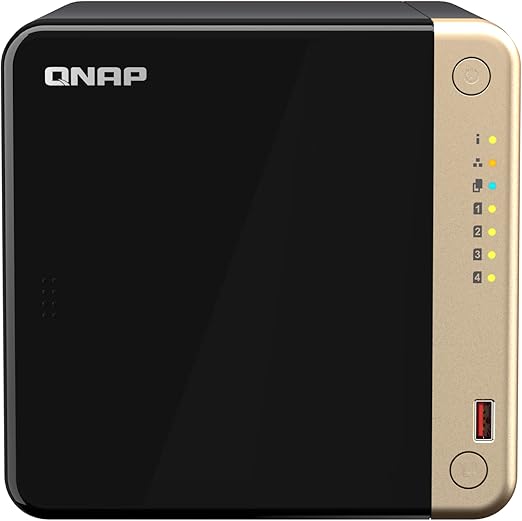 TS-464-8G
|
 AS5404T
|
 DS425+
|
|
|---|---|---|---|---|---|---|
| Best For | Budget home | Most homes | Entry QNAP | Power users | Media & gaming | Growing families |
| Bays | 2 | 2 | 2 | 4 | 4 | 4 |
| CPU | Realtek 4-core | Intel Celeron | ARM A55 4-core | Celeron N5095 | Celeron N5105 | Intel Celeron |
| RAM | 2GB | 2GB | 2GB | 8GB | 4GB | 2GB |
| Network | 1GbE | 2.5GbE + 1GbE | 1GbE | Dual 2.5GbE | Dual 2.5GbE | 2.5GbE + 1GbE |
| AU Price (from) | $479 | $599 (PLE Computers) | $399 | $989 (Scorptec) | $879 (Mwave) | $819 |
Prices last verified: 16 March 2026. Always check retailer before purchasing.
For our full comparison across all NAS brands and use cases including business models, see the best NAS Australia buying guide. This guide focuses purely on home use.
Best Budget Home NAS. Synology DS223
The Synology DS223 is the entry point into a serious home NAS at a price that doesn’t sting. At $479 from PLE or $489 from Mwave and Scorptec, it gives you two drive bays, a Realtek quad-core CPU, 2GB RAM, and access to Synology’s full DSM operating system. The same software that runs on their $3,000+ business models.
| CPU | Realtek RTD1619B quad-core 1.47GHz |
|---|---|
| RAM | 2GB DDR4 (not expandable) |
| Drive Bays | 2x 3.5"/2.5" SATA |
| Network | 1x Gigabit Ethernet |
| USB | 2x USB 3.2 Gen 1 |
| AU Price (PLE) | $479 |
| AU Price (Mwave) | $489 |
| AU Price (Scorptec) | $489 |
The DS223 suits households that want automatic phone and laptop backup, basic file sharing across the home network, and a reliable photo library. Synology Photos turns it into a self-hosted Google Photos replacement. Facial recognition, timeline view, mobile app, the lot. No monthly fees.
The limitation is 1GbE networking. On a Gigabit connection, large file transfers top out around 110-115 MB/s in practice. That’s fine for photo backup, document storage, and streaming a single 4K video. It becomes a bottleneck if you regularly move large video editing files or need to stream to multiple devices simultaneously.
Don’t buy this if you plan to run Plex with transcoding. The ARM-based CPU can direct-play media but cannot transcode video on the fly. If your media library has a mix of formats and your playback devices don’t support direct play, you’ll hit a wall. See our Plex NAS guide for models that handle transcoding.
Pros
- Excellent DSM software. Genuinely easy for non-technical users
- Synology Photos is the best self-hosted photo solution available
- Quiet operation, low power consumption (~15W under load)
- Strong mobile apps for iOS and Android
- 3-year warranty with strong AU retailer availability
Cons
- 1GbE only. No 2.5GbE upgrade path
- 2GB RAM not expandable
- ARM CPU cannot run Plex transcoding
- No M.2 SSD cache slots
Best Home NAS for Most People. Synology DS225+
The DS225+ is the NAS to buy for most Australian homes in 2026. At $549 from Scorptec, $585 from Mwave, or $599 from PLE, it steps up from the DS223 with an Intel Celeron CPU, 2.5GbE networking, and M.2 NVMe SSD cache slots. The Intel CPU means hardware-accelerated video transcoding. It can run Plex and transcode a 4K stream without breaking a sweat.
| CPU | Intel Celeron (quad-core, 2.0GHz) |
|---|---|
| RAM | 2GB DDR4 (expandable) |
| Drive Bays | 2x 3.5"/2.5" SATA |
| M.2 Slots | 2x NVMe (SSD cache) |
| Network | 1x 2.5GbE + 1x 1GbE |
| USB | 2x USB 3.2 Gen 1 |
| AU Price (Scorptec) | $549 |
| AU Price (Mwave) | $585 |
| AU Price (PLE) | $599 |
The 2.5GbE port is a meaningful upgrade for homes with newer routers or switches that support 2.5 Gigabit speeds. Even if your current network is Gigabit, the DS225+ is future-proofed for the next router upgrade. File transfers at 2.5GbE reach approximately 280 MB/s. Noticeably faster when backing up a laptop or transferring a large video file.
Two bays limit your maximum raw storage to around 40TB with current drives (2x 20TB), or around 18TB of usable space in a mirrored RAID (SHR-1) configuration with 2x 20TB drives. For most homes, that is years of photos, documents, and a substantial media library. If you think you might need more storage within the next 2-3 years, consider the four-bay DS425+ instead. Expanding from two bays to four later means buying a whole new NAS and migrating your drives.
For a detailed comparison of Synology’s full lineup, see our best Synology NAS guide.
Pros
- Intel CPU with hardware transcoding. Plex, Jellyfin, video surveillance all work well
- 2.5GbE networking future-proofs for faster home networks
- M.2 SSD cache slots for snappier file access
- Expandable RAM
- Same excellent DSM software as all Synology models
Cons
- Only 2 drive bays. Limited expansion
- Costs $70-$120 more than the DS223 for the same bay count
- 2GB base RAM. Upgrade recommended if running multiple apps
Best Value Entry NAS. QNAP TS-233
The QNAP TS-233 is the cheapest two-bay NAS worth buying from a major brand. At $399 from PLE or Scorptec and $487 from Mwave, it undercuts Synology’s entry models by $80-$90. The trade-off is a less polished software experience. QNAP’s QTS is more powerful but less intuitive than Synology’s DSM, particularly for first-time NAS users.
| CPU | ARM Cortex-A55 quad-core 2.0GHz |
|---|---|
| RAM | 2GB DDR4 (not expandable) |
| Drive Bays | 2x 3.5"/2.5" SATA |
| Network | 1x Gigabit Ethernet |
| USB | 1x USB 3.2 Gen 1, 1x USB 2.0 |
| AU Price (PLE) | $399 |
| AU Price (Scorptec) | $399 |
| AU Price (Mwave) | $487 |
The TS-233 handles the basics well: file storage, automatic backup via QNAP’s mobile apps, and basic media serving via DLNA. Like the Synology DS223, the ARM CPU means no hardware video transcoding. Plex will direct-play only. The software is functional but takes more effort to set up and maintain than Synology’s equivalent.
This NAS suits buyers who want basic networked storage at the lowest possible price and are comfortable with a slightly steeper learning curve. If you’re comparing the TS-233 at $399 against the Synology DS223 at $479, the saving is real. But the DS223’s software advantage is worth the premium for most home users. For a deeper comparison, see our Synology vs QNAP Australia guide.
Pros
- Cheapest two-bay NAS from a major brand in Australia
- Solid build quality for the price
- QNAP mobile apps are functional and improving
- 3-year warranty
Cons
- QTS software less polished than Synology DSM
- ARM CPU. No hardware transcoding
- 1GbE only, no 2.5GbE
- 2GB RAM not expandable
- QNAP has had more security vulnerabilities historically. Keep firmware updated
Best Four-Bay Home NAS. Synology DS425+
If you know you need more than two bays. A large media library, multiple family members backing up devices, or you simply want room to grow. The Synology DS425+ is the four-bay home NAS to buy. At $819 from Scorptec, $899 from Mwave, or $999 from PLE, it offers the same Intel CPU and 2.5GbE networking as the DS225+ but with double the drive bays.
| CPU | Intel Celeron (quad-core, 2.0GHz) |
|---|---|
| RAM | 2GB DDR4 (expandable) |
| Drive Bays | 4x 3.5"/2.5" SATA |
| M.2 Slots | 2x NVMe (SSD cache) |
| Network | 1x 2.5GbE + 1x 1GbE |
| USB | 2x USB 3.2 Gen 1 |
| AU Price (Scorptec) | $819 |
| AU Price (Mwave) | $899 |
| AU Price (PLE) | $999 |
Four bays let you run SHR-1 (Synology Hybrid RAID) with one-drive fault tolerance and still have meaningful usable capacity. With 4x 8TB drives, you get roughly 24TB usable. With 4x 16TB drives, around 48TB usable. That is enough for a substantial Plex library, years of family photos and videos, and full device backups for every family member.
The DS425+ is particularly strong for homes that want to consolidate: replace iCloud, Google Photos, and Dropbox with a single device. Synology Drive handles file sync (like Dropbox), Synology Photos handles the photo library (like Google Photos or iCloud), and Hyper Backup handles scheduled backups to an external drive or cloud storage for your 3-2-1 backup strategy.
Pros
- Four bays with room to grow storage over time
- Intel CPU with hardware transcoding
- 2.5GbE networking
- M.2 SSD cache for snappy performance
- Can replace multiple cloud subscriptions
Cons
- Significant price jump over the DS225+ for the extra two bays
- 2GB base RAM. Should upgrade if running Plex plus other apps
- Overkill if you just need basic file storage for two people
Best Home NAS for Power Users. QNAP TS-464
The QNAP TS-464 is the four-bay home NAS that gives you the most hardware for your dollar. At $999 from Scorptec or $1,099 from PLE, it comes with an Intel Celeron N5095 quad-core CPU, 8GB RAM, dual 2.5GbE ports, and two M.2 NVMe slots. That is significantly more RAM than any Synology at this price point, and dual 2.5GbE means you can connect to two networks or bond the ports for higher throughput.
| CPU | Intel Celeron N5095 quad-core 2.9GHz |
|---|---|
| RAM | 8GB DDR4 (expandable to 16GB) |
| Drive Bays | 4x 3.5"/2.5" SATA |
| M.2 Slots | 2x NVMe (SSD cache or storage pool) |
| Network | 2x 2.5GbE |
| HDMI | 1x HDMI 2.0 (4K output) |
| USB | 2x USB 3.2 Gen 2, 1x USB 2.0 |
| AU Price (Scorptec) | $999 |
| AU Price (PLE) | $1,099 |
The TS-464 has an HDMI port, which means you can connect it directly to a TV and use it as a media player with QNAP’s HD Station. No separate streaming device needed. The 8GB RAM lets you run multiple Docker containers, virtual machines, or apps without performance issues. For tinkerers who want to run Home Assistant, Pi-hole, or other self-hosted services alongside their NAS duties, the TS-464 has headroom that Synology’s 2GB models simply don’t.
The downside is software. QNAP’s QTS is powerful and configurable, but it has a steeper learning curve and a weaker track record on security compared to Synology. QNAP has had several high-profile ransomware incidents targeting their NAS devices in recent years. Keeping firmware updated, using strong passwords, and disabling unnecessary services are non-negotiable with any QNAP device exposed to the internet.
Pros
- 8GB RAM out of the box. Best in class at this price
- Dual 2.5GbE networking
- HDMI output for direct TV connection
- Strong hardware transcoding for Plex
- M.2 slots can be used as a storage pool, not just cache
- Expandable with QNAP expansion units
Cons
- QTS software not as polished as Synology DSM
- Weaker security track record. Must keep firmware updated
- Higher power consumption than Synology equivalents
- Photo management app not as refined as Synology Photos
Best Home NAS for Media and Gaming. Asustor AS5404T
Asustor’s Nimbustor 4 Gen2 (AS5404T) is worth considering if media playback and gaming downloads are your primary use case. At $799 from Scorptec, $849 from PLE, or $879 from Mwave, it offers an Intel Celeron N5105 CPU, 4GB RAM, dual 2.5GbE ports, and a distinctive gaming-inspired design that either appeals or doesn’t.
| CPU | Intel Celeron N5105 quad-core 2.0GHz |
|---|---|
| RAM | 4GB DDR4 (expandable to 16GB) |
| Drive Bays | 4x 3.5"/2.5" SATA |
| M.2 Slots | 2x NVMe |
| Network | 2x 2.5GbE |
| HDMI | 1x HDMI 2.0b (4K output) |
| USB | 3x USB 3.2 Gen 1, 1x USB-C 3.2 Gen 1 |
| AU Price (Scorptec) | $799 |
| AU Price (PLE) | $849 |
| AU Price (Mwave) | $879 |
Asustor’s ADM software includes Looksgood for media management and Portainer for Docker container management. The HDMI port supports 4K output, and Asustor’s Portal app lets you use the NAS as a direct media player connected to a TV. The hardware is competitive. Arguably better value than Synology at this price, though Synology’s software advantage remains significant for less technical users.
Asustor's ADM software includes Looksgood for media management and Portainer for Docker. App selection is narrower than DSM but covers the basics for home media users. Asustor availability in Australia is more limited than Synology and QNAP. See the AU buyers section below for retailer options.
Pros
- Strong hardware for the price. Undercuts QNAP TS-464 by $200
- HDMI 2.0b with 4K output for direct TV connection
- Dual 2.5GbE networking
- Good Docker support via Portainer
- USB-C port (uncommon at this price)
Cons
- Smallest software ecosystem of the three major brands
- Fewer third-party app packages than Synology or QNAP
- Gaming design may not suit every household
- Less established in Australia. Smaller community for troubleshooting
Budget Alternative. Synology DS223j
If your budget is tight and you just need basic networked storage, the Synology DS223j at $319 from Scorptec or $339 from PLE is the absolute cheapest Synology NAS worth buying. It runs the full DSM operating system, supports Synology Photos, Synology Drive, and Hyper Backup. However, with only 1GB of non-expandable RAM and a Realtek CPU, it is strictly for light duty. File storage and backup only.
Don’t buy this if you want to run more than two or three apps simultaneously, stream Plex, or use Docker containers. The 1GB RAM is genuinely constraining for anything beyond basic file serving. For an extra $160-$170, the DS223 with 2GB RAM is a significantly better investment. The DS223j is only the right choice if the budget absolutely cannot stretch further.
What About UGREEN and TerraMaster?
Two newer brands are entering the Australian home NAS market: UGREEN and TerraMaster. Both offer competitive hardware specifications at lower prices than the established trio of Synology, QNAP, and Asustor. However, there are practical considerations for Australian buyers.
UGREEN NASync
UGREEN launched their NASync NAS range in 2024, building on their reputation as an accessories brand. The hardware is genuinely impressive for the price. Models like the DXP4800 and DXP2800 offer Intel CPUs, ample RAM, and M.2 slots at prices that undercut Synology and QNAP significantly.
UGREEN's NAS software (UGOS) is still in early stages compared to DSM or QTS, and community support resources are limited. The hardware value is real, but the warranty and support picture for Australian buyers is different to Synology and QNAP. See the AU buyers section below.
TerraMaster
TerraMaster is available through DSTech distribution in Australia, with stock at Scorptec and Mwave. The F2-425 at $459 from Scorptec offers an Intel Celeron N5095. Similar hardware to the QNAP TS-464 at a lower price point. The F4-425 at~$989 from Scorptec provides a four-bay option with the same CPU.
TerraMaster’s TOS software has improved substantially but is still behind Synology and QNAP in stability, app ecosystem, and community support. For technically confident buyers who prioritise hardware value, TerraMaster is a legitimate option. For buyers who want a “set and forget” experience, Synology remains the safer choice.
How Many Drive Bays Do You Actually Need?
This is the most common question for home NAS buyers, and the honest answer is: two bays are enough for most households, but four bays give you meaningful flexibility.
Two-bay NAS (DS223, DS225+, TS-233)
With two drives in a mirror (RAID 1 or SHR), one drive can fail without data loss. Usable capacity equals one drive’s size. With 2x 8TB drives, you get ~8TB usable. That is enough for most families’ photo libraries, documents, and a moderate media collection. Two-bay NAS units are smaller, quieter, and use less power.
Four-bay NAS (DS425+, TS-464, AS5404T)
With four drives in SHR or RAID 5, one drive can fail without data loss and you get the capacity of three drives. With 4x 8TB drives, you get ~24TB usable. Four bays also let you start with two drives and add more later as your storage needs grow. Something you cannot do with a two-bay unit. If you have a large Plex library, multiple family members generating data, or plan to keep the NAS for 5+ years, four bays is worth the investment.
RAID is not backup. Whether you have two bays or four, a NAS with drive redundancy protects against a single drive failure. It does not protect against theft, fire, ransomware, or accidental deletion. Always maintain at least one additional copy of important data, either on an external USB drive or in the cloud. Follow a 3-2-1 backup strategy for real data protection.
What Drives Should You Buy?
The NAS itself is sold diskless. You buy the hard drives separately. For home NAS use, you want NAS-rated drives designed for 24/7 operation. The three main options are:
Seagate IronWolf: The most commonly recommended NAS drive. 3-year warranty, CMR recording, vibration sensors on 4TB+ models. Available from $209-$219 for 4TB at most AU retailers.
WD Red Plus: Western Digital’s equivalent NAS drive. 3-year warranty, CMR recording. Similar pricing to IronWolf. Avoid the non-Plus WD Red (SMR recording), which is not suitable for NAS RAID arrays.
Synology HAT3300 series: Synology’s own-brand NAS drives, manufactured by Toshiba. Guaranteed compatible with Synology NAS units and avoid the drive compatibility warnings that DSM can generate with third-party drives. The HAT3300-4T (4TB) is $299 at Scorptec, the HAT3300-6T (6TB) is $429. These are more expensive per TB than Seagate or WD equivalents, but if you want zero compatibility headaches with a Synology NAS, they are the simplest option. For a full breakdown, see our best NAS hard drive Australia guide.
Drive prices are volatile in 2026. A 4TB NAS drive that cost $149 in early 2025 is now pushing $209-$219 in Australia. Distributors are securing stock allocations as far forward as 2028. An unprecedented horizon. If you find drives at a good price, buy them. Waiting is unlikely to save you money in the current market.
🇦🇺 Australian Buyers: What You Need to Know
Two NBN-specific issues affect home NAS use in Australia:
Upload speeds limit remote access performance. On a typical NBN 100/20 plan, your upload speed is capped at around 20 Mbps (roughly 2.5 MB/s). That means accessing your NAS remotely. Streaming a video, downloading a file, or backing up a laptop from another location. Is limited by your home internet’s upload speed, not your NAS hardware. NBN 100/40 plans (where available) double the upload to 40 Mbps, which is a noticeable improvement for remote NAS access. For local use within your home, NBN speeds are irrelevant. Traffic stays on your local network.
CGNAT blocks direct remote access. Many Australian ISPs use Carrier-Grade NAT (CGNAT), which means you don’t get a unique public IP address. This blocks traditional port forwarding and VPN connections to your NAS. Both Synology (QuickConnect) and QNAP (myQNAPcloud) offer relay services that work around CGNAT by routing traffic through their servers. These work reliably but add a small amount of latency. If you need maximum remote performance, choose an ISP that offers a static or dynamic public IP address. Aussie Broadband, Superloop, and Leaptel are among the providers that offer this on request.
Where to Buy. Australian Retailers
Australian NAS pricing is remarkably uniform across retailers because margins are low. Most operate at 3-5% on NAS hardware. The real difference between retailers is stock depth, pre-sales knowledge, and what happens when something goes wrong.
Scorptec and PLE are the two retailers with the deepest NAS range and the best pre-sales knowledge. Both stock almost every current Synology, QNAP, and Asustor model. For first-time NAS buyers, these are the safest places to buy because their staff can answer genuine technical questions and their warranty processes are well-established.
Mwave carries a wide range but stocks fewer models on hand. Expect occasional delays while they order from distributors. Pricing is competitive, often splitting the difference between Scorptec and PLE.
Amazon AU has started holding NAS stock directly in 2026, often at prices 5-15% below local retailers. The risk: if your NAS fails and you need a direct replacement, Amazon may not have stock. Especially for older or less common models. They’ll push to give you a credit and leave you to find an alternative yourself, with your vulnerable hard drives sitting on your desk. Amazon is a valid option for confident buyers who don’t need support, but for first-time NAS buyers, a specialist retailer is worth the small premium.
Australian Consumer Law note: ACL protections apply when purchasing from Australian retailers. Your warranty claim goes to the retailer, not the manufacturer. Synology, QNAP, and Asustor don’t have service centres in Australia. This is why your choice of retailer matters. Before buying, ask: “If this unit fails, what is your warranty process? Is an advanced replacement available?” The answer tells you more about the value of buying from that retailer than the price on the website. For official information on your consumer rights, visit accc.gov.au.
How Much Does a Complete Home NAS Setup Cost?
A NAS is diskless. You need to budget for drives on top of the unit price. Here’s what a complete setup looks like at current Australian prices:
| Setup | NAS Unit | Drives | Total (approx.) |
|---|---|---|---|
| Budget 2-bay | DS223 ($479) | 2x 4TB IronWolf (~$440) | ~$920 |
| Mid-range 2-bay | DS225+ ($549) | 2x 8TB IronWolf (~$600) | ~$1,150 |
| Four-bay starter | DS425+ ($819) | 2x 8TB IronWolf (~$600) | ~$1,420 |
| Four-bay full | DS425+ ($819) | 4x 8TB IronWolf (~$1,200) | ~$2,020 |
| Power user 4-bay | TS-464 ($999) | 4x 8TB IronWolf (~$1,200) | ~$2,200 |
You can start a four-bay NAS with just two drives and add more later as budget allows. The NAS will operate in a degraded RAID state with fewer drives but remains fully functional. This lets you spread the cost over time.
Use our free NAS Sizing Wizard to get a personalised NAS recommendation.
For a direct comparison with direct-attached storage, see our guide to NAS vs DAS.Is a NAS better than an external hard drive for home backup?
Yes, for most households. An external hard drive gives you one copy of your data plugged into one computer. A NAS is accessible from every device on your network. Phones, laptops, tablets, smart TVs. And can back up automatically in the background. It also offers drive redundancy (two drives mirroring each other), which an external drive does not. The trade-off is cost: a NAS setup starts around $920 (unit plus drives), while a single external drive costs $150-$200. If you only have one computer and limited data, an external drive may be sufficient. If you have multiple devices or family members, a NAS is the more practical solution.
Can I access my NAS remotely when I’m away from home?
Yes. Both Synology (QuickConnect) and QNAP (myQNAPcloud) offer free relay services that let you access your NAS from anywhere with an internet connection. These services work around CGNAT, which blocks direct connections on many Australian NBN plans. Performance is limited by your home internet’s upload speed. On a typical NBN 100/20 plan, remote access tops out around 2.5 MB/s (20 Mbps). This is fine for viewing photos, downloading individual files, and light streaming. Large file transfers or 4K streaming remotely will be slow unless you have a higher upload speed plan like NBN 100/40.
How loud is a home NAS? Can I put it in the living room?
Modern home NAS units from Synology and QNAP are quiet enough for a living room or home office. Typical noise levels are 18-22 dB(A). Quieter than a whisper. The drives inside generate more noise than the NAS itself. If noise sensitivity is a priority, look for units with larger (92mm+) fans and consider using SSD storage instead of hard drives, though this significantly increases storage cost. Most people put their NAS in a cupboard, under a desk, or in a home office. Anywhere with adequate ventilation and an Ethernet connection to the router.
Do I need to buy a NAS-specific hard drive, or can I use any drive?
You should use NAS-rated drives. Regular desktop drives (like WD Blue or Seagate Barracuda) are not designed for the 24/7 operation, vibration, and RAID workloads that a NAS demands. NAS drives like the Seagate IronWolf and WD Red Plus have firmware optimised for always-on use, vibration tolerance for multi-drive enclosures, and better error recovery behaviour that works with RAID controllers. Using desktop drives in a NAS may work initially but risks premature drive failure and RAID rebuild issues. The price difference is modest. A few dollars per TB. And not worth the data risk.
Can a NAS replace my Google Drive or iCloud subscription?
Partially, yes. Synology Drive (file sync) and Synology Photos (photo management) can replace the core functionality of Google Drive, iCloud, and Dropbox. Files sync across devices, photos are organised with facial recognition and smart albums, and everything is accessible via mobile apps. The catch is that a NAS requires initial setup, you are responsible for maintenance and backups, and remote access speed depends on your home internet upload. Cloud services “just work” with no hardware to manage. A NAS is better value long-term (no monthly fees after the initial purchase) but requires more technical engagement than a cloud subscription. For a detailed walkthrough, see our guide on replacing iCloud with a NAS.
What happens if my NAS breaks? Is my data lost?
If the NAS unit itself fails but the drives are intact, your data is almost certainly recoverable. In most cases, you can move the drives to a replacement NAS of the same brand and the RAID array will be recognised automatically. If a single drive fails in a mirrored or RAID 5 setup, the NAS continues operating on the remaining drives while you replace the failed one. Data loss occurs when multiple drives fail simultaneously or when the NAS suffers physical damage (fire, water, theft). This is why a NAS alone is not a backup. Maintain an additional copy of important data offsite or in the cloud. The standard NAS warranty process in Australia takes 2-3 weeks: retailer to distributor to vendor in Taiwan, then back again.
Synology or QNAP for a first-time home NAS buyer?
Synology, without hesitation. DSM is the most intuitive NAS operating system available, the mobile apps are polished, and the setup process guides you through everything. QNAP offers more hardware for the money and more advanced features, but the software requires more technical knowledge to set up and maintain securely. If you have never used a NAS before and want the smoothest experience, buy a Synology. If you are comfortable with networking concepts and want to tinker, QNAP gives you more capability per dollar. See our Synology vs QNAP comparison for a full breakdown.
Looking for a broader comparison including business models? See our complete guide covering every NAS brand and use case in Australia.
Read: Best NAS Australia 2026 →