The Synology DS1525+ at $1,285 from Mwave is the strongest all-round business NAS under $2,000 in Australia right now. It delivers five bays, ECC-capable memory, dual NVMe cache slots, and the mature DSM operating system that Australian IT teams already know. But it is not the only option worth considering. Depending on your workload, bay count, and network setup, a QNAP, Asustor, or even a TerraMaster unit may suit better and cost less. This guide breaks down the real choices available to Australian businesses in 2026, with current AU pricing from major retailers.
In short: For most Australian small businesses, the Synology DS1525+ ($1,285 Mwave) is the safest pick under $2,000. Proven software, strong ecosystem, and five bays for growth. If you need more raw storage capacity, the Synology DS1825+ ($1,799 Scorptec) gives you eight bays. If you want better hardware specs per dollar and can handle a steeper learning curve, the QNAP TS-473A ($1,369 Scorptec) offers an AMD Ryzen CPU and 8GB RAM in a four-bay chassis.
What Makes a Good Business NAS Under $2,000?
A business NAS is not a home media server with a suit on. It needs to handle multiple concurrent users, run reliably around the clock, protect data through RAID and automated backups, and integrate with your existing network and software. Under $2,000, you are looking at 4-to-8-bay desktop units. Rack-mount options exist but eat most of your budget on the enclosure alone, leaving little for drives.
The features that matter most for business deployments at this price point are:
- CPU performance. X86 processors (Intel Celeron, AMD Ryzen) handle virtualisation, Docker containers, and heavier workloads. ARM chips are fine for basic file sharing but struggle with anything more.
- RAM. 4GB is the working minimum for business use. 8GB or more is strongly preferred, especially if running multiple packages or virtual machines.
- Bay count. More bays means more usable storage after RAID overhead, and more flexibility to expand later without rebuilding arrays.
- Network speed. 2.5GbE is now standard on most business models. 10GbE is available via PCIe add-in cards on some units, which matters if your office network supports it.
- Software ecosystem. Backup tools, Active Directory integration, surveillance station, and VPN capabilities vary significantly between vendors.
Remember that these prices are for the NAS enclosure only. Diskless. Budget an additional $200-$600 per drive depending on capacity. A four-bay NAS with 8TB drives will add roughly $800-$1,200 to the total cost using NAS-grade drives like the Seagate IronWolf or WD Red Plus. NAS-grade drive prices have risen significantly from early 2025 levels, so factor current pricing into your total budget.
The Top Business NAS Picks Under $2,000
Synology DS1525+. Best All-Round Business NAS
The DS1525+ is Synology's current 5-bay workhorse in the Plus series lineup and the model that suits the widest range of Australian businesses under $2,000. It runs on an AMD Ryzen R1600 dual-core processor with 8GB of DDR4 ECC RAM. Upgradeable to 32GB. Two M.2 NVMe slots provide SSD caching, and the dual 1GbE ports can be supplemented with a 10GbE add-in card via the PCIe expansion slot. Five bays in RAID 5 with 8TB drives gives you roughly 32TB of usable storage, with room to add more via a Synology DX525 expansion unit.
Synology's DSM operating system is the real differentiator. Active Backup for Business covers Windows, Mac, Linux, and VM-level backup without additional licence fees. Synology Drive provides a self-hosted Dropbox alternative. Surveillance Station includes two camera licences. For businesses already running Active Directory, DSM integrates natively. The ecosystem is mature, well-documented, and receives regular security patches. Important when the NAS sits on your business network 24/7.

| CPU | AMD Ryzen R1600 Dual-Core 2.6GHz |
|---|---|
| RAM | 8GB DDR4 ECC (expandable to 32GB) |
| Drive Bays | 5x 3.5"/2.5" SATA |
| M.2 Slots | 2x NVMe (SSD cache) |
| Network | 2x 1GbE RJ45 |
| Expansion | 1x PCIe 3.0 x2 slot, DX525 expansion unit |
| AU Price (Mwave) | $1,285 |
| AU Price (Scorptec) | $1,399 |
Pros
- DSM is the most polished NAS operating system available. Minimal learning curve for IT staff
- Active Backup for Business included at no extra cost. Covers PCs, servers, and VMs
- Five bays gives headroom for RAID 5 with a hot spare or future expansion
- ECC RAM and Ryzen CPU handle multi-user workloads without breaking a sweat
- PCIe slot allows 10GbE upgrade when your network is ready
Cons
- Only 1GbE out of the box. 2.5GbE would be expected at this price in 2026
- Synology locks you into their HDD compatibility list for full health monitoring
- Five bays is an odd number. Some businesses prefer four or six for RAID symmetry
- No HDMI output. Not usable as a media player (not that a business NAS should be)
Synology DS1825+. Best for Maximum Storage Under $2,000
If your business needs raw capacity and you want to stay in the Synology ecosystem, the DS1825+ is the eight-bay option that just squeaks under the $2,000 mark at $1,799 from Scorptec. It uses the same AMD Ryzen R1600 processor and 8GB ECC RAM as the DS1525+, but with eight bays you can run RAID 6 with 8TB drives and still have roughly 48TB of usable space. With dual-drive fault tolerance. That is a meaningful advantage for businesses storing large project files, video footage, or running Synology's Hyper Backup with versioning.
The trade-off is price. At $1,799 for the enclosure alone, you have virtually no budget left for drives within a $2,000 NAS-only budget. In practice, this is a unit for businesses that are budgeting $3,000-$4,000 total (NAS plus drives) and want the maximum bay count from Synology without jumping to their rackmount or XS+ line.

| CPU | AMD Ryzen R1600 Dual-Core 2.6GHz |
|---|---|
| RAM | 8GB DDR4 ECC (expandable to 32GB) |
| Drive Bays | 8x 3.5"/2.5" SATA |
| M.2 Slots | 2x NVMe (SSD cache) |
| Network | 2x 1GbE RJ45 |
| Expansion | 1x PCIe 3.0 x2 slot |
| AU Price (Scorptec) | $1,799 |
Pros
- Eight bays under $2,000. The most storage capacity in the Synology desktop range at this price
- RAID 6 with dual-drive fault tolerance is practical with eight bays
- Same proven DSM platform and backup suite as the DS1525+
- ECC RAM protects data integrity during write operations
Cons
- At $1,799, leaves almost no budget for drives within a $2,000 enclosure-only budget
- Same dual-core Ryzen R1600 as the five-bay model. No CPU upgrade despite the price jump
- Only 1GbE networking out of the box. Eight bays of data over gigabit is a bottleneck
- The DS1525+ at $1,285 is better value if five bays meet your capacity needs
Synology DS925+. Budget Business Entry Point
The DS925+ is the four-bay Plus series unit that sits at the lower end of the business-capable range. At $995 from Scorptec or $1,029 from Mwave, it is the most affordable way into Synology's business-grade feature set. It has the same Ryzen CPU and 4GB of ECC RAM (expandable) as its siblings, dual M.2 NVMe slots, and importantly for 2026 networks, it comes with a 2.5GbE port alongside its 1GbE port out of the box. That is actually a step up from the DS1525+ in the networking department.
Four bays is the minimum viable bay count for business RAID. RAID 5 across four 8TB drives gives you roughly 24TB of usable storage with single-drive fault tolerance. If four bays meet your foreseeable capacity needs, the DS925+ delivers the full DSM experience at roughly $300-$400 less than the DS1525+. That saving can go toward NAS-grade drives.
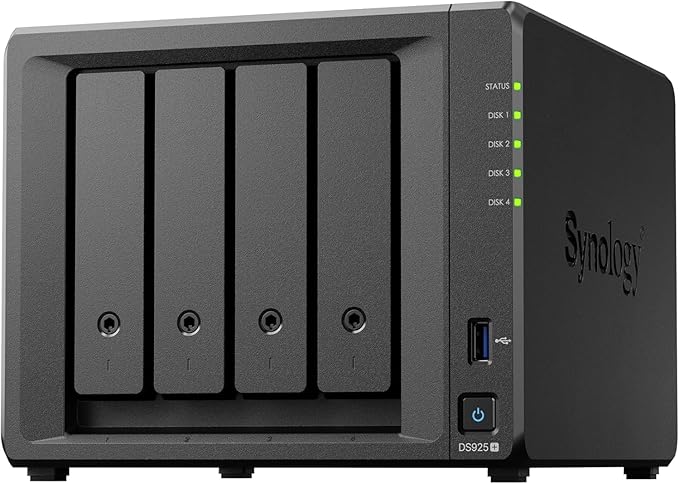
| CPU | AMD Ryzen R1600 Quad-Core |
|---|---|
| RAM | 4GB DDR4 ECC (expandable) |
| Drive Bays | 4x 3.5"/2.5" SATA |
| M.2 Slots | 2x NVMe (SSD cache) |
| Network | 1x 2.5GbE + 1x 1GbE RJ45 |
| Expansion | 1x PCIe 3.0 slot, DX525 expansion unit |
| AU Price (Scorptec) | $995 |
| AU Price (Mwave) | $1,029 |
Pros
- Under $1,000. The most affordable path to Synology's full business software suite
- 2.5GbE port included out of the box, which the more expensive DS1525+ lacks
- Full DSM feature set including Active Backup for Business
- DX525 expansion unit available if you outgrow four bays
Cons
- 4GB RAM. Plan to upgrade to 8GB or 16GB for multi-user business workloads
- Four bays limits RAID options and total capacity
- RAID 5 across four drives means a rebuild after one failure leaves you vulnerable until complete
- No RAID 6 practical option. Need at least five or six drives for dual-parity
QNAP TS-473A. Best Hardware Value
The QNAP TS-473A is the unit to consider if you want more CPU and RAM per dollar than Synology offers. It runs an AMD Ryzen V1500B quad-core processor with 8GB of DDR4 RAM. And unlike budget models, this is a proper quad-core/eight-thread chip that handles virtualisation and containerised applications without the compromises of a dual-core Celeron or ARM processor. At $1,369 from Scorptec or $1,489 from PLE, it sits between the DS925+ and DS1525+ in price while offering a four-bay chassis with two 2.5GbE ports, two M.2 NVMe slots, and two PCIe expansion slots.
QNAP's QTS operating system is more feature-dense than DSM but less polished. Businesses running Docker containers, virtual machines through QNAP's Virtualisation Station, or heavy surveillance workloads will benefit from the stronger CPU. The trade-off is that QTS requires more configuration knowledge, has had a rougher security track record historically, and the backup software suite (Hybrid Backup Sync) is functional but not as streamlined as Synology's Active Backup for Business.

| CPU | AMD Ryzen V1500B Quad-Core 2.2GHz (8 threads) |
|---|---|
| RAM | 8GB DDR4 (expandable to 64GB) |
| Drive Bays | 4x 3.5"/2.5" SATA |
| M.2 Slots | 2x NVMe (SSD cache / storage pool) |
| Network | 2x 2.5GbE RJ45 |
| Expansion | 2x PCIe Gen 3 slots |
| AU Price (Scorptec) | $1,369 |
| AU Price (PLE) | $1,489 |
Pros
- Quad-core Ryzen V1500B with 8 threads. The strongest CPU in a four-bay NAS under $1,500
- Dual 2.5GbE ports included. Link aggregation gives up to 5Gbps theoretical throughput
- Two PCIe slots allow adding 10GbE and an NVMe expansion card simultaneously
- 64GB RAM ceiling. Serious headroom for VMs and containers
Cons
- QTS has had more CVEs than DSM historically. Keep firmware updated and limit internet exposure
- Four bays only. The same capacity limitation as the DS925+ but at a higher price
- QNAP's backup software is functional but requires more manual setup than Synology's suite
- Business models like this are rarely held in retailer stock. Expect dropship delivery in 2-3 days even when listed as available
QNAP TS-664. Best Six-Bay Business NAS Under $2,000
The TS-664 fills the gap between four-bay and eight-bay models with six drive bays, a Celeron N5095 quad-core processor, 8GB of RAM, and dual 2.5GbE networking. At $1,549 from PLE or $1,649 from Scorptec, it is competitively priced against the Synology DS1525+ while offering an extra bay and faster networking out of the box. Six bays in RAID 5 with 8TB drives gives roughly 40TB of usable storage. A sweet spot for businesses that need more than four bays but find eight overkill.
The Celeron N5095 is a step down from the Ryzen V1500B in the TS-473A for multi-threaded workloads, but it handles file sharing, backup targets, and moderate Docker workloads without issue. Where the TS-664 shines is its six-bay RAID flexibility. RAID 6 with six drives provides dual-parity protection while still delivering solid usable capacity, something that four-bay models simply cannot offer.

| CPU | Intel Celeron N5095 Quad-Core 2.9GHz |
|---|---|
| RAM | 8GB DDR4 (expandable) |
| Drive Bays | 6x 3.5"/2.5" SATA |
| M.2 Slots | 2x NVMe |
| Network | 2x 2.5GbE RJ45 |
| Expansion | 2x PCIe Gen 3 slots |
| AU Price (PLE) | $1,549 |
| AU Price (Scorptec) | $1,649 |
Pros
- Six bays unlocks RAID 6 with usable capacity. The best balance of protection and storage
- Dual 2.5GbE out of the box plus PCIe slots for 10GbE upgrade
- HDMI output if you need to run the NAS as a direct media player or signage device
- Competitively priced against the five-bay Synology DS1525+
Cons
- Celeron N5095 is adequate but not powerful. Don't plan on heavy VM workloads
- QNAP's QTS security track record means you need to stay on top of firmware updates
- No ECC RAM. Less data integrity protection than the Synology Plus series
- Six bays means six drives to buy. Total ownership cost is higher than four-bay models
QNAP TS-h973AX. Best Hybrid Storage Under $2,000
The TS-h973AX is an unusual NAS that deserves attention from businesses with mixed storage needs. Its nine bays are split across three types: five 3.5" SATA bays for bulk HDD storage, two 2.5" SATA bays for SSDs, and two U.2 NVMe bays for high-speed solid-state storage. It runs an AMD Ryzen V1500B quad-core CPU and ships with either 8GB or 32GB of RAM. The 32GB model is available at PLE for $1,699. An extraordinary amount of RAM for a NAS at this price. Networking is where it gets interesting: one 10GbE RJ45 port plus two 2.5GbE ports, all built in.
This unit runs QNAP's QuTS hero operating system, which is ZFS-based rather than standard ext4/Btrfs. ZFS provides inline data deduplication, compression, and self-healing. Enterprise-grade features that are genuinely useful for businesses handling databases, virtual machine images, or large datasets with redundant content. The hybrid bay layout means you can tier your storage: fast NVMe for active databases, SSD for frequently accessed files, and HDD for bulk archival. All within a single NAS.

| CPU | AMD Ryzen V1500B Quad-Core 2.2GHz |
|---|---|
| RAM (32GB model) | 32GB DDR4 |
| Drive Bays | 5x 3.5" SATA + 2x 2.5" SATA + 2x U.2 NVMe |
| Network | 1x 10GbE RJ45 + 2x 2.5GbE RJ45 |
| Expansion | PCIe Gen 3 slot |
| AU Price (PLE, 32GB) | $1,699 |
Pros
- Built-in 10GbE port. No add-in card needed, and genuinely useful for business networks
- ZFS file system with inline deduplication and self-healing. Enterprise features at an SMB price
- 32GB RAM at $1,699 is unmatched value. Ideal for VMs, databases, and heavy workloads
- Hybrid bay layout allows storage tiering without external drives or expansion units
Cons
- ZFS is powerful but demanding. It is not beginner-friendly and requires understanding of pools, datasets, and ARC caching
- The hybrid bay layout means no single large RAID array. Storage management is more complex
- QuTS hero is a separate OS from standard QTS. Some QNAP apps may not be available
- This is a niche product that suits specific workloads. Don't buy it just because the specs look impressive
Asustor Lockerstor 6 AS6706T. Strong Alternative at a Lower Price
The Asustor Lockerstor 6 (AS6706T) provides a six-bay NAS with an Intel Celeron N5105 quad-core CPU and 8GB of RAM at $1,349 from PLE or $1,400 from Mwave. That undercuts the QNAP TS-664 while matching its core specs. It includes dual 2.5GbE ports, four USB ports (including USB-C), and two M.2 NVMe slots. For businesses that don't need the Synology or QNAP ecosystem specifically, this is a credible option.
Asustor's ADM (Asustor Data Master) operating system has improved significantly in recent years. It supports Docker natively, offers a built-in VPN server, and has a decent app ecosystem. However, it lacks the depth of Synology's Active Backup or QNAP's Virtualisation Station. Asustor is now distributed exclusively through Dicker Data in Australia, which means stock availability through major retailers is improving. The Lockerstor 6 suits businesses that are comfortable with a less hand-holding approach to NAS management and want to save a few hundred dollars on equivalent hardware.

| CPU | Intel Celeron N5105 Quad-Core 2.0GHz (burst 2.9GHz) |
|---|---|
| RAM | 8GB DDR4 (expandable) |
| Drive Bays | 6x 3.5"/2.5" SATA |
| M.2 Slots | 2x NVMe |
| Network | 2x 2.5GbE RJ45 |
| USB | 3x USB 3.2 Gen 2 (including USB-C) |
| AU Price (PLE) | $1,349 |
| AU Price (Mwave) | $1,400 |
Pros
- Six bays with dual 2.5GbE at a lower price than the QNAP TS-664 or Synology DS1525+
- USB-C port. Useful for direct external drive connections
- Good Docker support via Portainer integration
- Dicker Data distribution means improving AU stock availability and warranty support
Cons
- ADM software is less mature than DSM or QTS. Fewer first-party business apps
- Smaller community and fewer online resources for troubleshooting
- Asustor is still building its Australian presence. Less brand recognition with AU IT teams
- No equivalent to Synology's Active Backup for Business. Third-party backup tools needed
TerraMaster F4-424 Pro. Budget Powerhouse, But Read the Fine Print
The TerraMaster F4-424 Pro stands out on paper: an Intel Core i3 processor, 32GB of RAM, and a four-bay chassis for $1,099 from Scorptec or $1,100 from Mwave. Those are workstation-class specs in a NAS enclosure, and they blow away anything Synology or QNAP offers at this price. The hardware is genuinely impressive for virtualisation, database hosting, and compute-heavy NAS workloads.
The catch is software. TerraMaster's TOS operating system is functional but lacks the depth, polish, and ecosystem of DSM or QTS. Business-grade backup tools, Active Directory integration, and enterprise storage features are either limited or absent. TerraMaster is distributed by DSTech in Australia with a limited retail presence, which means warranty claims and stock availability are less predictable than with Synology or QNAP products distributed through BlueChip or Dicker Data. This is a unit for technically confident teams who are comfortable running Docker containers and managing their own backup infrastructure. Not for businesses that want a turnkey solution.

| CPU | Intel Core i3-N305 (or equivalent) |
|---|---|
| RAM | 32GB DDR5 |
| Drive Bays | 4x 3.5"/2.5" SATA |
| Network | 2x 2.5GbE RJ45 |
| AU Price (Scorptec) | $1,099 |
| AU Price (Mwave) | $1,100 |
Pros
- Core i3 CPU and 32GB RAM at $1,099. No other NAS vendor matches this hardware spec at the price
- Genuinely capable of running VMs, databases, and heavy Docker workloads
- Dual 2.5GbE networking included
Cons
- TOS software is years behind DSM and QTS in business features and polish
- Limited Australian distribution and retail presence. Warranty support is less established
- Smaller community, fewer online resources, and less third-party integration
- Don't buy this expecting a Synology or QNAP experience in cheaper packaging. The software gap is real
Comparison Table: Business NAS Under $2,000
Business NAS Under $2,000. Key Specs Compared
| DS1525+ | DS1825+ | DS925+ | TS-473A | TS-664 | TS-h973AX | AS6706T | F4-424 Pro | |
|---|---|---|---|---|---|---|---|---|
| Brand | Synology | Synology | Synology | QNAP | QNAP | QNAP | Asustor | TerraMaster |
| Bays | 5 | 8 | 4 | 4 | 6 | 9 (hybrid) | 6 | 4 |
| CPU | Ryzen R1600 | Ryzen R1600 | Ryzen R1600 | Ryzen V1500B | Celeron N5095 | Ryzen V1500B | Celeron N5105 | Core i3 |
| RAM | 8GB ECC | 8GB ECC | 4GB ECC | 8GB | 8GB | 32GB | 8GB | 32GB |
| Network | 2x 1GbE | 2x 1GbE | 2.5G + 1G | 2x 2.5GbE | 2x 2.5GbE | 10GbE + 2x 2.5G | 2x 2.5GbE | 2x 2.5GbE |
| Best AU Price | $1,285 | $1,765 (Mwave) | $995 | $1,489 (PLE Computers) | $1,549 | $1,699 | $1,400 (Mwave) | $760 (Mwave) |
| Best For | All-round | Max capacity | Budget entry | VM/Docker | 6-bay RAID 6 | Hybrid/ZFS | Value 6-bay | Raw hardware |
Prices last verified: 28 March 2026. Always check retailer before purchasing.
Networking Considerations for Australian Businesses
Most Australian businesses still run 1GbE internal networks, which means any NAS on this list will max out at roughly 110-115MB/s real-world transfer speeds regardless of how many 2.5GbE or 10GbE ports the NAS has. Upgrading your NAS networking only matters if the rest of your network can keep up. A 2.5GbE-capable switch like the QNAP QSW-1105-5T ($159 at Scorptec) is an affordable first step.
For businesses using their NAS as a remote access or cloud sync target, Australian NBN upload speeds are the real bottleneck. On a typical NBN 100 plan, upload speeds cap at around 20-40Mbps. Roughly 2.5-5MB/s. If you are backing up a remote office to a NAS at headquarters, plan your backup windows around this limitation. Synology Drive and QNAP's Hybrid Backup Sync both support delta sync (only transferring changed blocks), which helps enormously over slow WAN links. Also be aware that some NBN connections use CGNAT, which blocks inbound connections and makes direct remote access to your NAS impossible without a VPN service or Synology's QuickConnect/QNAP's myQNAPcloud relay.
Buying Advice for Australian Businesses
Australian NAS pricing is currently running 10-20% above US levels, driven by lower stock allocations, higher freight costs, and smaller market volumes. Most Australian retailers operate on 3-5% NAS margin, which is why pricing is remarkably uniform across the major stores. The real difference between retailers is what happens when something goes wrong.
For business purchases, always request a formal quote rather than buying at listed retail price. Resellers can request pricing support from distributors and vendors. Discounts that never appear on the website but are routinely available for quoted deals. Scorptec, PLE, and DeviceDeal all handle business quotes and can check real stock levels and delivery timelines before you commit.
Business models and rackmount NAS units are rarely held in retailer stock. Even when listed as "in stock," expect 2-3 days for the retailer to process through their distributor's dropship process. BlueChip holds the deepest NAS stock in Australia. Almost every Synology and QNAP model is available from them at any time, with air freight from Taiwan filling gaps in 2-3 weeks. This is relevant because your retailer's relationship with their distributor directly affects how quickly you get your NAS.
Warranty and ACL: In Australia, your warranty claim goes to the retailer, not the manufacturer. Synology, QNAP, and Asustor don't have service centres here. Your place of purchase is your first and only point of contact. Before buying, ask your retailer: "If this fails, what's your process? Can I get an advanced replacement?" The standard NAS warranty process runs through the full chain. Retailer to distributor to vendor in Taiwan. And takes 2-3 weeks minimum. Australian Consumer Law protections apply when purchasing from Australian retailers. For official information on your rights, visit accc.gov.au.
A NAS is not a backup. Plan for hardware failure as a certainty, not a possibility. Build your data protection strategy around the assumption that your NAS will eventually fail. Offsite backup, cloud sync, or a secondary NAS should all be in place before you need them. The cost of downtime and data recovery for a business will always exceed the cost of a proper backup strategy.
Which NAS Should Your Business Buy?
The right NAS depends on your specific workload, not on which brand has the best marketing. Here is a practical decision framework:
- General file sharing and backups for 5-20 users: Synology DS1525+ ($1,285). The software does the heavy lifting, five bays provide growth room, and DSM is the least likely to cause headaches for your IT staff.
- Maximum storage under $2,000: Synology DS1825+ ($1,799). Eight bays, same ecosystem. Only choose this if you genuinely need the capacity.
- Tight budget, full business features: Synology DS925+ ($995). Four bays, 2.5GbE, and the full DSM suite. Upgrade the RAM to 8GB and it handles most small business workloads.
- VMs, Docker, and compute-heavy tasks: QNAP TS-473A ($1,369). The Ryzen V1500B is the strongest CPU in a four-bay NAS at this price, and 64GB RAM ceiling gives long-term flexibility.
- Six-bay storage with RAID 6: QNAP TS-664 ($1,549) or Asustor AS6706T ($1,349). Six bays, dual 2.5GbE, similar specs. Choose QNAP if you value the larger app ecosystem, Asustor if you want to save $200.
- Hybrid storage or 10GbE networking: QNAP TS-h973AX ($1,699). ZFS, 32GB RAM, and built-in 10GbE. Powerful but complex. Don't buy this unless you understand ZFS.
- Raw hardware power on a budget: TerraMaster F4-424 Pro ($1,099). Core i3 and 32GB RAM are unmatched at the price, but the software lags behind. Suitable for Docker-first deployments managed by experienced administrators.
If you are buying a NAS for the first time, buy from a specialist like Scorptec or PLE where you can get genuine pre-sales guidance. Not from Amazon where the price might be better but the support is nonexistent. Gone are the days of waiting for Black Friday to buy tech. Australian retailers run rolling sale events throughout the year. If you need a NAS now, buy it now. The price won't be dramatically different in six months, and in 2026, the stock might not be there.
Related reading: our NAS buyer's guide.
Use our free NAS Sizing Wizard to get a personalised NAS recommendation.
See also: our NAS for Australian business guide.
Is a NAS under $2,000 powerful enough for a small business?
Yes, for most small businesses with 5-30 users doing standard file sharing, backups, and light application hosting. The Synology DS1525+ and QNAP TS-473A handle these workloads without issue. Where you will outgrow a sub-$2,000 NAS is if you need high-performance database hosting, large-scale virtualisation, or more than roughly 80-100TB of raw storage. At that point, you are looking at rackmount units or multi-NAS deployments that exceed this budget.
Should I buy a Synology or QNAP NAS for my business?
Synology suits businesses that value software polish, ease of use, and a comprehensive backup suite. Particularly if your IT team is small or non-specialist. QNAP suits businesses that want more hardware per dollar, better virtualisation support, and are comfortable with a more hands-on configuration experience. Both are distributed through established Australian channels (BlueChip for both brands, plus Dicker Data for QNAP), so warranty support is comparable. If you don't have a strong preference, Synology's DSM is the safer bet for most business environments.
How much does a complete NAS setup cost including drives?
For a four-bay NAS like the Synology DS925+ ($995) with four 8TB NAS-grade drives (roughly $250-$300 each in 2026), expect a total of $2,000-$2,200. A five-bay DS1525+ ($1,285) with five 8TB drives runs to $2,500-$2,800. An eight-bay DS1825+ ($1,799) with eight drives pushes past $3,800. NAS-grade HDD prices have risen from early 2025 levels, so always check current drive pricing before committing to a particular NAS model and bay count.
Can I use a business NAS for offsite backup over Australian NBN?
You can, but NBN upload speeds limit how much data you can push. On a typical NBN 100 plan, upload is capped at around 20-40Mbps. That is roughly 2.5-5MB/s. An initial full backup of 10TB would take weeks. After that, delta sync (transferring only changed data) makes ongoing backups practical. Both Synology Drive and QNAP Hybrid Backup Sync support delta sync natively. Be aware that some NBN connections use CGNAT, which prevents direct inbound connections to your NAS. Synology's QuickConnect and QNAP's myQNAPcloud provide relay workarounds, but a dedicated VPN or business-grade internet plan without CGNAT is preferable for reliable remote access.
What happens if my business NAS fails under warranty in Australia?
Your warranty claim goes to the retailer you purchased from. Not the manufacturer. NAS vendors like Synology, QNAP, and Asustor do not have service centres in Australia. The retailer escalates through their distributor to the vendor, and a replacement (not repair) is the standard resolution. This process typically takes 2-3 weeks. Advanced replacements. Receiving a new unit before returning the faulty one. Are generally not available through standard channels, but some resellers will arrange one if you ask before purchase. Plan for this downtime by maintaining offsite backups and a documented recovery plan. Australian Consumer Law protections apply, and for official guidance visit accc.gov.au.
Is UGREEN NASync a viable business option in Australia?
Not yet. UGREEN's NASync lineup (DXP2800, DXP4800, DXP6800 Pro, and others) looks promising on paper, but UGREEN does not yet have an official Australian distributor. This means warranty claims currently go through international channels, stock availability is unpredictable through Australian retailers, and the software ecosystem is still in its early stages. For a business NAS that stores critical data, the support infrastructure matters as much as the hardware. Wait until UGREEN establishes proper Australian distribution. Likely sometime in 2026. Before considering their NAS products for business use.
Should I buy a NAS from Amazon Australia to save money?
Amazon AU has started holding NAS stock directly in 2026, sometimes at prices below local retailers. However, their support model means you are largely on your own if a unit fails. Amazon will push to issue a credit or refund rather than manage a warranty replacement, especially for older or less common models. They lack the distributor relationships that specialist retailers like Scorptec and PLE use to source replacement units quickly. For a business-critical NAS, the potential savings of $50-$100 are not worth the risk of being without a NAS for weeks while you sort out a replacement yourself. Buy from Amazon if you are technically confident and have robust backup strategies. Buy from a specialist retailer if the NAS is critical to your operations.
Looking for the right hard drives to pair with your business NAS? Read our guide on the best NAS hard drives available in Australia with current pricing and compatibility advice.
Best NAS Hard Drives Australia →