Running AI workloads locally on a NAS is genuinely possible in 2026. But most NAS devices sold in Australia cannot do it meaningfully, and buying the wrong unit is an expensive mistake. Local large language models, AI-powered photo indexing, and edge inference all require a CPU or NPU capable of sustained vector math, significant RAM (16GB minimum for useful LLM work), and fast storage throughput. The ARM and entry-level Celeron chips in budget NAS units will technically run Ollama or Synology Photos AI. They'll just do it so slowly that the experience is frustrating rather than useful. This guide focuses on the models that can actually deliver a practical AI experience, what each use case demands from the hardware, and where to buy them in Australia at fair prices.
In short: For AI photo search and light local LLM use, the Synology DS925+ (from $995 at Scorptec) and QNAP TS-464 (from $989 at Scorptec) are the most accessible entry points in Australia. For serious local LLM inference (7B+ models), the QNAP TS-473A (from $1,369 at Scorptec) and TerraMaster F4-424 Pro (from $1,099 at Scorptec) offer the Ryzen and Core i3 muscle required. No consumer NAS currently ships with a discrete GPU. GPU-accelerated inference still requires a separate machine or a cloud endpoint.
What Does "AI on a NAS" Actually Mean in 2026?
The phrase "AI NAS" covers three distinct workloads, and they have very different hardware demands. Understanding which one you actually want is the first step to buying the right device.
- AI photo and video search: Face recognition, object detection, and semantic scene indexing run at indexing time (not query time). Synology Photos, QNAP QuMagie, and Asustor AiData all perform this locally. A quad-core Celeron N5095 with 4GB RAM can do this. Slowly. A Ryzen V1500B or AMD Ryzen R1600 with 8-16GB RAM does it at a pace that keeps up with a large photo library without hours-long initial indexing queues.
- Local LLM inference (Ollama, LM Studio via network): Running a 7B parameter model like Llama 3 8B or Mistral 7B requires a minimum of 8GB RAM just to load the model weights. 16GB is the practical floor for comfortable operation with a 4-bit quantised model. CPU-only inference on these models is slow even on desktop hardware; on a NAS Celeron it becomes borderline unusable. Ryzen V1500B and Core i3/i5 class CPUs produce tolerable token generation speeds for text tasks that don't require real-time responses.
- Edge inference / vector search / RAG pipelines: Running retrieval-augmented generation (RAG) locally. Indexing documents, generating embeddings, and querying a local vector database like ChromaDB or Qdrant. Is more memory-bound than compute-bound. 16GB+ RAM, fast NVMe cache, and a capable CPU all contribute meaningfully here. This is also where 10GbE networking starts to matter if multiple clients are querying simultaneously.
GPU-accelerated inference (llama.cpp with CUDA/ROCm, Whisper transcription at real speed, image generation) is not achievable on any current consumer or prosumer NAS. No model ships with a discrete GPU, and the PCIe slots available on QNAP's higher-end units are occupied by network and storage expansion cards in any practical deployment. If GPU acceleration is a hard requirement, a separate mini PC or workstation running Ollama with GPU passthrough. Accessed from the NAS via API. Is the right architecture.
Minimum Specs for AI Use Cases. What to Look For
Before diving into specific models, here are the hardware thresholds that meaningfully separate usable AI performance from theoretical AI capability:
| Use Case | Minimum CPU | Minimum RAM | Storage Requirement | Network |
|---|---|---|---|---|
| AI photo indexing (Synology Photos / QuMagie) | Intel Celeron N5095 or better | 4GB (8GB preferred) | Standard HDD array | 1GbE sufficient |
| Local LLM 7B model (4-bit quant) | AMD Ryzen V1500B / R1600 / Core i3 | 16GB | NVMe cache recommended | 1GbE sufficient |
| RAG pipeline / vector database | AMD Ryzen or Intel Core class | 16-32GB | NVMe SSD or fast cache | 2.5GbE+ preferred |
| Whisper transcription (CPU only) | Intel Core i3 N305 or Ryzen class | 8GB+ | SSD preferred | 1GbE sufficient |
ARM CPUs (Realtek RTD1619B, Cortex-A55) are not suitable for LLM inference. Synology DS223, DS423, QNAP TS-233, TS-433, and similar ARM-based models can run AI photo features at a basic level, but they cannot run Ollama or any LLM inference workload at a usable speed. Don't buy these units for AI use cases beyond basic photo tagging.
Best NAS for AI Photo Search. Synology DS925+
The Synology DS925+ is the best-balanced option for Australian buyers who want AI photo search as their primary use case, with enough headroom for light LLM experimentation. At $995 at Scorptec and $1,029 at Mwave, it sits at a price point where the performance-per-dollar case is strong.
Synology Photos is the most polished AI photo management software in the NAS category. Face recognition, object tagging, and location clustering all run locally on the unit. On the DS925+, which runs an AMD Ryzen R-series quad-core CPU with 4GB of ECC-capable DDR5 RAM (expandable to 32GB), initial indexing of a 100,000-photo library completes in a reasonable timeframe rather than taking days. The 2.5GbE port ensures photo streaming to clients doesn't become a bottleneck once the library is indexed.
The DS925+ also runs Synology's Container Manager (Docker-compatible), which means deploying Ollama as a container is straightforward. With RAM expanded to 16GB or 32GB using a third-party SODIMM, a 7B quantised model becomes usable for occasional text tasks. Think document summarisation or a local chatbot for personal use, not production throughput. Be aware that Synology's official RAM compatibility list is conservative; community testing shows many standard DDR5 SODIMMs work correctly, but this carries no warranty guarantee.
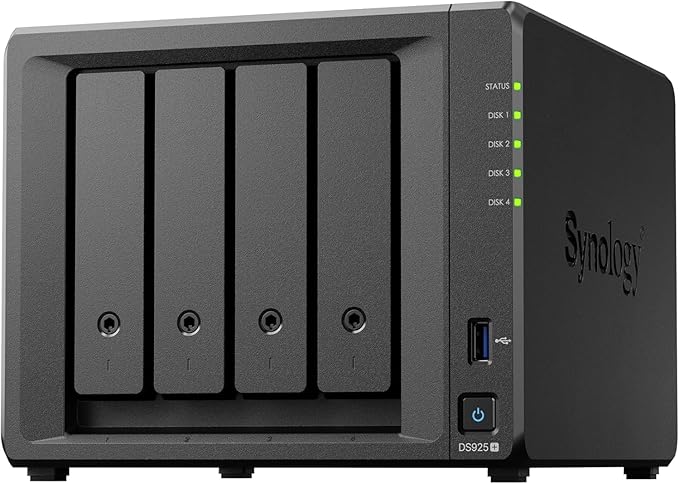
| Model | Synology DS925+ |
|---|---|
| CPU | AMD Ryzen R-series quad-core (exact model TBC by Synology) |
| RAM | 4GB DDR5 (expandable to 32GB) |
| Drive Bays | 4x 3.5"/2.5" SATA + 2x M.2 NVMe (cache) |
| Network | 1x 2.5GbE + 1x 1GbE |
| USB | 3x USB 3.2 |
| AU Price (Scorptec) | $995 |
| AU Price (Mwave) | $1,029 |
Pros
- Synology Photos AI is the most polished photo intelligence software in the NAS category
- Expandable to 32GB RAM. Opens door to 7B LLM use with third-party SODIMMs
- M.2 NVMe cache slots improve container/AI workload I/O significantly
- 2.5GbE standard. No additional network card needed for most home/SMB use
- Strong DSM ecosystem. Container Manager, Active Backup, Surveillance Station all available
- 3-year warranty, strong Australian distributor support via BlueChip
Cons
- 4GB base RAM is too low for LLM work. Budget for RAM upgrade at purchase
- No PCIe expansion slot for 10GbE or GPU acceleration
- Synology's official RAM compatibility list limits warranty-safe upgrade options
- Only 4 HDD bays. Capacity ceiling lower than 6-bay alternatives at similar price
Best NAS for Local LLMs on a Budget. QNAP TS-473A
The QNAP TS-473A is the strongest value case for local LLM inference in Australia's current retail market. Available from $1,369 at Scorptec and $1,489 at PLE, it ships with an AMD Ryzen V1500B quad-core/8-thread CPU and 8GB DDR4 ECC RAM. And crucially, it has a PCIe 3.0 x4 expansion slot that can accept a 10GbE card or an M.2 NVMe adapter for faster storage.
The Ryzen V1500B is a meaningful step above Celeron for CPU-bound AI work. Running Ollama with a Llama 3 8B Q4 model on this chip produces token generation speeds in the range of 3-6 tokens per second. Slow by GPU standards, but usable for tasks where you submit a query and come back in 30 seconds for a result. For document processing pipelines running overnight, it's entirely practical.
QNAP's AI tools (QuMagie for photos, AI Assistant in QTS 5.2+) are available and functional, though less polished than Synology's equivalents. The TS-473A's real advantage over Synology at this price point is the PCIe slot and QNAP's more open ecosystem. Deploying custom AI containers via Container Station involves fewer restrictions than Synology's DSM environment.
RAM can be expanded to 64GB using standard DDR4 ECC SO-DIMMs. At 32GB, models up to 13B parameters become accessible in 4-bit quantisation. At 64GB, 34B models become theoretically runnable. Though token generation at that scale on CPU-only hardware will test your patience.

| Model | QNAP TS-473A-8G |
|---|---|
| CPU | AMD Ryzen V1500B quad-core/8-thread 2.2GHz |
| RAM | 8GB DDR4 ECC SO-DIMM (expandable to 64GB) |
| Drive Bays | 4x 3.5"/2.5" SATA |
| M.2 Slots | 2x M.2 2280 PCIe NVMe (built-in) |
| Network | 2x 2.5GbE |
| Expansion | 1x PCIe 3.0 x4 (for 10GbE or additional M.2) |
| AU Price (Scorptec) | $1,369 |
| AU Price (PLE) | $1,489 |
Pros
- Ryzen V1500B delivers meaningful CPU AI performance vs Celeron alternatives
- PCIe expansion slot enables 10GbE upgrade. Important for multi-client AI serving
- Built-in M.2 NVMe slots for fast model storage and cache
- Expandable to 64GB ECC RAM. Supports larger LLM models
- QNAP Container Station has fewer deployment restrictions than Synology
- Dual 2.5GbE standard
Cons
- QNAP's AI software (QuMagie) is less polished than Synology Photos
- QTS ecosystem more complex than DSM. Steeper learning curve
- No GPU slot. CPU inference only
- Only 4 HDD bays
- QNAP's recent security track record has required active patching discipline
Best NAS for AI on a Tight Budget. QNAP TS-464
If $1,000 is your ceiling and you still want AI photo search plus the option to experiment with lightweight AI containers, the QNAP TS-464-8G at $989 at Scorptec and $1,099 at PLE is the most capable unit in this price band. The Intel Celeron N5095 quad-core CPU is weaker than a Ryzen V1500B for sustained AI workloads, but it runs QNAP's QuMagie photo AI competently and handles containerised services like ChromaDB or lightweight embedding generation without issue. As long as expectations are appropriately calibrated.
The TS-464 ships with 8GB DDR4 RAM and dual 2.5GbE ports. It also has two built-in M.2 NVMe slots. For LLM inference, the Celeron N5095 will generate tokens noticeably slower than a Ryzen V1500B. Expect 1-3 tokens per second on a 7B Q4 model. It's usable for asynchronous tasks and overnight batch jobs, but frustrating for interactive use. Don't buy the TS-464 primarily for LLM inference; buy it primarily for AI photo management and occasional container experiments.
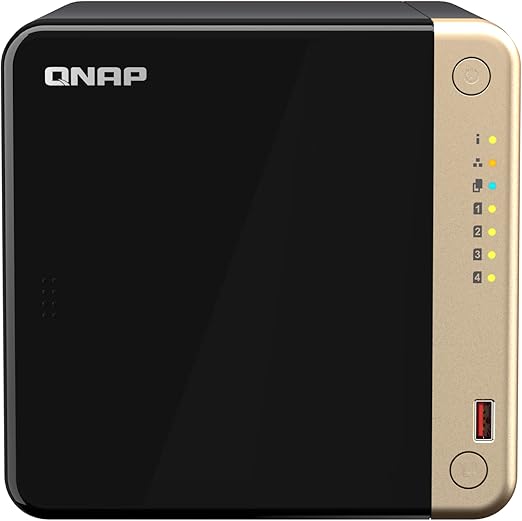
| Model | QNAP TS-464-8G |
|---|---|
| CPU | Intel Celeron N5095 quad-core 2.0GHz (burst 2.9GHz) |
| RAM | 8GB DDR4 SO-DIMM (expandable to 16GB) |
| Drive Bays | 4x 3.5"/2.5" SATA |
| M.2 Slots | 2x M.2 2280 PCIe NVMe |
| Network | 2x 2.5GbE |
| AU Price (Scorptec) | $989 |
| AU Price (PLE) | $1,099 |
Pros
- Best-value 4-bay Celeron NAS with dual 2.5GbE and built-in NVMe slots
- 8GB RAM out of box. Functional for photo AI without upgrade
- Handles QuMagie photo indexing competently
- Suitable for running ChromaDB, Qdrant, or other vector database containers
- Dual 2.5GbE useful for simultaneous NAS storage and AI API traffic
Cons
- Celeron N5095 is noticeably slower than Ryzen for LLM token generation
- 16GB RAM ceiling limits maximum LLM model size
- No PCIe expansion slot on this model
- Interactive LLM use will feel slow. Better suited to batch/async tasks
Best NAS for AI. SMB / Power User. TerraMaster F4-424 Pro
The TerraMaster F4-424 Pro is a genuine standout for AI workloads at its price point, and it's arguably the most overlooked option in Australia's NAS market for this use case. Available from $1,099 at Scorptec and $1,100 at Mwave, it ships with an Intel Core i3 (12th Gen) and 32GB DDR4 RAM from the factory. The only sub-$1,200 NAS in Australian retail that arrives ready for serious local LLM work without any RAM upgrade.
The Core i3-N305 (or equivalent 12th Gen variant used in the F4-424 Pro) delivers meaningfully better single-thread performance than the Ryzen V1500B, which matters for LLM inference. Per-token latency is determined largely by single-thread memory bandwidth and CPU clock speed on consumer hardware. In practice, the F4-424 Pro produces faster token generation than the TS-473A on 7B models while costing less.
TerraMaster's TOS (TerraMaster OS) is less mature than DSM or QTS. Docker container support exists (via ContainerStation equivalent), but the ecosystem of first-party AI applications is thinner than either Synology or QNAP. For buyers who plan to self-manage Ollama containers and don't need hand-holding from the NAS OS, this is not a meaningful disadvantage. For buyers who want a polished, integrated AI photo experience comparable to Synology Photos, it is a real limitation.
One consideration specific to Australia: TerraMaster is distributed here by DSTech, a smaller distributor with limited market presence. Warranty processes and post-sales support are less established than the BlueChip/Dicker Data chains backing Synology and QNAP. Factor this into your risk assessment. For a business-critical deployment, the uncertainty around warranty turnaround time is a legitimate concern. For a home power user or small creative studio comfortable with self-managing support, it's less of an issue.

| Model | TerraMaster F4-424 Pro |
|---|---|
| CPU | Intel Core i3 (12th Gen). 4-core |
| RAM | 32GB DDR4 (factory. No upgrade needed for 7B LLMs) |
| Drive Bays | 4x 3.5"/2.5" SATA |
| M.2 Slots | 2x M.2 NVMe |
| Network | 2x 2.5GbE |
| AU Price (Scorptec) | $1,099 |
| AU Price (Mwave) | $1,100 |
Pros
- 32GB RAM factory standard. No upgrade needed for 7B LLM work
- Core i3 12th Gen delivers better single-thread LLM performance than Ryzen V1500B
- Best price-to-AI-performance ratio of any 4-bay NAS in AU retail
- Full Docker/container support for Ollama, ChromaDB, Whisper, etc.
- Dual 2.5GbE and M.2 NVMe slots included
Cons
- TerraMaster TOS is less mature and less polished than DSM or QTS
- AI photo management software significantly behind Synology Photos and QuMagie
- DSTech distribution means weaker AU warranty chain vs BlueChip/Dicker
- Smaller community = less online troubleshooting help in Australia
- Not a good fit for buyers who want a turnkey AI photo experience
Best for AI Photo Search. High-End Option. Synology DS1825+
For users with large photo and video libraries (500,000+ files), the Synology DS1825+ at $1,799 at Scorptec delivers the capacity and performance to keep AI indexing from becoming a permanent background burden. Eight bays, a Ryzen V1500B CPU, and Synology's mature DSM platform make this the natural endpoint for serious Synology Photos deployments in Australia.
Unlike the DS925+, the DS1825+ gives you room to grow storage capacity well beyond 4 drives. Relevant when a photo and video library includes raw camera files, 4K video, and multi-year archive material. The same Ryzen V1500B CPU means AI workload performance is comparable to the TS-473A, and RAM can be expanded to 32GB using standard DDR4 ECC SO-DIMMs for LLM experimentation alongside the photo AI workloads.
The DS1825+ is priced as a prosumer/SMB device. Synology is distributed through BlueChip in Australia. Effectively every model is in stock at all times, and warranty claims flow through a well-established chain with 2-3 week turnaround as the typical expectation. For buyers who want certainty around after-sales support, Synology's AU distribution structure is the strongest in the category.

| Model | Synology DS1825+ |
|---|---|
| CPU | AMD Ryzen V1500B quad-core 2.2GHz |
| RAM | 4GB DDR4 ECC (expandable to 32GB) |
| Drive Bays | 8x 3.5"/2.5" SATA + 2x M.2 NVMe |
| Network | 2x 1GbE (10GbE via PCIe expansion card) |
| Expansion | 1x PCIe 3.0 slot + 5-bay DX517 expansion supported |
| AU Price (Scorptec) | $1,799 |
Pros
- 8 bays provides headroom for large photo/video archives
- Ryzen V1500B handles sustained AI indexing without thermal throttling concerns
- PCIe slot enables 10GbE upgrade. Meaningful for multi-client or RAG serving
- Synology Photos AI is best-in-class for photo intelligence
- Strongest AU warranty chain of any NAS brand (BlueChip distribution)
- DX517 expansion unit available if storage grows further
Cons
- 4GB base RAM requires upgrade for any LLM use. Add ~$168 for Synology 4GB SODIMM or use third-party
- No built-in 2.5GbE. Base networking is 1GbE unless PCIe card added
- At $1,799 diskless, drive costs add significantly to total investment
- Overkill for users with photo libraries under 100,000 files
Comparison: AI NAS Models Available in Australia
AI NAS Comparison. Australia 2026
| Synology DS925+ | QNAP TS-473A | QNAP TS-464 | TerraMaster F4-424 Pro | Synology DS1825+ | |
|---|---|---|---|---|---|
| CPU Class | AMD Ryzen (latest) | Ryzen V1500B | Celeron N5095 | Core i3 12th Gen | Ryzen V1500B |
| Base RAM | 4GB DDR5 | 8GB DDR4 ECC | 8GB DDR4 | 32GB DDR4 | 4GB DDR4 ECC |
| Max RAM | 32GB | 64GB | 16GB | 32GB | 32GB |
| Drive Bays | 4 | 4 | 4 | 4 | 8 |
| Built-in M.2 NVMe | Yes (2x) | Yes (2x) | Yes (2x) | Yes (2x) | Yes (2x) |
| Best Network | 2.5GbE | 2.5GbE x2 | 2.5GbE x2 | 2.5GbE x2 | 1GbE x2 (upgradeable) |
| PCIe Expansion | No | Yes (x4) | No | No | Yes |
| AI Photo Software | Synology Photos (best-in-class) | QuMagie (good) | QuMagie (good) | TOS AI (basic) | Synology Photos (best-in-class) |
| LLM Suitability | Good (with RAM upgrade) | Very good | Fair | Very good (32GB ready) | Good (with RAM upgrade) |
| AU Price (approx) | $995 | $1,489 (PLE Computers) | $989 | $760 (Mwave) | $1,765 (Mwave) |
| AU Warranty Chain | Strong (BlueChip) | Strong (BlueChip) | Strong (BlueChip) | Limited (DSTech) | Strong (BlueChip) |
Prices last verified: 28 March 2026. Always check retailer before purchasing.
What About the QNAP TS-673A for AI?
The QNAP TS-673A at $1,699 at PLE and Scorptec is worth mentioning for buyers who need six bays and want AI capability. It uses the same Ryzen V1500B chip as the TS-473A with 8GB DDR4 ECC RAM and dual 2.5GbE, adding two more drive bays. The PCIe expansion slot is present, enabling a 10GbE upgrade path. The AI workload story is identical to the TS-473A. The extra bays are the only meaningful difference. If your storage needs have you filling four bays already, the TS-673A is the natural step up without sacrificing AI performance.
Networking for AI: Why Upload Speed and Local Network Matter
If you plan to use your NAS-hosted LLM or vector search from multiple devices on your local network, or to query it remotely, there are two Australian-specific network realities worth noting.
On local network: 1GbE is the bandwidth floor for serving a local LLM API. Realistically, text-based LLM inference generates very little data per token. 1GbE is more than adequate for the response stream. Where bandwidth matters is when serving large embedding payloads or returning vector search results over many simultaneous connections. For single-user or low-concurrency use cases, 1GbE is fine. For multi-user office deployments, 2.5GbE or 10GbE is worth the upgrade.
On NBN: If you're considering exposing your local LLM endpoint to the internet for remote access, Australia's typical NBN 50/100 plans provide around 56Mbps upload at best. This is workable for remote API queries to a text LLM, but it's a hard ceiling for any application that streams large amounts of data (video processing results, large document embeddings). More importantly, many Australian residential and some business NBN connections sit behind CGNAT (Carrier Grade NAT), which blocks inbound connections entirely. Making remote access to a home-hosted AI endpoint impossible without a VPN tunnel, reverse proxy, or a Tailscale-style solution. Check with your ISP before planning remote access to a home NAS AI endpoint.
UGREEN NASync. Worth Considering?
UGREEN's NASync range. The DH2300 at $340 and DH4300 Plus at $595 direct from UGREEN AU. Are priced aggressively and use Intel Celeron and Core class processors. On paper, the DH4300 Plus with its Core processor and 8GB RAM is a candidate for AI photo use and light LLM work.
However, UGREEN does not yet have an official Australian distributor. The Need to Know IT team's understanding is that a local distributor arrangement is likely in 2026, but until it's confirmed, warranty claims for UGREEN NAS in Australia go through international channels. Slower, less certain, and without the established distributor escalation path that Synology, QNAP, and Asustor provide. The UGOS operating system is also younger and less documented than DSM, QTS, or even TOS, which means less community support when deploying custom AI containers.
The UGREEN NASync units represent good value hardware, but the absence of local distribution support is a meaningful risk for any device that will hold your primary data and AI workloads. Buyers who are technically self-sufficient and accept the support trade-off will find them interesting. Buyers who want certainty should wait until UGREEN's AU distribution is formalised.
Australian Consumer Law note: Australian Consumer Law protections apply when purchasing any NAS from an authorised Australian retailer, regardless of brand. Your warranty claim is against the place of purchase, not the manufacturer. For NAS devices specifically. Which hold your data. Understanding the retailer's warranty replacement process before you buy is essential. Ask: "If this unit fails within warranty, what's your process? Is an advanced replacement available?" Most standard NAS warranty processes in Australia take 2-3 weeks minimum. Plan your backup strategy accordingly. For official ACL guidance, visit accc.gov.au. This article provides general guidance only and does not constitute legal advice.
Don't Buy These for AI
These models are good NAS devices for their intended use cases but are not suitable for meaningful AI workloads:
- Synology DS423 ($635): ARM-based RTD1619B CPU. Synology Photos basic tagging only. No LLM capability.
- Synology DS225+ ($585): Intel Celeron J4125. Passable for photo indexing at small scale. Too slow for LLM inference and RAM ceiling is low.
- QNAP TS-433 ($639): ARM Cortex-A55. Same ARM limitation as Synology ARM models. Basic photo AI only.
- QNAP TS-233 (~$639): ARM, 2GB RAM. Not suitable for any meaningful AI workload beyond basic QuMagie features.
- Asustor AS3304T ($585): Realtek RTD1619B ARM CPU. Same ARM limitation applies.
The ARM-CPU models in this list are perfectly capable NAS devices for file storage, media serving, and backup. The limitation is specifically for AI workloads. If AI is not a priority, they remain valid options at their respective price points.
Where to Buy in Australia. Pricing and Retailer Notes
Australian NAS pricing is relatively uniform across the major retailers. Most operate on 3-5% margin, leaving little room for meaningful price variation. The key differences between retailers are stock depth, pre-sales guidance, and what happens when something goes wrong.
Scorptec and PLE Computers are the strongest all-round choices for AI NAS purchases in Australia. Both hold genuine stock of most current models, have staff who can provide pre-sales guidance, and have established processes for warranty claims. For the models covered in this guide: Synology DS925+ from $995 (Scorptec), DS1825+ from $1,799 (Scorptec), QNAP TS-473A from $1,369 (Scorptec), TS-464 from~$1699 (Scorptec), TerraMaster F4-424 Pro from $1,099 (Scorptec).
Mwave stocks a solid range of Synology and QNAP models at competitive prices and is a reliable option. PLE is particularly strong on Asustor and QNAP.
Synology and QNAP are both distributed primarily through BlueChip in Australia. The deepest NAS stock holder in the market. This means that even when a retailer shows a unit as temporarily out of stock, restocking from the distributor typically takes 2-3 days for standard models. Enterprise and rackmount units are a different story. These are rarely held in retailer stock and may need to be ordered through the distributor, adding 2-3 days processing even when listed as available.
For business buyers, always request a formal quote rather than buying at listed retail price. Resellers can request pricing support from distributors, and discounts that never appear on the website are routinely available for quoted deals. Particularly on business-grade units.
HDD prices in 2026 remain elevated from early 2025 levels. NAS-grade 4TB drives that were under $160 a year ago are now consistently above $200. Budget accordingly when calculating the total cost of a diskless NAS purchase.
Summary: Which AI NAS for Which Use Case
The Synology DS925+ suits home users and small creative professionals who want the best AI photo experience available in a NAS, with room to expand RAM for occasional LLM use. The polished Synology Photos ecosystem and strong Australian warranty chain justify the $995 entry price.
The QNAP TS-473A suits technically capable users who want maximum flexibility for self-hosted AI containers. Ollama, ChromaDB, Whisper, RAG pipelines. And are willing to manage QNAP's more complex ecosystem in exchange for expandable RAM (up to 64GB), a PCIe expansion slot, and open container deployment.
The QNAP TS-464 suits budget-conscious buyers primarily after AI photo management with the option to experiment with lightweight AI containers. Don't buy it expecting interactive LLM performance. It's capable but slow for that use case.
The TerraMaster F4-424 Pro suits power users who prioritise raw AI compute at the lowest price. 32GB factory RAM and a Core i3 CPU at $1,099 is an unusually strong value proposition. Accept the less mature software ecosystem and weaker AU warranty chain as the trade-off.
The Synology DS1825+ suits users with large (500,000+ file) photo and video archives who need 8 bays, want Synology's mature AI photo tools, and value the certainty of Synology's AU distribution and warranty chain over all other factors.
Related reading: our NAS buyer's guide, our NAS vs cloud storage comparison, and our NAS explainer.
Free tools: NAS Sizing Wizard and AI Hardware Requirements Calculator. No signup required.
Related reading: our OCR on NAS guide.
Can any NAS run a local LLM like Llama 3 or Mistral?
Yes, but with significant caveats. Any NAS running a Linux-compatible operating system with Docker/container support can technically run Ollama and serve a local LLM. The practical question is whether the hardware makes the experience usable. ARM-based NAS units (Realtek, Cortex-A55) cannot run llama.cpp at usable speeds. Avoid these for LLM work entirely. Intel Celeron NAS units (N5095, N5105) can run 7B quantised models but generate tokens slowly (1-3 per second). AMD Ryzen V1500B and Intel Core i3/i5 NAS units are the minimum for a tolerable interactive experience. All consumer NAS units are CPU-only for inference. No GPU acceleration is available on any current NAS model.
How much RAM do I need for local LLM inference on a NAS?
The RAM requirement is determined by the model you want to run. A 7B parameter model in 4-bit quantisation (Q4_K_M) requires approximately 5-6GB of RAM for the model weights alone. Meaning 8GB total RAM is the absolute minimum, and the system will have very little headroom for the OS and other services. 16GB is the comfortable minimum for a 7B model with concurrent NAS services running. A 13B Q4 model needs approximately 9-10GB for weights. 16GB works, 32GB is comfortable. TerraMaster's F4-424 Pro ships with 32GB from the factory, making it the only sub-$1,200 NAS in Australian retail that arrives ready for 13B model work without a RAM upgrade.
Which NAS has the best AI photo search in Australia?
Synology Photos, running on any Synology Plus-series or higher NAS, is the most polished AI photo management software available in the NAS category. Face recognition, object detection, location clustering, and smart album generation all work reliably and improve with use. QNAP's QuMagie is a solid second. Capable and well-featured, though the interface is less intuitive. Asustor's AiData is functional but behind both. TerraMaster's photo AI tools are basic by comparison. For AI photo search as the primary use case, a Synology DS925+ or DS1825+ running Synology Photos is the strongest recommendation in Australia's current retail market.
Can I access my NAS-hosted AI tools remotely from outside my home?
Technically yes, but there are Australian-specific complications. Many residential and some business NBN connections sit behind CGNAT (Carrier Grade NAT), which blocks inbound connections. If your connection uses CGNAT, standard port forwarding won't work. You'll need a VPN tunnel (Tailscale, WireGuard), a reverse proxy through a cloud relay, or a Synology/QNAP QuickConnect-style relay service. NBN upload speeds also cap at approximately 56Mbps on NBN 100 plans, which is workable for remote text LLM queries but limits use cases involving large data transfers. Check with your ISP whether your connection uses CGNAT before planning remote AI access to a home NAS.
What happens if my AI NAS fails during the warranty period in Australia?
Your warranty claim goes to the retailer where you purchased the unit. Not the manufacturer. Synology, QNAP, and Asustor don't have service centres in Australia. The retailer escalates to their distributor (BlueChip for Synology and QNAP, Dicker Data for Asustor), who escalates to the vendor in Taiwan. Resolution. Almost always a replacement rather than repair. Flows back down the chain. Expect a minimum of 2-3 weeks from the time you lodge a claim to receiving a replacement. Advanced replacements (receiving a new unit before returning the faulty one) are not officially supported by most vendors, though some resellers will arrange an informal purchase-and-refund process. Ask your retailer about their warranty process at the time of purchase, not when a failure occurs. Under Australian Consumer Law, a hardware failure is generally a minor failure. The retailer can choose the remedy (repair, replace, or refund) rather than being obligated to provide an immediate refund. For official ACL guidance, visit accc.gov.au.
Is the UGREEN NASync DH4300 Plus a good AI NAS option for Australia?
The UGREEN NASync DH4300 Plus at $595 from the UGREEN AU store is compelling on price-to-hardware value, and the Intel processor variant is capable enough for AI photo indexing and light LLM work. The significant concern for Australian buyers is that UGREEN does not currently have a local distributor in Australia. Warranty claims go through international channels. Slower and less certain than the established distributor chains behind Synology, QNAP, and Asustor. UGOS (UGREEN's OS) is also younger and less documented, with a smaller community for troubleshooting. If UGREEN secures a local distributor arrangement in 2026 (which the Need to Know IT team expects is likely), the calculus changes. Until then, buyers who prioritise warranty certainty and post-sales support should look at established options first. Technically confident buyers who accept the support trade-off will find the DH4300 Plus interesting at its price point.
Do I need a 10GbE network for AI workloads on a NAS?
For most home and small office AI NAS use cases. Personal photo libraries, single-user LLM inference, personal RAG pipelines. 1GbE or 2.5GbE is sufficient. LLM text responses generate very little bandwidth per token, and 2.5GbE provides more than enough throughput for simultaneous NAS file storage and AI API traffic for 1-3 concurrent users. 10GbE becomes relevant when serving AI workloads to a larger number of simultaneous users, when embedding large document corpora with fast turnaround requirements, or when the NAS is also serving large media files at the same time as handling AI requests. For the models covered in this guide, 2.5GbE is the practical sweet spot. It's standard on the QNAP TS-473A, TS-464, and TerraMaster F4-424 Pro, while the Synology DS925+ includes a 2.5GbE port. The DS1825+ is the exception. It ships with 1GbE by default and requires a PCIe expansion card for 10GbE.
Choosing the right NAS for your AI use case depends on more than specs. Storage planning, network setup, and backup strategy all matter. Explore the Need to Know IT NAS buying guides for deeper coverage of each platform.
Browse All NAS Buying Guides →