A NAS can absolutely serve 4K content. But whether it handles that stream smoothly depends almost entirely on what your client device does with it. Direct play requires nothing from the NAS CPU: the client decodes the file itself, and the NAS just reads bytes off disk and pushes them over the network. Transcoding is the opposite: the NAS CPU re-encodes the video in real time, and that is where most NAS hardware hits a hard wall with 4K. Understanding this distinction before buying will save considerable frustration.
In short: For 4K direct play, almost any current NAS with gigabit Ethernet works. Including the Synology DS425+ ($899, Mwave) and QNAP TS-464 ($1,099, PLE). For 4K software transcoding, nearly all consumer NAS CPUs fail. Only models with Intel Quick Sync hardware acceleration (such as the QNAP TS-264 at $917, Mwave) can reliably handle even one 4K transcode stream. If multiple family members will stream simultaneously, budget for 2.5GbE and a capable CPU.
4K Direct Play vs Transcoding: Why It Matters
The phrase "4K streaming" covers two very different workloads, and confusing them is the most common mistake buyers make when choosing a NAS for media.
Direct play means the client device. Your TV, Apple TV, Shield TV, or Plex app on a phone. Reads the video file in its original format and decodes it natively. The NAS is just a file server: it reads data from disk and sends it across the network. CPU load on the NAS is minimal. Almost any NAS sold today can serve direct play 4K streams to one or more clients simultaneously, provided the network has sufficient bandwidth.
Transcoding means the NAS converts the video into a different format or bitrate in real time. Because the client cannot decode the original format, or because the network cannot carry the full bitrate. A 4K HDR file encoded in HEVC/H.265 transcoded to H.264 for an older Smart TV is a demanding compute task. A single 4K transcode stream requires processing in the range of 8,000-12,000 PassMark CPU score to handle reliably in software. No current consumer NAS CPU comes close to this in pure software processing.
The saving grace is hardware acceleration. Intel Quick Sync, built into certain Intel processors, can offload video encode/decode to dedicated silicon. Dramatically reducing the CPU burden. NAS models with Intel Celeron N5095 or N5105 chips (found in the QNAP TS-264, TS-464, and Asustor Lockerstor 2 AS6702T) support Quick Sync and can manage one to two simultaneous 4K transcode streams where software transcoding would fail entirely.
4K Bitrate Requirements
Bitrate is the volume of data moving per second. For 4K HDR content, typical bitrates range from 40 Mbps to 80 Mbps per stream, with some high-quality rips and Blu-ray remuxes pushing above 100 Mbps. SDR 4K content tends to sit in the 20-50 Mbps range.
A standard gigabit Ethernet connection carries a theoretical 1,000 Mbps and a practical throughput of around 900-950 Mbps. A single 4K stream uses at most 100 Mbps. So one client on gigabit is straightforward. Where bandwidth becomes relevant:
- Multiple simultaneous streams: Three 4K direct play streams at 80 Mbps each = 240 Mbps. Still fine on gigabit.
- Wi-Fi weakness: A TV connected via Wi-Fi (even Wi-Fi 5 or 6) may not sustain 80 Mbps reliably, particularly through walls. Wired connections are strongly recommended for 4K.
- 2.5GbE for future-proofing: If you expect five or more simultaneous 4K streams or plan to mix in write-heavy NAS tasks while streaming, 2.5GbE from the NAS to your switch is a sensible upgrade. Several current NAS models. Including the Synology DS225+, DS425+, QNAP TS-264, TS-464, and Asustor Nimbustor 4 Gen2 AS5404T. Include 2.5GbE built in.
Plex vs Jellyfin for 4K on a NAS
Both Plex and Jellyfin are viable for 4K NAS streaming, but they behave differently in practice.
Plex is the more polished platform with wider client compatibility and better mobile and TV app support. The free tier supports direct play; Plex Pass (required for some clients and hardware transcoding unlock) costs around $8.99/month or $179 lifetime. Plex has strong hardware acceleration support on Intel Quick Sync where the NAS CPU supports it. The QNAP TS-264 and TS-464 are known working platforms. One catch: Plex's 4K HDR handling historically required clients that support HDR passthrough. Without it, Plex tone-maps the HDR stream to SDR, which is a CPU-intensive operation that further stresses the NAS.
Jellyfin is free, open-source, and self-hosted. No subscription, no phone-home. Hardware acceleration requires more manual configuration but works on the same Intel Quick Sync NAS hardware. Jellyfin's client app ecosystem is less polished than Plex, but the Android and Apple TV clients handle 4K well. For a technically capable user who objects to ongoing subscription costs, Jellyfin on a Quick Sync-capable NAS is a compelling setup.
The practical difference for 4K: If your clients (TV, streaming stick, phone) can all direct play 4K HEVC, the software you use barely matters. Both Plex and Jellyfin will serve the stream without touching the CPU. If even one client needs a transcode, hardware acceleration support becomes critical, and that points to Intel Quick Sync NAS models regardless of which software you choose.
Recommended NAS Models for 4K Streaming in Australia
The following models represent the best practical options across different budgets and use cases, selected from models currently stocked in Australia as of March 2026.
Synology DS425+. Best for 4K Direct Play on a Budget
The DS425+ is carries a 2.0GHz Intel Celeron J4125 quad-core CPU with 2GB DDR4 RAM (expandable to 6GB). It includes both a 2.5GbE and a 1GbE port. Genuinely useful for multi-stream households. Four bays give it enough storage capacity for a substantial media library. For a home media server where clients direct play 4K, the DS425+ handles multiple simultaneous streams without complaint.
The Intel J4125 does support Quick Sync, which means Plex and Jellyfin can offload basic transcoding to the GPU. Though 4K HEVC to H.264 hardware transcode on this chip is marginal and may stutter with complex HDR content. For direct play-only households, that limitation is irrelevant.

| CPU | Intel Celeron J4125 (4-core, 2.0GHz) |
|---|---|
| RAM | 2GB DDR4 (expandable to 6GB) |
| Bays | 4 x 3.5"/2.5" |
| Network | 1x 2.5GbE + 1x 1GbE |
| AU Price (Mwave) | $899 |
| AU Price (PLE) | $999 |
| AU Price (Scorptec) | $819 |
Pros
- 2.5GbE built in. No adapter needed for multi-stream households
- Intel Quick Sync supports hardware-accelerated transcoding for SD and 1080p
- 4 bays provides practical media library capacity
- Synology DSM is the most polished NAS operating system available
- Strong Plex and Jellyfin support from the community
Cons
- 4K HEVC hardware transcode is marginal on J4125. Direct play clients strongly recommended
- 2GB RAM stock is low; upgrading to 6GB is advisable for Plex Server
- No PCIe slot for 10GbE upgrade
QNAP TS-264. Best for 4K Hardware Transcoding
If transcoding 4K streams is genuinely required. Because clients vary, or because some TVs in the household can't direct play HEVC. The QNAP TS-264 is the standout recommendation. It carries an Intel Celeron N5095 quad-core at 2.9GHz with 8GB DDR4 RAM, and dual 2.5GbE ports. The N5095's Quick Sync implementation is meaningfully stronger than the older J4125 and handles 4K HEVC to H.264 transcoding in hardware with acceptable reliability on Plex with Plex Pass or Jellyfin with hardware acceleration enabled.
Two bays limit storage capacity, but for a dedicated media server. Especially where media is also hosted on external storage or a second NAS. This is an acceptable trade-off for the transcoding performance it delivers at this price point.

| CPU | Intel Celeron N5095 (4-core, 2.9GHz) |
|---|---|
| RAM | 8GB DDR4 |
| Bays | 2 x 3.5"/2.5" |
| Network | 2x 2.5GbE |
| M.2 Slots | 2x M.2 2280 PCIe (NVMe SSD cache) |
| AU Price (Mwave) | $917 |
| AU Price (PLE) | $819 |
Pros
- Intel N5095 Quick Sync handles 4K hardware transcoding in Plex and Jellyfin
- 8GB RAM stock. No immediate upgrade needed for media server use
- Dual 2.5GbE for multi-stream bandwidth
- Two M.2 slots for SSD caching to speed up library scanning
- One of the best-value transcoding NAS available in AU
Cons
- Only 2 bays. Limited storage for large media collections without external expansion
- 4K HDR tone-mapping transcode still stresses the hardware; keep expectations realistic
- QNAP's QTS software has more complexity than Synology DSM
QNAP TS-464. Best 4-Bay with Hardware Transcoding
The TS-464 extends the TS-264 formula to four bays. Same N5095 CPU, same 8GB RAM, dual 2.5GbE, plus two M.2 PCIe slots. But with four SATA bays for meaningful media library storage. At $1,099 from PLE or Scorptec, it costs more than the TS-264, but the additional storage capacity justifies the premium for households building a serious media library alongside streaming capability. This is the model to choose if the two-bay TS-264 feels storage-limited and transcoding capability is still required.

| CPU | Intel Celeron N5095 (4-core, 2.9GHz) |
|---|---|
| RAM | 8GB DDR4 |
| Bays | 4 x 3.5"/2.5" |
| Network | 2x 2.5GbE |
| M.2 Slots | 2x M.2 2280 PCIe |
| AU Price (PLE) | $1,099 |
| AU Price (Scorptec) | $1,099 |
Asustor Nimbustor 4 Gen2 AS5404T. Alternative 4-Bay with Quick Sync
The AS5404T is Asustor's answer to the QNAP TS-464: Intel Celeron N5105 quad-core (virtually identical to N5095 for media workloads), 4GB DDR4 RAM, four bays, and dual 2.5GbE ports. It adds HDMI output. Useful for connecting the NAS directly to a display if the living room setup ever calls for it. At $879 from Mwave or $799 from Scorptec, it undercuts the TS-464 meaningfully. The trade-off is 4GB RAM stock versus the TS-464's 8GB, and Asustor's ADM software is less mature than QNAP's QTS. For Plex-focused households, the AS5404T performs comparably to the TS-464 in Quick Sync transcoding tasks.
Note that Asustor is exclusively distributed in Australia through Dicker Data. Stock availability at major retailers is generally reliable for consumer models, and Scorptec holds AS5404T stock consistently.

| CPU | Intel Celeron N5105 (4-core, 2.0GHz base / 2.9GHz boost) |
|---|---|
| RAM | 4GB DDR4 (expandable to 16GB) |
| Bays | 4 x 3.5"/2.5" |
| Network | 2x 2.5GbE |
| HDMI | Yes. HDMI 2.0 output |
| AU Price (Mwave) | $879 |
| AU Price (Scorptec) | $799 |
Synology DS925+. For Large Libraries with Plex
The DS925+ is a step up in processor class. AMD Ryzen R-series embedded quad-core. With 4GB DDR4 ECC RAM, four bays, and a 2.5GbE port alongside a 1GbE port. The Ryzen CPU is meaningfully faster than Celeron for general NAS tasks and Plex library management, but critically it does not include Quick Sync. Software transcoding 4K on a Ryzen R1600-class chip is still inadequate for real-time 4K HEVC. Direct play clients remain essential. Where the DS925+ earns its place in a streaming setup is for large, busy households who want fast library scanning, snappy Plex metadata loading, and smooth operation across many users simultaneously. With direct play clients throughout.
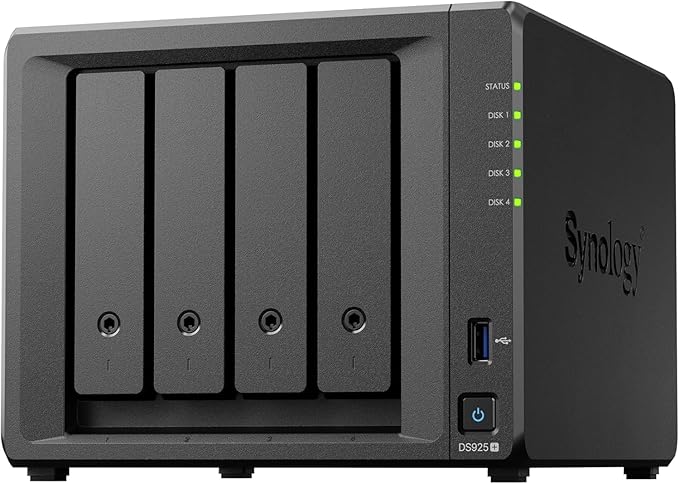
| CPU | AMD Ryzen R1600 or equivalent quad-core |
|---|---|
| RAM | 4GB DDR4 ECC (expandable) |
| Bays | 4 x 3.5"/2.5" |
| Network | 1x 2.5GbE + 1x 1GbE |
| AU Price (Mwave) | $1,029 |
| AU Price (Scorptec) | $995 |
Comparison: 4K Streaming NAS Options
4K Streaming NAS Comparison. Australia 2026
|
Synology DS425+
|
QNAP TS-264
|
QNAP TS-464
|
Asustor AS5404T
|
Synology DS925+
|
|
|---|---|---|---|---|---|
| AU Price (from) | $819 | $819 | $989 (Scorptec) | $879 (Mwave) | $995 |
| CPU | Intel J4125 | Intel N5095 | Intel N5095 | Intel N5105 | AMD Ryzen |
| Bays | 4 | 2 | 4 | 4 | 4 |
| 2.5GbE | Yes (1 port) | Yes (2 ports) | Yes (2 ports) | Yes (2 ports) | Yes (1 port) |
| Quick Sync HW Accel | Yes (limited) | Yes (strong) | Yes (strong) | Yes (strong) | No |
| 4K Direct Play | Excellent | Excellent | Excellent | Excellent | Excellent |
| 4K Transcode (1 stream) | Marginal | Yes | Yes | Yes | No |
| RAM (stock) | 2GB | 8GB | 8GB | 4GB | 4GB ECC |
Prices last verified: 10 March 2026. Always check retailer before purchasing.
Network Requirements for 4K Streaming
A single 4K HDR stream peaks at around 80 Mbps. Gigabit Ethernet to the NAS (and to wired client devices) is sufficient for up to ten simultaneous 4K streams in theory. Though in practice, a household with five or more concurrent 4K viewers will benefit from 2.5GbE at the NAS level to avoid contention with other network traffic.
Wi-Fi is the weak point. Even Wi-Fi 6 can sustain 4K reliably to a single device in close proximity to the access point, but 4K through walls or at distance becomes unreliable. For a dedicated home theatre setup, a wired Ethernet run to the TV or streaming stick is the single most impactful upgrade for reliable 4K playback.
Switch considerations: If the NAS has 2.5GbE, the switch it connects to also needs 2.5GbE ports. A standard gigabit switch will bottleneck a 2.5GbE NAS. Budget around $100-$200 for a multi-port 2.5GbE switch if upgrading the local network.
NBN and Remote 4K Streaming
Streaming 4K from a home NAS to a remote location. A holiday house, a relative's home, or a laptop on the road. Adds a significant constraint: the NBN upload speed on the home connection.
On a typical Australian NBN 100 plan, upload speed averages around 15-20 Mbps. Remote 4K direct play at 40-80 Mbps is impossible on this connection. The NAS must transcode the stream down to a bitrate the upload pipe can carry. Which circles back to the transcoding hardware discussion above. An Intel Quick Sync-capable NAS can transcode 4K to a lower-bitrate H.264 stream that fits within an NBN upload, but quality will be 1080p at best on most connections.
NBN Home Fast (NBN 250) and NBN Ultrafast plans provide upload speeds of 25 Mbps and 50 Mbps respectively. Still insufficient for raw 4K. Only dedicated business fibre connections (25/25, 100/100 symmetrical) provide enough upload bandwidth for remote 4K at full bitrate.
An additional consideration: many Australian NBN connections use CGNAT (Carrier-Grade NAT), which prevents direct incoming connections to the home network. This blocks remote NAS access unless a VPN or a service like Plex's relay feature is used. Plex Relay routes traffic through Plex servers but limits bitrate. Tailscale or WireGuard VPN are better solutions for reliable remote playback. But they require the NAS or a device on the home network to act as a VPN server. For a detailed guide on NBN remote access, see the Transfer Speed Estimator and the NTKIT remote access guide.
Remote 4K streaming reality: On most Australian NBN plans, remote 4K streaming from a home NAS is not viable at full bitrate. The NAS must transcode to fit the upload pipe. Which requires Quick Sync hardware acceleration. Plan for 1080p quality on remote connections unless operating on a Business-grade fibre plan with symmetrical upload speeds above 40 Mbps.
Don't Buy These for 4K Transcoding
Several popular NAS models are frequently recommended for home use but are unsuitable for 4K transcoding. The need to know IT team flags these specifically because they represent common buying mistakes:
- Synology DS423 ($635, Scorptec) / DS223 (~$628, Scorptec): Realtek RTD1619B ARM processor. No Quick Sync, no hardware acceleration for transcoding. 4K direct play is fine; 4K transcode is not possible.
- QNAP TS-433 ($699, PLE) / TS-233 (~$639, PLE): ARM-based. Same situation. Excellent for direct play, no transcoding capability.
- Synology DS223J (~$399, Scorptec): Realtek quad-core, 1GB RAM. Barely adequate for even 1080p transcoding. Not suitable for a 4K streaming setup of any kind.
- TerraMaster F2-425 ($459, Scorptec): Intel N5095 inside, which does support Quick Sync. However, TerraMaster's TOS software has limited Plex and Jellyfin hardware acceleration support compared to QNAP and Asustor. Software reliability is also less proven for media server workloads.
If 4K transcoding is a genuine requirement, stick to models explicitly confirmed to work: QNAP TS-264, TS-464, TS-473A, and the Asustor Nimbustor 4 Gen2 AS5404T and Lockerstor 2 AS6702T are the clearest options at accessible AU price points.
Network, Storage, and Software Setup Tips
Getting the best 4K streaming performance from a NAS involves more than picking the right model. A few practical notes:
- RAM matters for Plex: Plex Server benefits from RAM, particularly for the database and transcoder buffers. If buying a NAS with 2GB stock RAM (such as the DS425+), upgrading to 4-6GB is worthwhile for a busy Plex server. QNAP models with 8GB stock have enough for most home setups.
- SSD caching improves library speed: NAS models with M.2 slots (TS-264, TS-464, AS5404T) can use NVMe SSDs as read/write cache. For Plex, caching the metadata and database directories on SSD dramatically speeds up library loading and thumbnail generation.
- Direct connect or wired-to-TV: A 4K TV with Plex or Jellyfin app and a wired Ethernet connection will almost always direct play HEVC, eliminating the transcoding requirement entirely. The Plex app on Samsung TIZEN and LG webOS TVs handles 4K HEVC direct play reliably. Apple TV 4K is the gold standard client for direct play compatibility.
- Container format matters: MKV files are broadly supported for direct play. MP4/M4V containers are safer for older or less capable clients. If building a library from scratch, standardise on MKV for maximum flexibility.
Buying from Australian Retailers
All prices in this guide are sourced from current AU retail scrapes (March 2026) at Mwave, Scorptec, and PLE Computers. These three retailers represent the most reliable combination of stock depth and pre-sales knowledge for NAS buyers in Australia.
Most consumer NAS models (2-4 bay) are held in stock and ship within 1-2 business days. The QNAP TS-473A and similar business-class models are often listed as available but may have a 2-3 day fulfilment delay through distributor dropship even when showing as in-stock online.
Australian NAS pricing currently runs approximately 10-20% above US list prices, driven by lower stock allocations and higher freight costs. There is limited value in grey importing given the warranty implications. In Australia, your warranty claim is made against the retailer, not the manufacturer, and warranty resolution typically takes 2-3 weeks through the distributor chain. For a device storing your media library, buying locally from a known specialist is the practical choice.
Australian Consumer Law: Australian Consumer Law protections apply when purchasing NAS devices from Australian authorised retailers. In Australia, your warranty claim is against the place of purchase, not the manufacturer. Synology, QNAP, and Asustor do not have service centres in Australia. All warranty resolution flows through the retailer and their distributor. For official guidance on your consumer rights, visit accc.gov.au.
Related reading: our NAS buyer's guide.
Use our free Plex Media Planner to check if your NAS can handle your library.
Related reading: our Synology vs QNAP comparison.
Can any NAS transcode 4K video?
Most consumer NAS devices cannot transcode 4K in real time using software alone. The CPU workload is too high. The exception is NAS units with Intel Quick Sync hardware acceleration: the QNAP TS-264, TS-464, and Asustor AS5404T all include Intel Celeron N5095 or N5105 CPUs with Quick Sync support. These can handle one or two simultaneous 4K transcode streams when configured correctly in Plex (with Plex Pass) or Jellyfin. ARM-based NAS devices (Synology DS423, DS223, QNAP TS-433) and AMD Ryzen NAS devices (Synology DS925+, DS725+) cannot transcode 4K reliably because they lack Intel Quick Sync.
What bitrate does 4K HDR streaming require?
4K HDR content typically runs between 40 Mbps and 80 Mbps per stream, with high-quality Blu-ray remuxes sometimes exceeding 100 Mbps. SDR 4K content is usually 20-50 Mbps. A standard gigabit Ethernet connection handles multiple simultaneous 4K streams without issue. The limitation is usually the client device (Wi-Fi instability, format incompatibility) or the NAS CPU (if transcoding is required), not the network bandwidth itself. Provided clients are wired or on strong Wi-Fi.
Is Plex or Jellyfin better for 4K on a NAS?
Both Plex and Jellyfin support 4K direct play and hardware-accelerated transcoding on compatible NAS hardware. Plex has a more polished interface and broader client app support, but requires Plex Pass for hardware transcoding and some client features (around $9/month or $179 lifetime). Jellyfin is completely free and open-source with no subscription, but requires more technical setup for hardware acceleration. For most households, Plex is easier to configure and maintain. For technically confident users who want zero ongoing costs, Jellyfin on a Quick Sync NAS is a viable and cost-effective alternative.
Can I stream 4K from my NAS over the internet to a remote location?
Remote 4K streaming from a home NAS is limited by NBN upload speeds. A typical Australian NBN 100 plan provides around 15-20 Mbps upload. Insufficient for 4K direct play at 40-80 Mbps. The NAS must transcode the stream to a lower bitrate, requiring Intel Quick Sync hardware. Even then, quality tops out around 1080p at 15-20 Mbps on a standard NBN plan. A further complication: many Australian NBN connections use CGNAT (Carrier-Grade NAT), blocking direct incoming connections. Plex Relay or a VPN solution (Tailscale or WireGuard) is required to reach the NAS remotely on a CGNAT connection. Reliable remote 4K requires a Business-grade symmetrical connection with upload speeds above 40 Mbps.
Do I need a 2.5GbE NAS for 4K streaming?
Gigabit Ethernet is sufficient for up to around ten simultaneous 4K direct play streams. Far more than most households will ever need. 2.5GbE becomes relevant when combining heavy 4K streaming with simultaneous write workloads (backups, large file transfers) or when planning for five or more concurrent streams alongside other network-intensive tasks. NAS models with 2.5GbE built in. The QNAP TS-264, TS-464, Synology DS225+, DS425+, and Asustor AS5404T. Are all good choices, but note that the switch they connect to must also support 2.5GbE to realise the benefit.
How much RAM does a Plex NAS need for 4K?
For 4K direct play only, 2GB RAM is functional but tight for Plex Server. Library scanning and metadata operations are sluggish at 2GB. Upgrading to 4-6GB significantly improves the Plex experience. For a NAS handling one or two 4K transcode streams, 8GB RAM is the practical minimum to keep the Plex transcoder, database, and operating system running smoothly. The QNAP TS-264 and TS-464 ship with 8GB stock, making them immediately ready for transcoding workloads. The Synology DS425+ ships with 2GB and benefits from a RAM upgrade for Plex use.
Need to size storage for your 4K media library? The NTKIT NAS Sizing Wizard walks through drives, RAID, and capacity planning for media server builds.
Open the NAS Sizing Wizard