The NAS for 4K and 8K video editing isn't measured by drive count. It's measured by sustained read throughput, and most 2-bay NAS units connected via Gigabit Ethernet will bottleneck your editing workflow before your CPU does. 4K ProRes 422 HQ requires around 875 Mbps (110 MB/s) per stream. A single GbE connection maxes out at ~120 MB/s real-world, which means one editor cutting 4K ProRes over Gigabit is at the ceiling. 8K ProRes RAW requires 2,600 Mbps (325 MB/s) per stream. A Gigabit connection can't handle it at all. For professional video work, the NAS selection starts with the network, not the enclosure.
In short: For solo 4K editing over GbE, the DS225+ or DS423 with SSD cache works but is marginal. For reliable 4K or any 8K editing, you need 10GbE and a capable NAS. The DS725+, DS925+, or QNAP TS-464 with a 10GbE card are the practical entry points in Australia. For multi-editor shared storage, move up to a DS1525+ or rack-mount unit. Budget AU $1,000-2,500 for the NAS; add 10GbE adapters for both the NAS and your editing workstation.
Understanding the Throughput Requirements
Before picking a NAS, establish your actual bandwidth requirements based on the codec you shoot:
Video Codec Bandwidth Requirements
| 4K H.264 (consumer) | 4K H.265/HEVC | 4K ProRes 422 HQ | 4K ProRes RAW | 8K ProRes RAW | |
|---|---|---|---|---|---|
| Bitrate per stream | ~100 Mbps | ~80 Mbps | 875 Mbps | ~1,400 Mbps | ~2,600 Mbps |
| MB/s per stream | ~12 MB/s | ~10 MB/s | ~110 MB/s | ~175 MB/s | ~325 MB/s |
| Works on 1GbE? | Yes | Yes | Marginal | No | No |
| Requires 10GbE? | No | No | Recommended | Yes | Yes |
H.264 and H.265 from mirrorless cameras or drones are well within 1GbE range. A basic NAS handles these fine. ProRes is the format that creates the real constraint. If you're shooting Blackmagic RAW, RED RAW, or ARRI ProRes, 10GbE is not optional; it's the minimum for real-time playback from NAS. BRAW at its most demanding settings (~2,400 Mbps) has the same requirements as 8K ProRes RAW.
The Network First: 10GbE is the Starting Point
For 4K ProRes and above, your setup needs 10GbE end-to-end. NAS, switch (or direct connection), and editing workstation. On a Mac, Thunderbolt 3/4 to 10GbE adapters are available from OWC, Akitio, and others for $200-350 AUD. Most editing PC builds need a 10GbE NIC. Options from Asus, QNAP, and Synology run $180-500 depending on port count and form factor.
A direct 10GbE connection (DAC cable between NAS and workstation, no switch) is the simplest and cheapest option for a single-editor setup. A 10GbE DAC cable costs ~$30 and eliminates the need for a 10GbE switch (which starts at ~$400 for managed 10GbE). For multi-editor shared storage, a 10GbE switch becomes necessary. Budget $600-1,200 for a capable 8-port 10GbE managed switch (Netgear MS310, Zyxel XGS1010-12).
Best NAS Options for 4K and 8K Editing in Australia
NAS Models for Video Editing (AU Pricing)
 DS725+
|
 DS925+
|
 QNAP TS-464
|
 DS1525+
|
QNAP TS-873A | |
|---|---|---|---|---|---|
| AU Price (diskless) | $869 | $995 (Scorptec) | $989 (Scorptec) | $1,285 | $2,135 (Scorptec) |
| CPU | AMD Ryzen R1600 | Quad-core | Intel Celeron N5105 | AMD Ryzen V1500B | AMD Ryzen V1500B |
| RAM | 4GB (to 32GB) | 4GB (to 32GB) | 4GB (to 16GB) | 8GB (to 32GB) | 8GB (to 64GB) |
| 10GbE (built-in) | No. Add card | No. Add card | No. Add card | No. Add card | Yes (2× 2.5GbE base) |
| PCIe expansion | Yes (×2) | Yes (×2) | Yes (×2) | Yes (×2) | Yes (×2) |
| Drive bays | 2 × 3.5" + 2 M.2 | 4 × 3.5" + 2 M.2 | 4 × 3.5" + 2 M.2 | 5 × 3.5" + 2 M.2 | 8 × 3.5" + 2 M.2 |
| Best for | Solo 4K editor (1 stream) | Solo 4K/light 8K editor | 4K editor, tight budget | Multi-editor 4K shared | Multi-editor 4K-8K shared |
Prices last verified: 17 March 2026. Always check retailer before purchasing.
Synology DS725+. Solo Editor Entry Point
The DS725+ ($869 at Mwave) is Synology's 2-bay Ryzen R1600 model with two M.2 NVMe slots and PCIe expansion for a 10GbE card. The Ryzen CPU is a meaningful step up from Celeron for sustained I/O. It handles SSD caching operations and multiple concurrent processes without the Celeron's performance ceiling.
With a Synology E10G30-T2 10GbE card ($430) added, the DS725+ can sustain 900+ MB/s sequential reads from SSD cache or a fast HDD RAID. Well above 4K ProRes requirements. The limitation is the 2-bay chassis: 2× 8TB WD Red Plus drives give 8TB usable in RAID 1, which is modest for a high-volume video workflow. Pairing with an external DX517 expansion unit ($865) extends to 7 bays total, though that's a significant additional investment.
The DS725+ suits: A single 4K editor working in ProRes 422 or ProRes 422 HQ, with up to 8-16TB of project storage, who wants a Synology ecosystem (Photos, Drive, Active Backup) alongside editing storage.
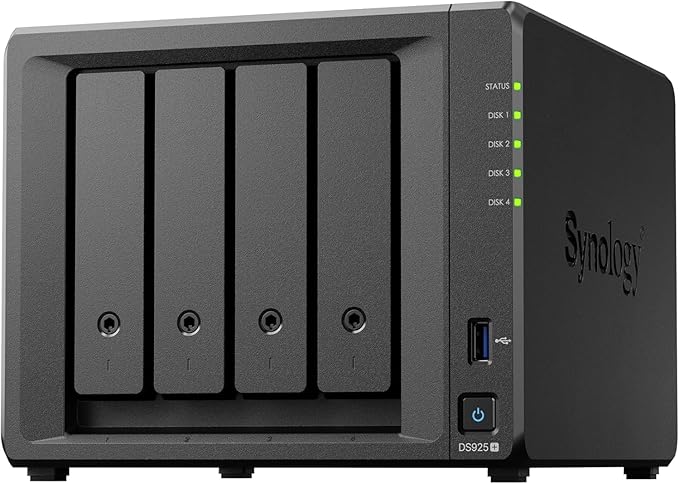
Synology DS925+. The Practical 4K Editing NAS
The DS925+ ($1,029 at Mwave) adds two more drive bays and a quad-core processor. With 4× 8TB WD Red Plus, that's 24TB usable in SHR (or 16TB in RAID 5). Enough for a realistic multi-project video library. Add a 10GbE card and two M.2 NVMe SSDs as an SSD read cache, and the DS925+ sustains sequential reads well above the 4K ProRes 422 HQ threshold.
The M.2 NVMe read cache is the key trick: active project files on cache deliver near-SSD speeds (~900-1,000 MB/s) to the 10GbE connected workstation. Completed projects tier down to the spinning drives for archival. Synology's tiered SSD cache handles the hot/cold split automatically with minimal configuration.
The DS925+ suits: A solo or light dual-editor setup in 4K ProRes, with up to 24-32TB of spinning storage plus SSD cache for active projects. The most cost-effective Synology option for serious video work below the SMB tier.
Synology DS1525+. Multi-Editor Shared Storage
The DS1525+ ($1,285 at Mwave) is Synology's 5-bay AMD Ryzen V1500B model with 8GB ECC RAM. The first consumer-tier Synology that's credibly positioned for shared editing storage serving multiple concurrent users. With a 10GbE card and 5× 16TB WD Red Pro drives (~$650 each from Mwave), you get ~48TB usable in SHR-2 plus adequate CPU/RAM to serve 2-4 concurrent 4K editors without noticeable contention.
For post-production houses sharing footage across a facility, the DS1525+ is the starting point. The Ryzen V1500B handles simultaneous SMB connections, background indexing, and Hyper Backup offsite backup without the CPU bottleneck that plagues Celeron-based units under multi-user load.
The DS1525+ suits: 2-4 editors sharing a common 4K project library, with the NAS as a central production server and individual workstations editing directly from shared volumes.
QNAP Options for Video Editing
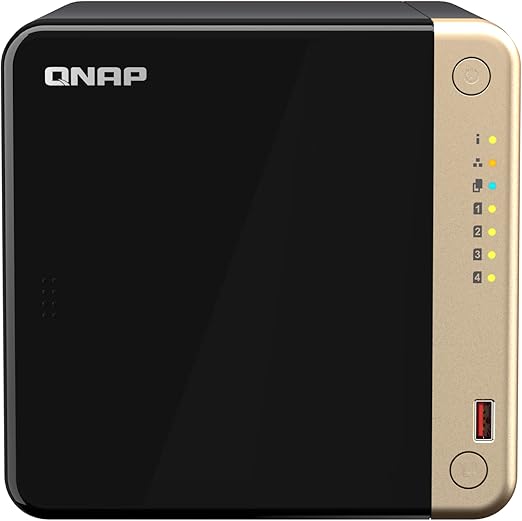
QNAP's strength in the editing space is more aggressive 10GbE integration. Models like the TS-464 (approximately $1,000 locally) include a Celeron N5105 with 4 drive bays and PCIe for network expansion. The QNAP TVS-h674 (Xeon-based, ~$3,000+) is a prosumer editing workhorse with 10GbE built-in and HDMI output for direct monitoring. Though at that price point it's competing with Synology's rackmount units.
QNAP's QTS operating system has more granular RAID management options than DSM and supports QNAP's own SSD caching tiers (Qtier) more aggressively. For users already embedded in the QNAP ecosystem or who need the TS-h series' ZFS-based QTS Hero OS, QNAP is a viable alternative to Synology at similar price points.
The trade-off: QNAP's interface is more complex, and some QNAP models have had security issues requiring prompt firmware updates. If you want a set-and-forget editing NAS, Synology's DSM is generally more polished for that use case.
UGREEN NASync for 4K Editing
UGREEN's DX4600 Pro and DX4800 Plus NAS units include 2.5GbE built-in and support M.2 NVMe drives. Making them competitive for H.264/H.265 4K work without a 10GbE investment. At ~$550-700 for the DX4600 Pro, they undercut Synology on price for comparable RAID and connectivity.
The limitation for serious ProRes editing is the 2.5GbE ceiling (~280 MB/s) and a less mature software ecosystem compared to DSM. For YouTube creators or documentary filmmakers shooting H.265 4K who want affordable shared storage, UGREEN is worth evaluating. For ProRes-heavy production, the 2.5GbE limit means UGREEN is sufficient for project delivery and backup but not real-time ProRes 422 HQ streaming. See the UGREEN NAS Australia guide for model details and AU pricing.
Storage Sizing for Video Workflows
Video data grows faster than most users plan for. A conservative rule: budget 1TB per hour of raw 4K ProRes 422 HQ footage. A two-week documentary shoot generating 40 hours of raw footage needs 40TB of project storage before proxies, exports, or archives. 8K ProRes RAW at 3+ TB/hour demands even more aggressive storage planning.
For a practical NAS workflow:
- Working storage (NAS spinning drives): Active projects for current and previous quarter. Typically 16-32TB
- SSD cache tier: 2× M.2 NVMe for hot files (current edit project). 1-2TB NVMe SSDs (~$150-300 each at local retailers)
- Archive storage: Completed projects move to LTO tape (if at scale) or a second NAS on slower/cheaper drives. The 3-2-1 backup guide covers archival strategies
Related reading: our NAS buyer's guide.
Use our free Transfer Speed Estimator to estimate how long large transfers will take over your connection.
Do I need 10GbE for 4K video editing from a NAS?
It depends on the codec. 4K H.264 and H.265 at typical camera bitrates (50-200 Mbps) work fine over 1GbE. 4K ProRes 422 (not HQ) is marginal on 1GbE. Playback works but scrubbing and rendering may stutter. 4K ProRes 422 HQ, ProRes RAW, and Blackmagic RAW all require 10GbE for real-time editing. 8K in any professional codec needs 10GbE as a baseline. If you're working in a compressed delivery codec, 1GbE is likely enough. If you're cutting in the original camera master files (common in professional workflows), check the bitrate and size accordingly.
How many editors can share a NAS for 4K editing simultaneously?
With a 10GbE NAS and a 10GbE switch, the practical limit is the NAS's total throughput divided by per-stream requirements. A DS925+ with SSD cache saturating a 10GbE connection at ~900 MB/s can serve approximately 4 simultaneous 4K ProRes 422 HQ streams (each requiring ~110 MB/s), leaving headroom for scrubbing overhead. A DS1525+ at similar speeds handles similar concurrent loads with more predictable performance under sustained multi-user access. For 4+ simultaneous editors, move to a DS1823xs+ or a dedicated storage platform.
Is SSD cache worth it for video editing?
Yes, significantly so. SSD read cache (two M.2 NVMe drives in a read-only cache pool) keeps the active edit project's files in SSD-speed cache, delivering near-SSD throughput to the editing workstation while the bulk of the library sits on spinning drives. Cache hits are served at 900+ MB/s; cache misses fall back to the HDD pool (~200-400 MB/s in RAID). For a single editor on one active project, the active files almost entirely fit in a 1-2TB SSD cache, effectively eliminating HDD seek latency during editing. The DS725+, DS925+, and DS1525+ all have two M.2 slots for SSD cache. It's one of the best value upgrades you can make to a video editing NAS.
Should I use Thunderbolt instead of 10GbE for NAS-to-workstation connections?
Thunderbolt direct-attach (TB3/TB4 to NAS) is only available on a small number of NAS models (some QNAP units). It provides 40Gbps bandwidth. Theoretically much faster than 10GbE. But requires the NAS and workstation to be physically close and limits NAS connectivity to one workstation at a time without a Thunderbolt switch (which is expensive). For a single-editor workflow where the NAS is at the desk, Thunderbolt is a strong option. For shared storage serving multiple workstations, 10GbE over a switch is more practical and scalable.
Can I edit directly from the NAS or should I copy files to a local drive first?
With adequate network throughput (10GbE and the right NAS), editing directly from NAS is viable and is the standard workflow in professional post-production environments. The advantage is no copy time. Open project files directly, save renders directly. The risk is network dependency: if the NAS goes offline or network performance degrades mid-render, you lose work. For mission-critical deadlines, some editors copy the current day's active project to a local SSD for the edit session and sync back to NAS at end of day. This hedges against network issues while retaining the NAS as the master library.
Running a multi-editor post-production setup? Read the shared NAS storage guide for video teams. Covers SMB vs NFS, user permissions, simultaneous access limits, and AU networking options for post-production workflows.
Multi-Editor Shared Storage Guide →