The Synology DS925+ is the best 4-bay NAS for Australian buyers who want expandable storage, upgradeable RAM, and headroom for Docker and AI workloads. At $995 from Scorptec. If your focus is Plex, file sharing, or light home automation, the DS425+ at $819 handles those tasks comfortably. It uses the same Intel Celeron as the DS225+ with hardware Quick Sync transcoding. Something the DS925+ actually lacks. Four-bay NAS devices now cover a wide range of prices and capabilities in Australia, from the~$980 Synology DS423 for basic file sharing through to the $1,099 TerraMaster F4-424 Pro for compute-heavy workloads. The right choice depends on what you actually need the NAS to do, how much you want to spend on drives, and whether you plan to grow your storage over time.
For a broader overview of this topic, see our NAS buying guide hub.
In short: The Synology DS925+ ($995 at Scorptec) suits most home and small business users who want reliable storage, excellent software, and room to grow. The Synology DS423 ($635 at Scorptec) is the best value 4-bay if you just need straightforward file storage without heavy apps. The QNAP TS-464-8G ($999 at Scorptec) is the pick for media streaming and Docker workloads thanks to 8GB RAM, HDMI output, and dual 2.5GbE. The Asustor AS5404T ($799 at Scorptec) is the strongest Plex option with HDMI and hardware transcoding at a competitive price.
Why a 4-Bay NAS?
A 4-bay NAS hits the sweet spot for most Australian households and small offices. Four drive bays give you enough capacity for meaningful storage (up to 96TB with current 24TB drives) while supporting proper RAID configurations like RAID 5 or SHR, which protect your data against a single drive failure without halving your usable space the way a 2-bay mirror does. Four bays also give you future flexibility: start with two drives and add more as your storage needs grow.
The cost of entry is higher than a 2-bay unit, but the per-terabyte economics improve significantly once you factor in RAID overhead. In a 2-bay NAS using RAID 1, you lose 50% of your raw capacity to redundancy. In a 4-bay NAS using RAID 5 or SHR, you only lose 25%. With NAS hard drive prices having risen through 2025 and into 2026, making the most of every drive bay matters more than ever. Distributors are securing stock allocations further forward than usual, and NAS-grade drives that sat comfortably under $160 in early 2025 are now consistently above $200 for 4TB models.
Best 4-Bay NAS Comparison Table
Here is how every recommended 4-bay NAS in this guide stacks up across the key specifications. All prices are current Australian retail pricing from major AU retailers as of February 2026. For a broader look at NAS options across all bay counts and budgets, see the full Best NAS Australia 2026 guide.
Best 4-Bay NAS Australia 2026. Comparison
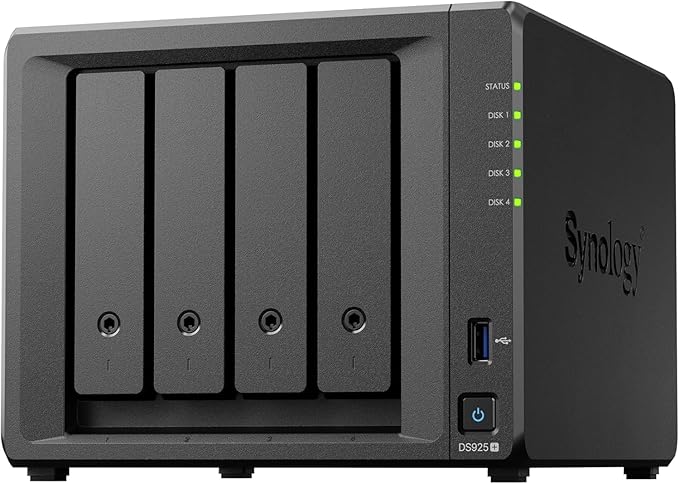 Synology DS925+
|
 Synology DS423
|
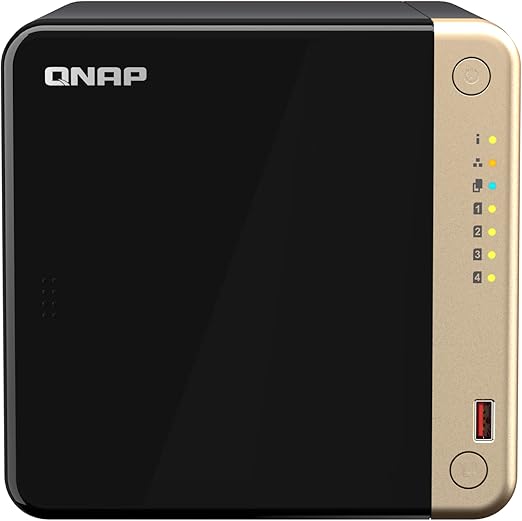 QNAP TS-464-8G
|
 Asustor AS5404T
|
 UGREEN DXP4800 Plus
|
 TerraMaster F4-424 Pro
|
|
|---|---|---|---|---|---|---|
| AU Price (from) | $995 | $635 | $989 (Scorptec) | $879 (Mwave) | ~$699 | $760 (Mwave) |
| CPU | AMD Ryzen R1600 (4-core) | Realtek RTD1619B (4-core) | Intel Celeron N5095 (4-core) | Intel Celeron N5105 (4-core) | Intel N100 (4-core) | Intel Core i3-N305 (8-core) |
| RAM | 4GB DDR4 (expandable) | 2GB DDR4 | 8GB DDR4 (expandable) | 4GB DDR4 | 8GB DDR5 | 32GB DDR5 |
| Drive Bays | 4x 3.5"/2.5" | 4x 3.5"/2.5" | 4x 3.5"/2.5" | 4x 3.5"/2.5" | 4x 3.5"/2.5" | 4x 3.5"/2.5" |
| Networking | 2x 1GbE + 1x 2.5GbE | 2x 1GbE | 2x 2.5GbE | 1x 2.5GbE | 2x 2.5GbE | 2x 2.5GbE |
| NVMe Slots | 2x M.2 NVMe | None | 2x M.2 NVMe | 4x M.2 NVMe | 2x M.2 NVMe | 2x M.2 NVMe |
| HDMI Output | No | No | Yes (4K) | Yes (4K) | No | No |
| Best For | All-round / business | Budget file sharing | Media / Docker | Plex / media | Value Intel N100 | Raw performance |
Prices last verified: 10 March 2026. Always check retailer before purchasing.
Synology DS925+. Best Overall 4-Bay NAS
The Synology DS925+ is the successor to the DS925+, one of the most popular NAS devices ever sold in Australia. It takes everything that made the DS925+ a safe recommendation and improves where it mattered most: the AMD Ryzen R1600 processor brings noticeably better multi-threaded performance, and the addition of a native 2.5GbE port alongside the two 1GbE ports means faster network transfers without needing a network upgrade beyond a basic 2.5GbE switch. For a detailed breakdown, see the full Synology DS925+ review.
DSM 7 remains the gold standard for NAS operating systems. It is polished, stable, and has a mature ecosystem of first-party packages: Synology Drive for file sync, Synology Photos for photo management, Hyper Backup for automated backups, and Surveillance Station for camera recording. For small business deployments, Active Backup for Business provides free agent-based backup for Windows PCs and servers. No other NAS vendor matches Synology's software depth without requiring third-party apps or Docker knowledge.
The DS925+ is available from Scorptec at $995 and Mwave at $1,029. Pricing across Australian retailers is fairly uniform for Synology products, as most operate on 3-5% NAS margin. The meaningful differences between retailers are stock depth, pre-sales knowledge, and post-sales support. If you are a first-time NAS buyer, purchasing from a specialist like Scorptec or PLE where you can get genuine guidance is worth any small price premium over Amazon. For a full rundown of the Synology NAS range in Australia, see the dedicated guide.
| CPU | AMD Ryzen R1600, 4-core / 8-thread |
|---|---|
| RAM | 4GB DDR4 ECC (expandable to 32GB) |
| Drive Bays | 4x 3.5"/2.5" SATA (expandable to 9 with DX525) |
| NVMe Slots | 2x M.2 2280 NVMe (SSD cache or storage pool) |
| Networking | 2x 1GbE + 1x 2.5GbE RJ45 |
| USB | 2x USB 3.2 Gen 1 |
| Operating System | Synology DSM 7 |
| Warranty | 3 years (extendable to 5) |
| AU Price (Scorptec) | $995 |
| AU Price (Mwave) | $1,029 |
Pros
- Best-in-class DSM 7 software with mature first-party apps
- AMD Ryzen R1600 provides strong performance for multitasking and Docker
- Native 2.5GbE port. No adapter needed for faster transfers
- ECC RAM support protects data integrity
- Expandable to 9 bays with DX525 expansion unit
- Two M.2 NVMe slots for SSD cache or storage pools
- Excellent Australian support chain via BlueChip and MMT distributors
Cons
- No HDMI output. Not suitable for direct-to-TV media playback
- 4GB base RAM is tight for heavy Docker workloads (upgrade recommended)
- Higher price than competing x86 4-bay units from Asustor and QNAP
- Synology locks some features to their own branded drives (storage pool warnings)
Synology DS423. Best Value 4-Bay NAS
The Synology DS423 is the budget entry into Synology's 4-bay range. It uses an ARM-based Realtek RTD1619B processor rather than the x86 chips found in the Plus series, which means it won't run Docker containers or handle heavy virtualisation workloads. What it will do, and do well, is serve files, run Synology Drive for file sync, handle Synology Photos, and manage automated backups via Hyper Backup. For households and small offices that need reliable shared storage without the overhead of running apps, the DS423 at $635 from Scorptec is genuinely hard to beat.
The trade-off is clear: you save roughly $360 compared to the DS925+, but you lose Docker support, NVMe cache slots, and 2.5GbE networking. The two 1GbE ports can be link-aggregated for some throughput improvement, but in practice most home users won't notice the difference for standard file transfers and media streaming. On a typical Australian NBN connection with around 56Mbps upload on an NBN 100 plan, the 1GbE networking is more than adequate for remote access and cloud sync tasks. Where the DS423 falls short is local transfers of large files across a fast LAN. If you regularly move video production files or large datasets, the DS925+ or a unit with 2.5GbE is a better fit.
| CPU | Realtek RTD1619B, 4-core ARM |
|---|---|
| RAM | 2GB DDR4 (not expandable) |
| Drive Bays | 4x 3.5"/2.5" SATA |
| NVMe Slots | None |
| Networking | 2x 1GbE RJ45 |
| USB | 2x USB 3.2 Gen 1 |
| Operating System | Synology DSM 7 |
| Warranty | 2 years |
| AU Price (Scorptec) | $635 |
| AU Price (Mwave) | $699 |
Pros
- Lowest-cost 4-bay NAS with Synology DSM 7 software
- Runs all core Synology apps: Drive, Photos, Hyper Backup
- Very low power consumption. Ideal for 24/7 operation
- Simple setup suitable for first-time NAS users
- Quiet fan design with minimal noise
Cons
- ARM processor. No Docker or Container Manager support
- Only 2GB non-expandable RAM limits multitasking
- No NVMe SSD cache slots
- 1GbE networking only. Slower local transfers than 2.5GbE models
- No Plex transcoding capability
QNAP TS-464-8G. Best for Media and Docker
The QNAP TS-464-8G packs more hardware per dollar than any other 4-bay NAS in this guide. Dual 2.5GbE ports, 8GB of RAM out of the box, an Intel Celeron N5095 quad-core processor, HDMI 2.0 output, and two M.2 NVMe slots. All for $999 at Scorptec or $1,099 at PLE. For buyers who want to run Docker containers, virtual machines, media servers, and home automation alongside their file storage, the TS-464 has the hardware headroom to handle it. For a broader look at the QNAP NAS range in Australia, see the dedicated guide.
QNAP's operating system, QTS, is feature-rich but takes more time to learn than Synology's DSM. The app ecosystem is broad. QNAP's Container Station makes Docker accessible, and the built-in virtualisation support lets you run full Windows or Linux VMs directly on the NAS. The HDMI output allows direct media playback to a TV using QNAP's HD Station or Plex, which makes the TS-464 a capable lounge-room media server without needing a separate streaming device.
The TS-464's main limitation is QTS software polish. QTS has improved significantly in recent years, but it still has more rough edges than DSM. Particularly around mobile apps, notification management, and the initial setup experience. QNAP also has a history of more frequent security advisories than Synology, which means keeping the firmware updated promptly is essential. If you are comfortable with a slightly steeper learning curve and proactive about updates, the TS-464 delivers outstanding value for what you get hardware-wise.
| CPU | Intel Celeron N5095, 4-core up to 2.9GHz |
|---|---|
| RAM | 8GB DDR4 (expandable to 16GB) |
| Drive Bays | 4x 3.5"/2.5" SATA |
| NVMe Slots | 2x M.2 2280 NVMe (PCIe Gen 3) |
| Networking | 2x 2.5GbE RJ45 |
| HDMI Output | 1x HDMI 2.0 (4K @ 60Hz) |
| USB | 2x USB 3.2 Gen 2, 1x USB 2.0 |
| Operating System | QNAP QTS 5 |
| Warranty | 2 years (extendable) |
| AU Price (Scorptec) | $999 |
| AU Price (PLE) | $1,099 |
Pros
- Dual 2.5GbE networking included. Best connectivity at this price
- 8GB RAM out of the box. Excellent for Docker and VMs
- HDMI 2.0 output for direct media playback to a TV
- Intel Celeron N5095 handles Plex transcoding well
- Two M.2 NVMe slots for SSD cache or tiered storage
- Container Station and virtualisation support built in
Cons
- QTS has a steeper learning curve than Synology DSM
- QNAP has had more security advisories historically. Firmware updates are essential
- Mobile apps are less polished than Synology's
- Fan noise is noticeable under sustained load
- Higher power consumption than ARM-based alternatives
Asustor AS5404T. Best for Plex
The Asustor AS5404T (Nimbustor 4 Gen2) is the strongest dedicated Plex NAS in the 4-bay segment. It features an Intel Celeron N5105 processor with Intel UHD Graphics that handles hardware-accelerated Plex transcoding for multiple simultaneous streams, an HDMI 2.1 port for direct 4K output to a TV, and 2.5GbE networking. At $799 from Scorptec and PLE, it undercuts the QNAP TS-464 while offering comparable media performance. For more on Asustor NAS devices in Australia, see the brand guide.
Asustor's ADM (Asustor Data Master) operating system is simpler than both DSM and QTS, which works in its favour for media-focused users who don't need enterprise features. The Portainer-based Docker management is straightforward, and Asustor's Looksgood media player app provides a decent built-in media experience alongside Plex. The four M.2 NVMe slots are unusual at this price point. They allow SSD caching or even all-flash storage pools for users who want to push performance further.
The trade-off with Asustor is ecosystem maturity. ADM's first-party app selection is thinner than Synology's, and the backup ecosystem is less comprehensive. Asustor's Australian distribution is now handled exclusively by Dicker Data, which is a positive sign for local stock availability and support, but the brand still has a smaller install base in Australia than Synology or QNAP. If your primary use case is media streaming and you don't need Synology's deep first-party app ecosystem, the AS5404T offers excellent value.
| CPU | Intel Celeron N5105, 4-core up to 2.0GHz |
|---|---|
| RAM | 4GB DDR4 (expandable to 16GB) |
| Drive Bays | 4x 3.5"/2.5" SATA |
| NVMe Slots | 4x M.2 2280 NVMe |
| Networking | 1x 2.5GbE RJ45 |
| HDMI Output | 1x HDMI 2.1 (4K @ 60Hz) |
| USB | 3x USB 3.2 Gen 1, 1x USB-C 3.2 Gen 1 |
| Operating System | Asustor ADM 4 |
| Warranty | 3 years |
| AU Price (Scorptec) | $799 |
| AU Price (Mwave) | $879 |
Pros
- Excellent Plex transcoding performance with Intel Quick Sync
- HDMI 2.1 output for direct media playback
- Four M.2 NVMe slots. Unusual at this price point
- 2.5GbE networking included
- Competitive pricing against QNAP and Synology equivalents
- Gamer-inspired design with striking aesthetic
Cons
- Only single 2.5GbE port (no link aggregation at 2.5G speed)
- ADM first-party app ecosystem is thinner than Synology DSM
- Smaller Australian community and knowledge base
- 4GB base RAM. Upgrade recommended for Docker workloads
- Backup app ecosystem less mature than Synology Hyper Backup
UGREEN DXP4800 Plus. Best Newcomer
UGREEN's entry into the NAS market is one of the most interesting developments in Australian storage in 2026. The DXP4800 Plus is a 4-bay NAS powered by an Intel N100 processor with 8GB of DDR5 RAM, dual 2.5GbE networking, and two M.2 NVMe slots. At an estimated $649-749 AUD (pricing varies as UGREEN does not yet have an official Australian distributor), it undercuts established players on hardware specifications alone. The Intel N100 is a capable modern processor that handles Plex transcoding, Docker containers, and general NAS duties with low power consumption.
UGREEN's NAS operating system, UGOS, is based on Linux and has improved rapidly since the product line launched. It supports Docker via Compose, has a clean web interface, and covers the basics: file sharing, media streaming, photo management, and backup. However, UGOS is not yet in the same league as DSM or QTS for reliability, polish, or breadth of features. It is a version-one product from a company that is best known for USB cables and chargers, not enterprise storage.
The critical consideration for Australian buyers is support and warranty. UGREEN doesn't yet have an official Australian distributor, which means warranty claims currently go through international channels. This is expected to change in 2026, but until then, factor in the support risk. Most stock is available through Amazon AU and select marketplace sellers. If you are technically confident, have a solid backup strategy, and don't mind being an early adopter, the DXP4800 Plus is a compelling hardware package. If you want a proven ecosystem and local support certainty, stick with Synology, QNAP, or Asustor.
UGREEN distributor note: UGREEN does not yet have an official Australian distributor. Warranty claims may need to go through international channels. Check the seller's return policy carefully before purchasing, and ensure you have a robust backup strategy in place. This situation is expected to improve through 2026 as UGREEN establishes formal AU distribution.

| CPU | Intel N100, 4-core up to 3.4GHz |
|---|---|
| RAM | 8GB DDR5 (not user-expandable) |
| Drive Bays | 4x 3.5"/2.5" SATA |
| NVMe Slots | 2x M.2 2280 NVMe |
| Networking | 2x 2.5GbE RJ45 |
| HDMI Output | No |
| USB | 2x USB 3.2, 1x USB-C |
| Operating System | UGREEN UGOS |
| Warranty | 2 years (varies by seller) |
| AU Price (approx) | $649-$749 (Amazon AU / marketplace) |
Pros
- Intel N100 processor is efficient and capable. Handles Plex and Docker well
- 8GB DDR5 RAM out of the box. More than most competitors at this price
- Dual 2.5GbE networking included
- Competitive pricing for the hardware specifications
- Clean, modern hardware design
- Docker support via Compose
Cons
- No official Australian distributor. Warranty support is uncertain
- UGOS is still maturing. Fewer features and less polish than DSM or QTS
- Limited first-party app ecosystem compared to established vendors
- RAM is not user-expandable
- No HDMI output for direct media playback
- UGREEN has no track record in the NAS market for long-term software support
TerraMaster F4-424 Pro. Budget Power Option
The TerraMaster F4-424 Pro is the raw hardware champion of this roundup. An Intel Core i3-N305 processor with 8 cores, 32GB of DDR5 RAM, dual 2.5GbE networking, and two M.2 NVMe slots. Specifications that rival a mid-range desktop PC. At $1,099 from Scorptec and $1,100 from Mwave, it is more expensive than the DS925+ or TS-464, but the hardware gap is significant. For users who want to run multiple Docker containers, virtual machines, or intensive applications like home automation platforms, surveillance systems, or development environments, the F4-424 Pro has the grunt to handle it.
TerraMaster's operating system, TOS, has improved over recent releases but remains the least mature software platform in this comparison. It covers the basics. File sharing, RAID management, Docker support. But lacks the depth and reliability of DSM or QTS. TerraMaster's Australian distribution is handled through DSTech with a limited presence in the AU market, which can affect stock availability and support response times. The F4-424 Pro suits technically experienced users who view the NAS primarily as a Linux server and plan to run most services through Docker rather than relying on the vendor's first-party apps.
Don't buy the F4-424 Pro if you want a polished, set-and-forget NAS experience. The software requires more hands-on management than Synology or QNAP, and TOS updates have historically been less predictable in their release cadence. However, if you are comfortable in a command line and want maximum hardware for your dollar, it is a legitimate option.
| CPU | Intel Core i3-N305, 8-core up to 3.8GHz |
|---|---|
| RAM | 32GB DDR5 (expandable) |
| Drive Bays | 4x 3.5"/2.5" SATA |
| NVMe Slots | 2x M.2 2280 NVMe |
| Networking | 2x 2.5GbE RJ45 |
| HDMI Output | No |
| USB | 2x USB 3.2 Gen 2, 1x USB-C |
| Operating System | TerraMaster TOS |
| Warranty | 2 years |
| AU Price (Scorptec) | $1,099 |
| AU Price (Mwave) | $1,100 |
Pros
- Intel Core i3-N305 8-core CPU. The most powerful processor in this roundup
- 32GB DDR5 RAM. Handles any home lab or Docker workload
- Dual 2.5GbE networking included
- Two M.2 NVMe slots for SSD cache or storage
- Exceptional value for the hardware specifications
- Docker and VM support
Cons
- TOS software is the least mature in this comparison
- Limited Australian distribution and support presence
- No HDMI output
- Community and knowledge base are significantly smaller than Synology or QNAP
- First-party app ecosystem is thin. Relies heavily on Docker for services
- Less predictable firmware update schedule
How to Choose: Which 4-Bay NAS Suits You?
Choosing between these six NAS devices comes down to three questions: what will you use it for, how much do you want to manage yourself, and how important is local support?
For most users: The choice comes down to workload. If you run Plex, a basic Docker stack (Home Assistant, Pi-hole), or use the NAS as a family file server. The DS425+ at $819 does the job. Its Intel Quick Sync handles 1-2 transcoded streams cleanly. If you need expandable storage via DX525, upgradeable ECC RAM, or AMD Ryzen performance for AI photo indexing and heavy container workloads. The DS925+ at $995 is worth the step up. DSM is the same on both. Synology’s Australian support chain through BlueChip and MMT distributors is the strongest in the country regardless of which model you choose.
For budget file storage: The Synology DS423 at $635 is the lowest-cost path into a reliable 4-bay NAS with proven software. Accept the ARM processor limitations (no Docker, no Plex transcoding) and enjoy the simplicity.
For media and tinkering: The QNAP TS-464-8G or Asustor AS5404T both excel here. The TS-464 has the edge on networking (dual 2.5GbE vs single) and RAM (8GB vs 4GB), while the AS5404T is cheaper and has four M.2 slots. Both have HDMI output for direct TV playback.
For maximum hardware value: The TerraMaster F4-424 Pro and UGREEN DXP4800 Plus offer the most raw hardware per dollar, but both come with software and support trade-offs that experienced users should be comfortable managing.
What Drives Should You Buy?
A 4-bay NAS is sold without drives. Budget for at least two NAS-rated drives to start (running in RAID 1 or SHR-1), with the option to add two more later. Popular choices for Australian buyers include Seagate IronWolf and WD Red Plus in 4TB to 16TB capacities. Avoid using desktop drives (WD Blue, Seagate Barracuda). They are not designed for the vibration, heat, and 24/7 operation environment of a multi-bay NAS. For a full breakdown of current pricing and recommendations, see the best NAS hard drive Australia guide.
HDD prices have risen significantly through 2025-2026, driven by NAND supply constraints, AI-related demand pulling resources from traditional storage, and global freight cost increases. Factor the total cost of drives into your NAS budget. A DS925+ at $995 plus four 8TB NAS drives at approximately$980-$1099 each puts the total system cost at roughly $2,400-2,600. A significant investment that underscores the importance of proper RAID configuration and offsite backup.
Networking Considerations for Australian Buyers
Every NAS in this guide except the DS423 includes at least one 2.5GbE network port. To take advantage of this, you need a 2.5GbE switch and a 2.5GbE adapter for your PC or laptop. Affordable 2.5GbE switches from QNAP and other vendors start around $150-300 in Australia. For most home users, the speed improvement from 1GbE (roughly 110MB/s real-world) to 2.5GbE (roughly 280MB/s) is noticeable when transferring large files. For a deeper dive into optimising your network for NAS, see the NAS networking guide.
For remote access over the internet, your NBN connection is the bottleneck, not the NAS. On a typical NBN 100 plan, upload speeds sit around 40-56Mbps (5-7MB/s), which is adequate for syncing documents and accessing photos remotely but slow for streaming high-bitrate 4K video. If your NBN connection uses CGNAT (Carrier-Grade NAT), remote access becomes more complicated. Services like Synology QuickConnect or QNAP myQNAPcloud can work around this, but direct VPN connections may not function without requesting a static IP from your ISP.
Where to Buy a 4-Bay NAS in Australia
Australian NAS pricing is remarkably uniform across the major retailers, because margins in this category sit at just 3-5%. The real difference between retailers is what happens when something goes wrong. For a product that stores your data, the retailer relationship matters when a drive fails or the unit needs warranty service. For a full breakdown of Australian NAS retailers and what to look for, see the where to buy NAS Australia guide.
Full-range specialists like Scorptec and PLE carry the widest NAS selections and can offer genuine pre-sales guidance. Mwave lists a broad range at competitive prices. Amazon AU has started holding NAS stock directly in 2026, often at prices 5-15% below local retailers. But their support model means you are on your own if a unit fails with your data inside. Amazon is a valid option for technically confident buyers who have strong backup strategies, but it is not recommended for first-time NAS buyers or business-critical deployments.
For business, education, and government purchases, always request a formal quote rather than buying at listed retail price. Resellers can request pricing support from distributors and vendors. Discounts that never appear on the website but are routinely available for quoted deals.
Australian Consumer Law note: When purchasing from an Australian retailer, ACL protections apply. Your warranty claim goes to the retailer, not the manufacturer. Synology, QNAP, and Asustor don't have service centres in Australia. The standard warranty process runs through the full chain: retailer to distributor to vendor in Taiwan, then back again. Expect 2-3 weeks minimum for a resolution. Before buying, ask your retailer: "If this fails, what's your process?" The answer tells you more about the value of buying from that retailer than the price on the sticker. For official consumer rights information, visit accc.gov.au.
Power Consumption: A Hidden Cost
A NAS runs 24/7, which means power consumption adds up over time. The ARM-based DS423 sips the least power at around 20-25W under load. The x86 models. DS925+, TS-464, AS5404T. Typically draw 30-45W depending on the number of drives spinning and the workload. The TerraMaster F4-424 Pro, with its 8-core i3 and 32GB of RAM, can draw 50-65W under sustained load. At current Australian electricity rates of roughly $0.30-0.35/kWh, the difference between a 25W and a 55W NAS running 24/7 works out to approximately $80-90 per year. Not a dealbreaker, but worth factoring into the total cost of ownership over the 5-7 year lifespan of a typical NAS.
Use our free NAS Sizing Wizard to get a personalised NAS recommendation.
Is a 4-bay NAS enough for a small business in Australia?
For most small businesses with 1-10 employees, a 4-bay NAS is more than sufficient. A Synology DS925+ or QNAP TS-464 with four 8TB drives in RAID 5 gives you roughly 24TB of usable space. Enough for years of documents, emails, and project files. If you anticipate rapid data growth or need to run multiple business applications simultaneously, consider stepping up to a 5-bay or larger unit. See the best NAS for small business guide for more detail.
Can I use a 4-bay NAS as a Plex server?
Yes, but you need an x86 processor for hardware-accelerated transcoding. The Asustor AS5404T and QNAP TS-464 are the best choices for Plex because they include Intel processors with Quick Sync (for transcoding) and HDMI output (for direct TV playback). The Synology DS925+ also handles Plex transcoding well via its AMD processor, but lacks HDMI. The Synology DS423 with its ARM processor is not suitable for Plex transcoding. See the best NAS for Plex Australia guide for a full comparison.
How much does a 4-bay NAS cost in total with drives?
Budget $1,500-$3,500 depending on the NAS unit and drive configuration. For example, a Synology DS925+ ($995) with four 8TB Seagate IronWolf drives (approximately $350-400 each) totals around $2,400-2,600. A budget DS423 ($635) with four 4TB drives (approximately $220-250 each) comes to roughly $1,500-1,635. Drive prices have risen through 2025-2026, so check current pricing before committing.
Should I buy from Amazon AU or a specialist NAS retailer?
Amazon AU has started holding NAS stock directly, sometimes at prices 5-15% below specialist retailers. The trade-off is support: Amazon's warranty process centres on refunds and credits rather than direct replacements. If a NAS fails and Amazon doesn't have stock, they may credit you and leave you to source a replacement yourself. Specialist retailers like Scorptec and PLE have access to distributor stock through BlueChip and Dicker Data, making direct replacements far more likely. For first-time buyers or business-critical deployments, a specialist retailer is the safer choice.
Do I need 2.5GbE networking for my NAS?
For local file transfers, 2.5GbE makes a meaningful difference. Roughly 280MB/s real-world compared to 110MB/s over 1GbE. If you regularly move large files (video editing, photo libraries, large backups), the faster networking is worth the investment in a 2.5GbE switch. For basic document sharing, media streaming, and remote access over NBN, 1GbE is perfectly adequate. Most streaming services and Plex clients work comfortably within 1GbE bandwidth.
What RAID level should I use in a 4-bay NAS?
RAID 5 or Synology's SHR (Synology Hybrid RAID) are the most popular choices for a 4-bay NAS. Both protect against a single drive failure while giving you roughly 75% of your raw drive capacity as usable storage. For example, four 8TB drives in RAID 5 give you approximately 24TB usable space. RAID 10 (mirrored pairs) provides better write performance and faster rebuilds but halves your usable capacity. For most home and small business users, RAID 5 or SHR-1 is the right balance. See the full RAID explained guide for details on each level.
Is the UGREEN DXP4800 Plus a good first NAS?
The hardware is impressive for the price, but UGREEN's NAS operating system (UGOS) is still maturing, and the lack of an official Australian distributor creates warranty uncertainty. For a first NAS, the Synology DS423 or DS925+ with DSM 7 offers a dramatically better setup experience, more comprehensive first-party apps, and a proven Australian support chain. The UGREEN suits technically confident buyers who are comfortable with Docker-based setups and have existing backup strategies in place.
Can I access my 4-bay NAS remotely over Australian NBN?
Yes, all NAS devices in this guide support remote access. Synology QuickConnect, QNAP myQNAPcloud, and Asustor EZ-Connect provide relay-based access that works even through CGNAT (Carrier-Grade NAT), which some NBN connections use. For direct VPN connections, you may need to request a static IP from your ISP if you are behind CGNAT. Upload speeds on a typical NBN 100 plan sit around 40-56Mbps (5-7MB/s), which is fine for remote document access and photo syncing but slow for large file transfers or 4K video streaming.
How long do NAS devices typically last?
A well-maintained NAS should last 5-7 years of continuous 24/7 operation. The drives will likely fail before the NAS unit itself. NAS-rated drives like Seagate IronWolf and WD Red carry 3-year warranties, while Pro variants carry 5-year warranties. Plan for drive replacements over the life of the NAS, and always maintain a proper backup strategy. A NAS is not a backup. It is one copy of your data. Follow a 3-2-1 backup strategy: three copies of data, on two different media types, with one copy offsite.
Looking at all NAS options across every bay count and budget? See the complete guide for Australian buyers.
Read: Best NAS Australia 2026 →